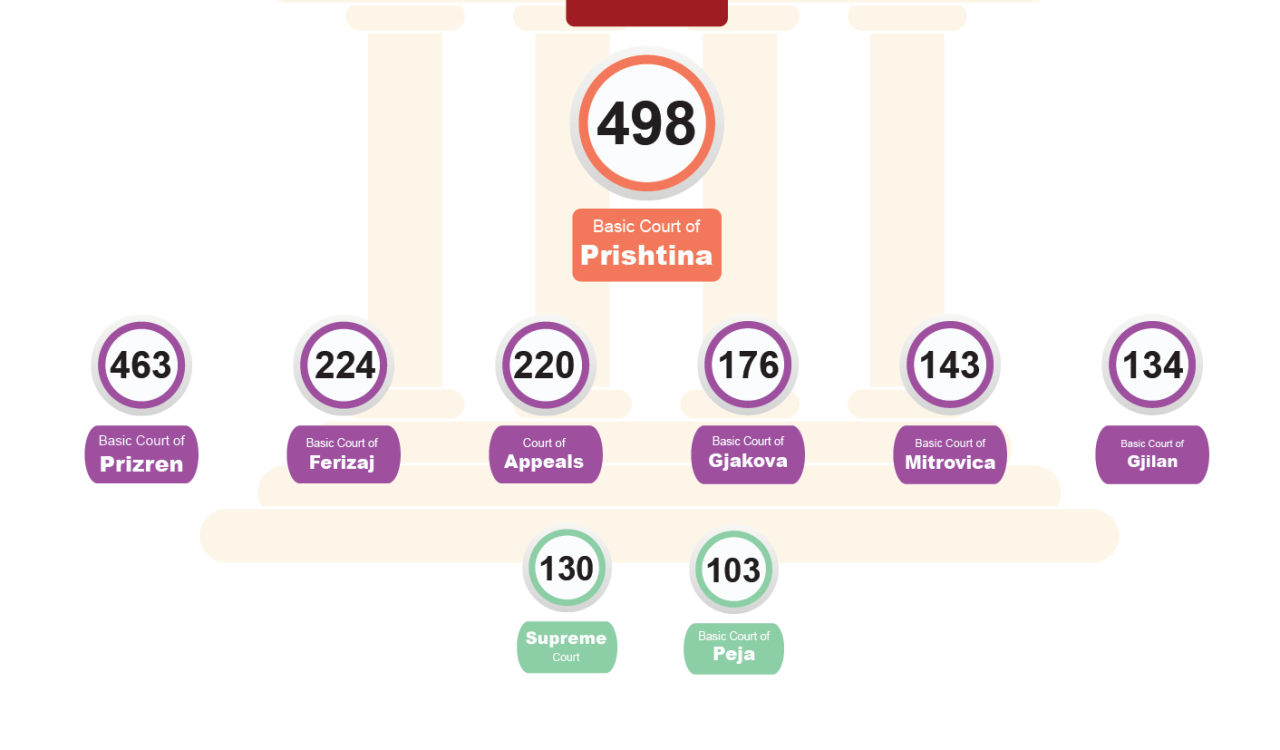
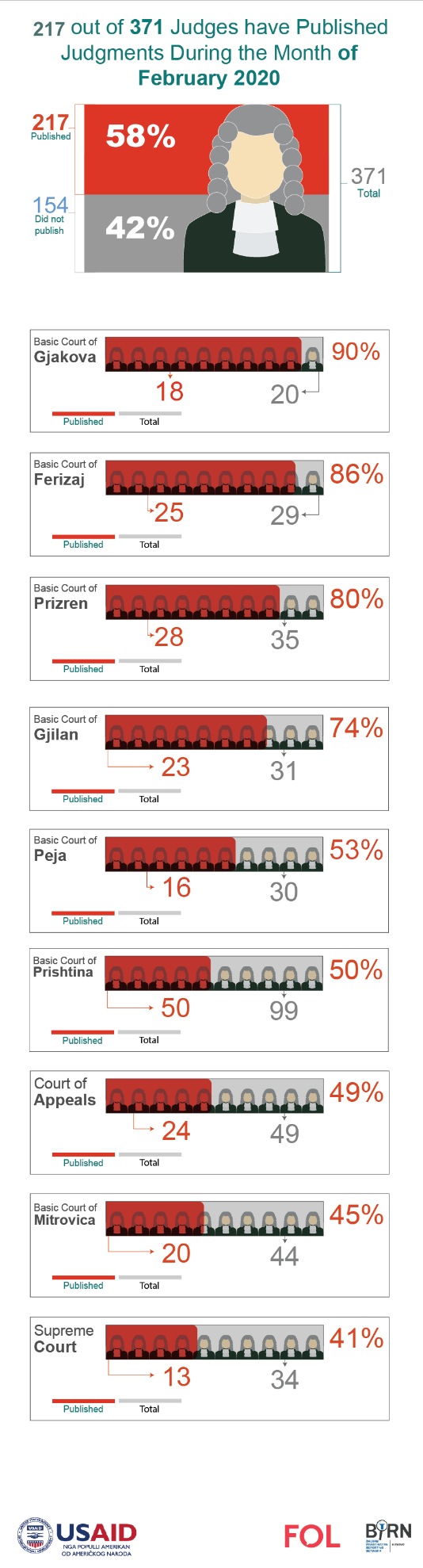
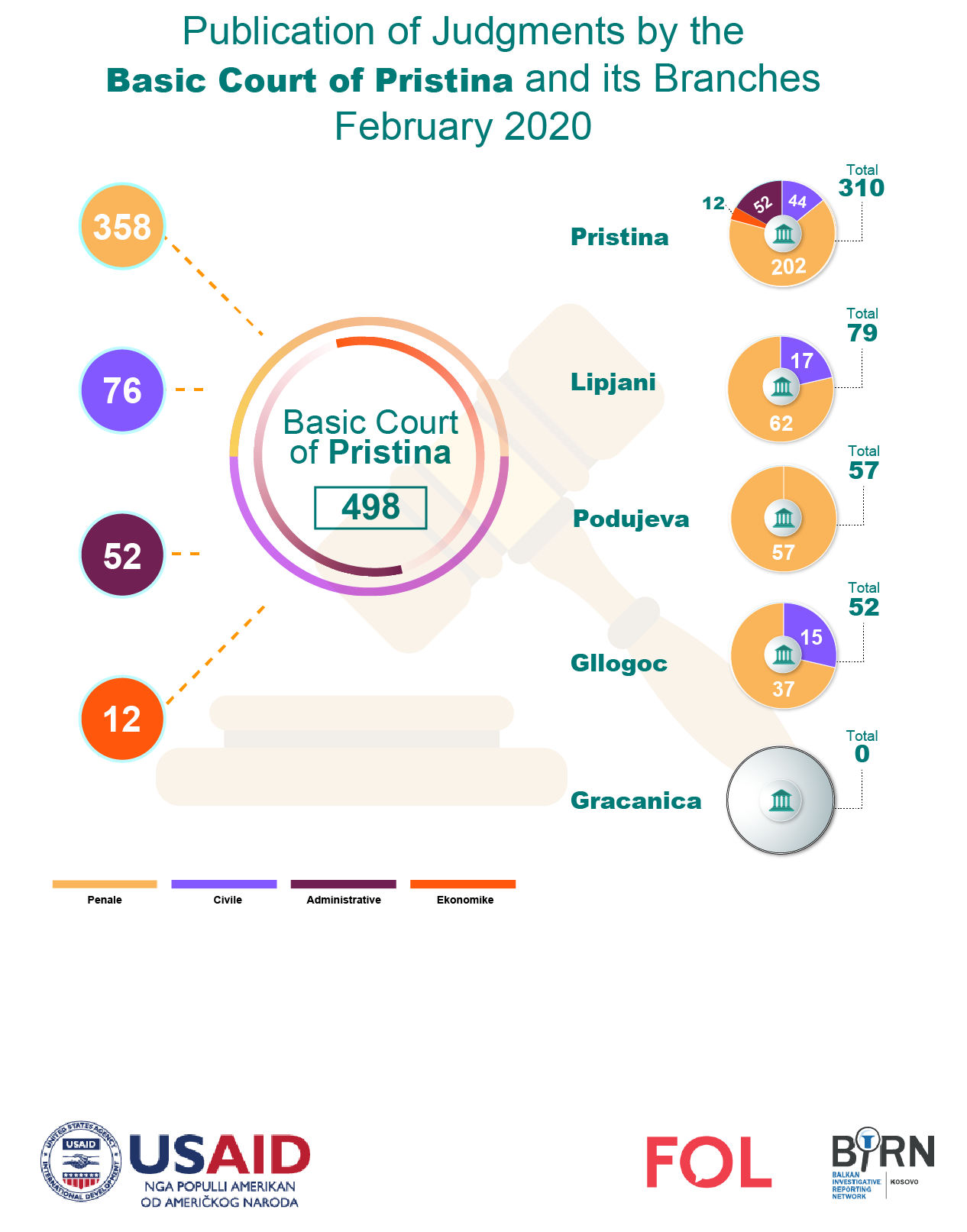
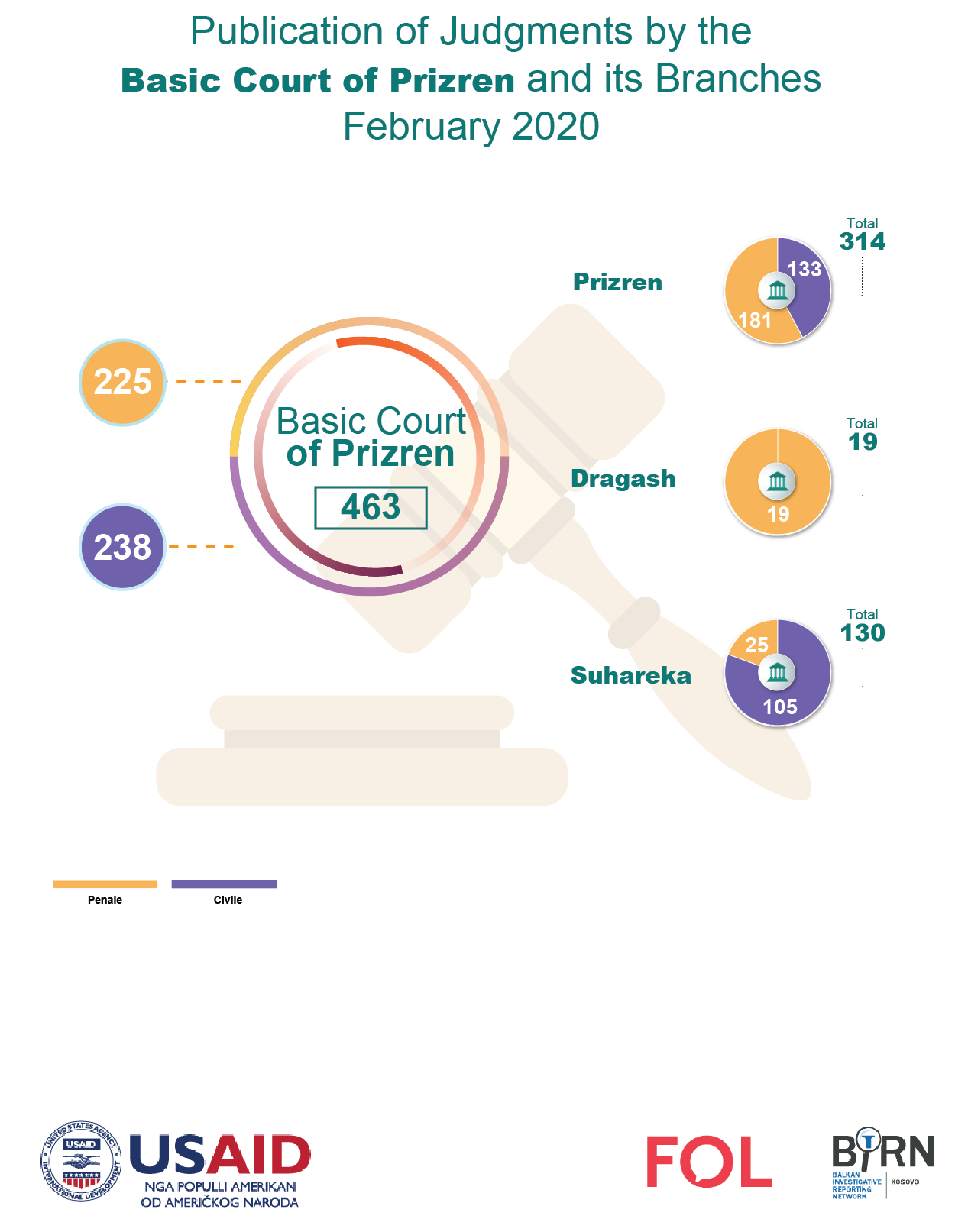
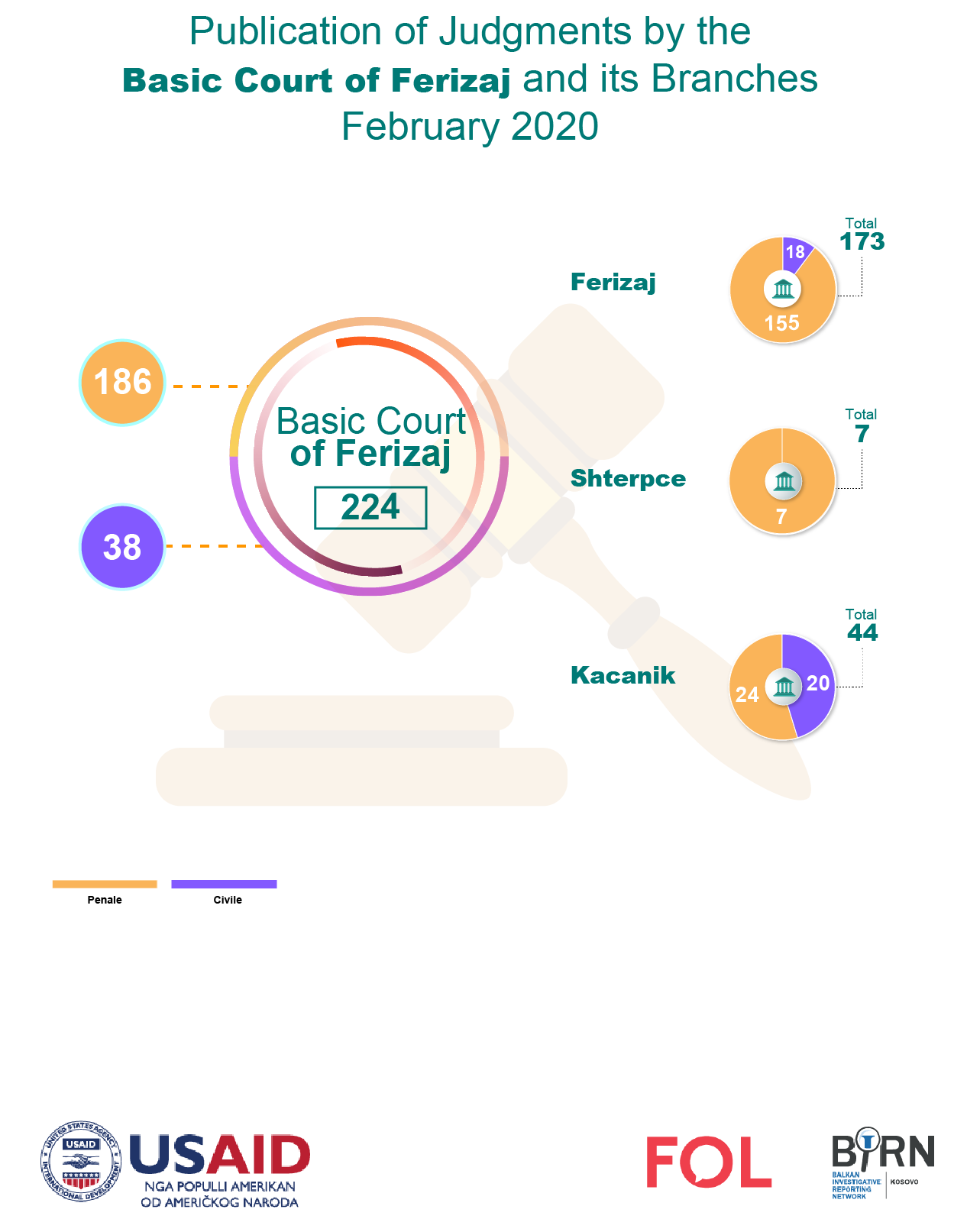
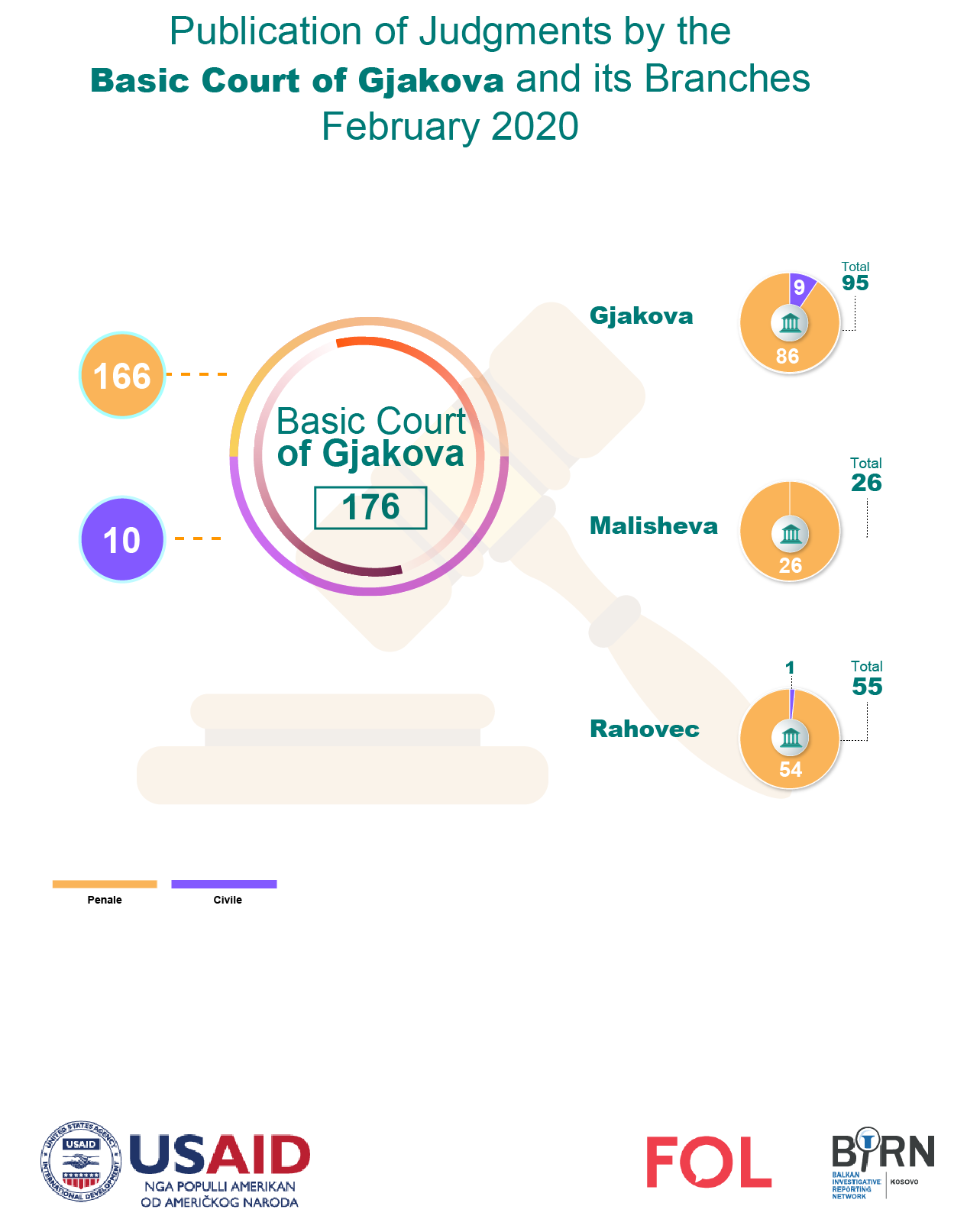
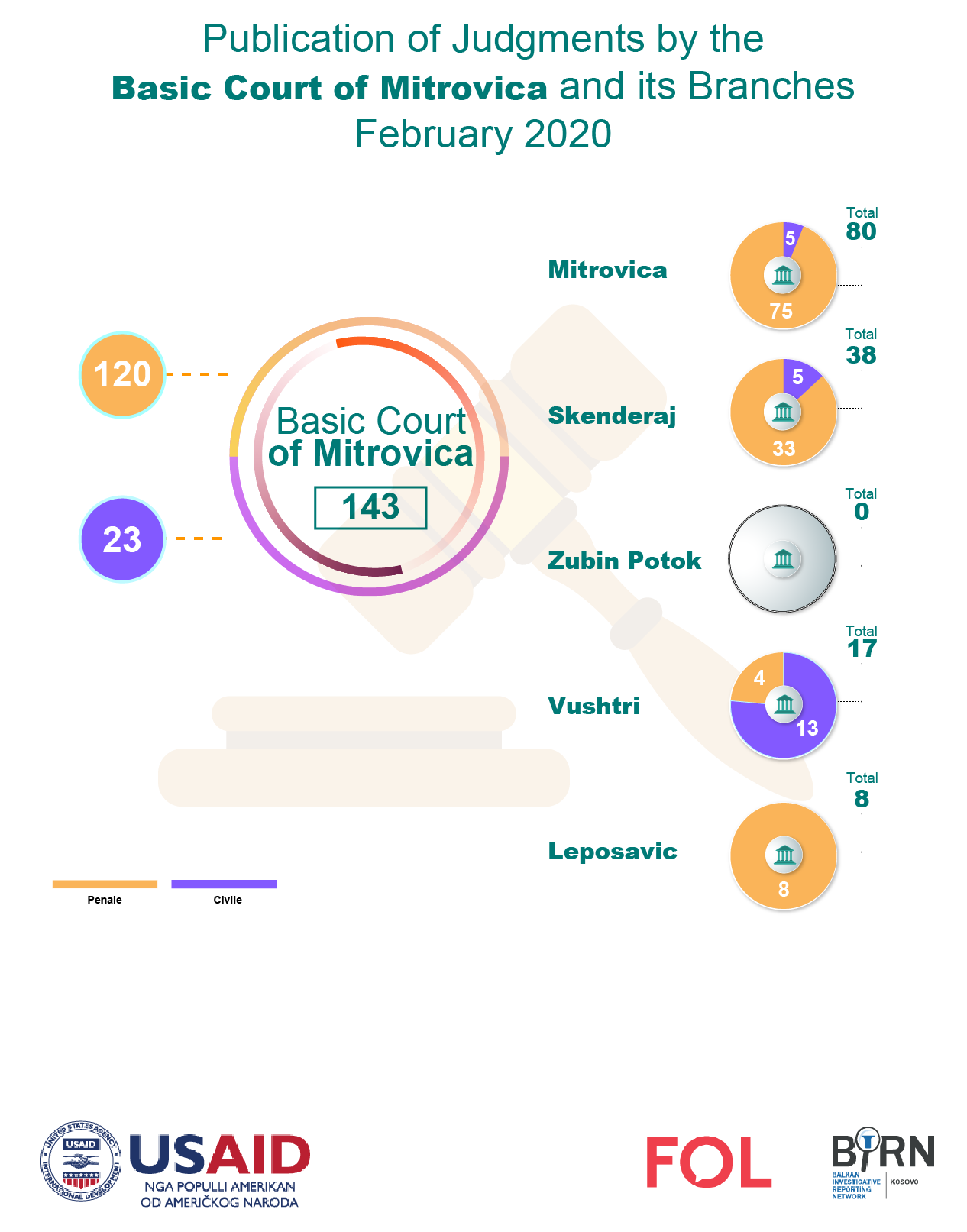
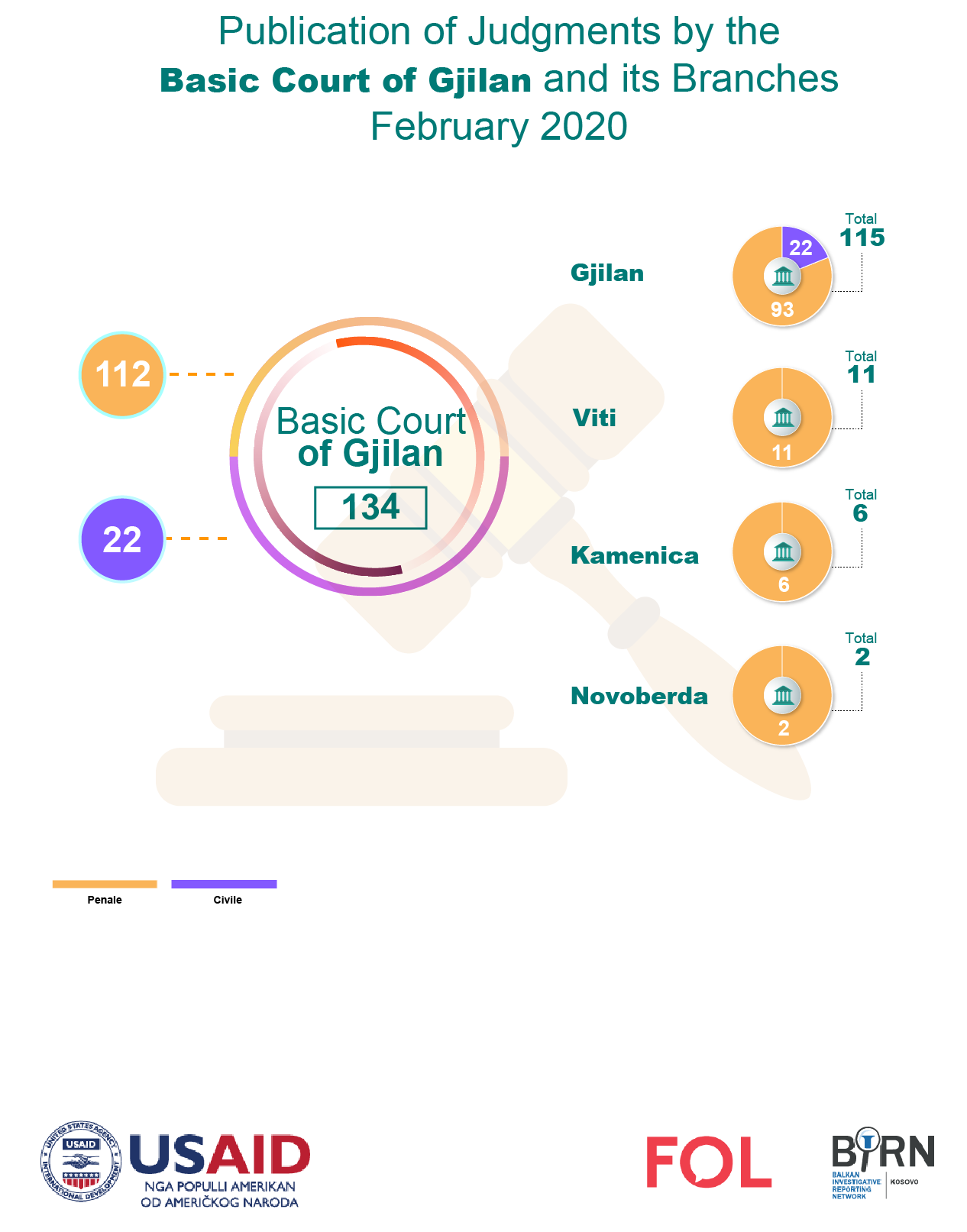
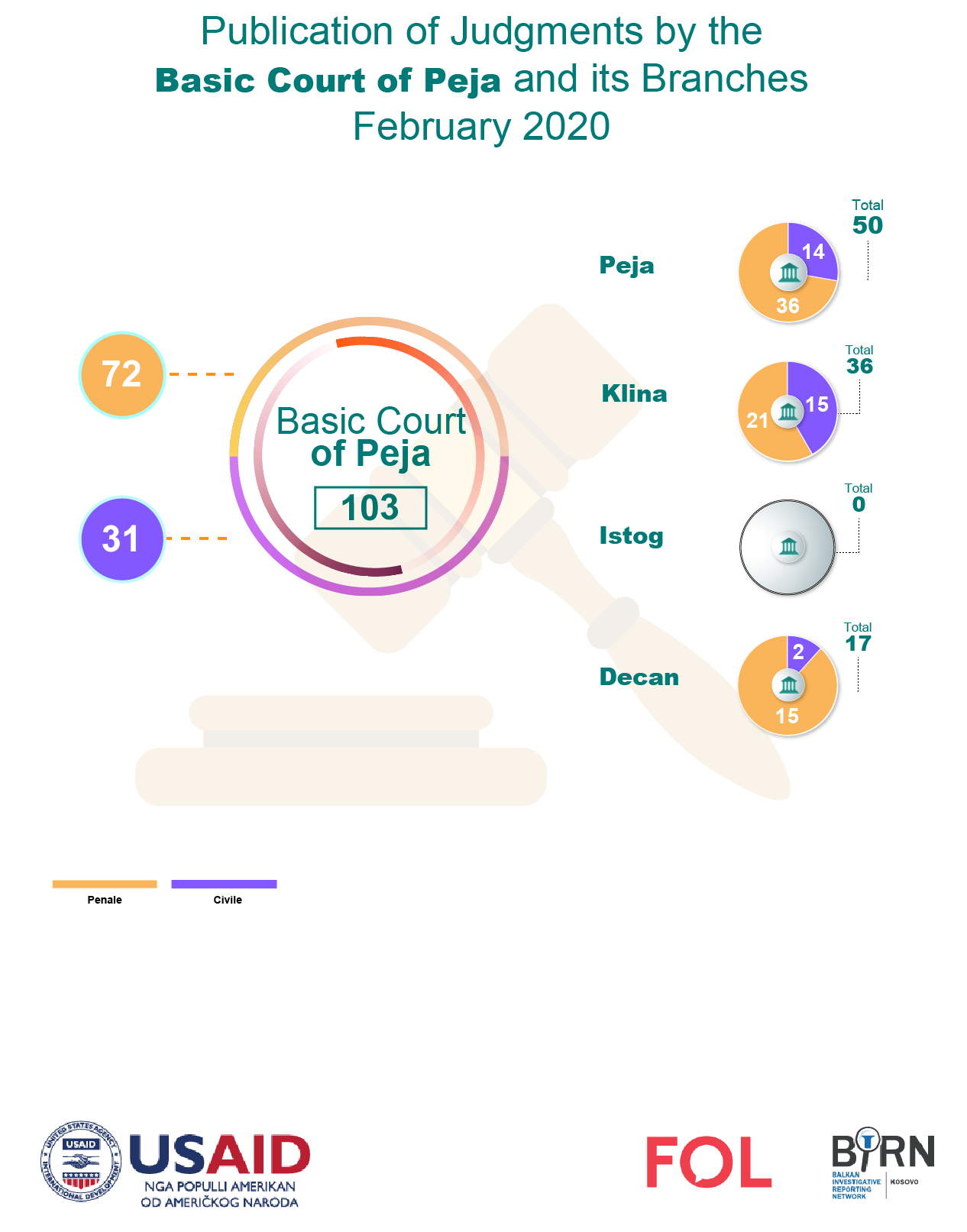
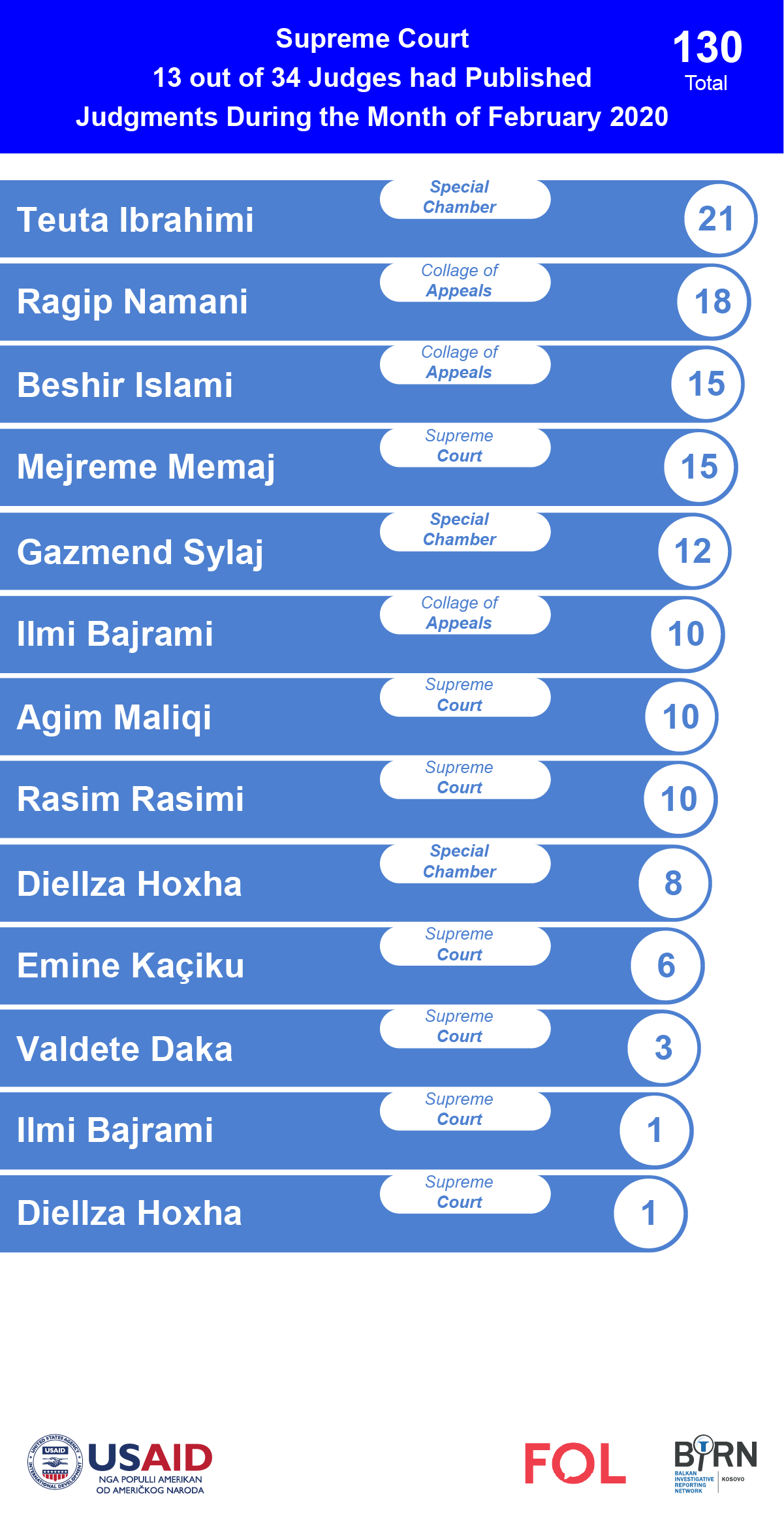
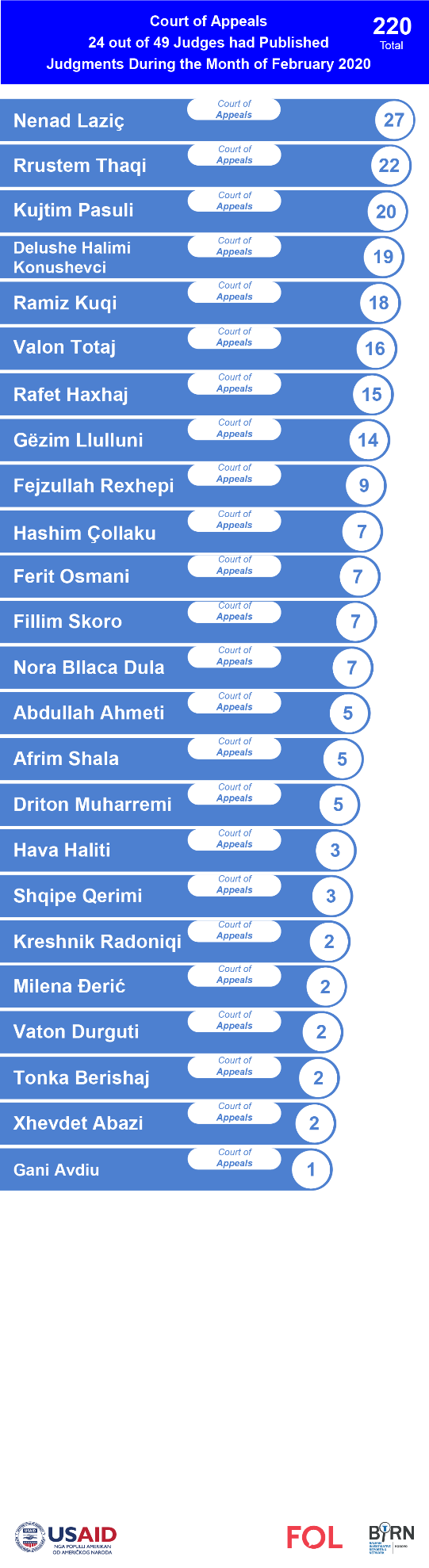
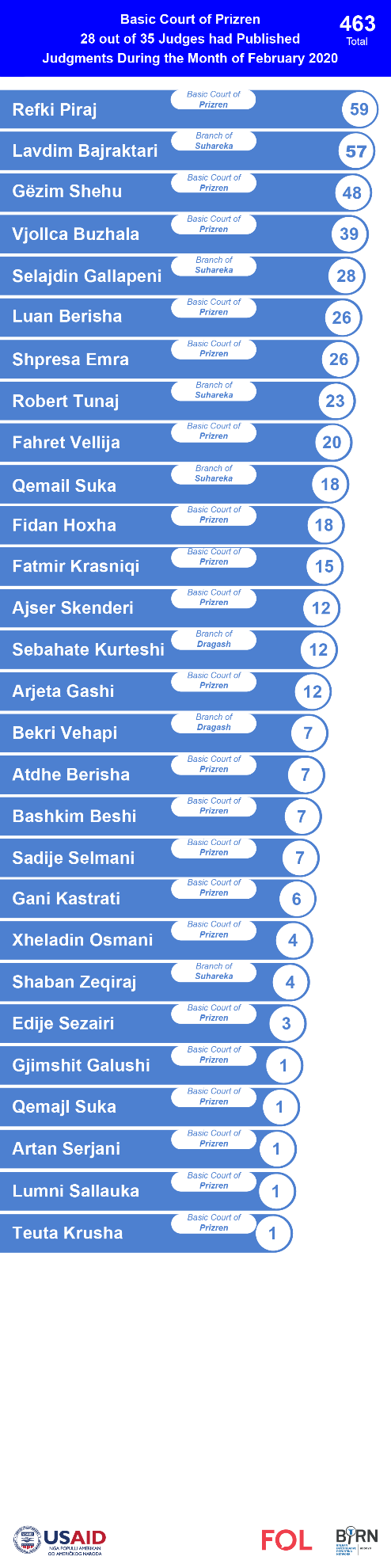
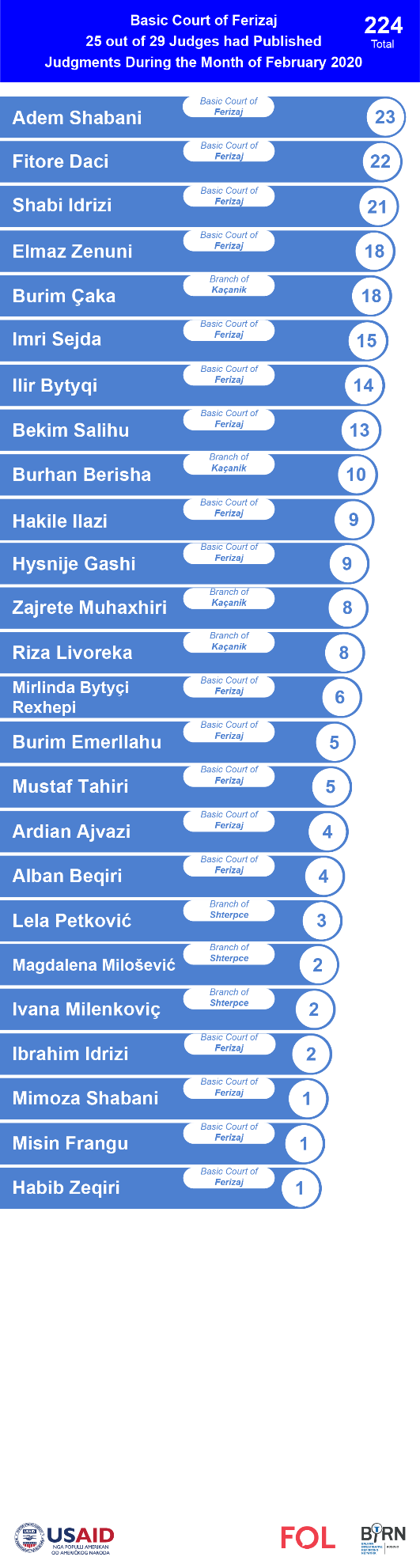
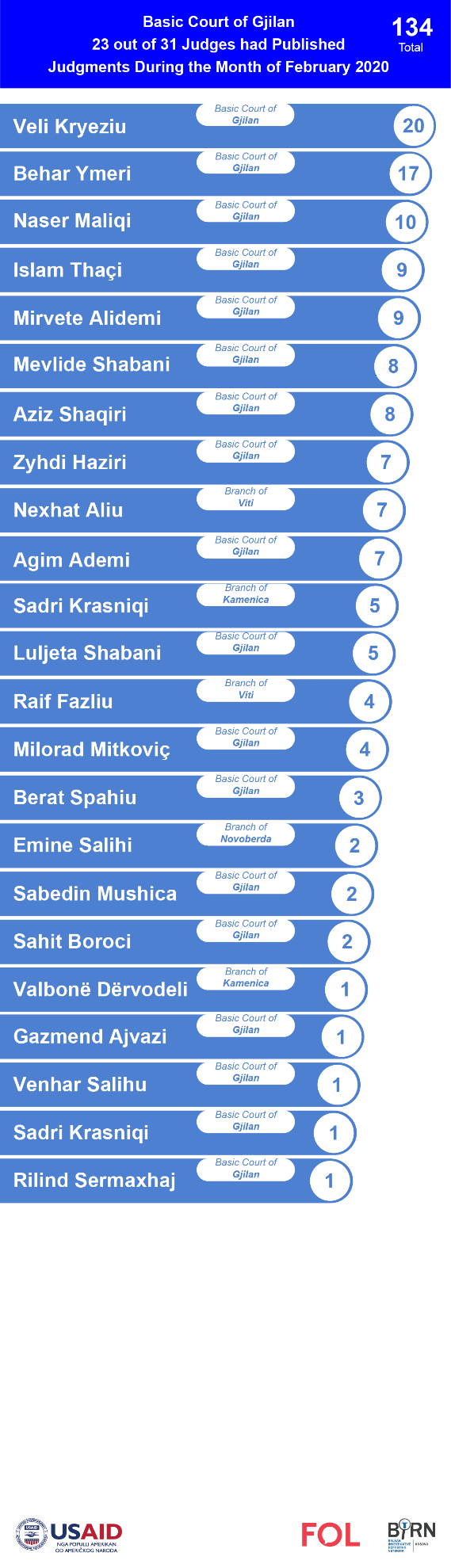
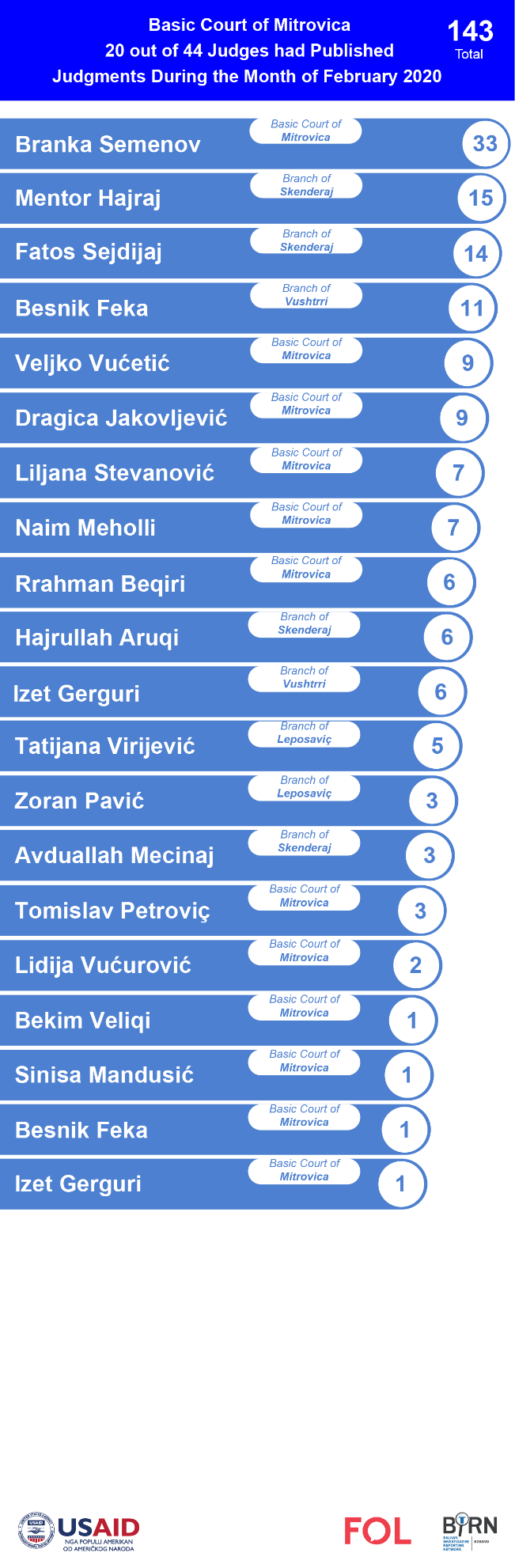
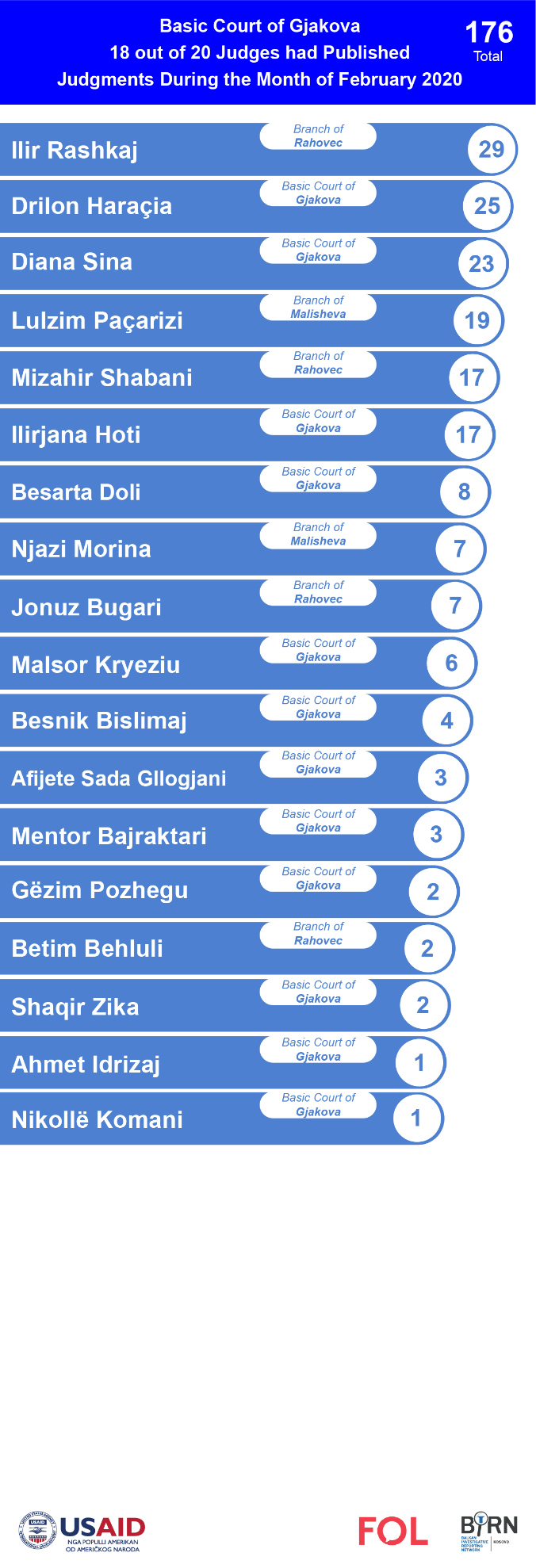
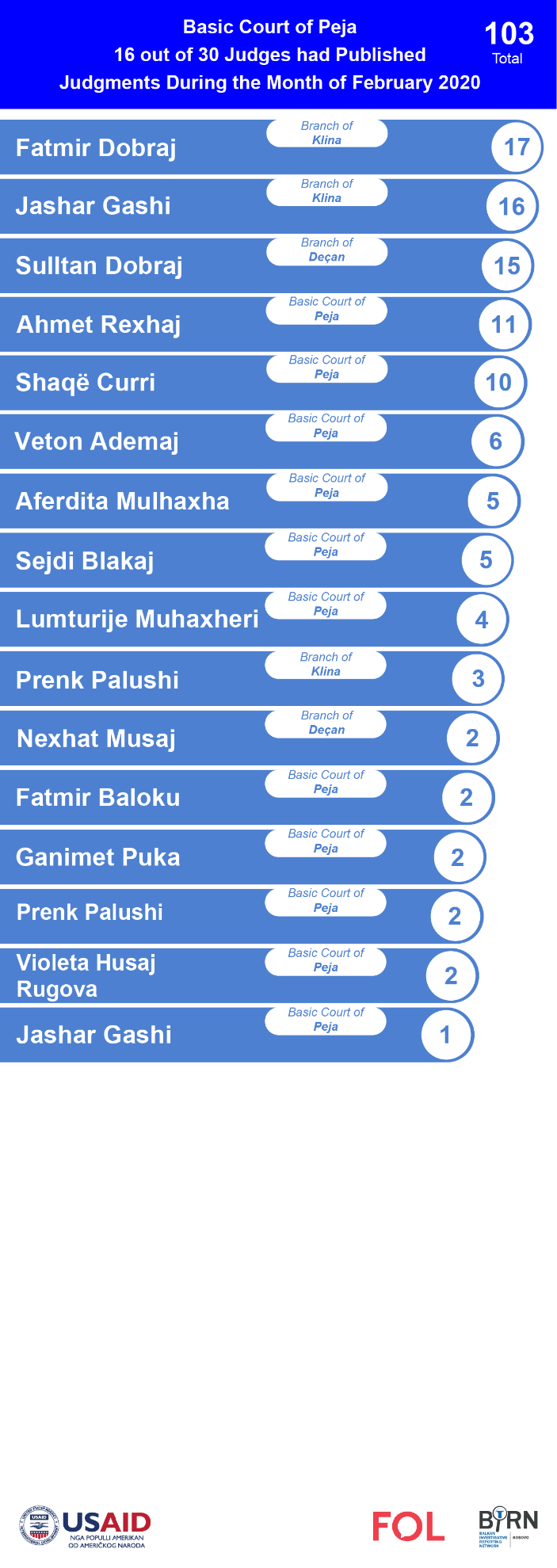
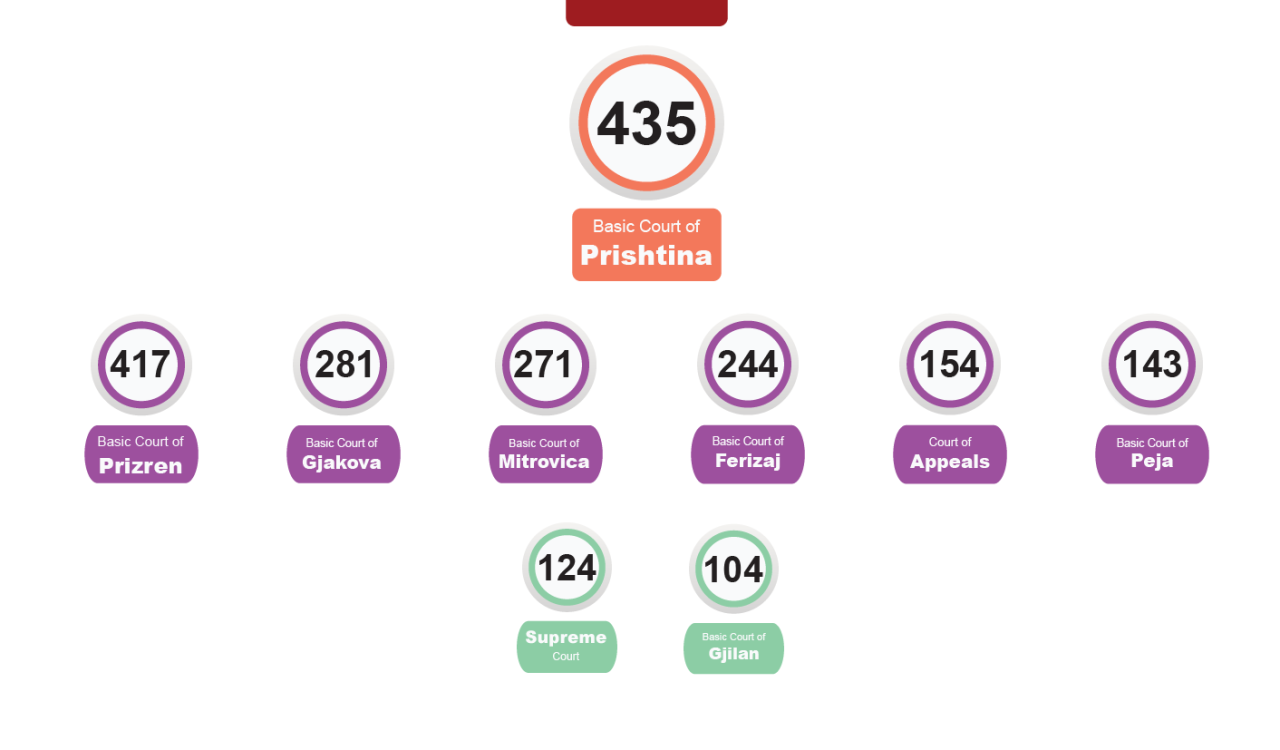
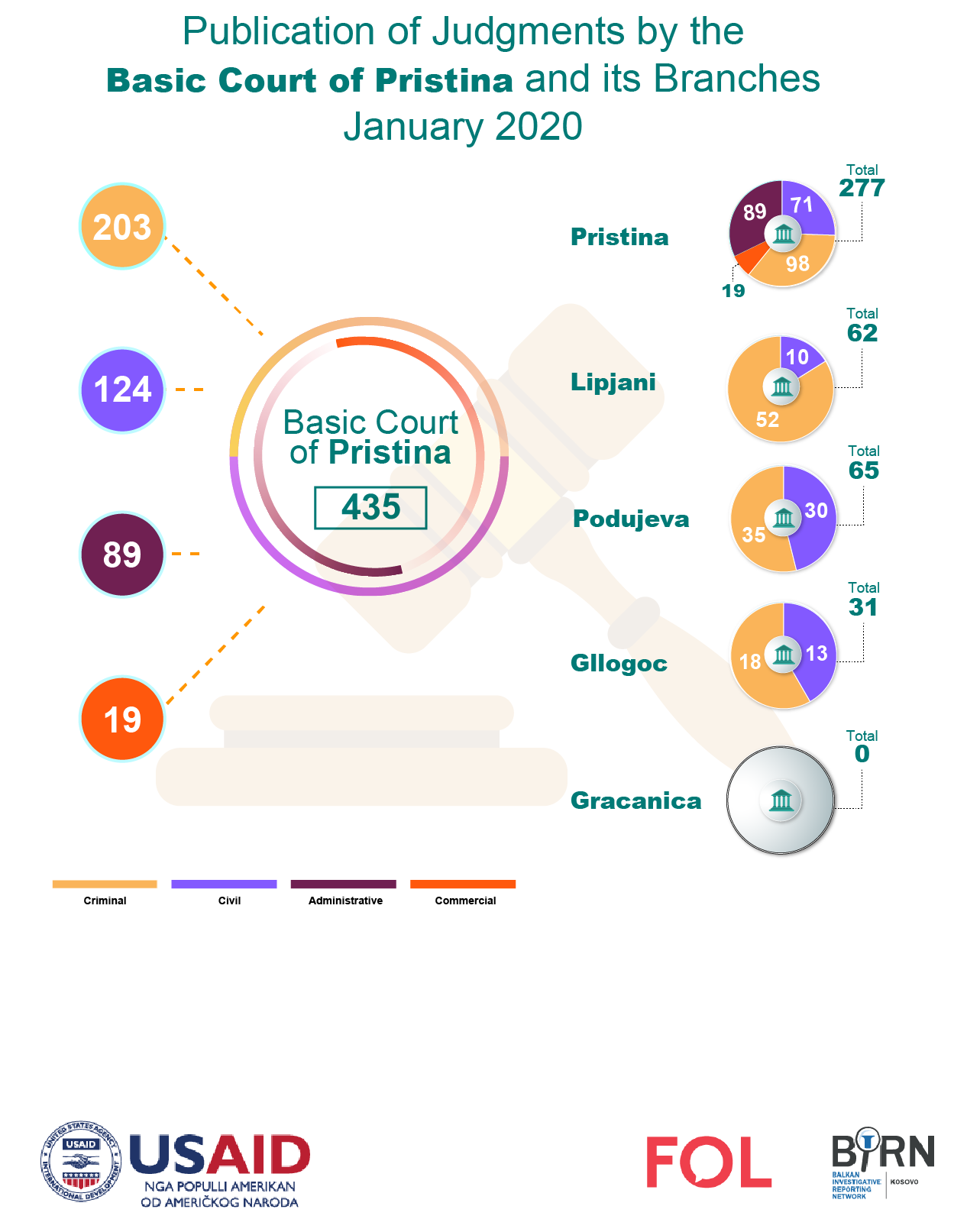
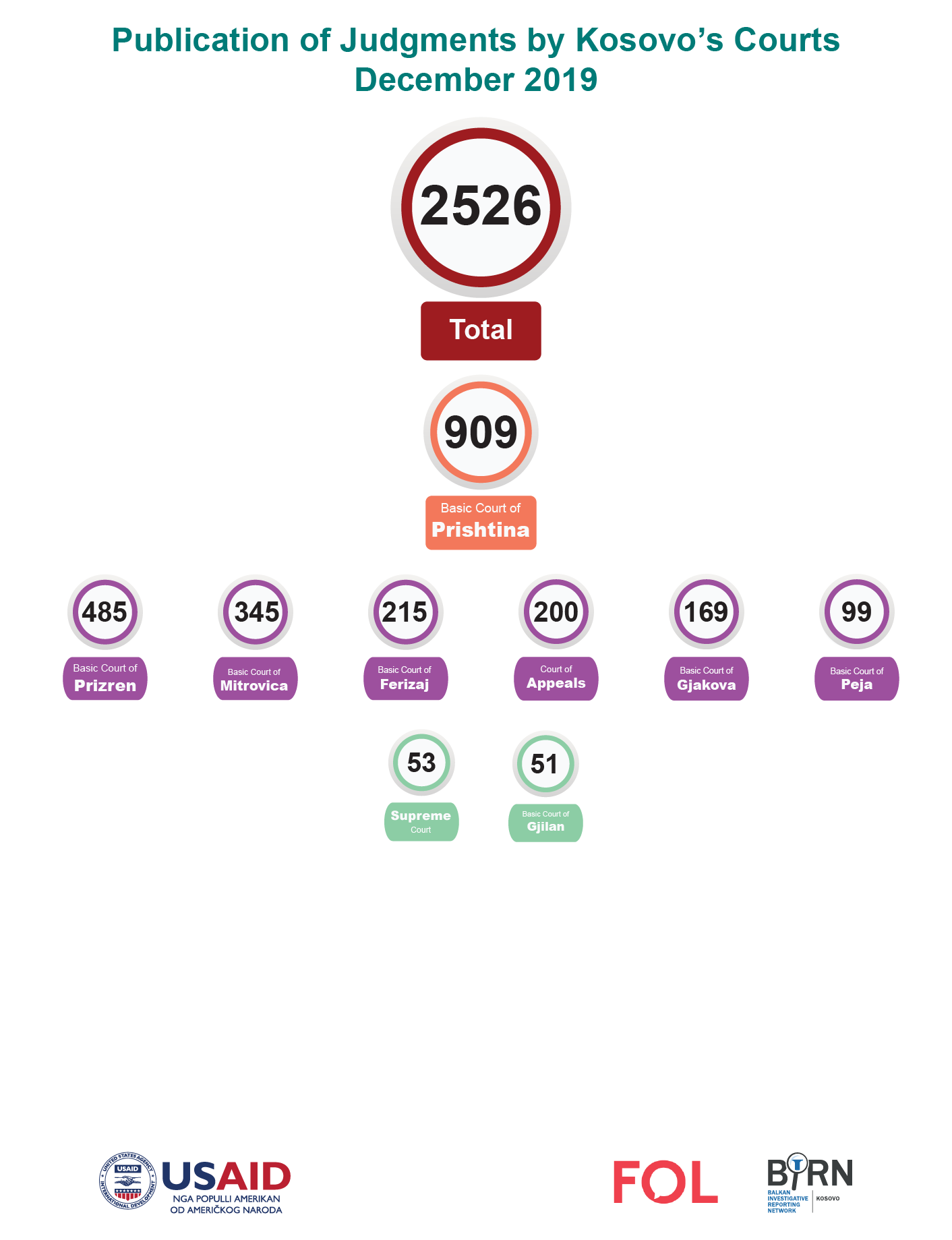
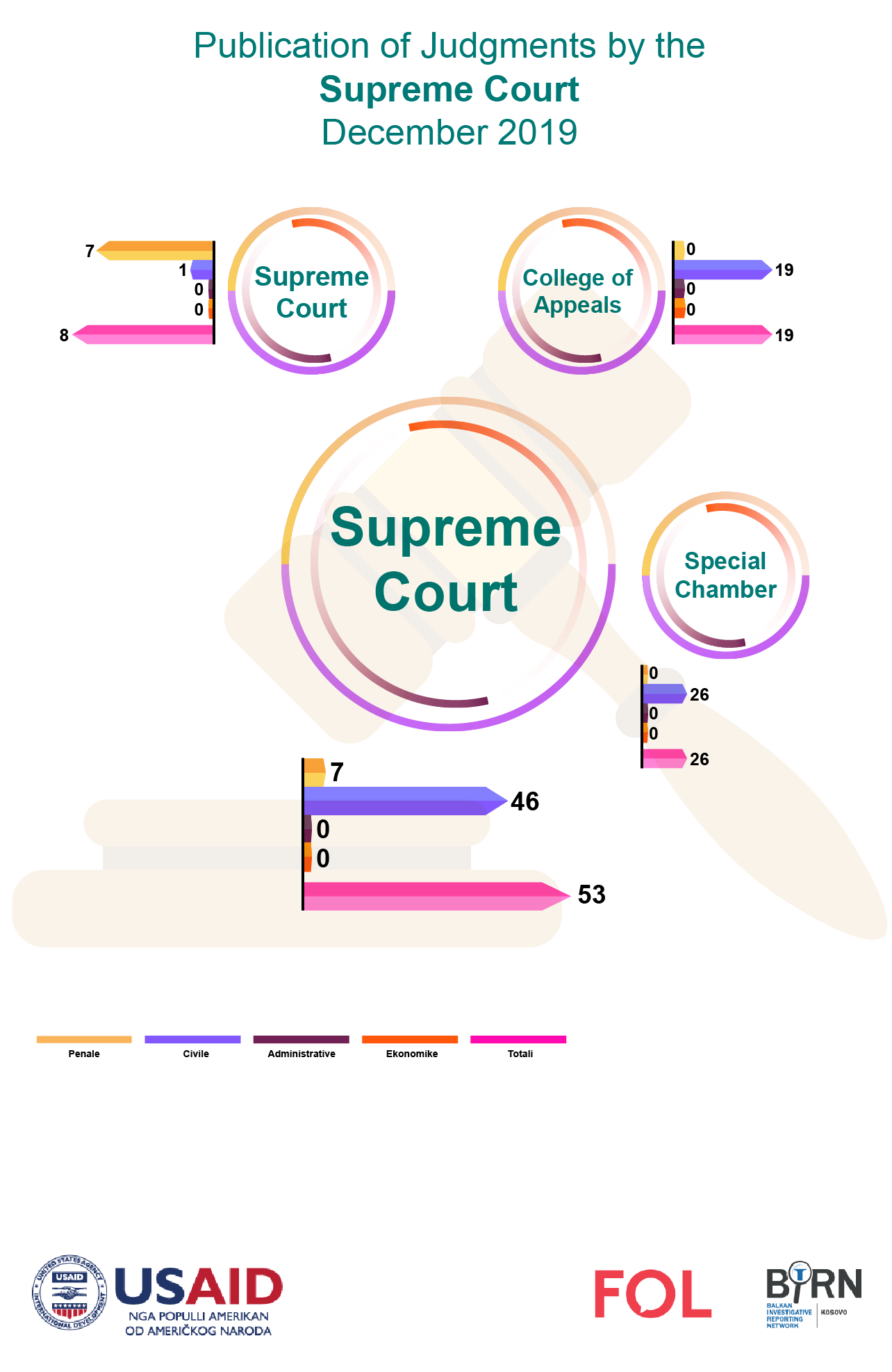
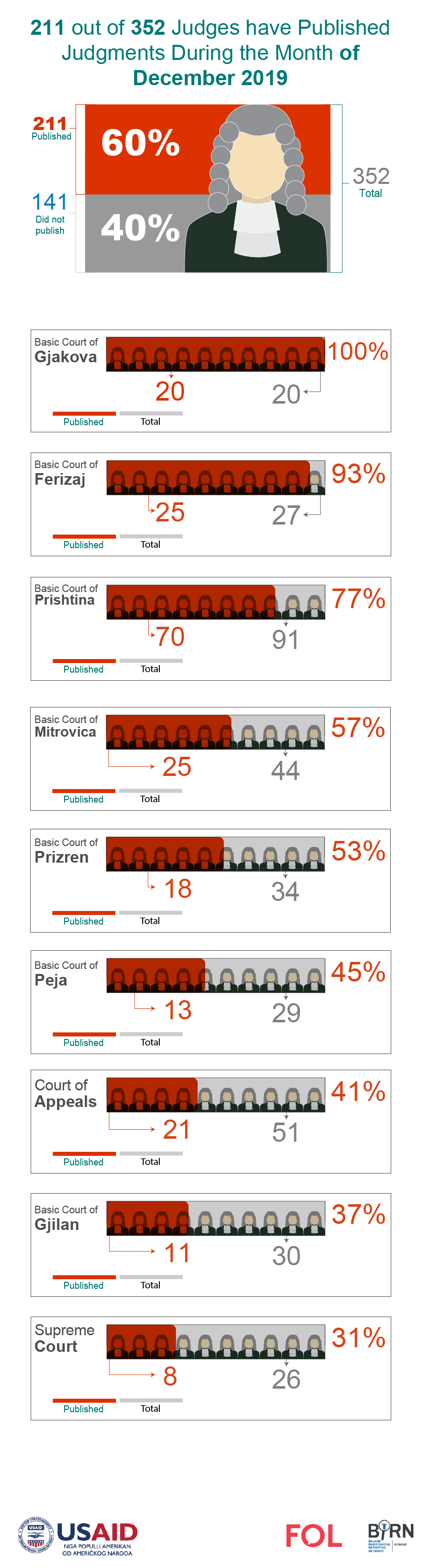
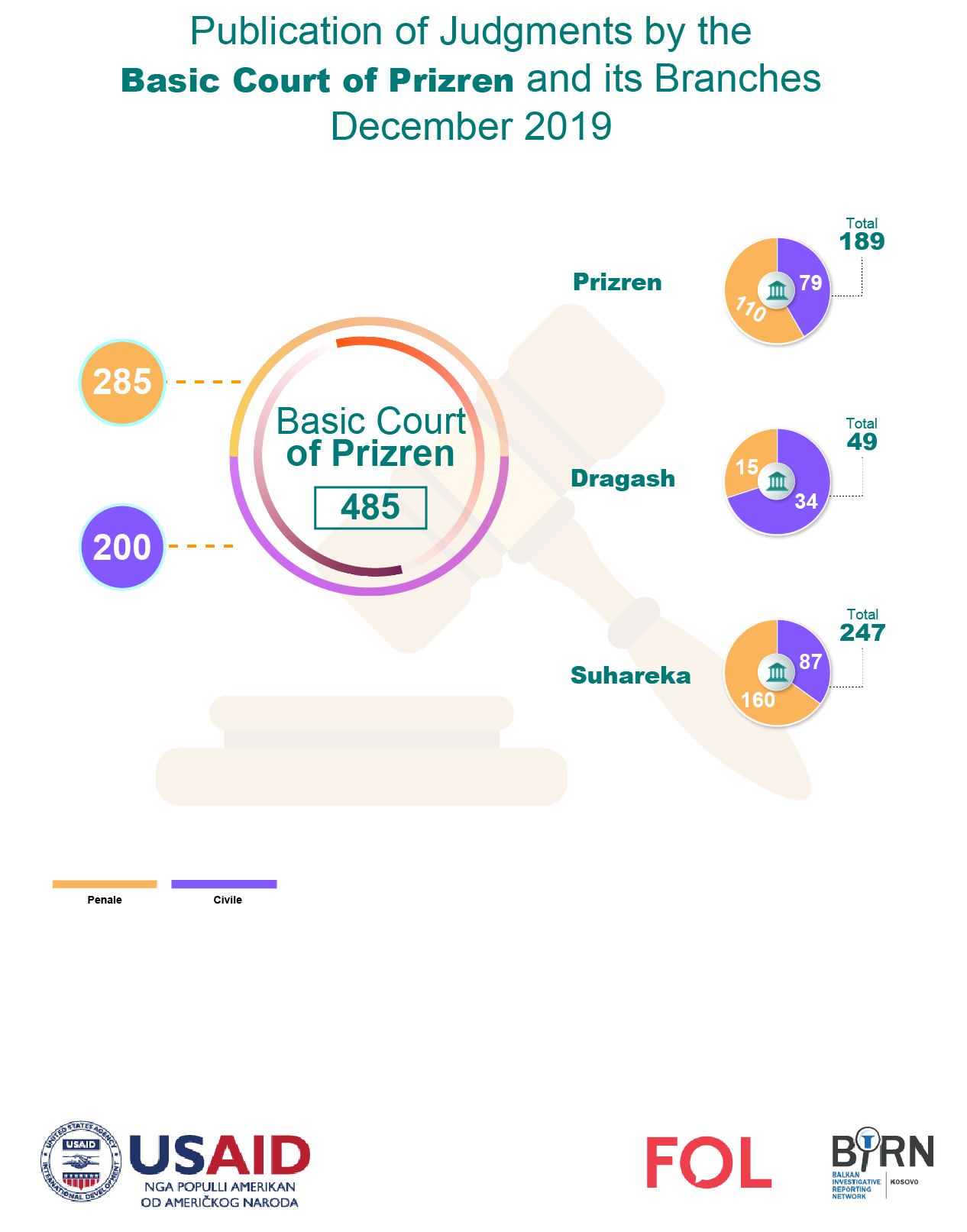
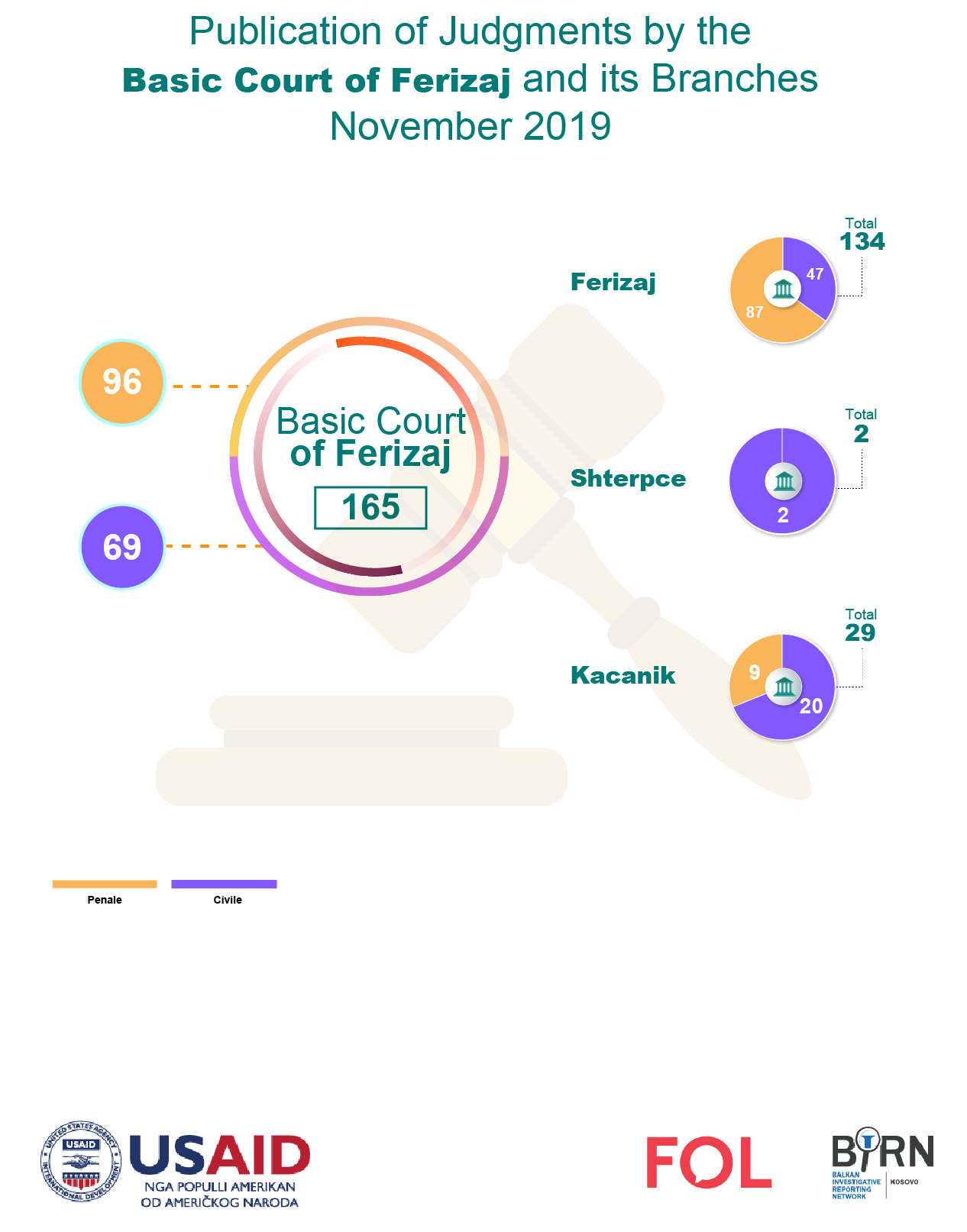
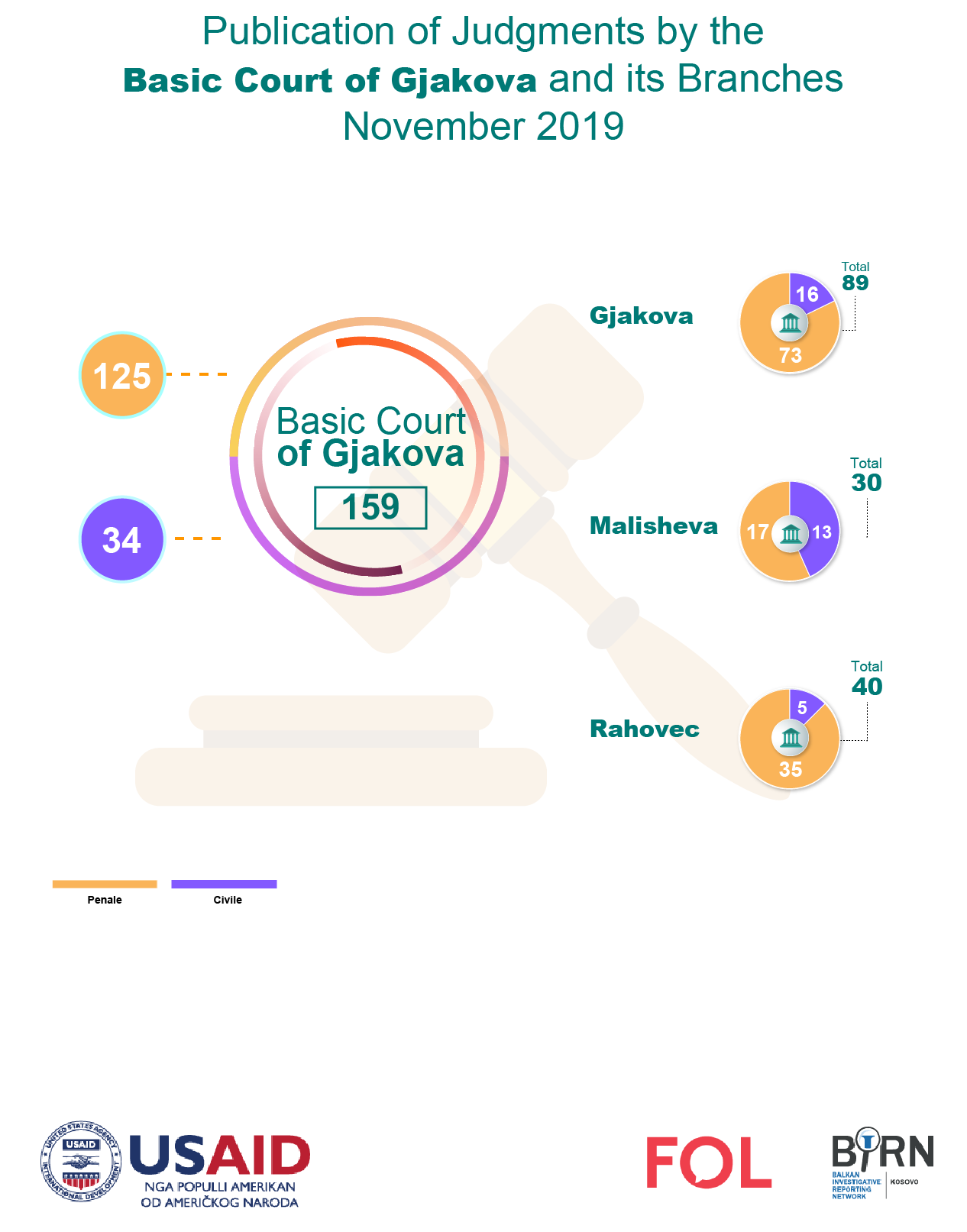
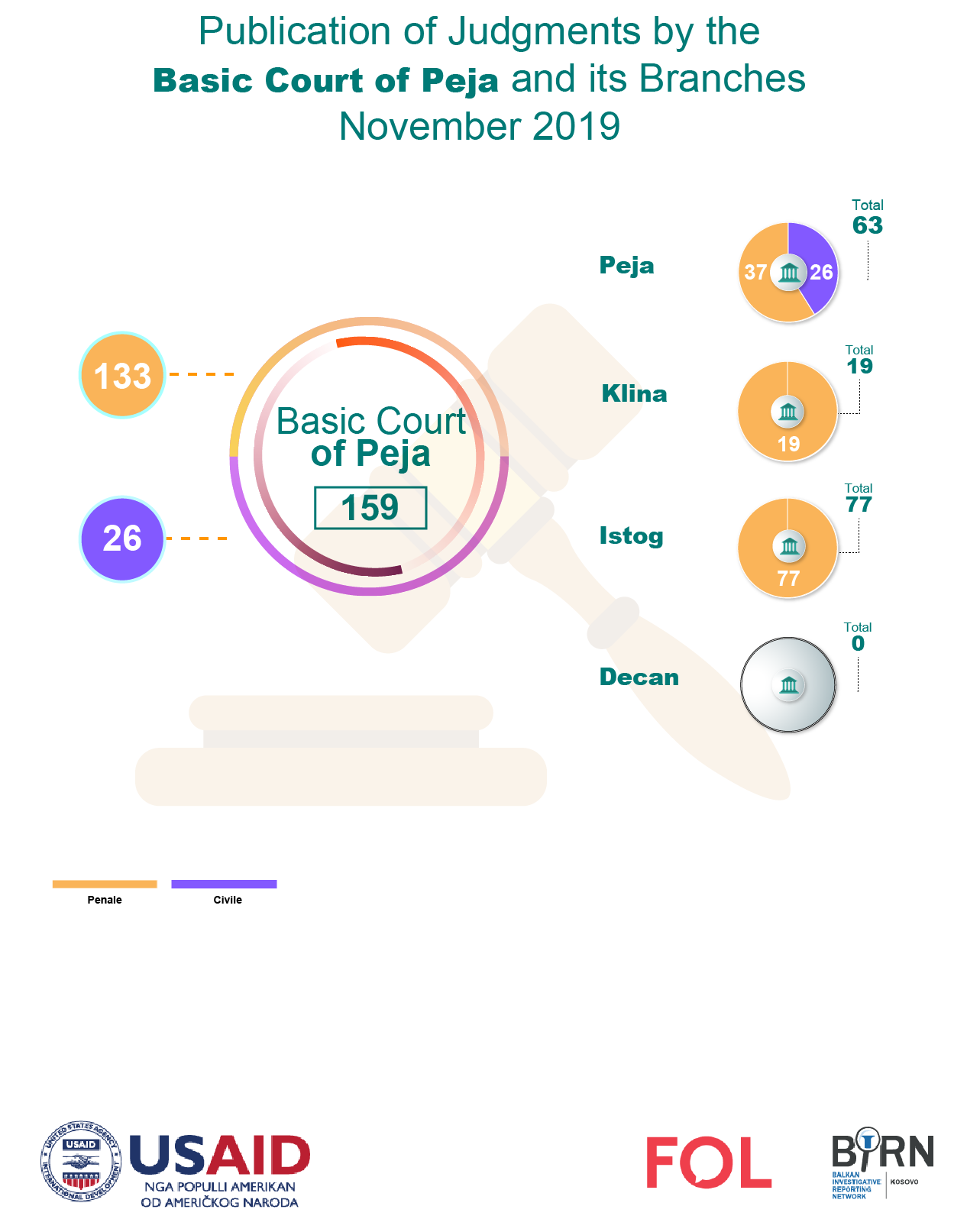
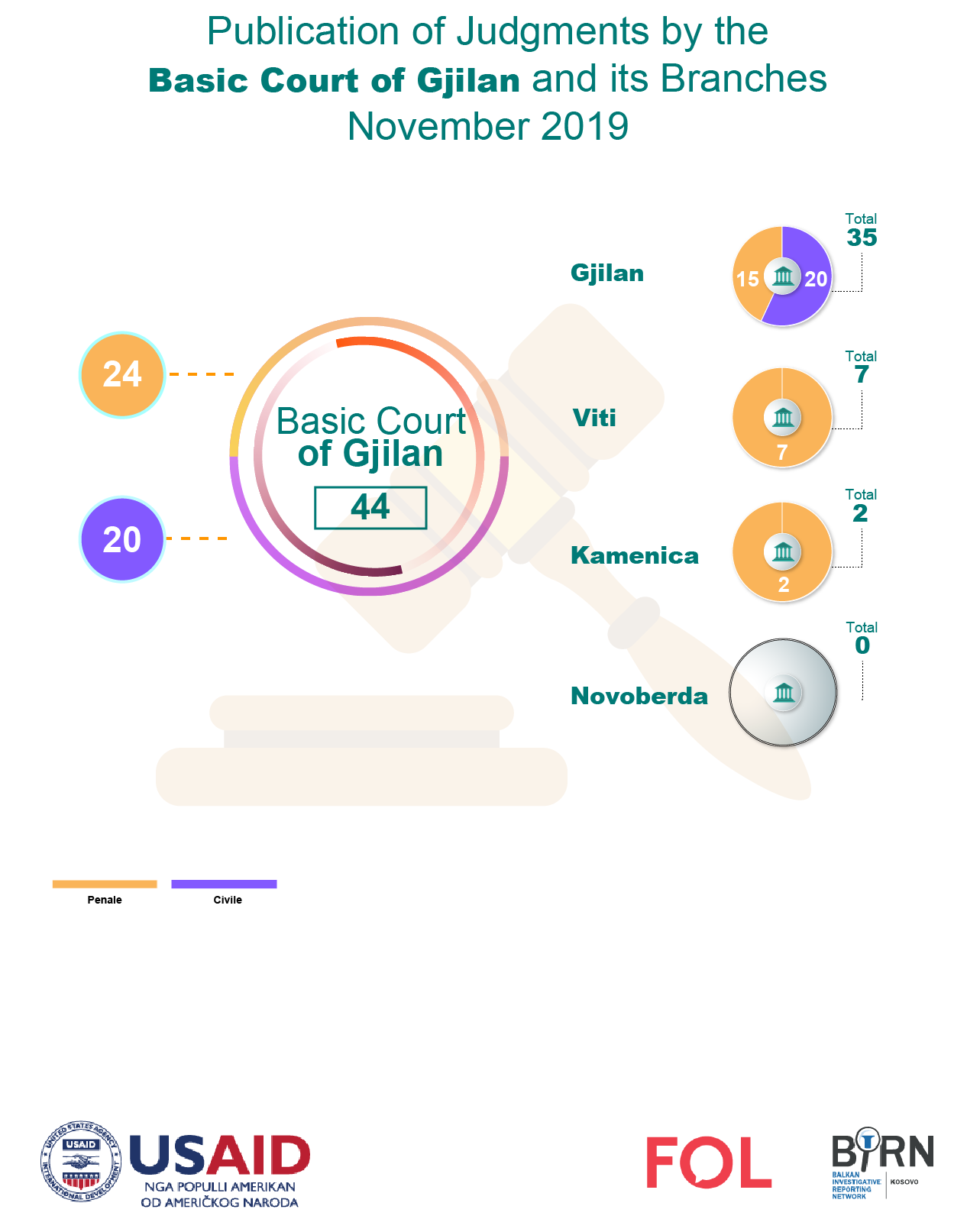
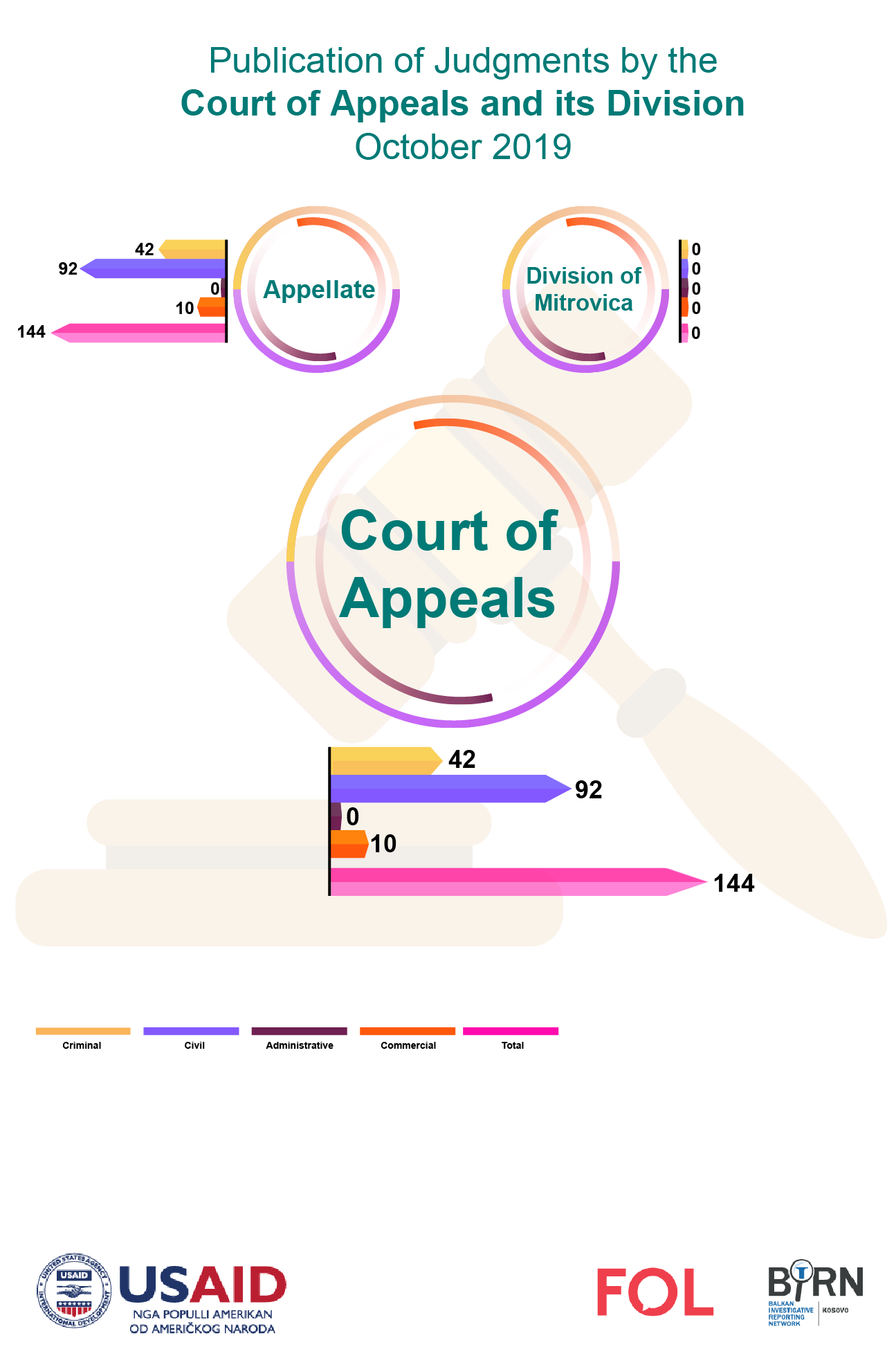
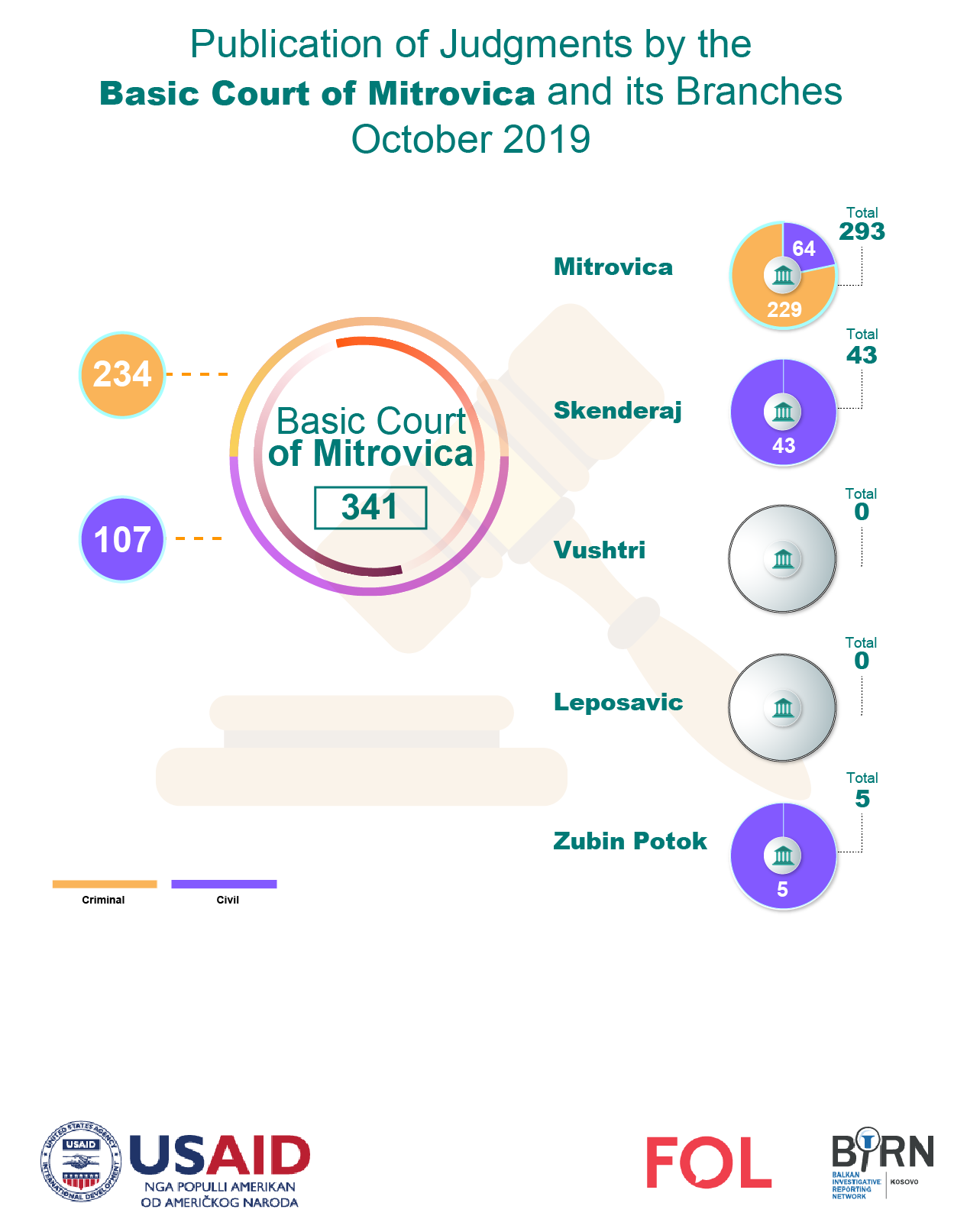
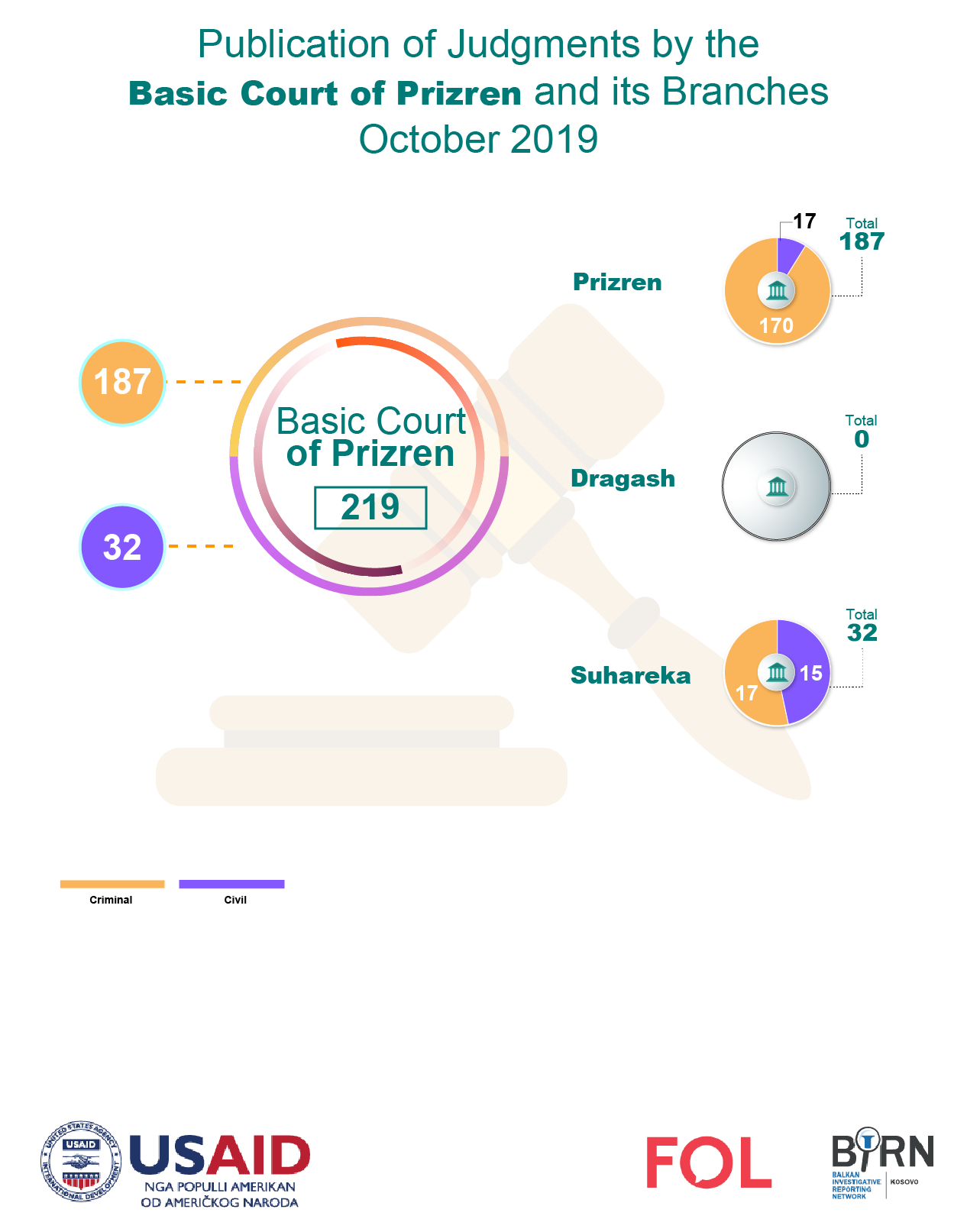
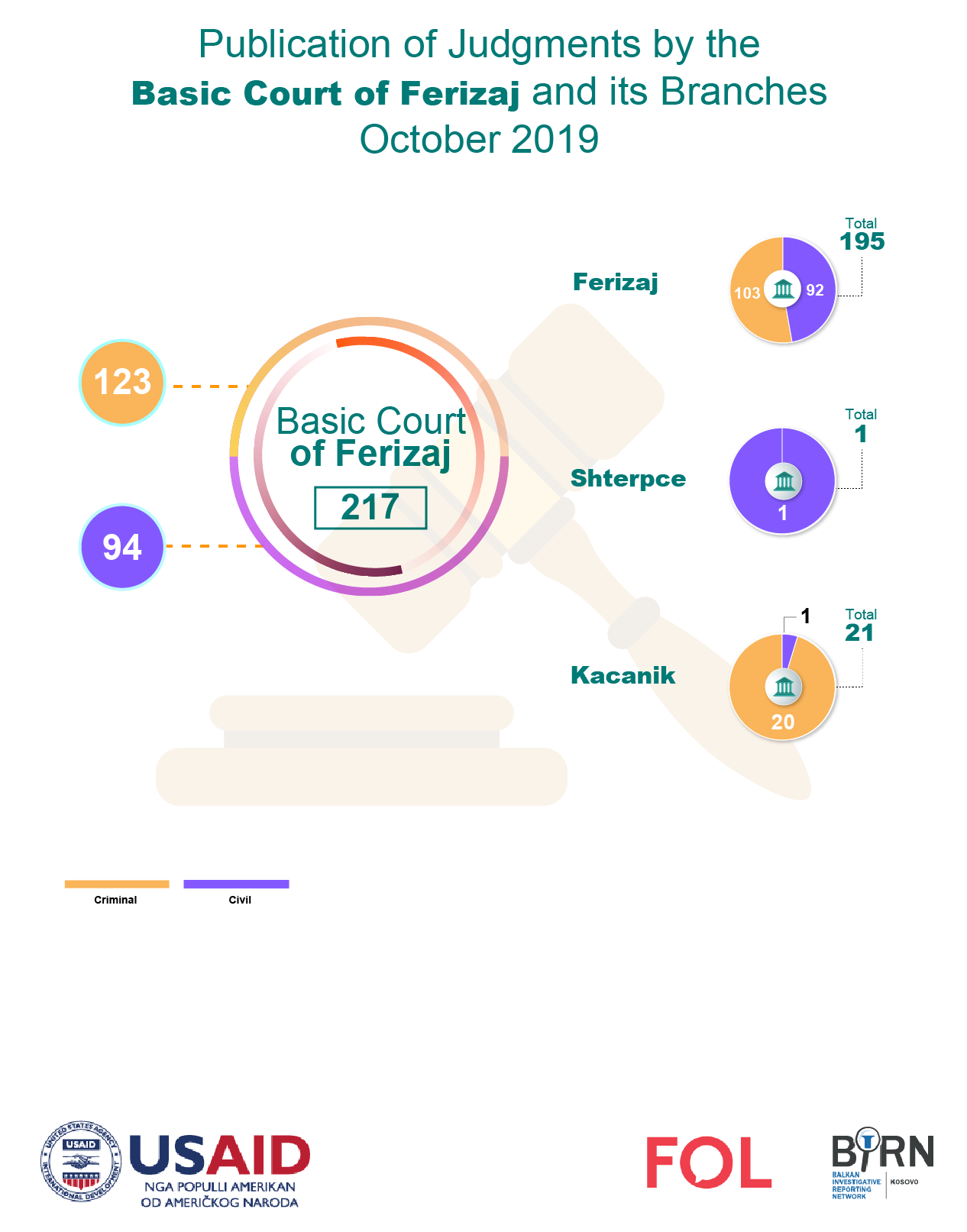
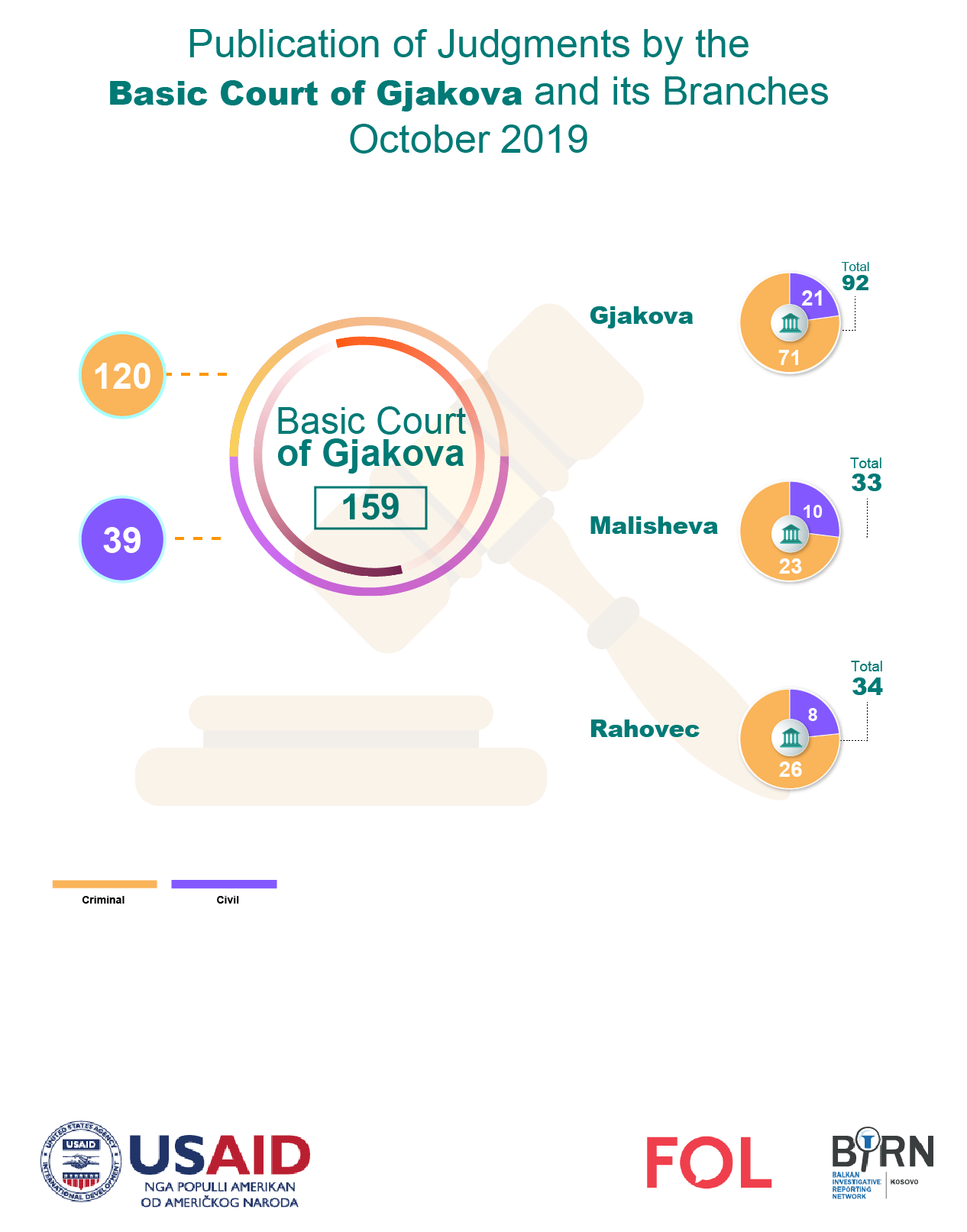
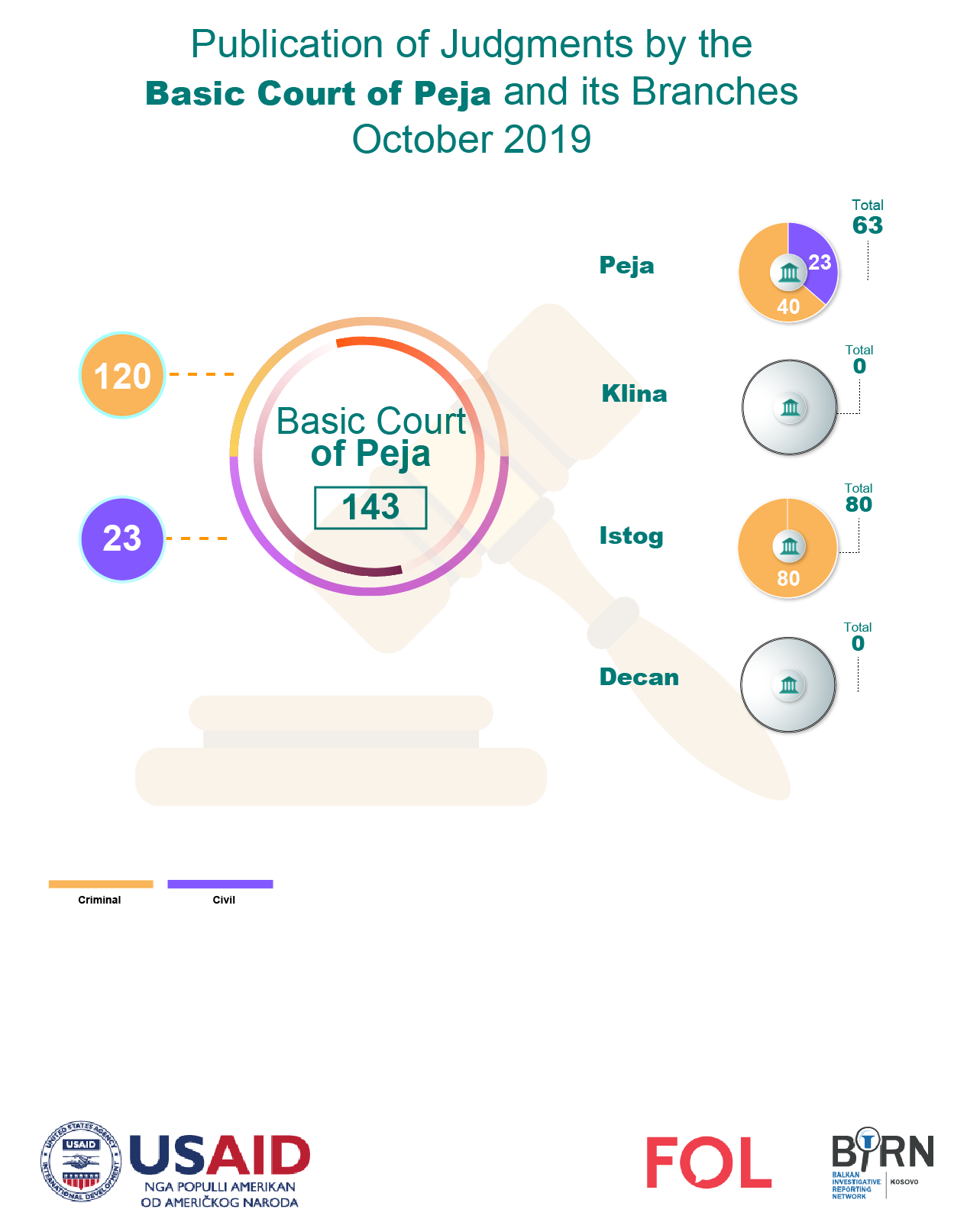
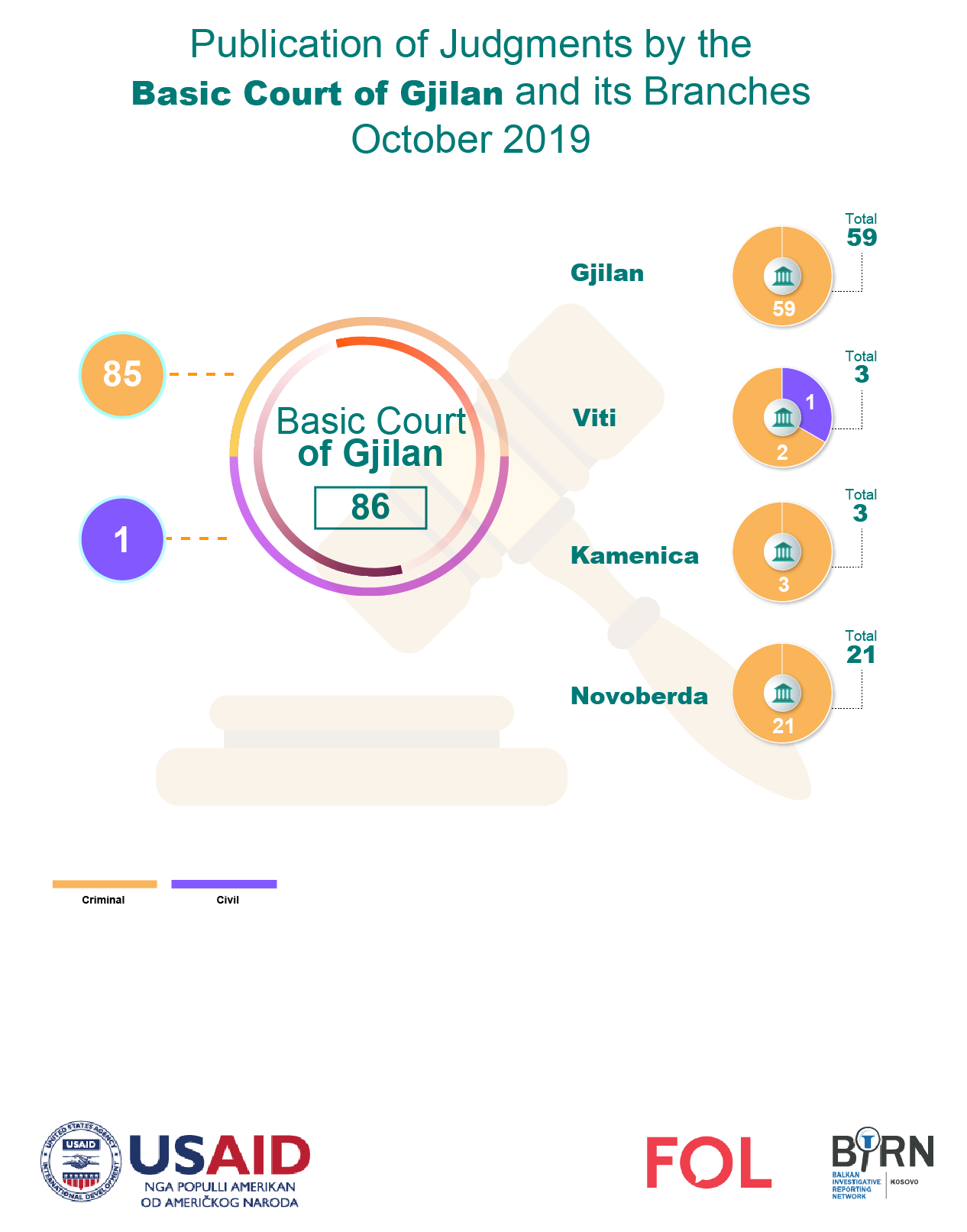
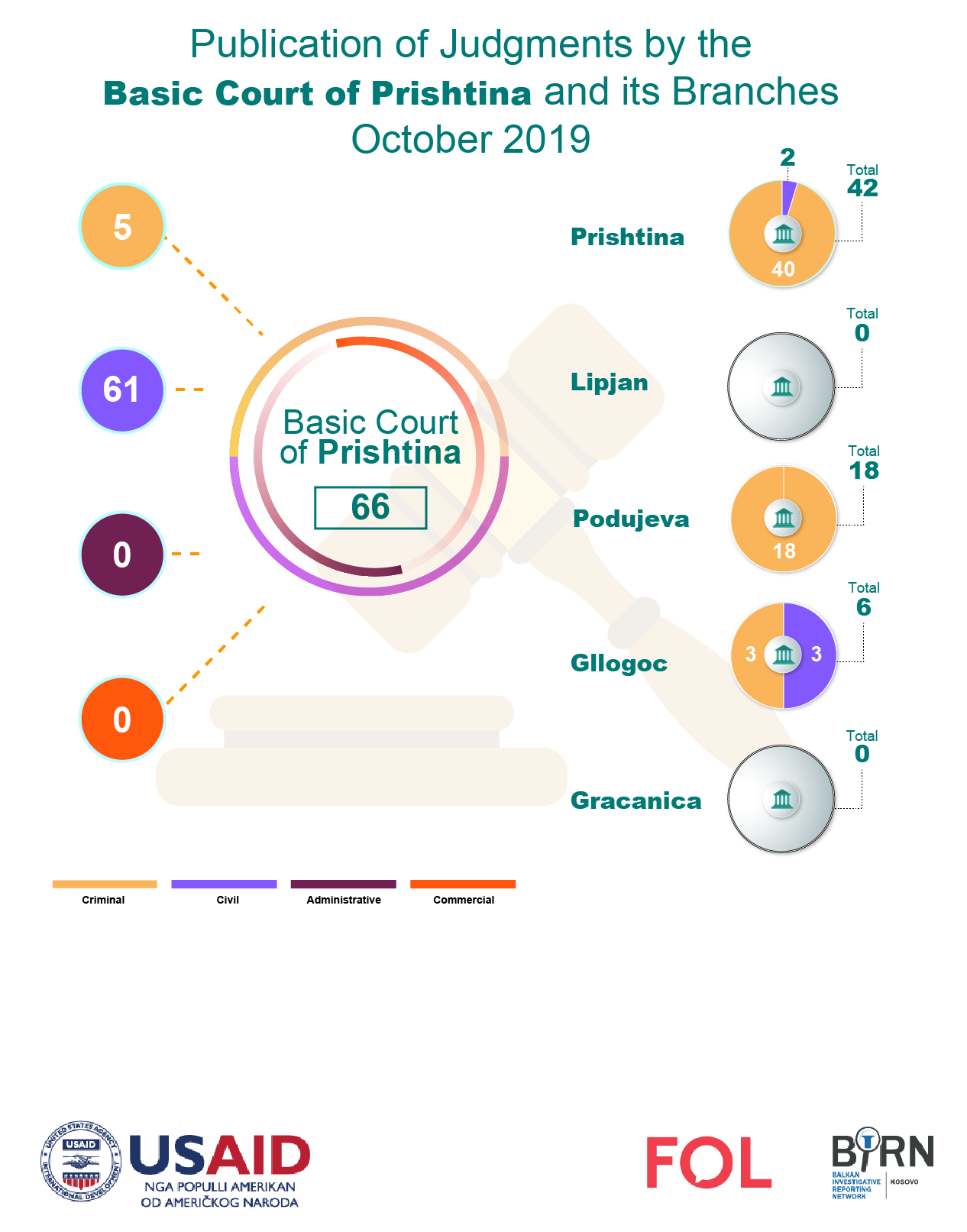
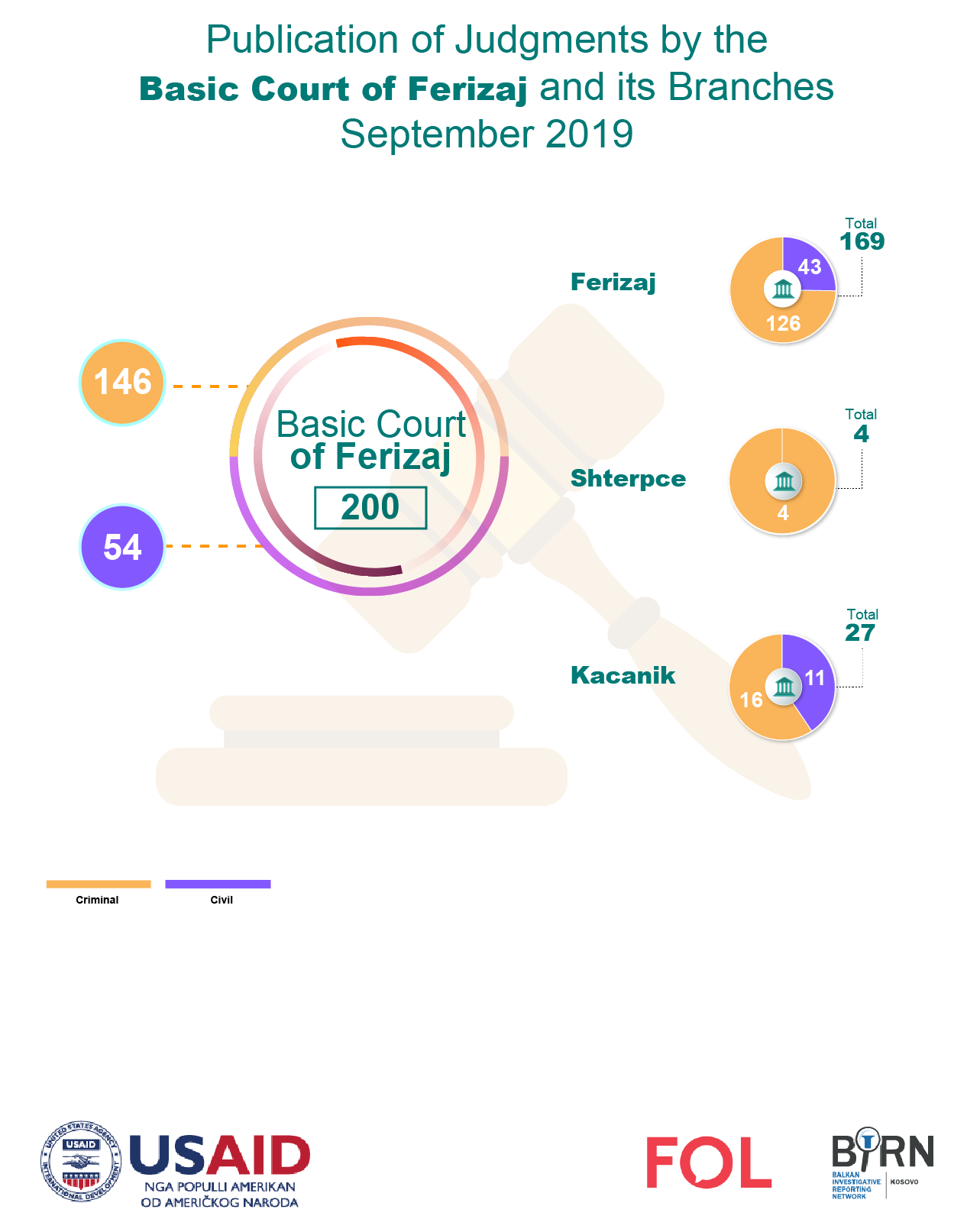
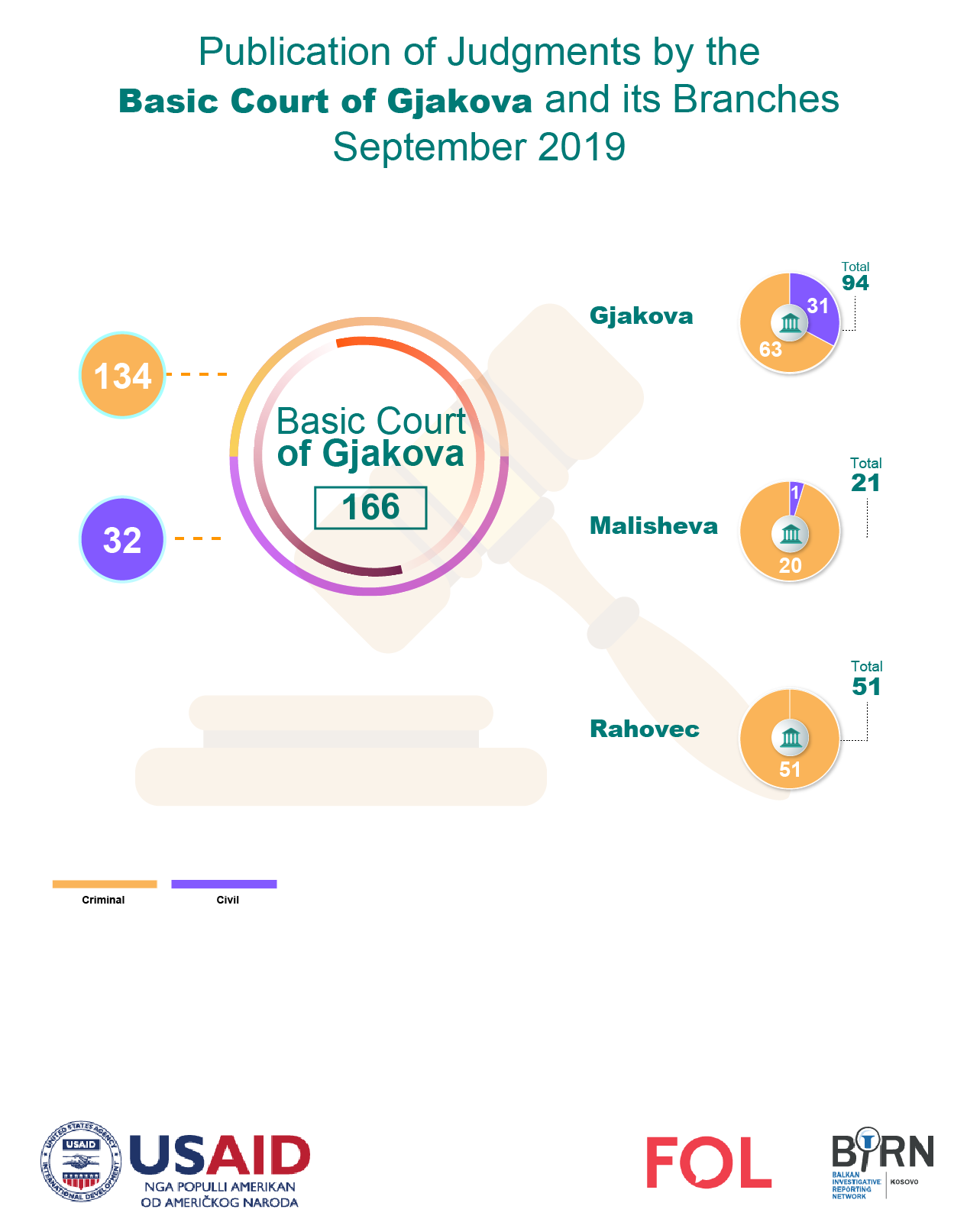
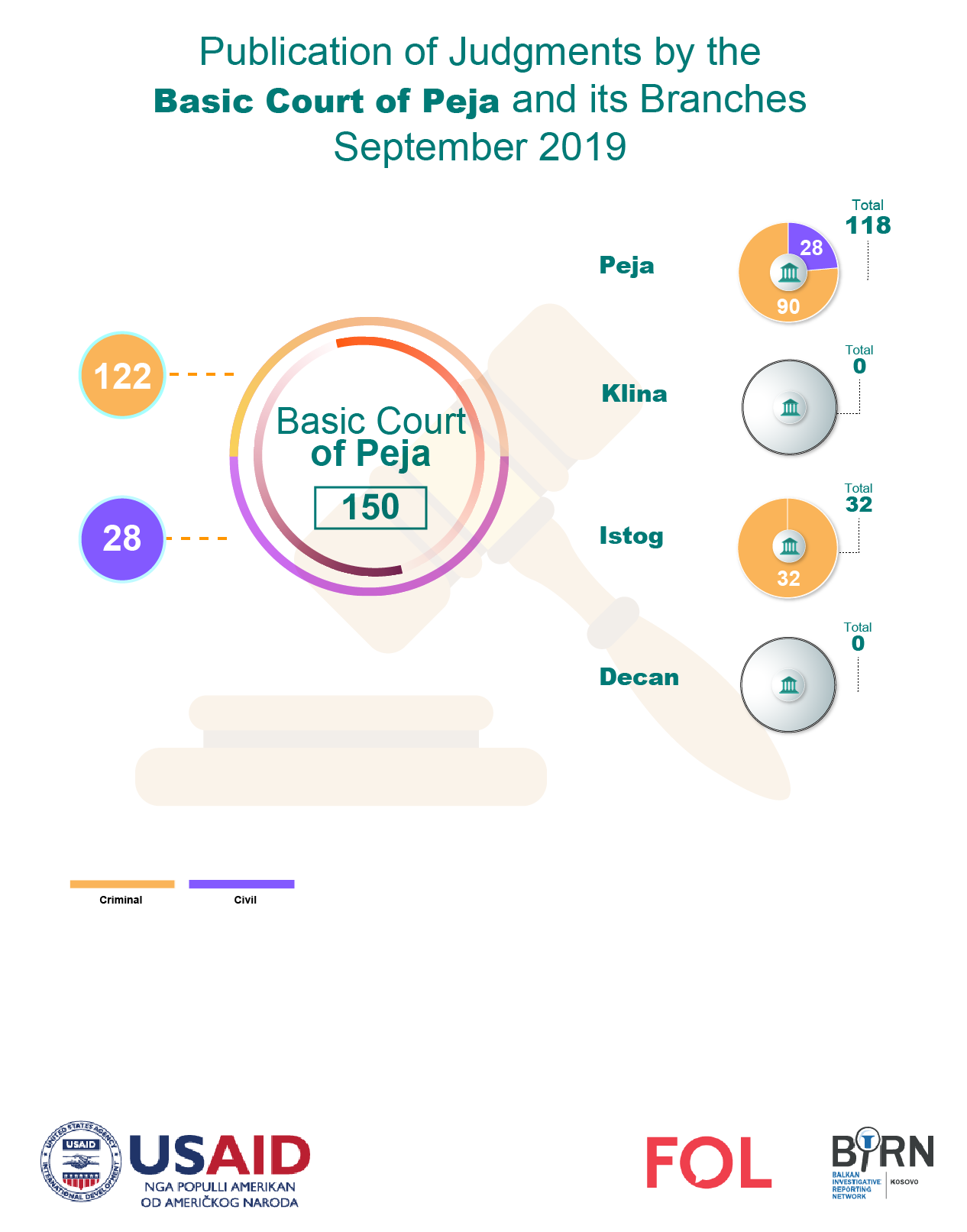
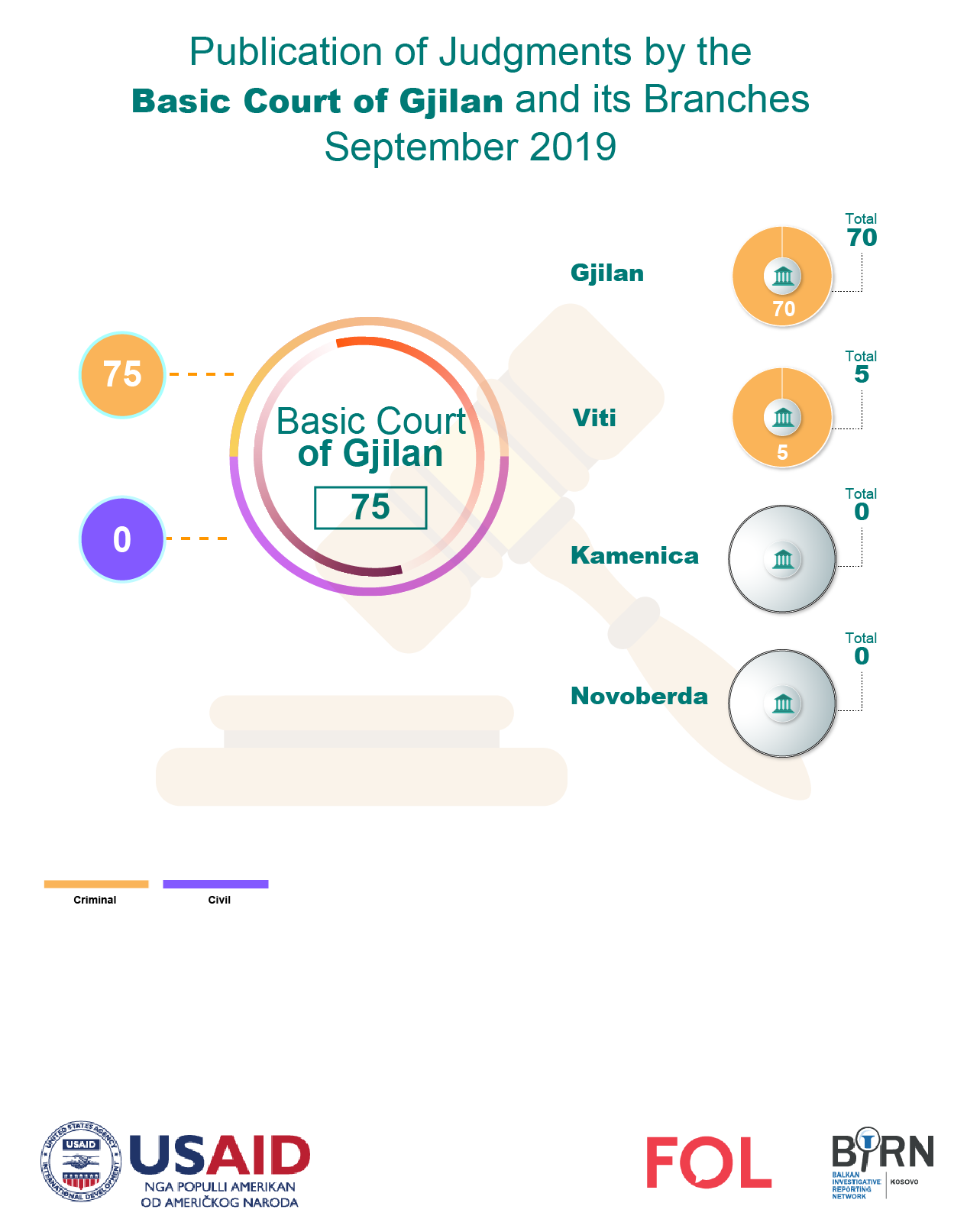
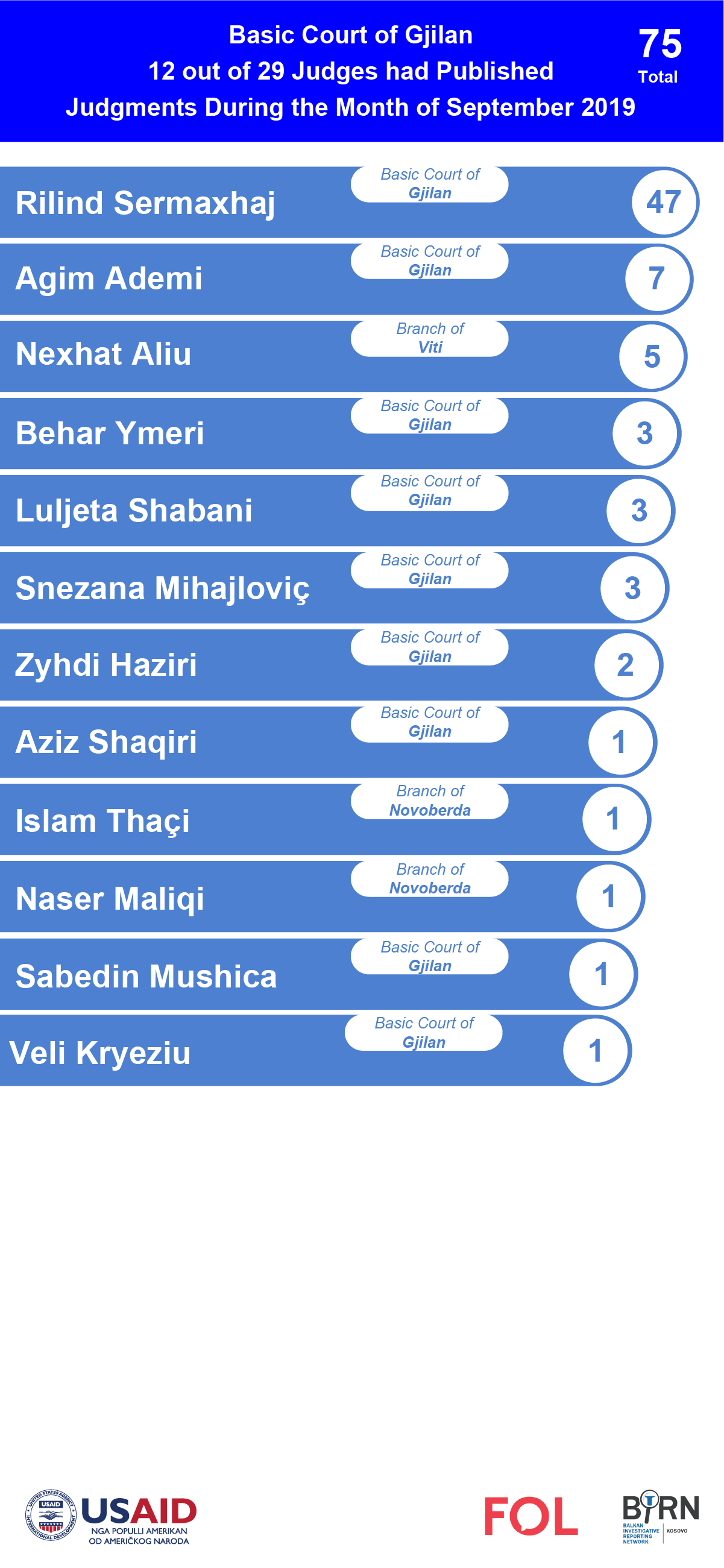
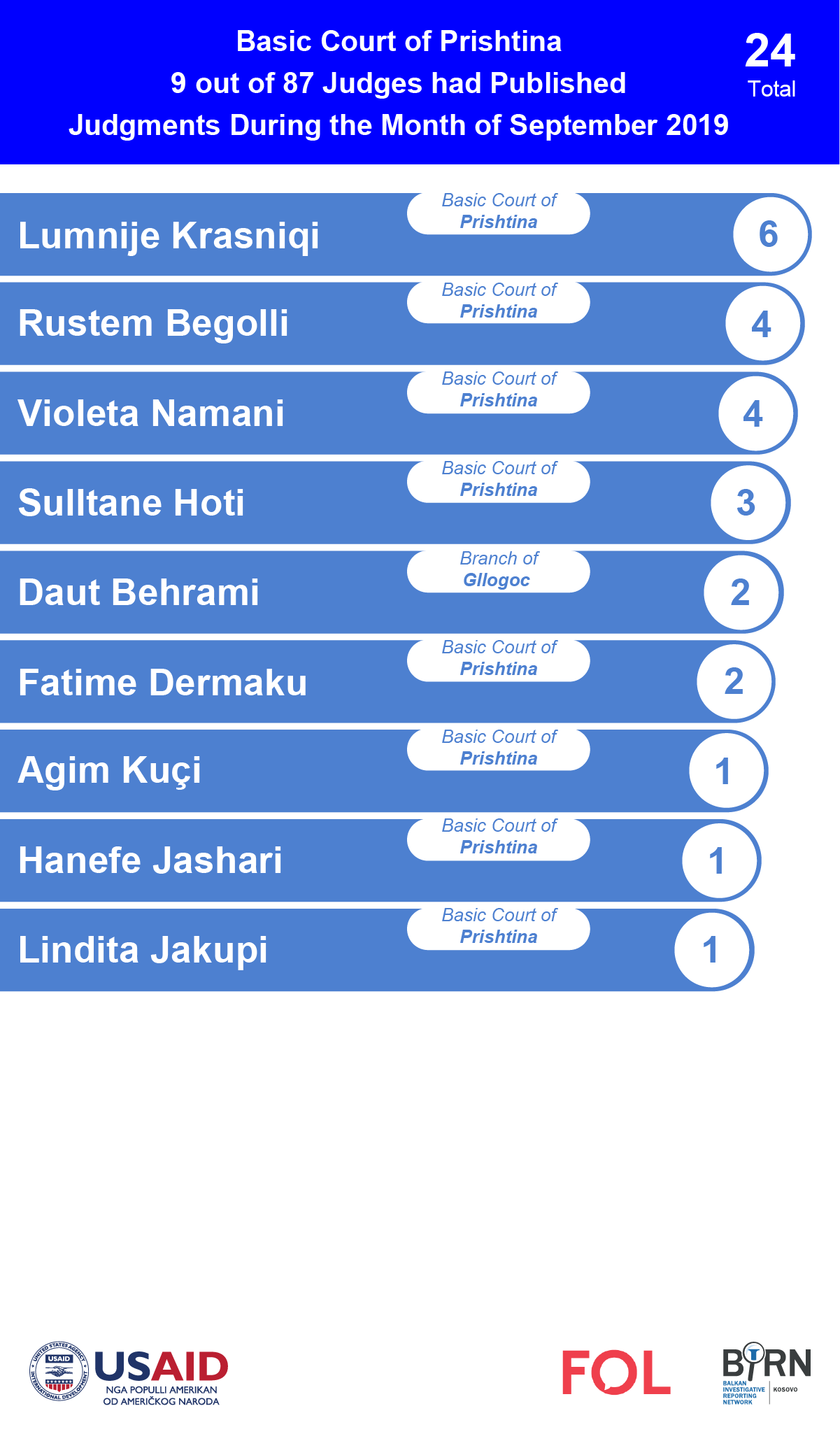
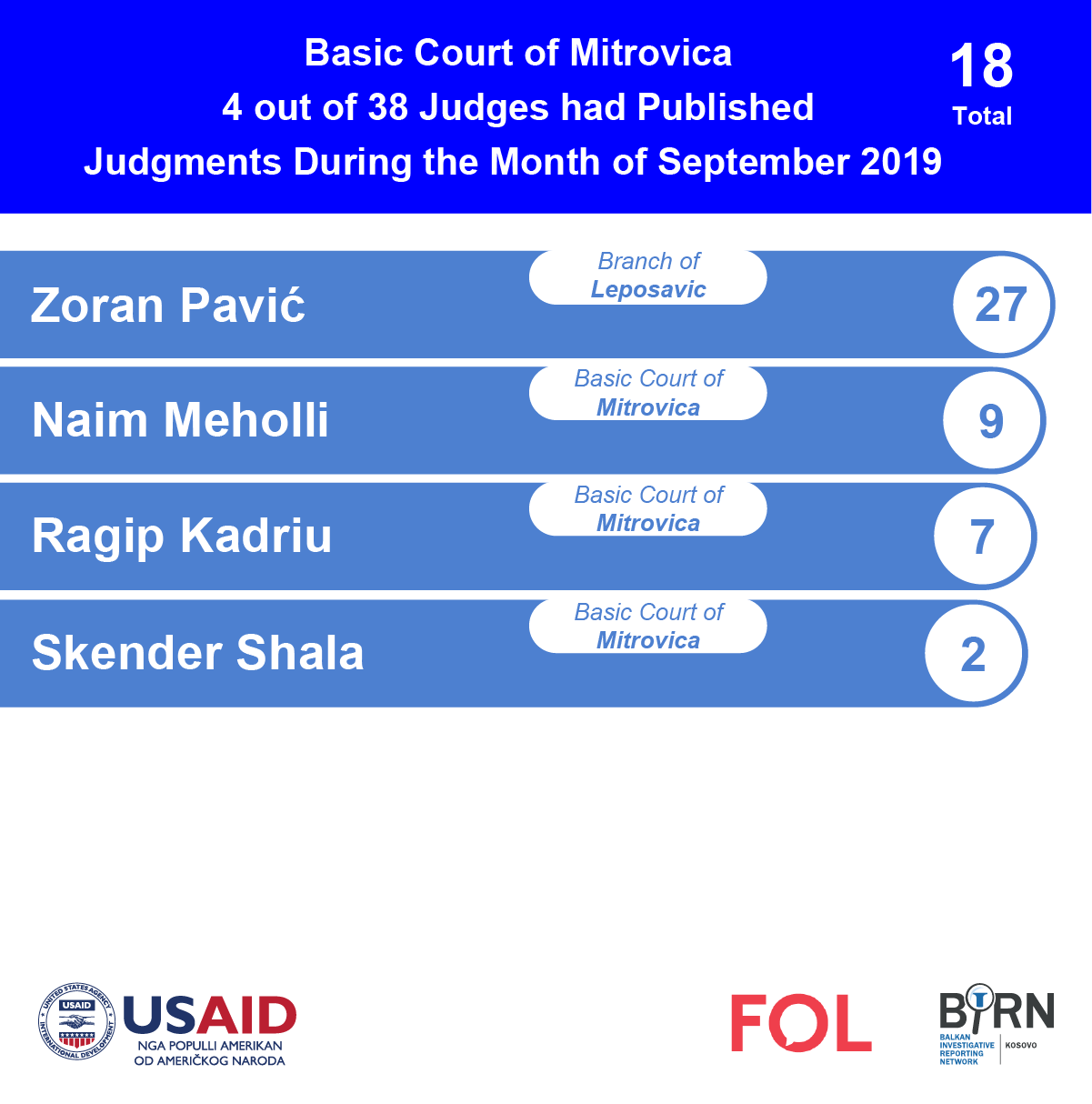
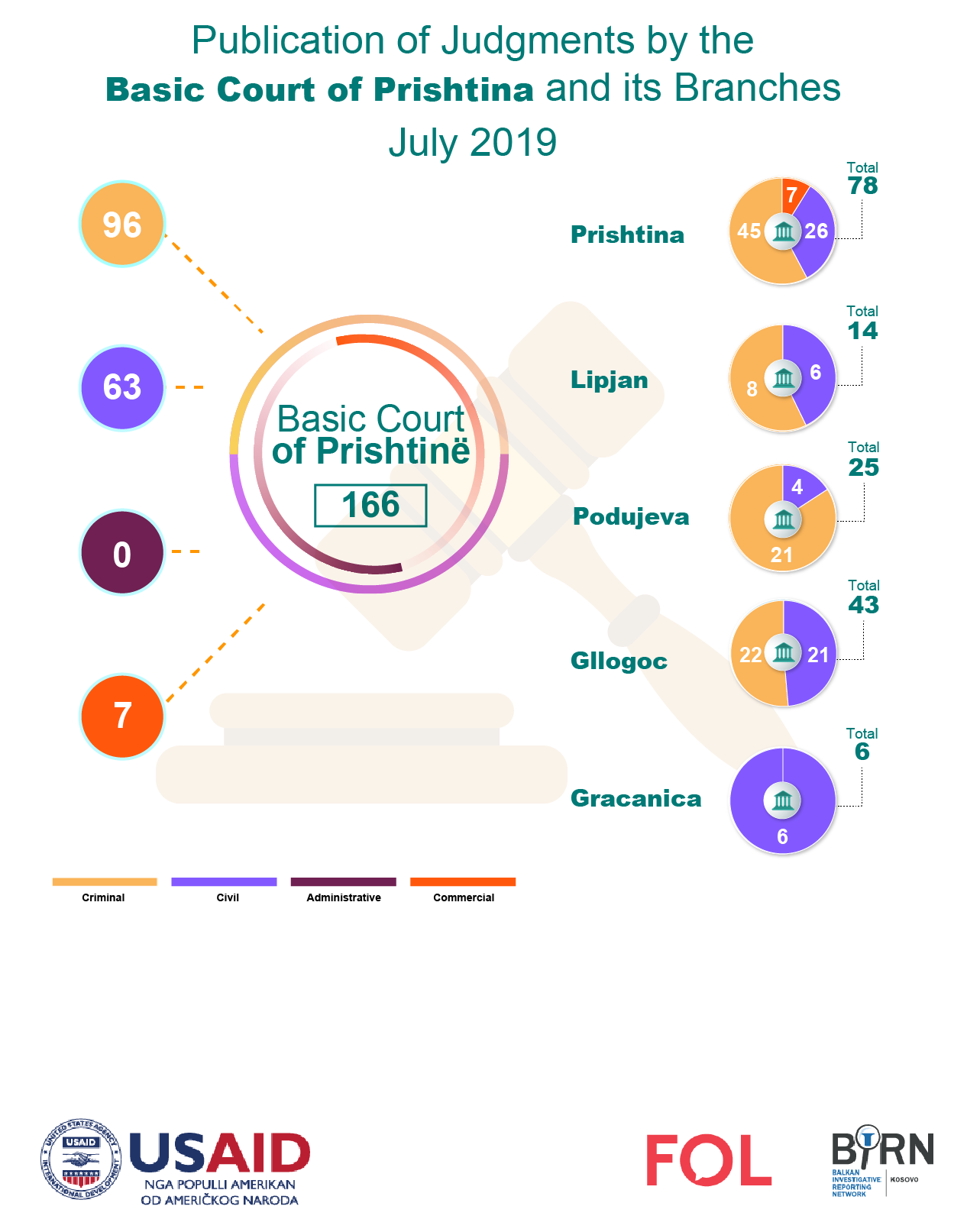
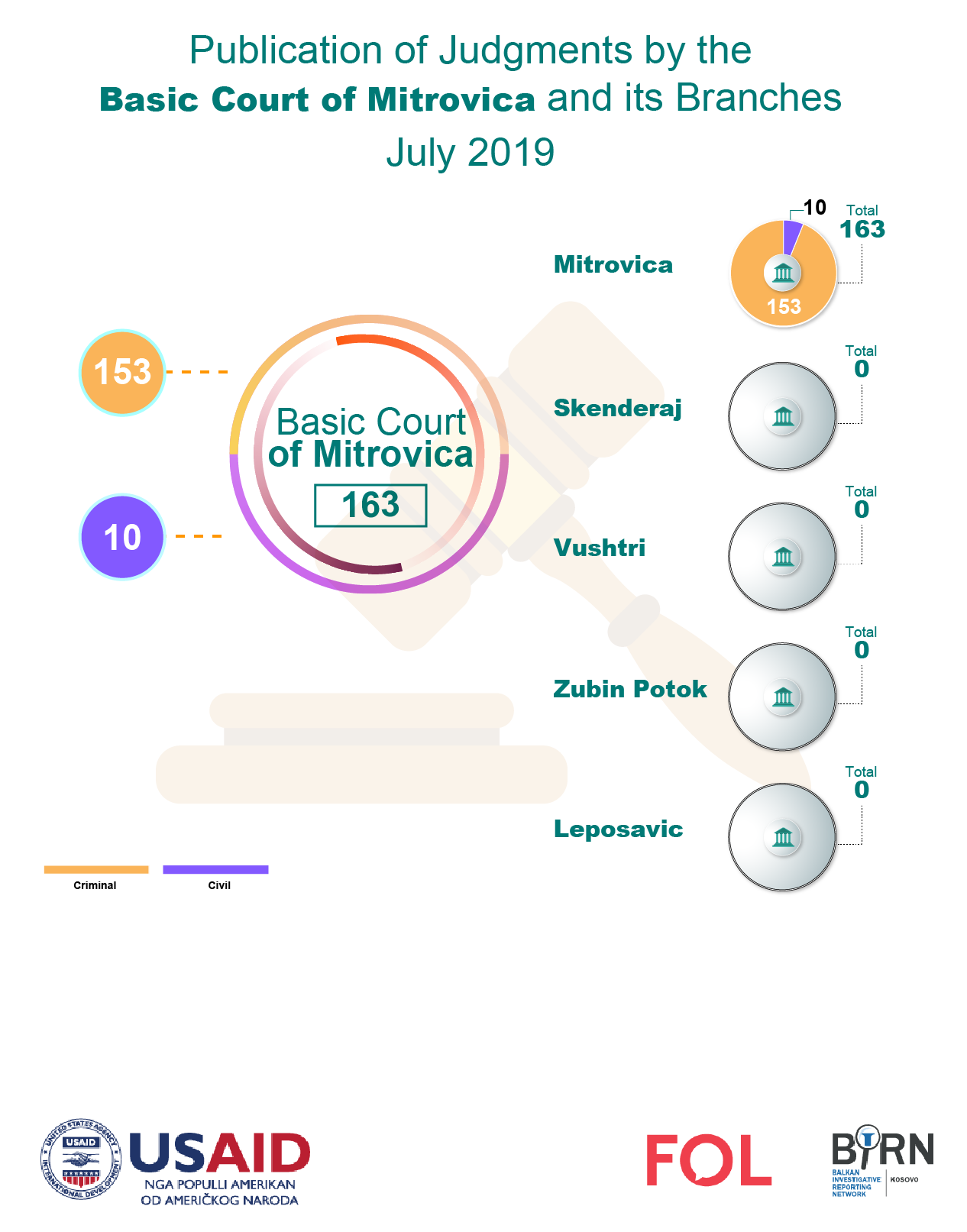
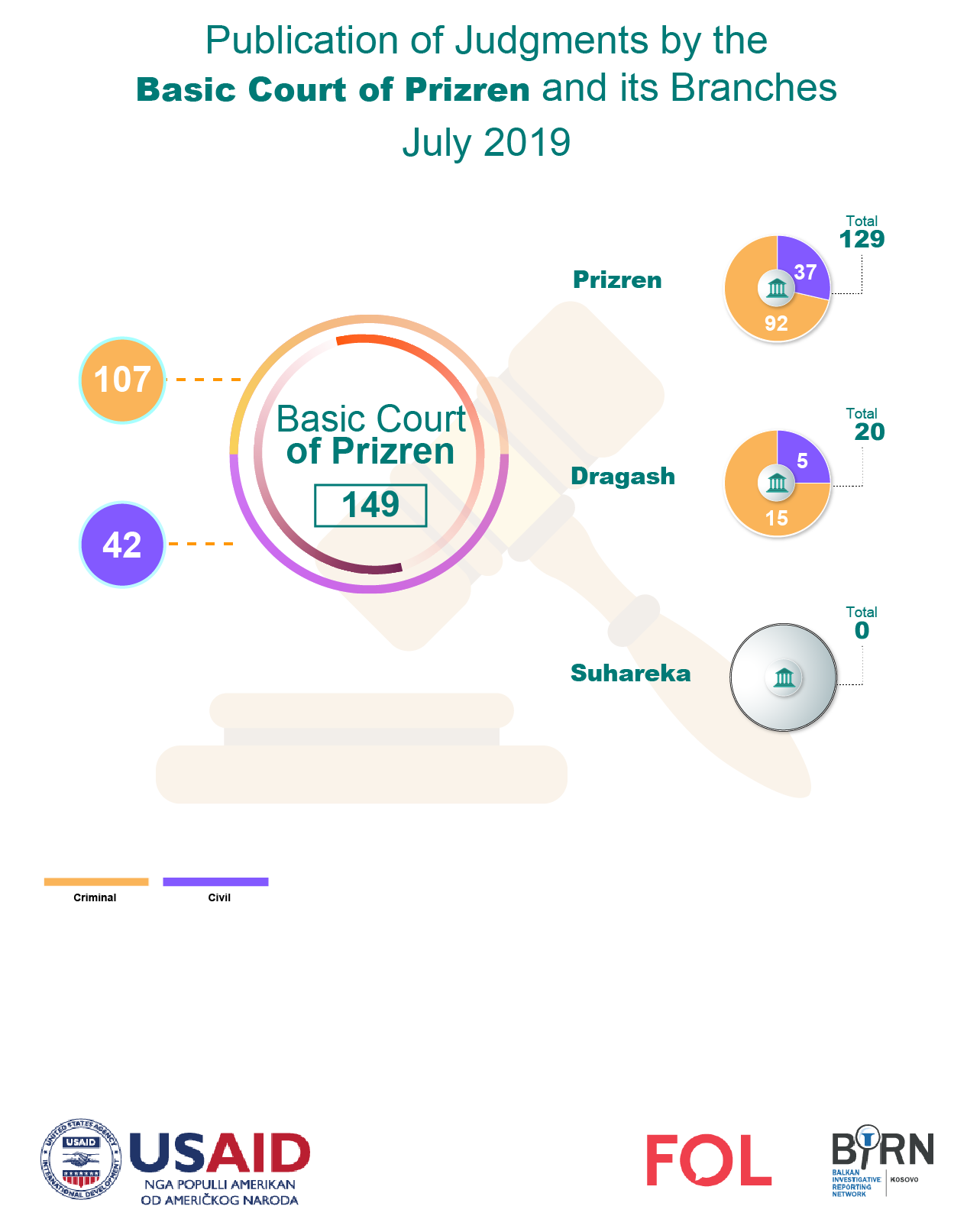
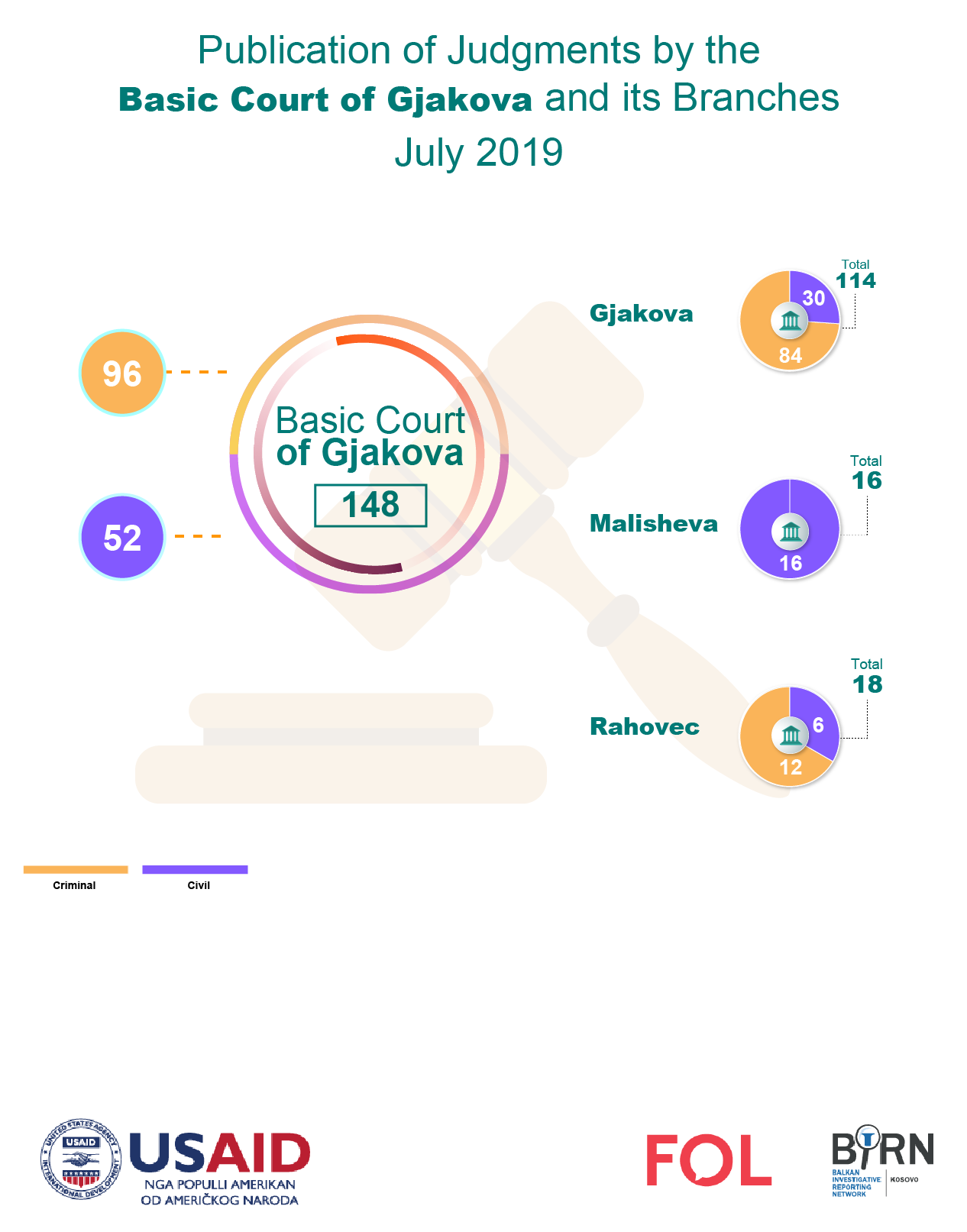
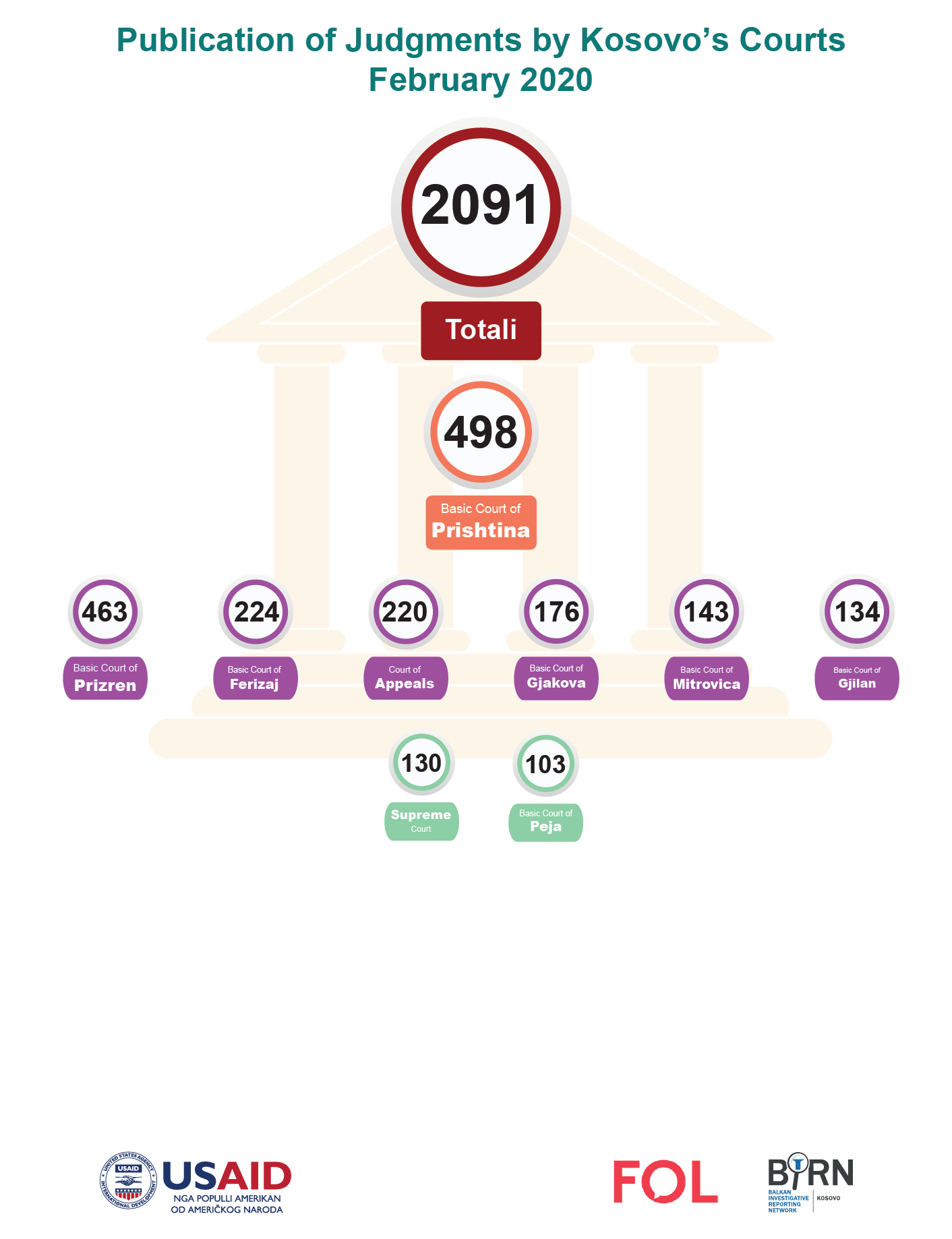
The Basic Court of Prishtina for the third month in a row is leading with publications of judgments

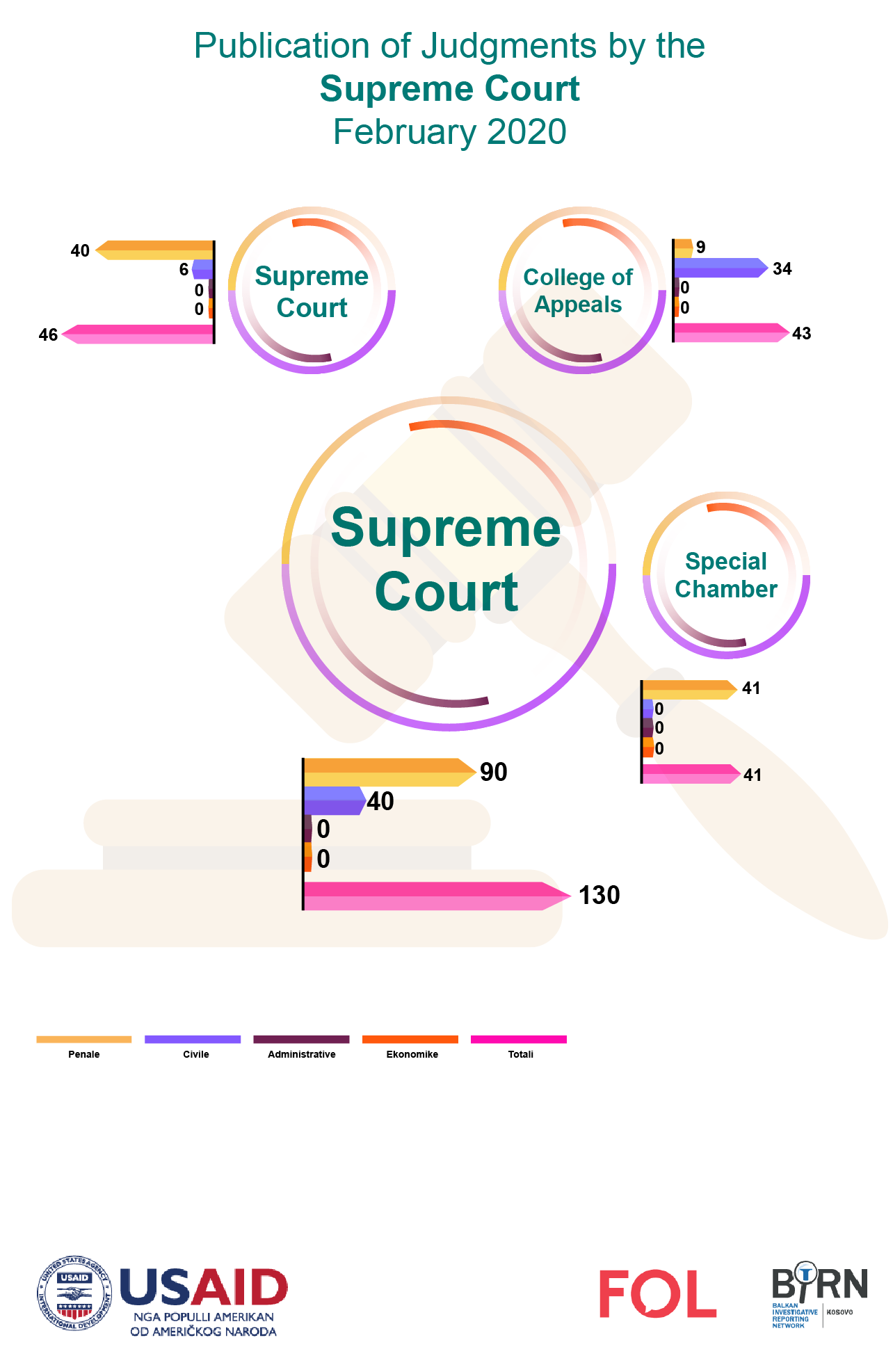
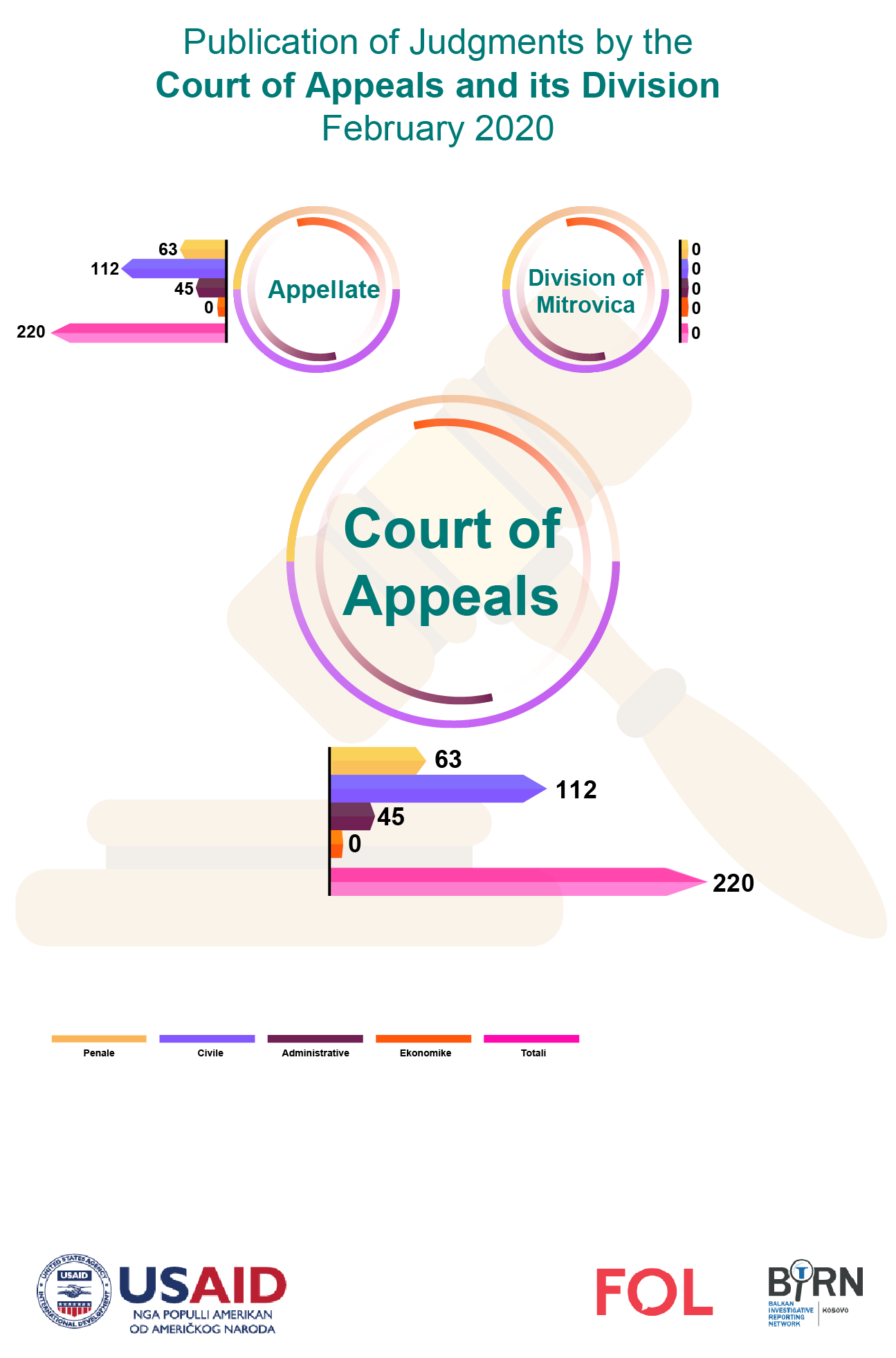
Pristina, 24 March 2020 – FOL Movement and BIRN Kosovo with the support of USAID – Justice System Strengthening Program (JSSP) present monitoring data on the publication of judgments in all Kosovo Courts. Through the following infographics you can see the publication of all judgments by all Kosovo courts for February 2020.


Clarification: The publication of judgments during the period of February 1 to February 29, 2020 was monitored for all Kosovo’s courts focusing on criminal, civil, commercial, and administrative departments. Additionally, this monitoring covered the publication of judgments according to judges from all courts (including their branches) for the abovementioned departments. The President of the Supreme Court; President of the Court of Appeals; Presidents of the Basic Courts; and the Judges from the Division for Minor Offences are not included in this monitoring.

During the monitoring of judgments published in the Kosovo Judicial Council’s website, for the above-mentioned period, it has been noted that there is a total of 2,110 judgments published, or 19 more than BIRN and FOL have in their database. This difference in is due to publication of decisions and double publication of judgments.

Additionally, during the month of February, it has been noticed that courts have published judgments made by judges who have been promoted to more senior positions, have been transferred to Minor Offence Division, or have retired. These shortcomings were noted during a detailed verification by BIRN and FOL.

*Disclaimer: This monitoring was made possible by the support of the American People through the United States Agency for International Development (USAID). The content of this article is the sole responsibility of FOL Movement and BIRN Kosova and does not necessarily reflect the views of the United States Agency for International Development or the United States Government.


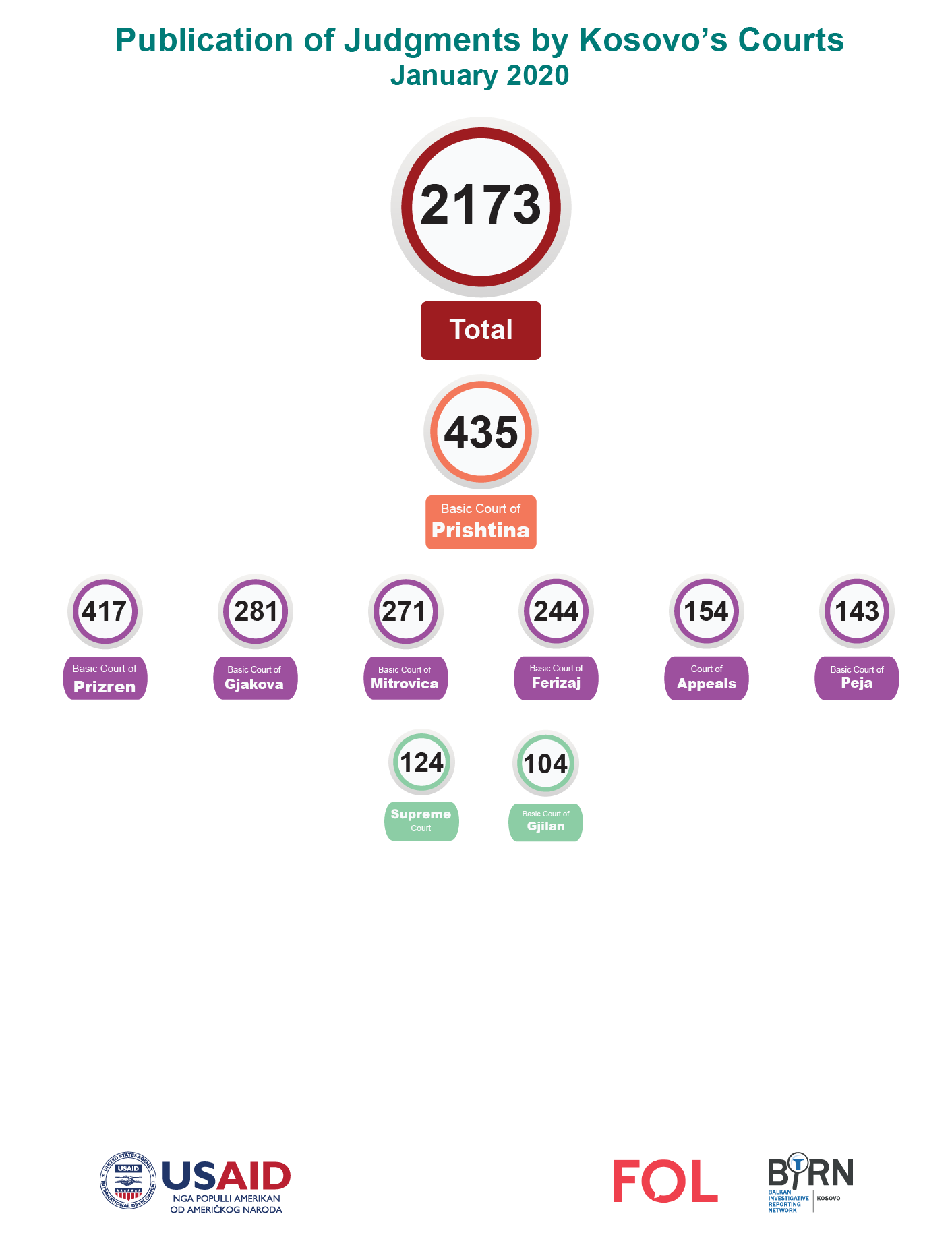
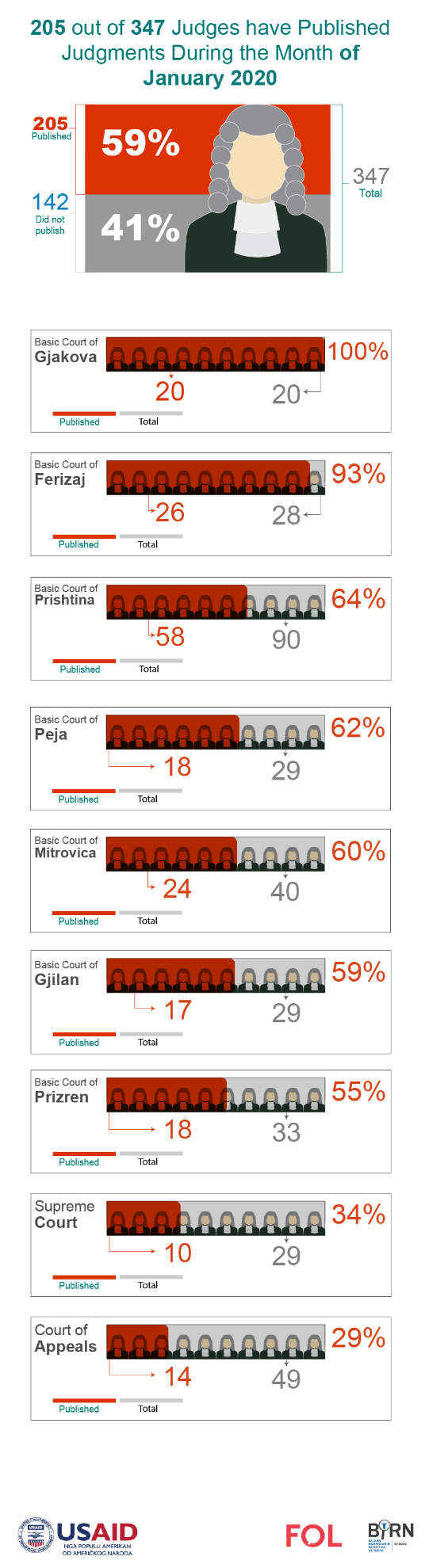
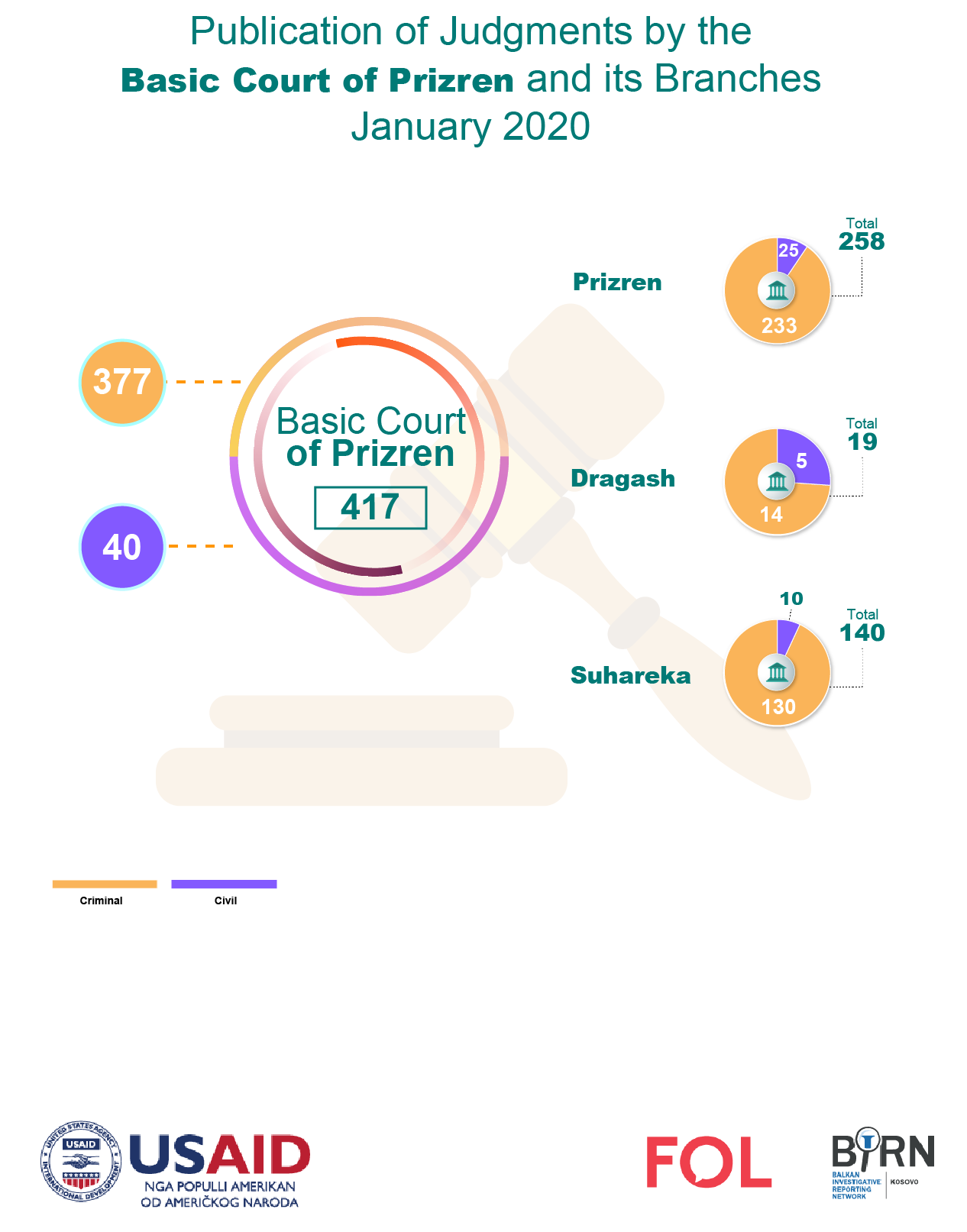
Basic Court Pristina and Prizren lead with jugements publishing for January 2020

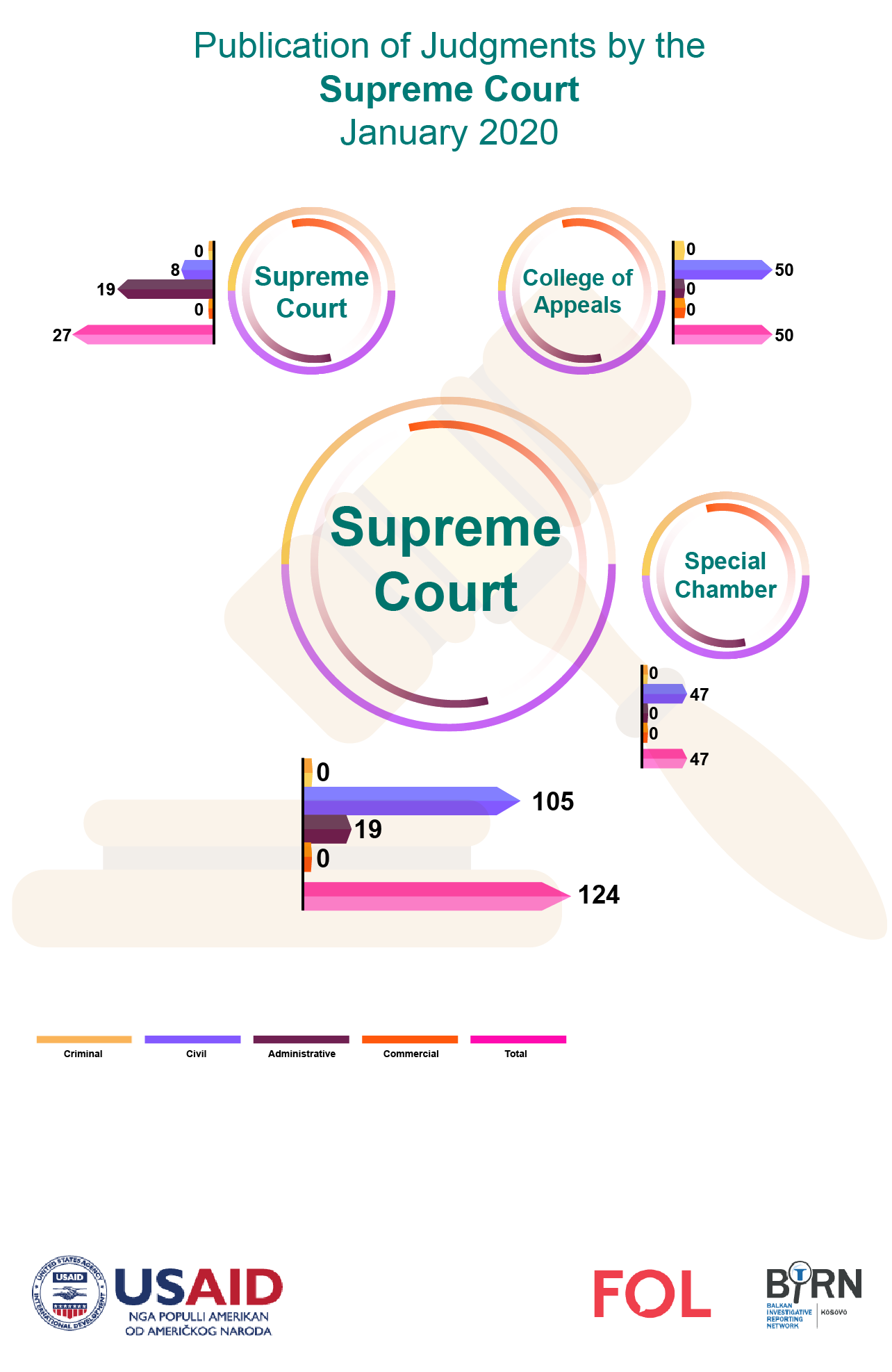
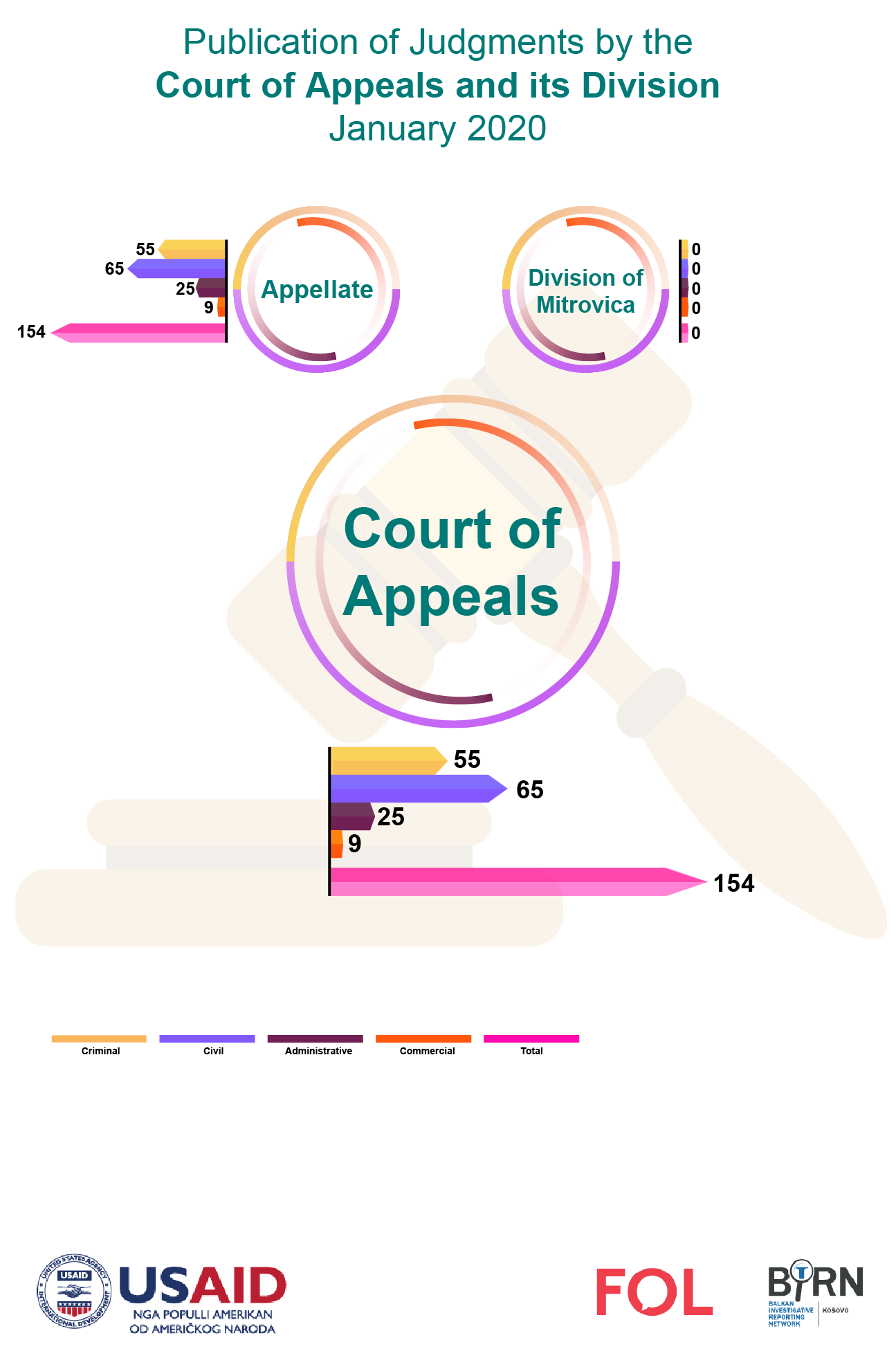
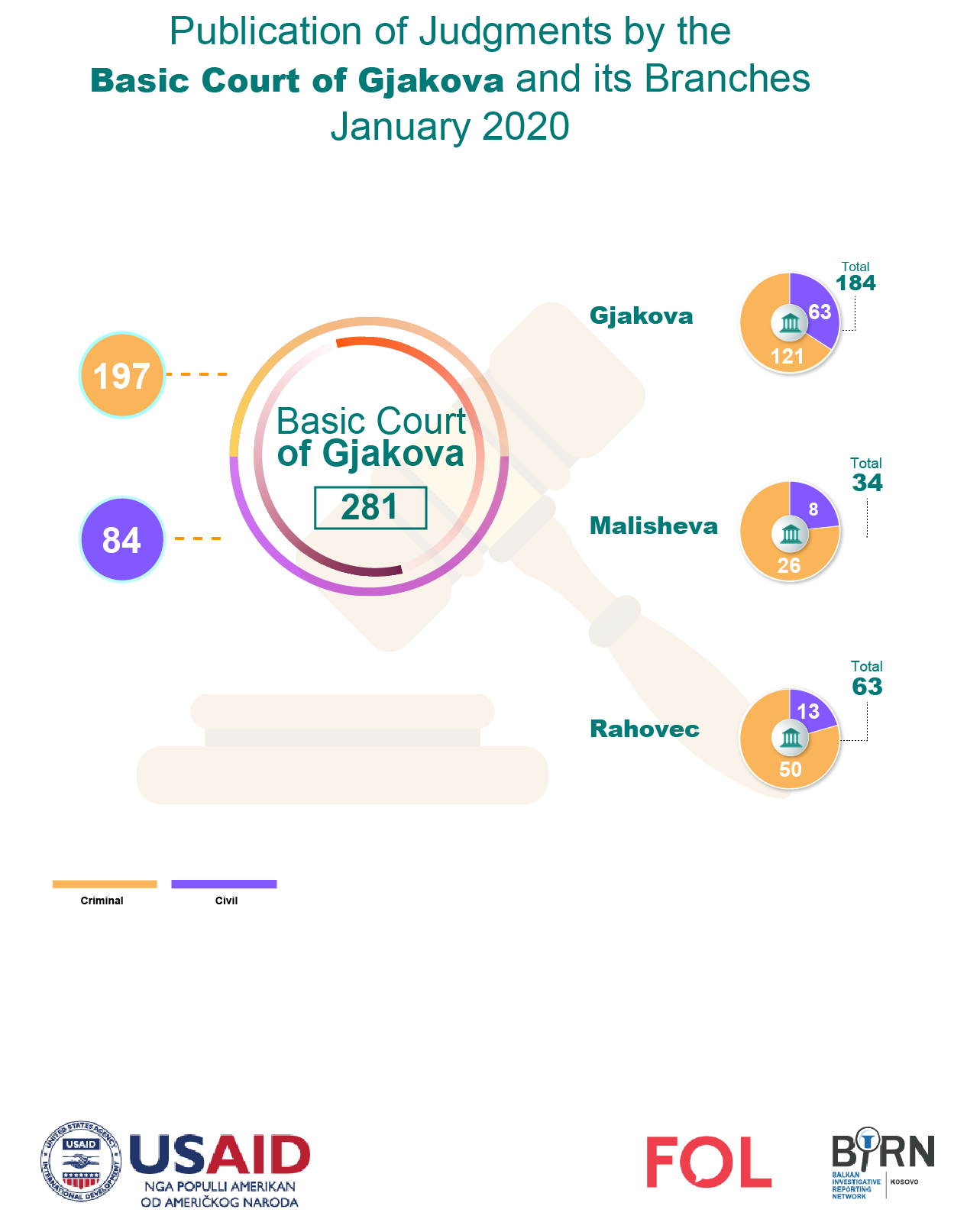
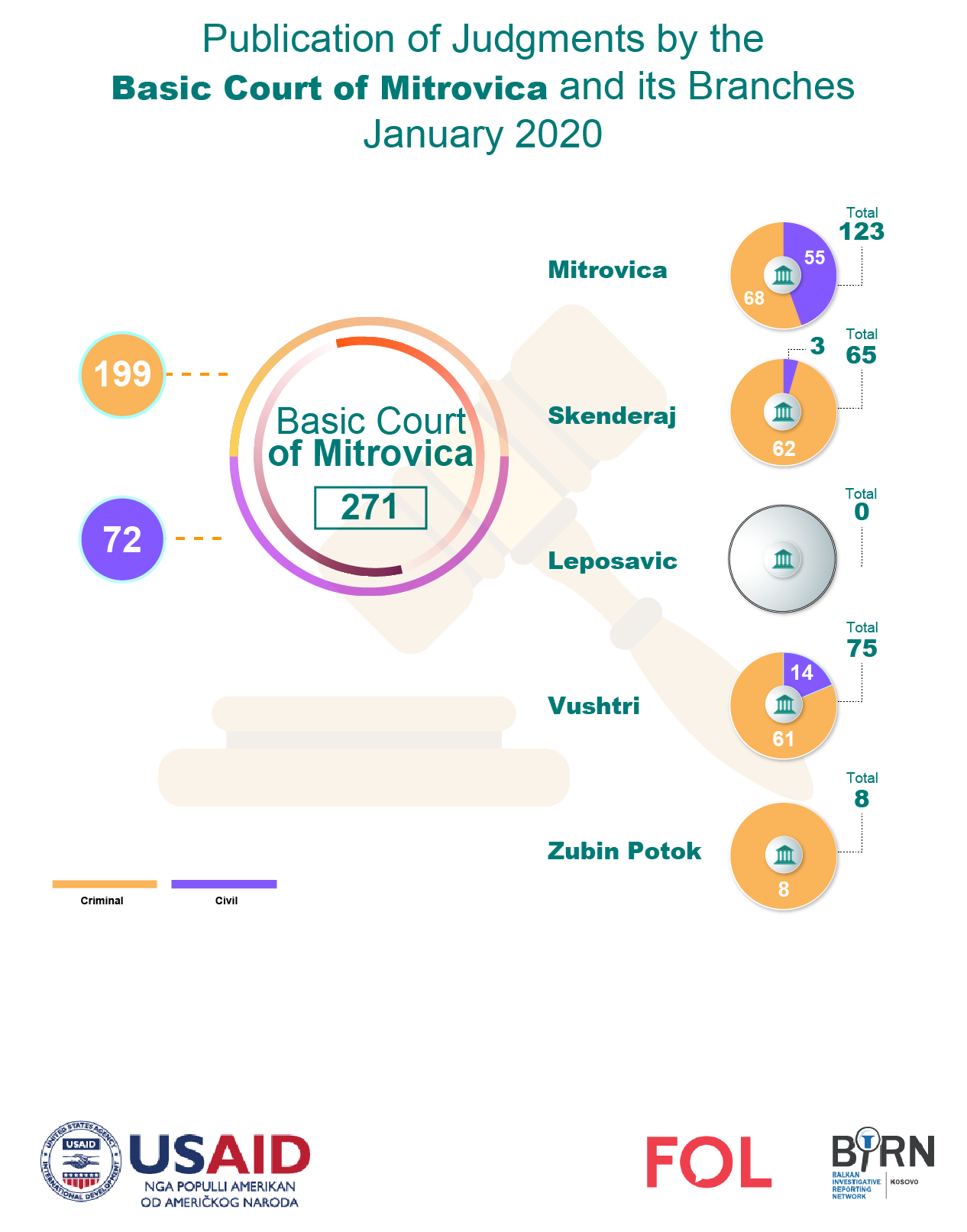
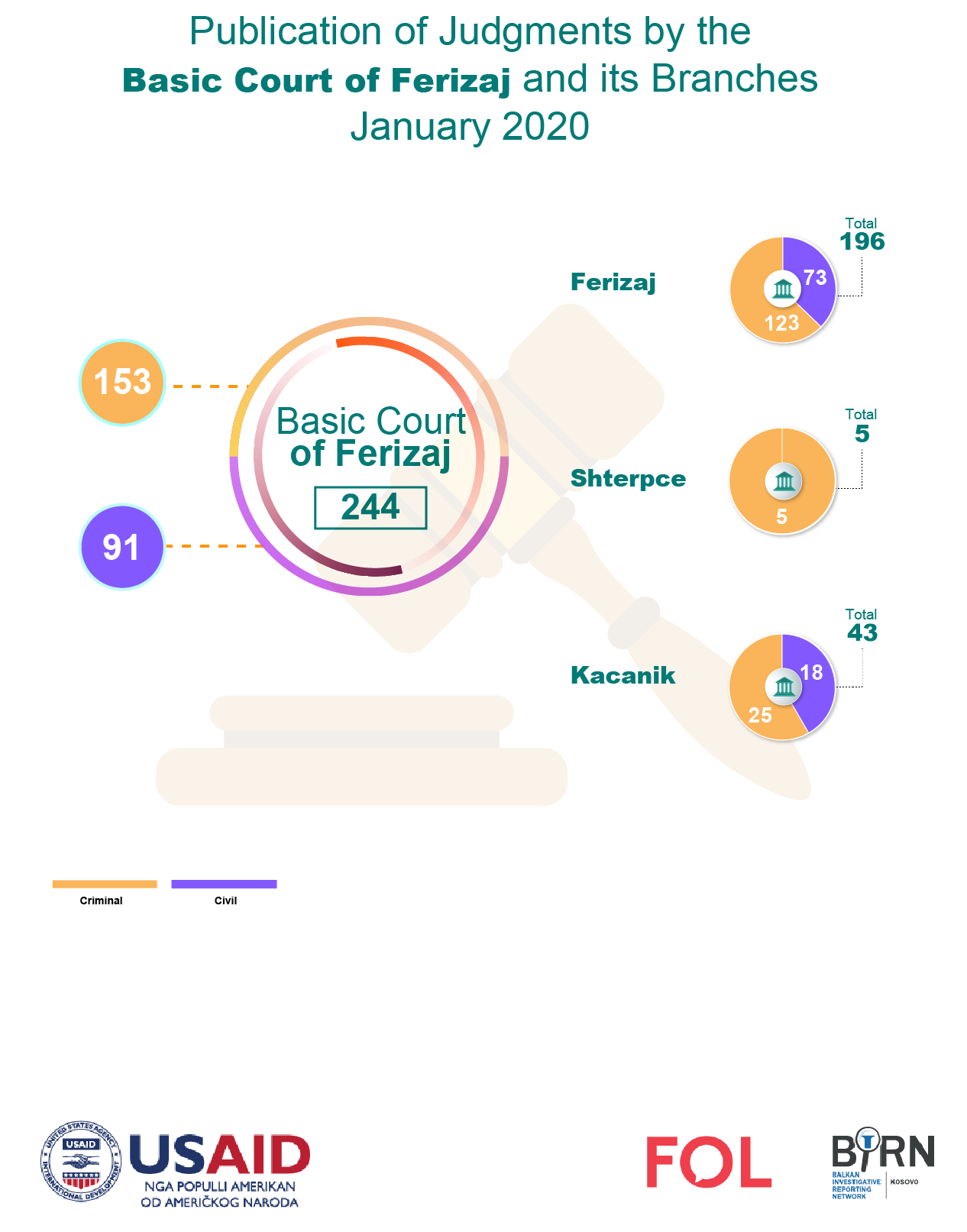
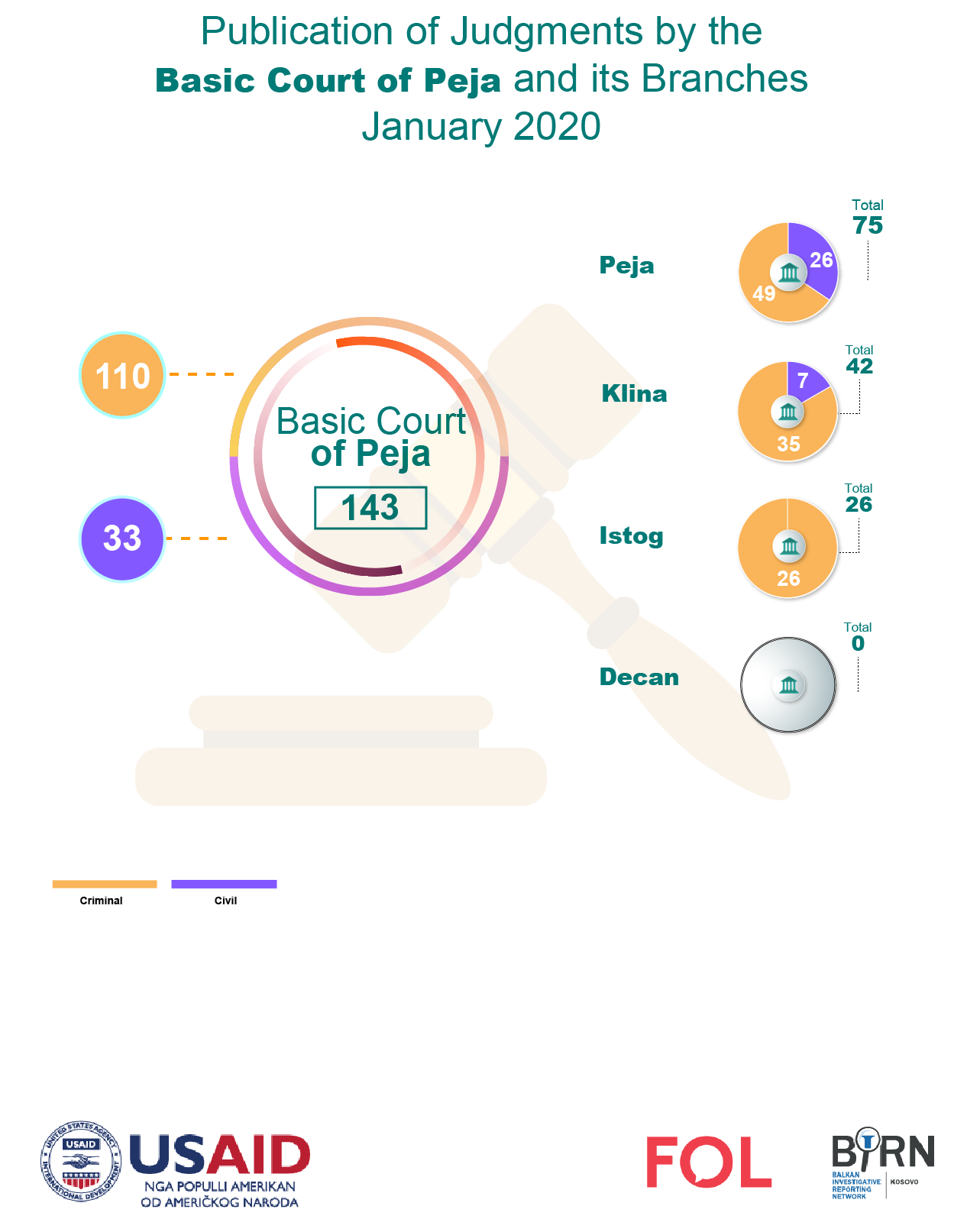
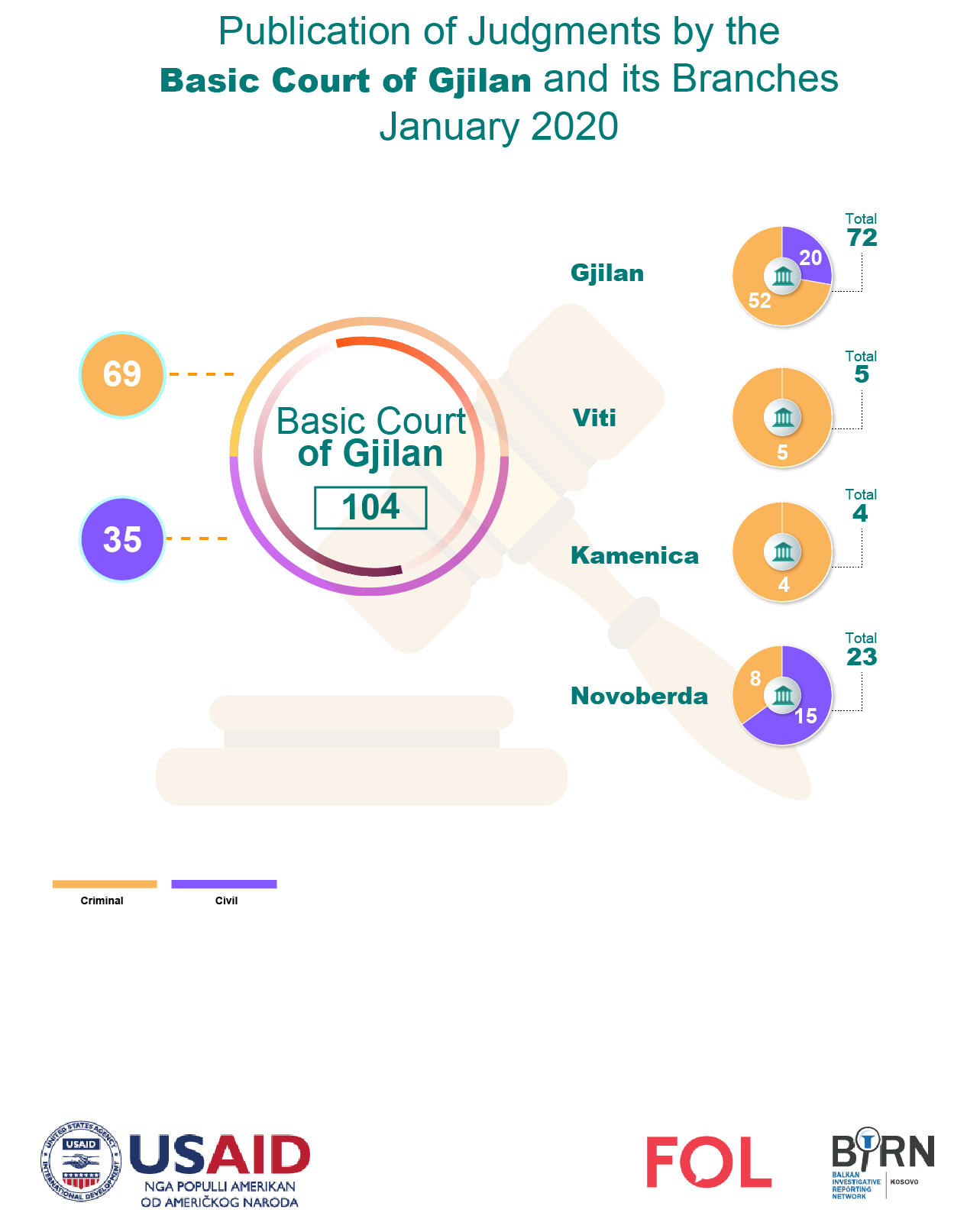
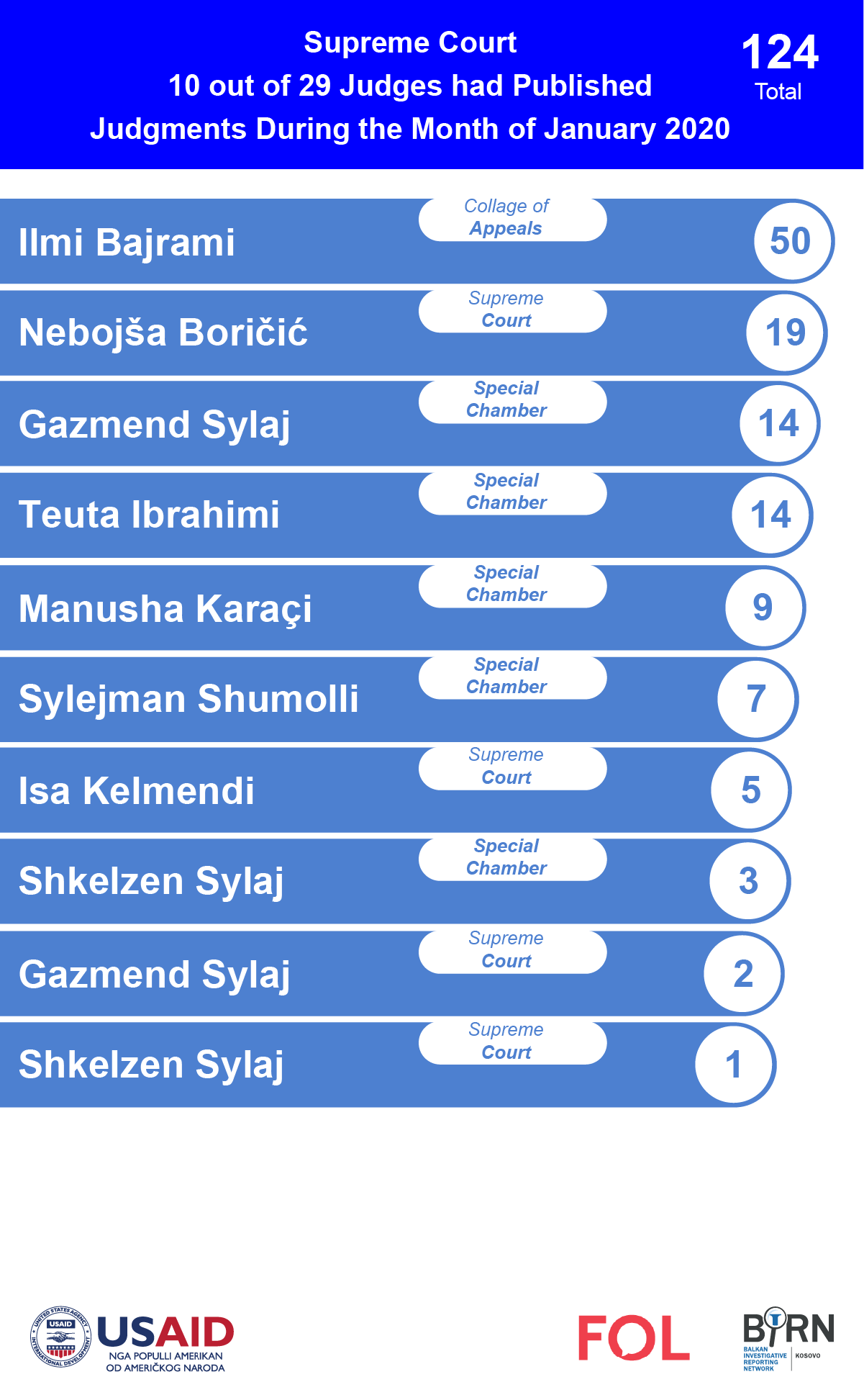
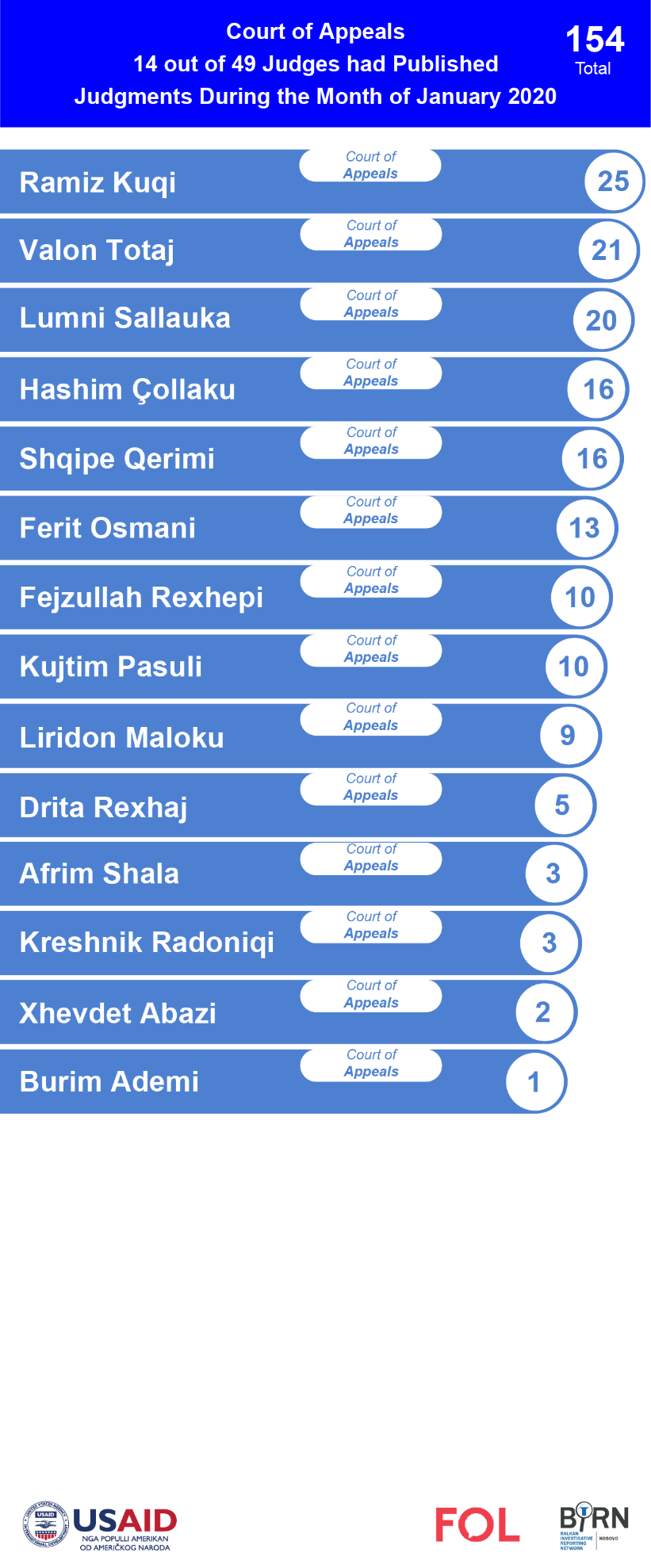
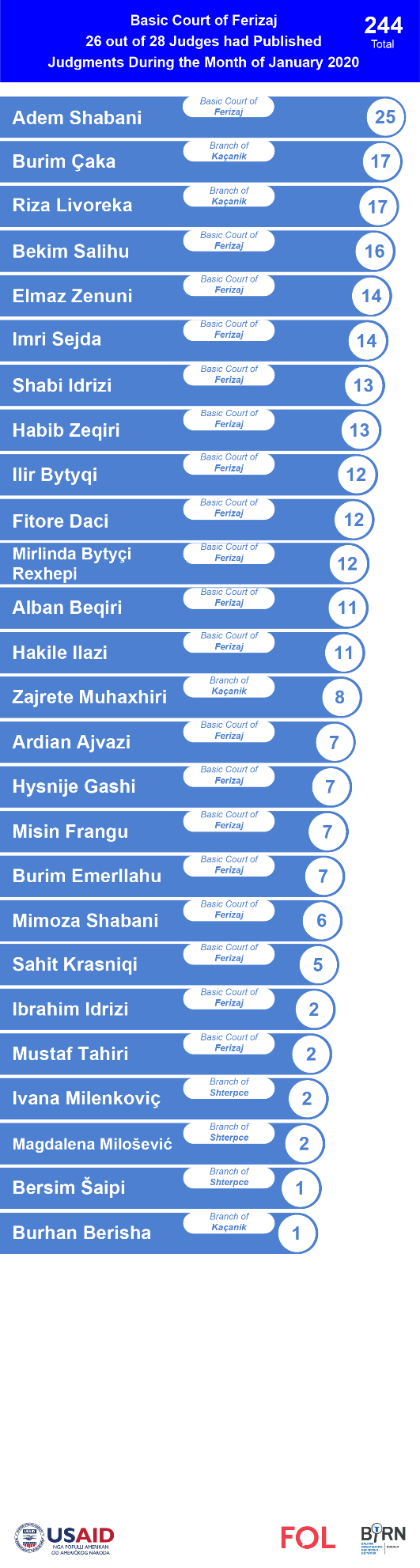
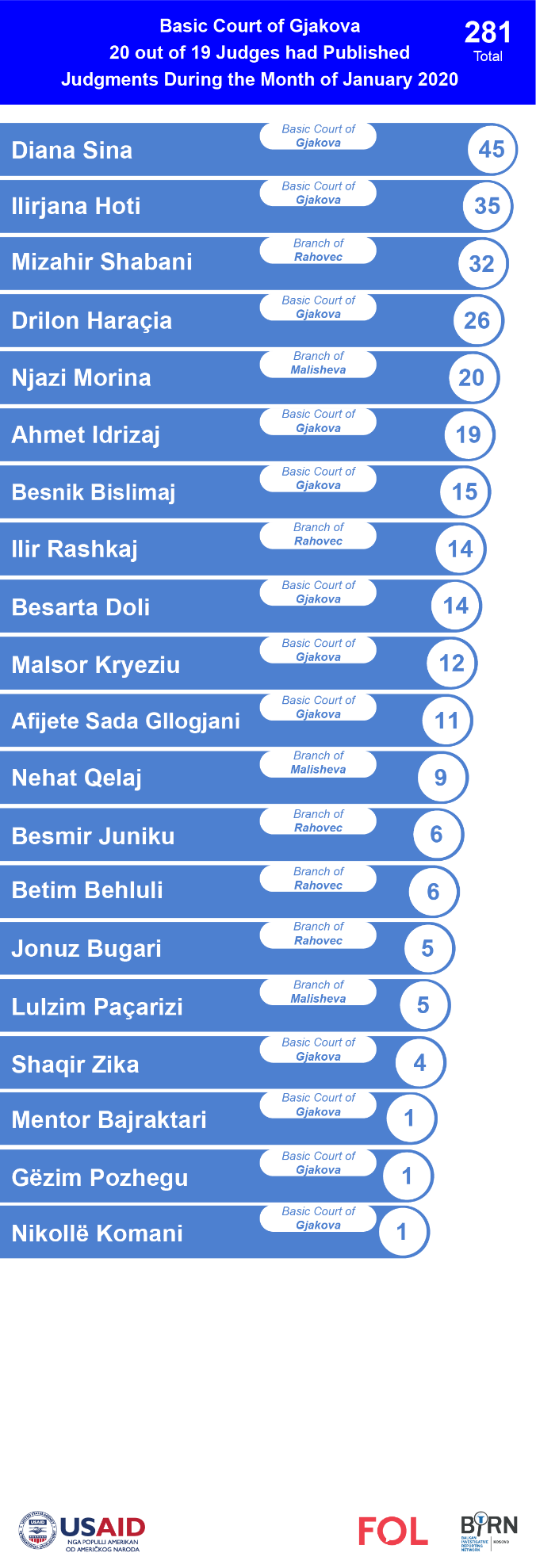
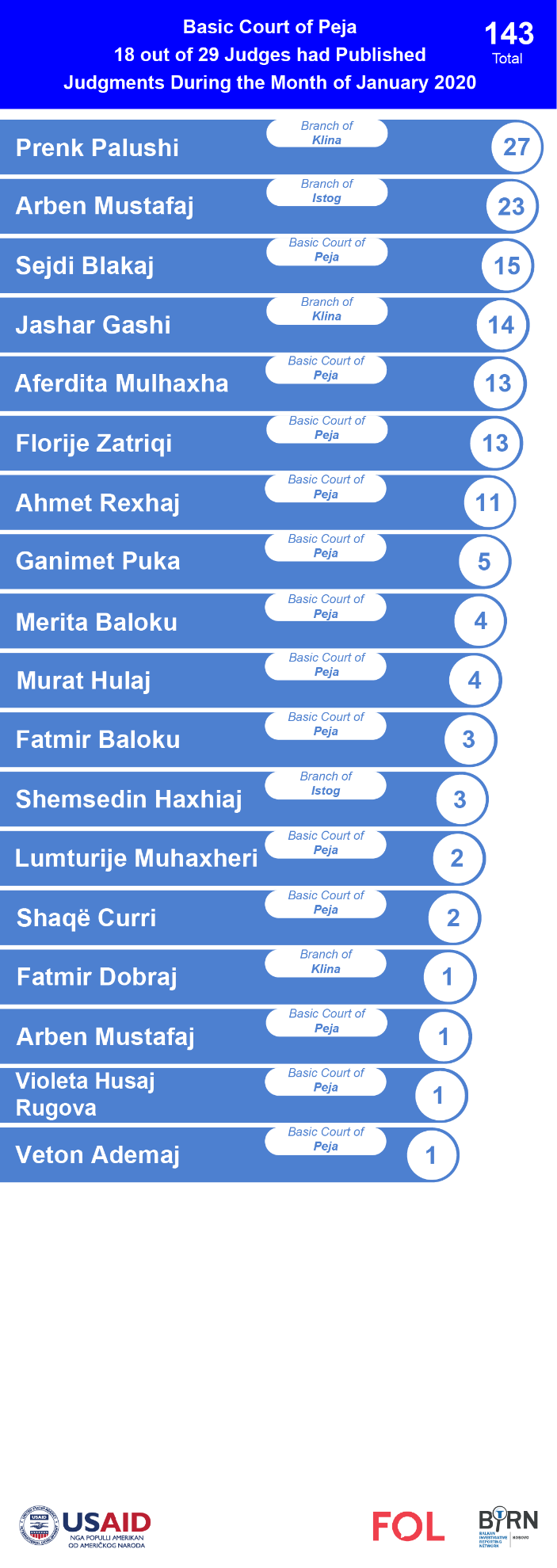
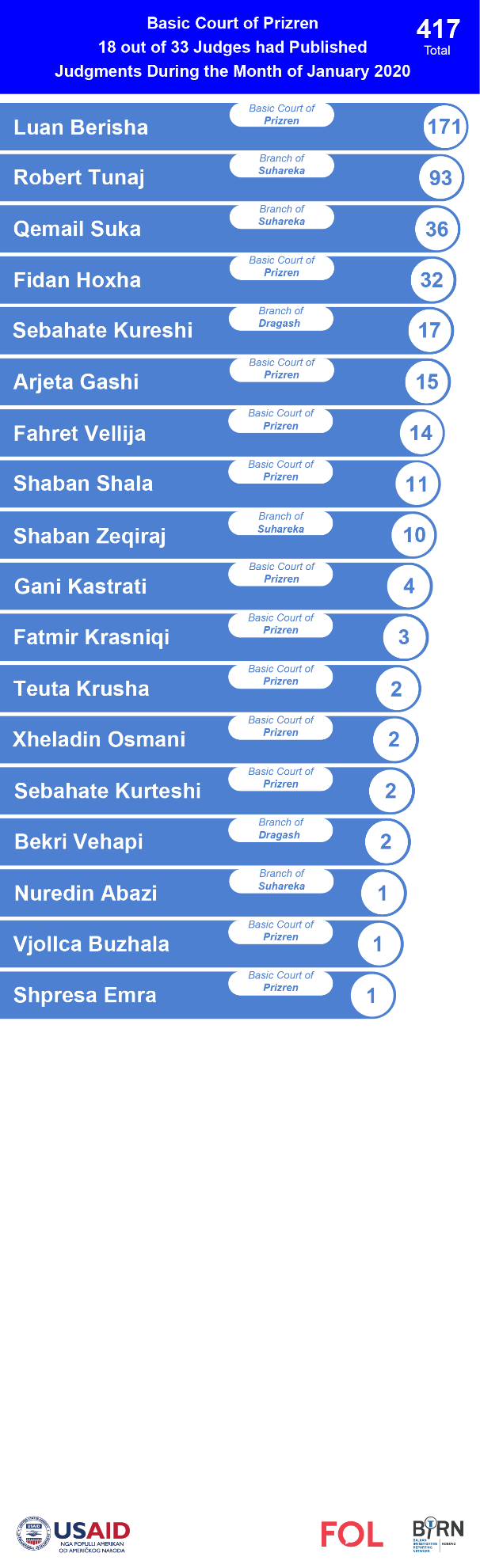
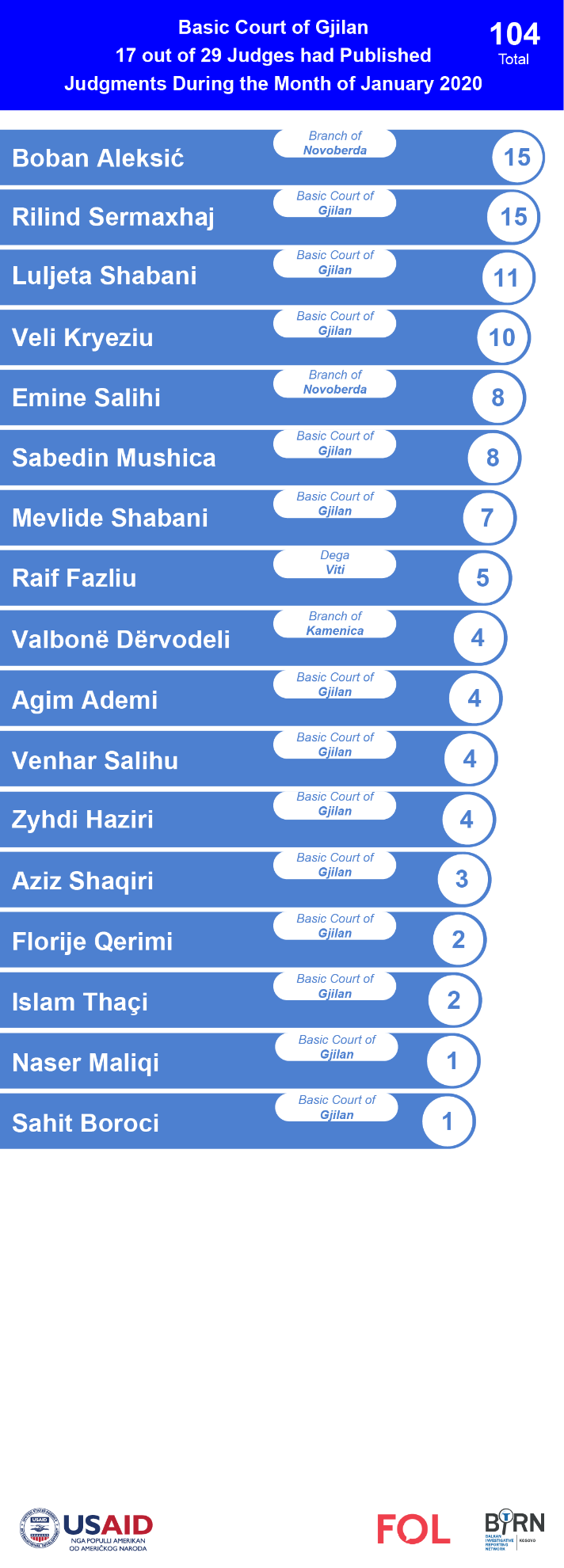
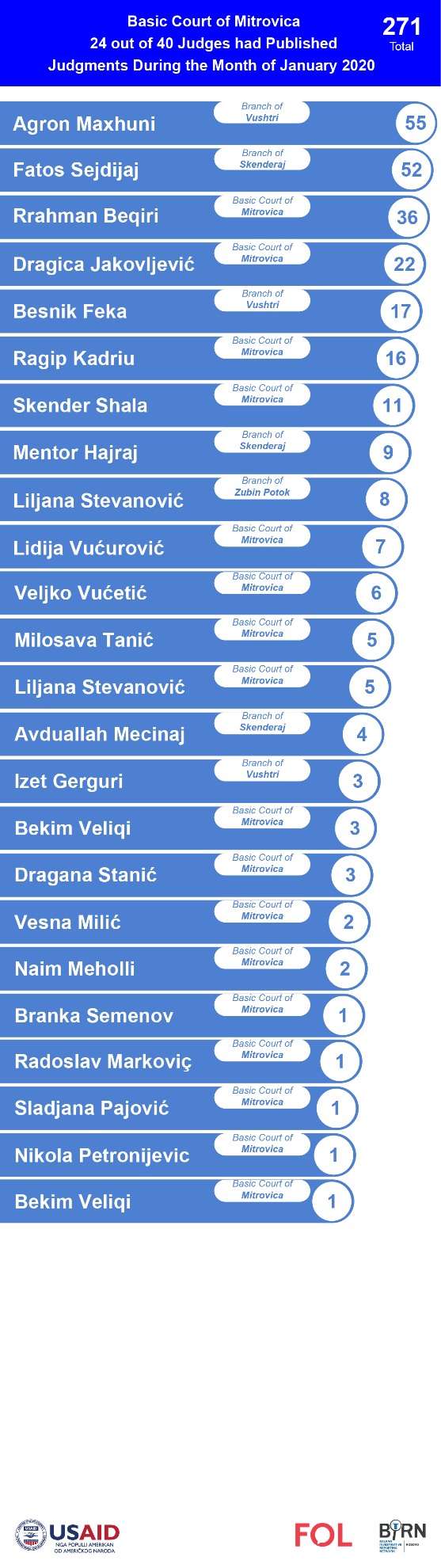
Pristina, 18 February 2020 – FOL Movement and BIRN Kosovo with the support of USAID – Justice System Strengthening Program (JSSP) present monitoring data on the publication of judgments in all Kosovo Courts. Through the following infographics you can see the publication of all judgments by all Kosovo courts for January 2020.


Clarification: The publication of judgments during the period of January 1 to January 31, 2020 was monitored for all Kosovo’s courts focusing on criminal, civil, commercial, and administrative departments. Additionally, this monitoring covered the publication of judgments according to judges from all courts (including their branches) for the abovementioned departments. The President of the Supreme Court; President of the Court of Appeals; Presidents of the Basic Courts; and the Judges from the Division for Minor Offences are not included in this monitoring.


During the monitoring of judgments published in the Kosovo Judicial Council’s website, for the above-mentioned period, it has been noted that there is a total of 2,181 judgments published, or 8 more than BIRN and FOL have in their database. This difference in is due to publication of decisions.

Additionally, during the month of January, it has been noticed that courts have published judgments made by judges who have been promoted to more senior positions, have been transferred to Minor Offence Division, or have retired. These shortcomings were noted during a detailed verification by BIRN and FOL.


*Disclaimer: This monitoring was made possible by the support of the American People through the United States Agency for International Development (USAID). The content of this article is the sole responsibility of FOL Movement and BIRN Kosova and does not necessarily reflect the views of the United States Agency for International Development or the United States Government.

Report on the monitoring of publication of judgments

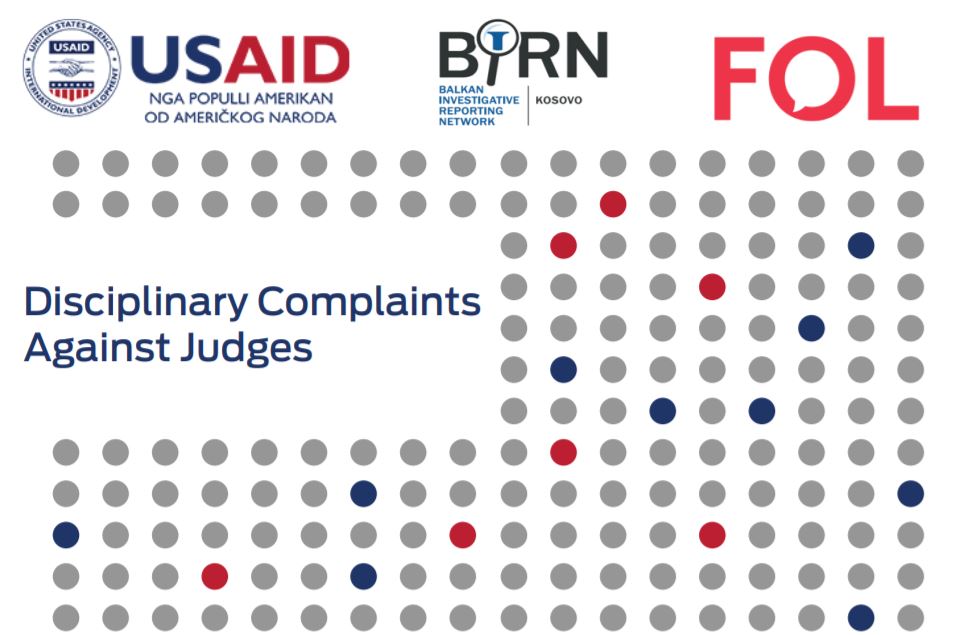
Disciplinary Complaints Against Judges

The monitoring outlined in this report was conducted by BIRN Kosovo (BIRN)and FOL Movement (FOL), commissioned by the USAID Justice System Strengthening Program (USAID/JSSP). The report aims to assess the eciency of competent institutions in treating disciplinary complaints initiated against judges and court presidents of the Republic of Kosovo over a period of four months, specifically between July 1 and November 1, 2019.

Pristina Basic Court breaks the record in publishing judgments

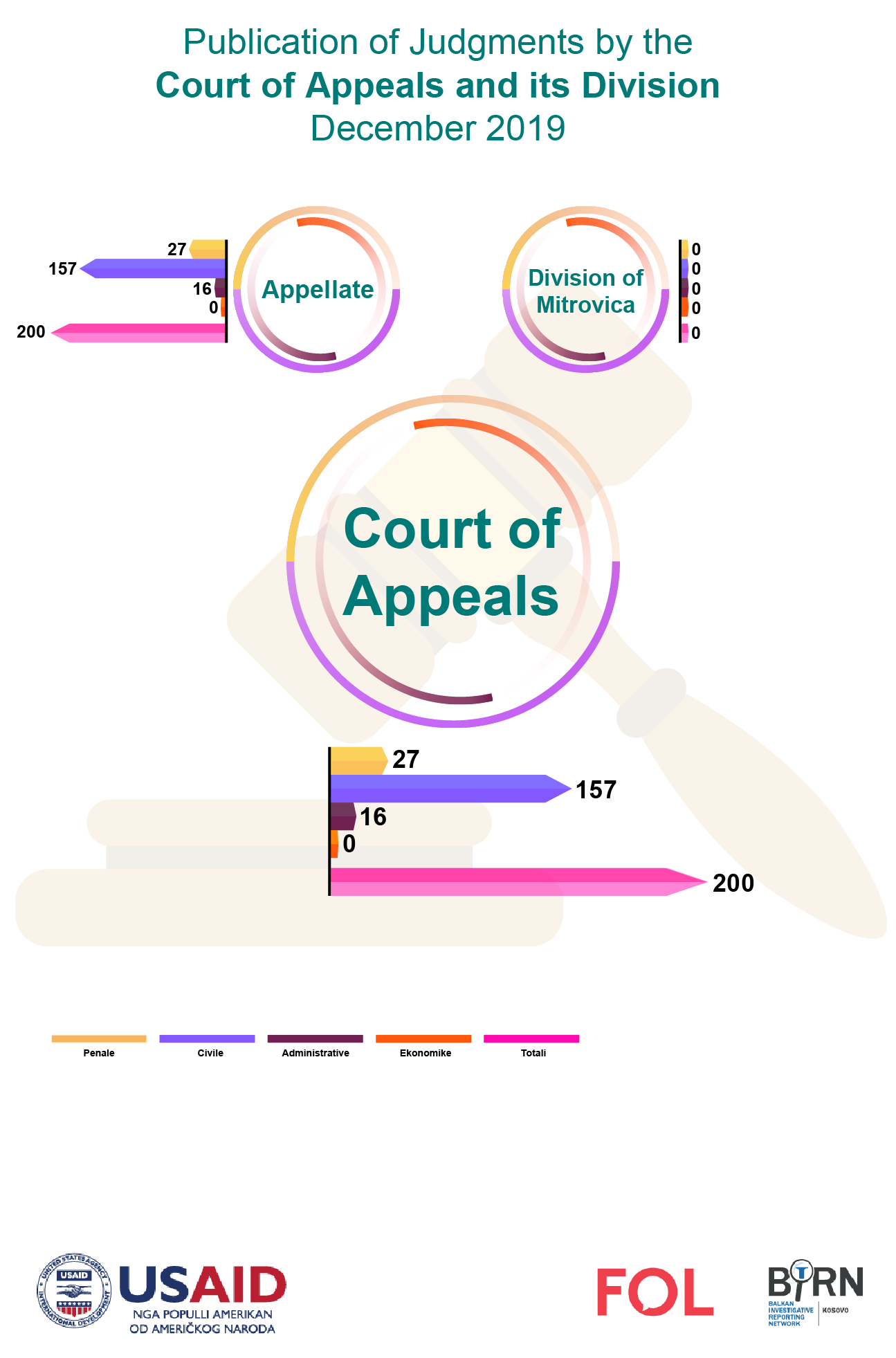
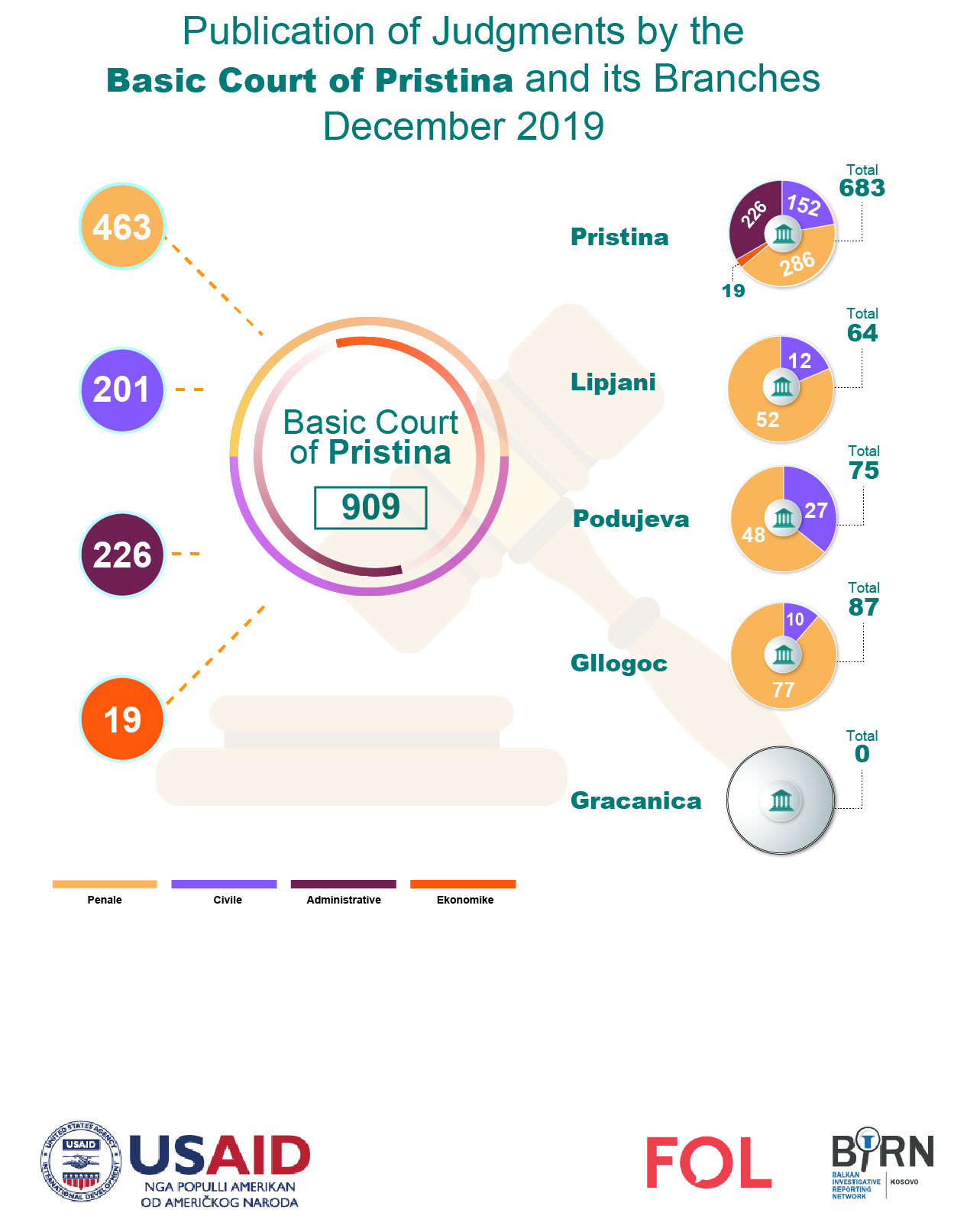
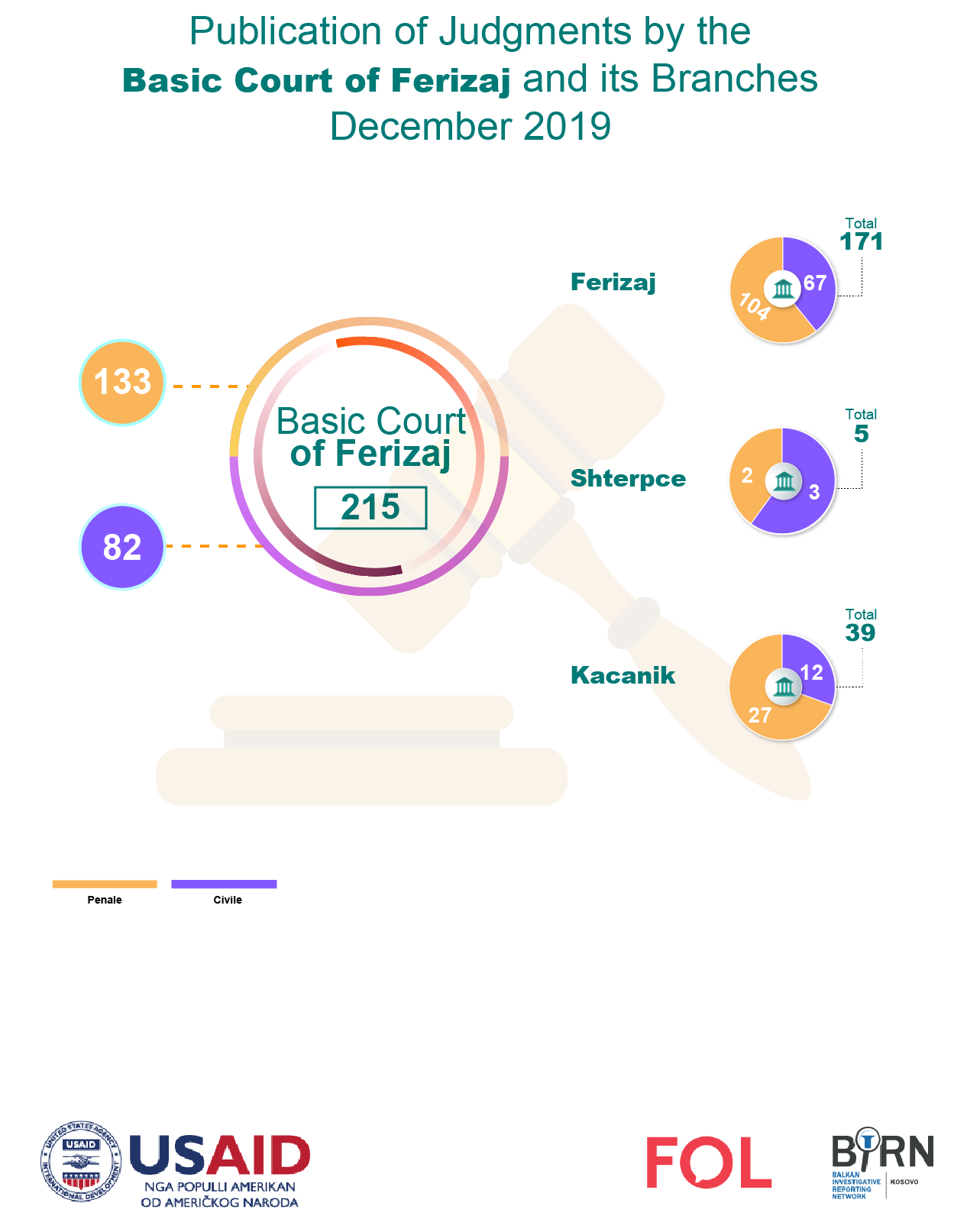
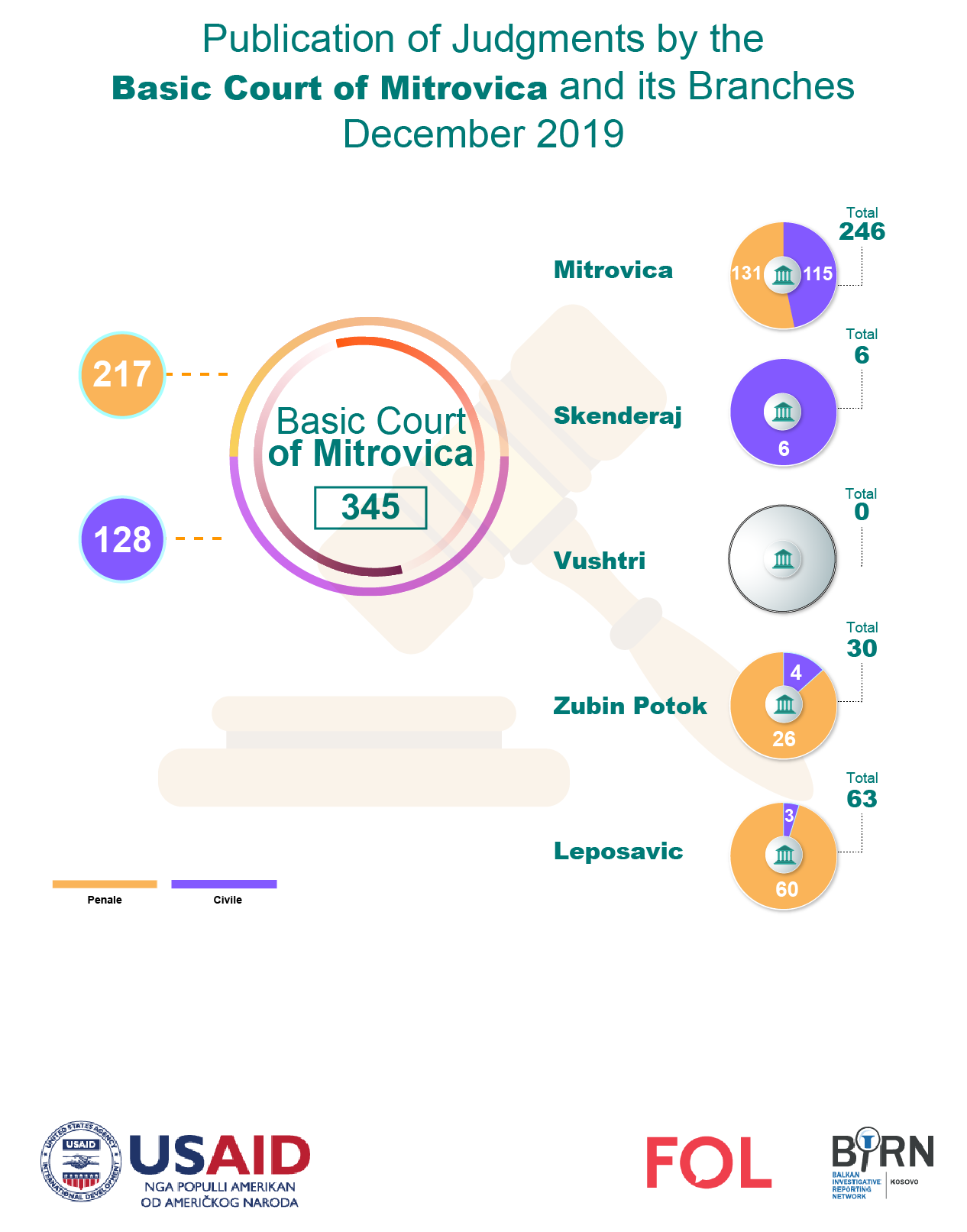
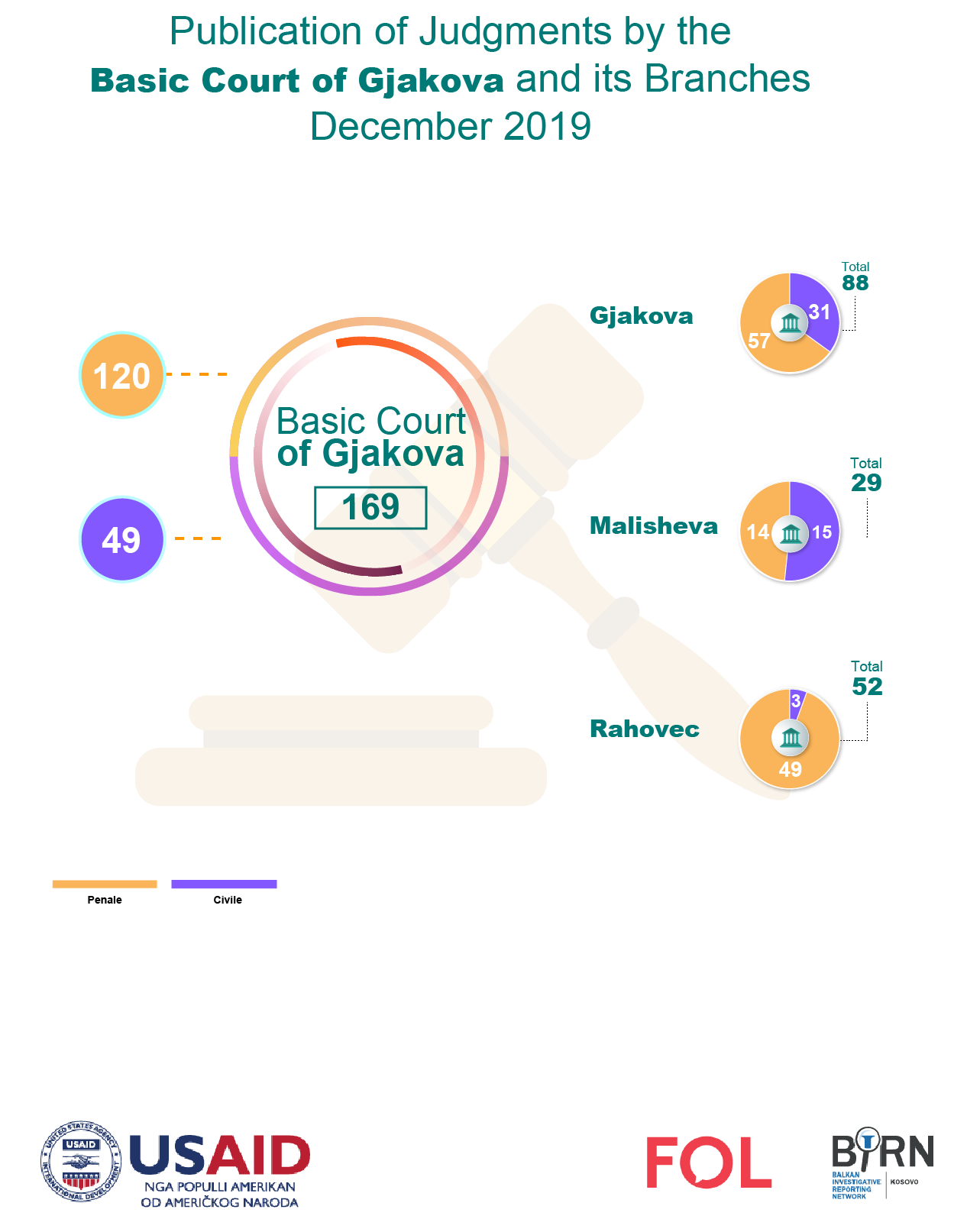
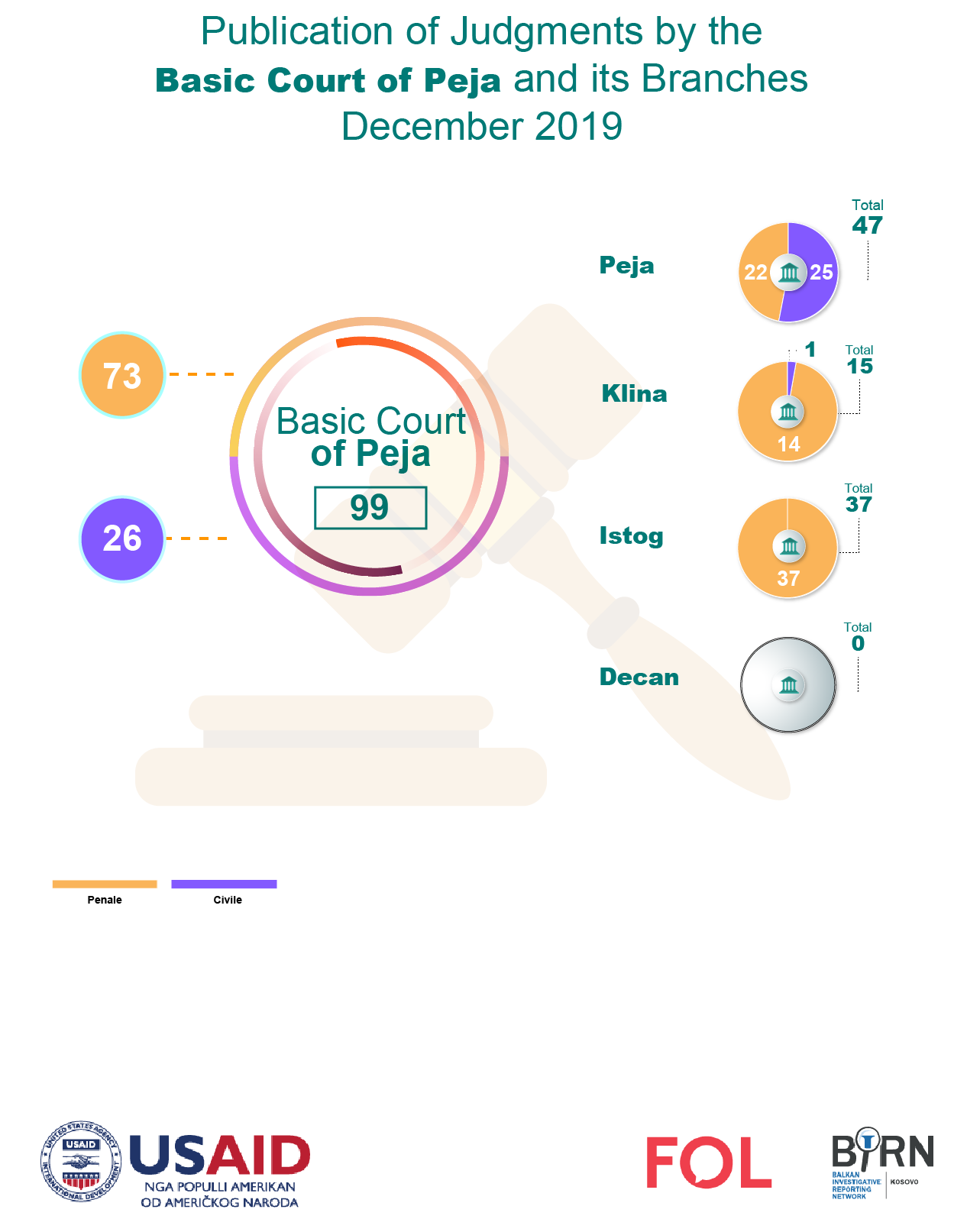
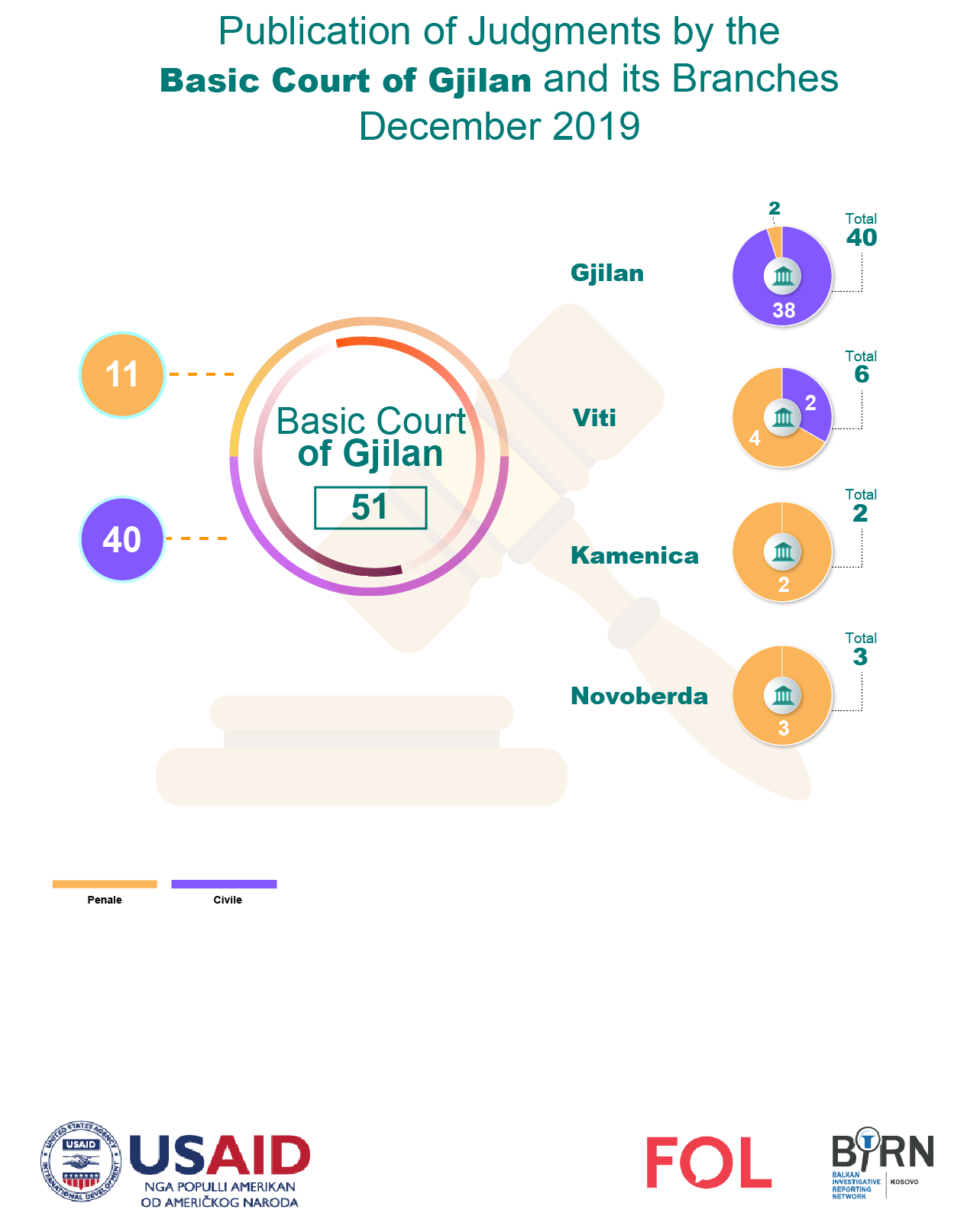
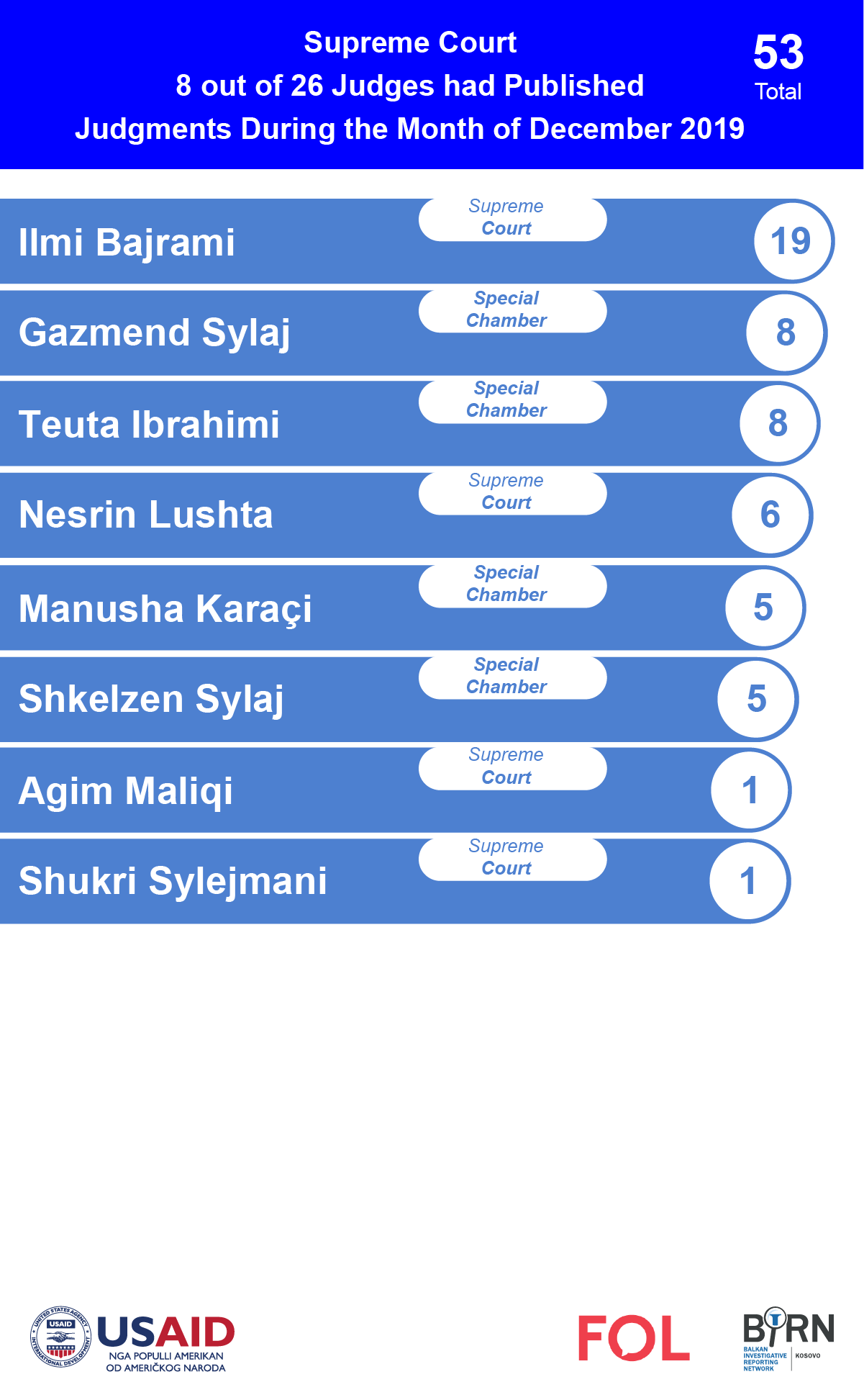
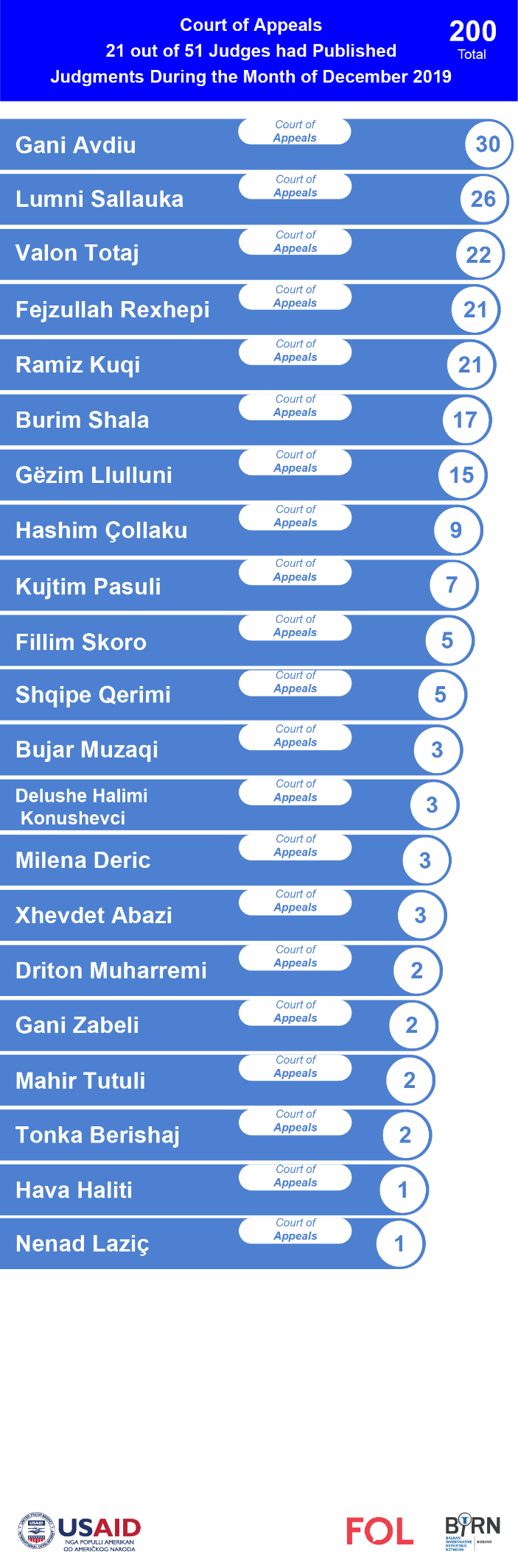
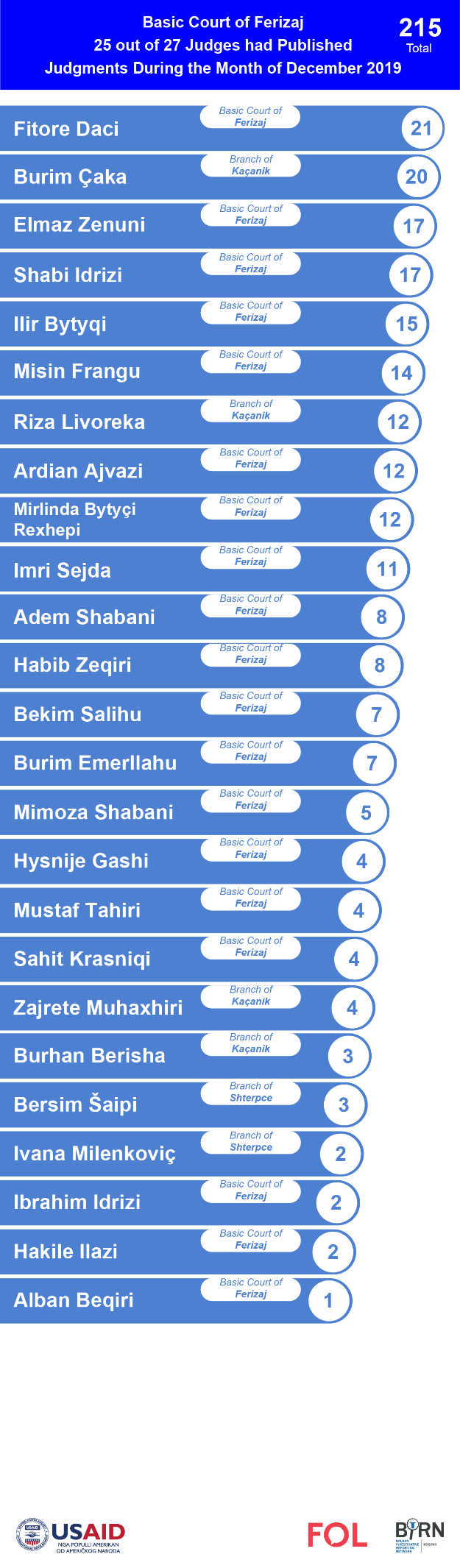
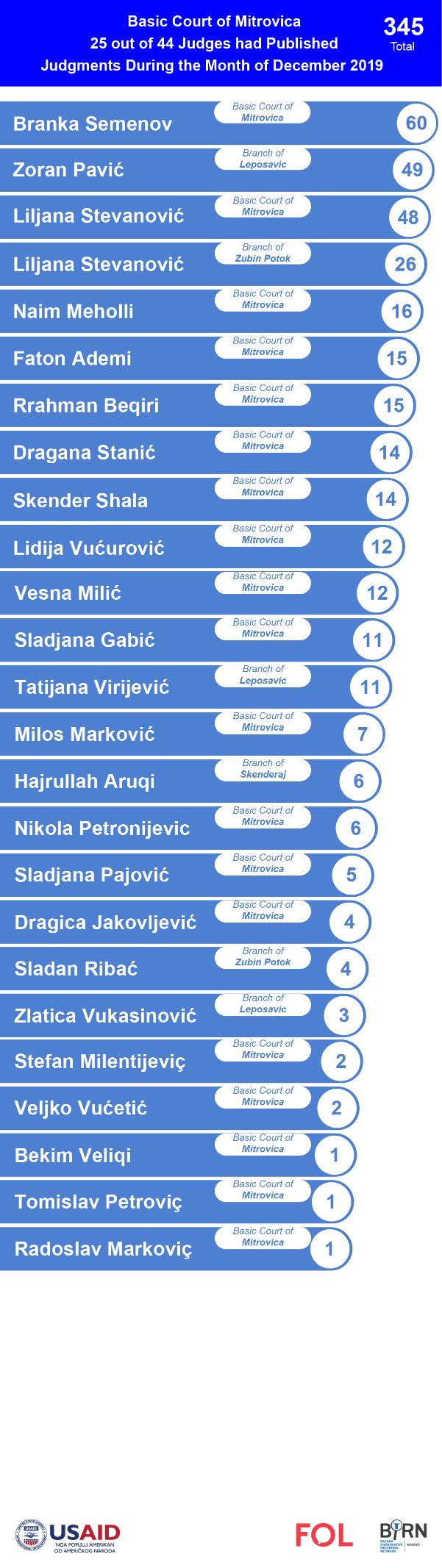
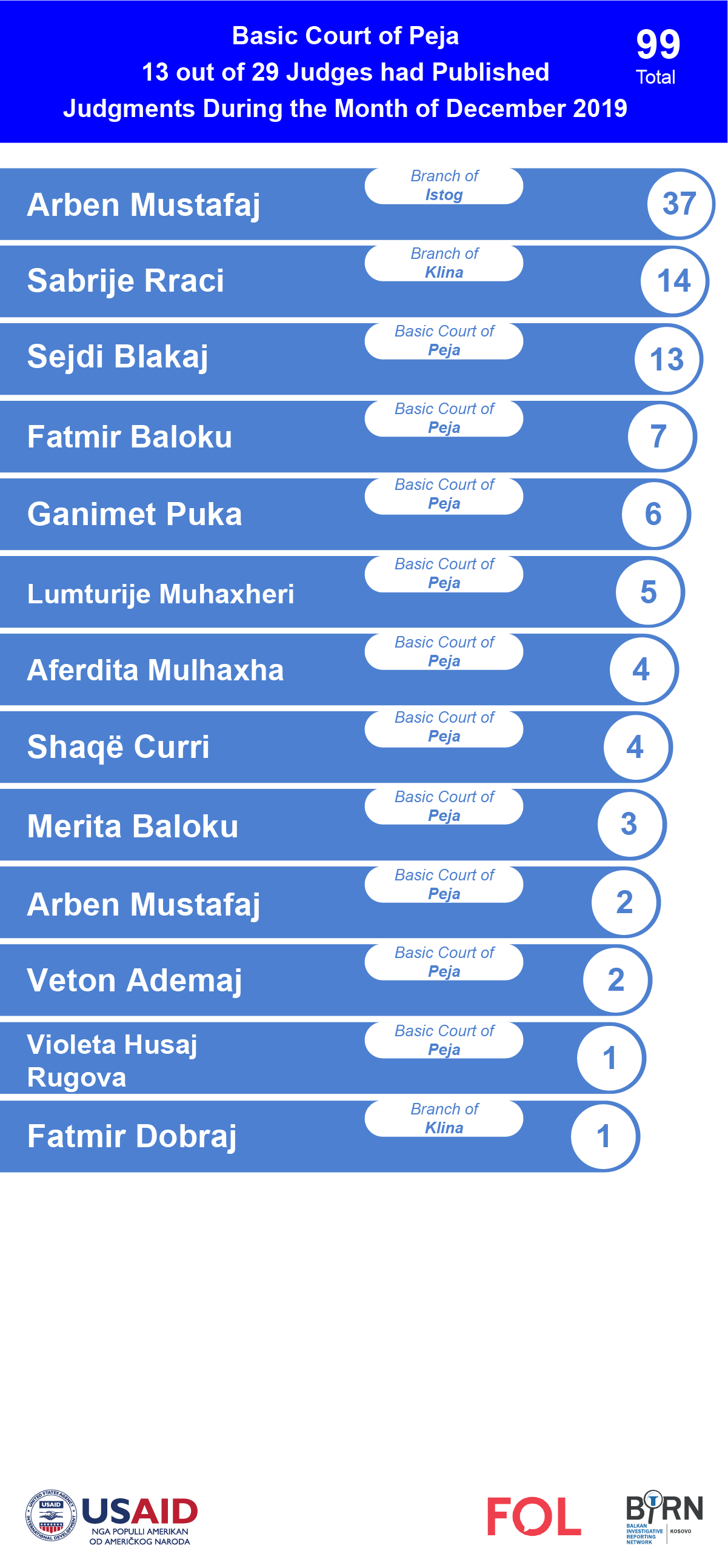
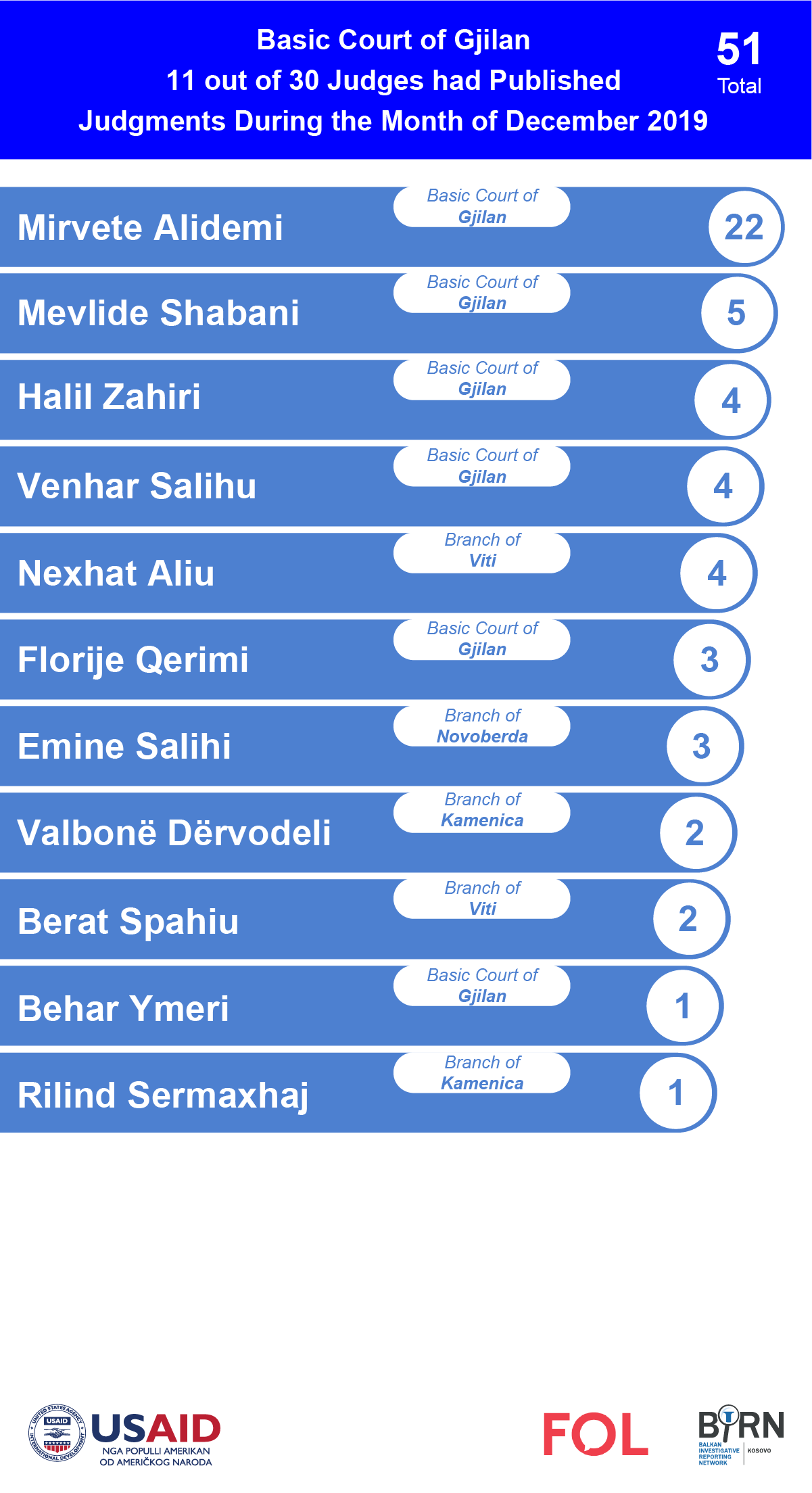
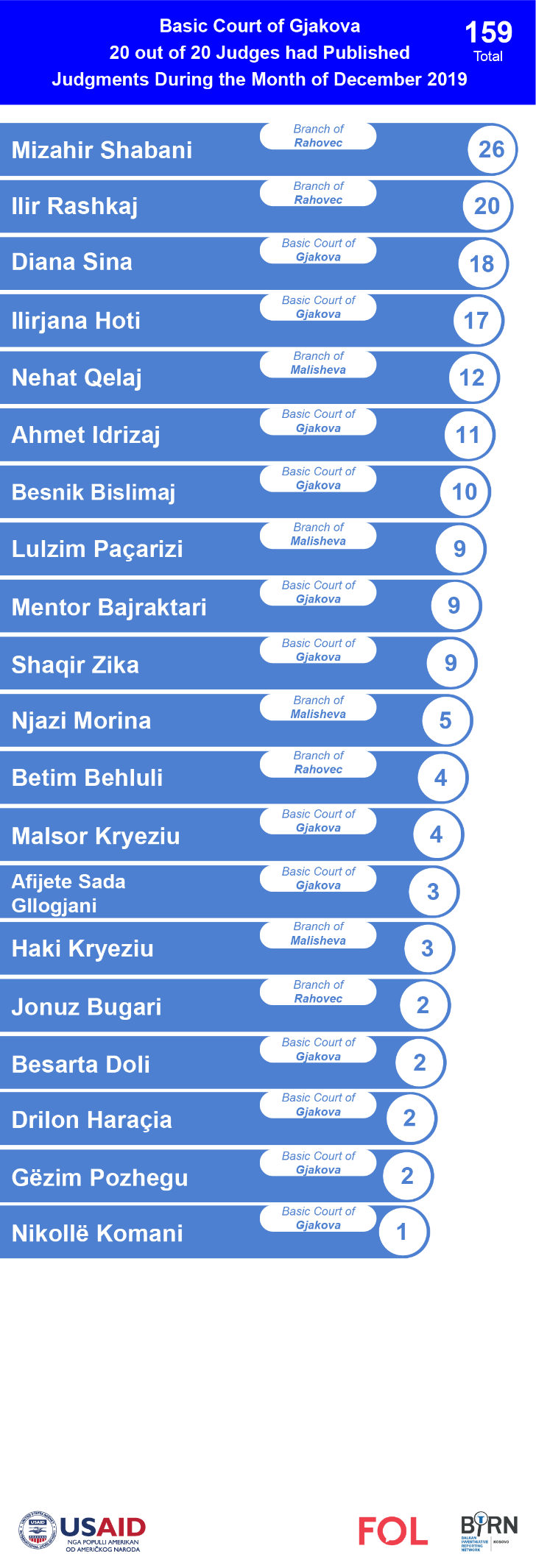
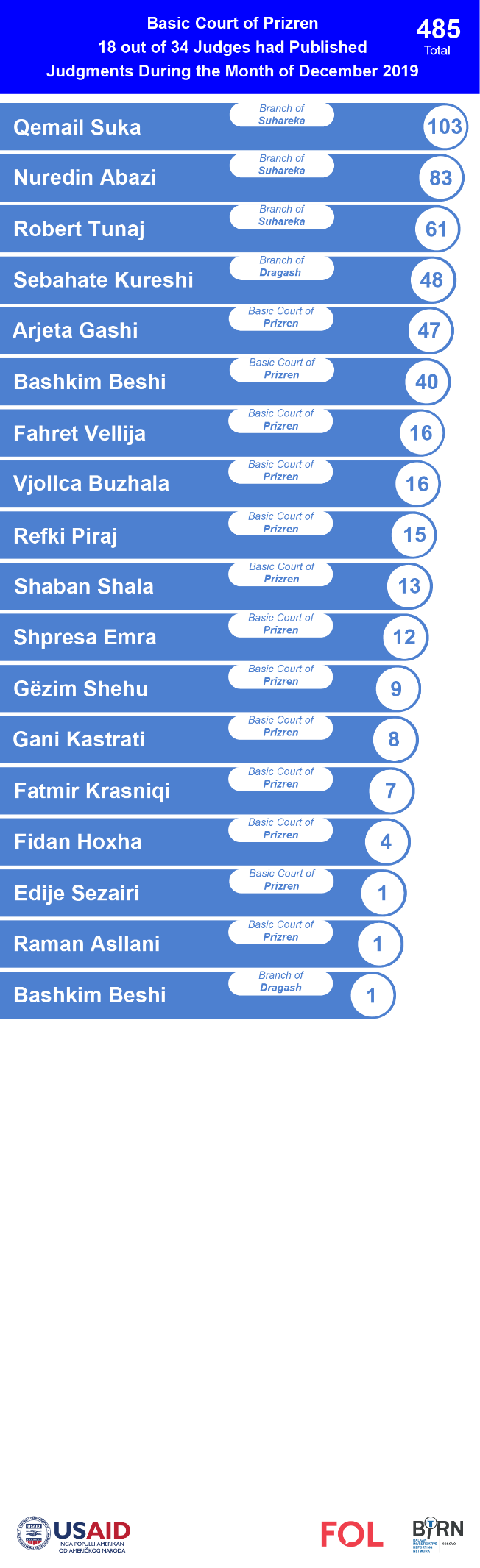
Pristina, January 17th, 2020 – Since 2016 (when courts started publishing judgments) courts published the highest number of judgments per month during December 2019 with a total of 2,526 judgments. This is a significant increase and shows that the monitoring of courts by BIRN and FOL supported by the USAID Justice System Strengthening Program is having a positive impact.


Clarification: The publication of judgments during the period of December 1 to December 31, 2019 was monitored for all Kosovo’s courts focusing on criminal, civil, commercial, and administrative departments. Additionally, this monitoring covered the publication of judgments according to judges from all courts (including their branches) for the abovementioned departments. The President of the Supreme Court; President of the Court of Appeals; Presidents of the Basic Courts; and the Judges from the Division for Minor Offences are not included in this monitoring.

During the monitoring of judgments published in the Kosovo Judicial Council’s website, for the above-mentioned period, it has been noted that there is a total of 2,550 judgments published, or 24 more than BIRN and FOL have in their database. This difference in is due to publication of decisions.

Additionally, during the month of December, it has been noticed that courts have published judgments made by judges who have been promoted to more senior positions, have been transferred to Minor Offence Division, or have retired. These shortcomings were noted during a detailed verification by BIRN and FOL.

*Disclaimer: This monitoring was made possible by the support of the American People through the United States Agency for International Development (USAID). The content of this article is the sole responsibility of FOL Movement and BIRN Kosova and does not necessarily reflect the views of the United States Agency for International Development or the United States Government.


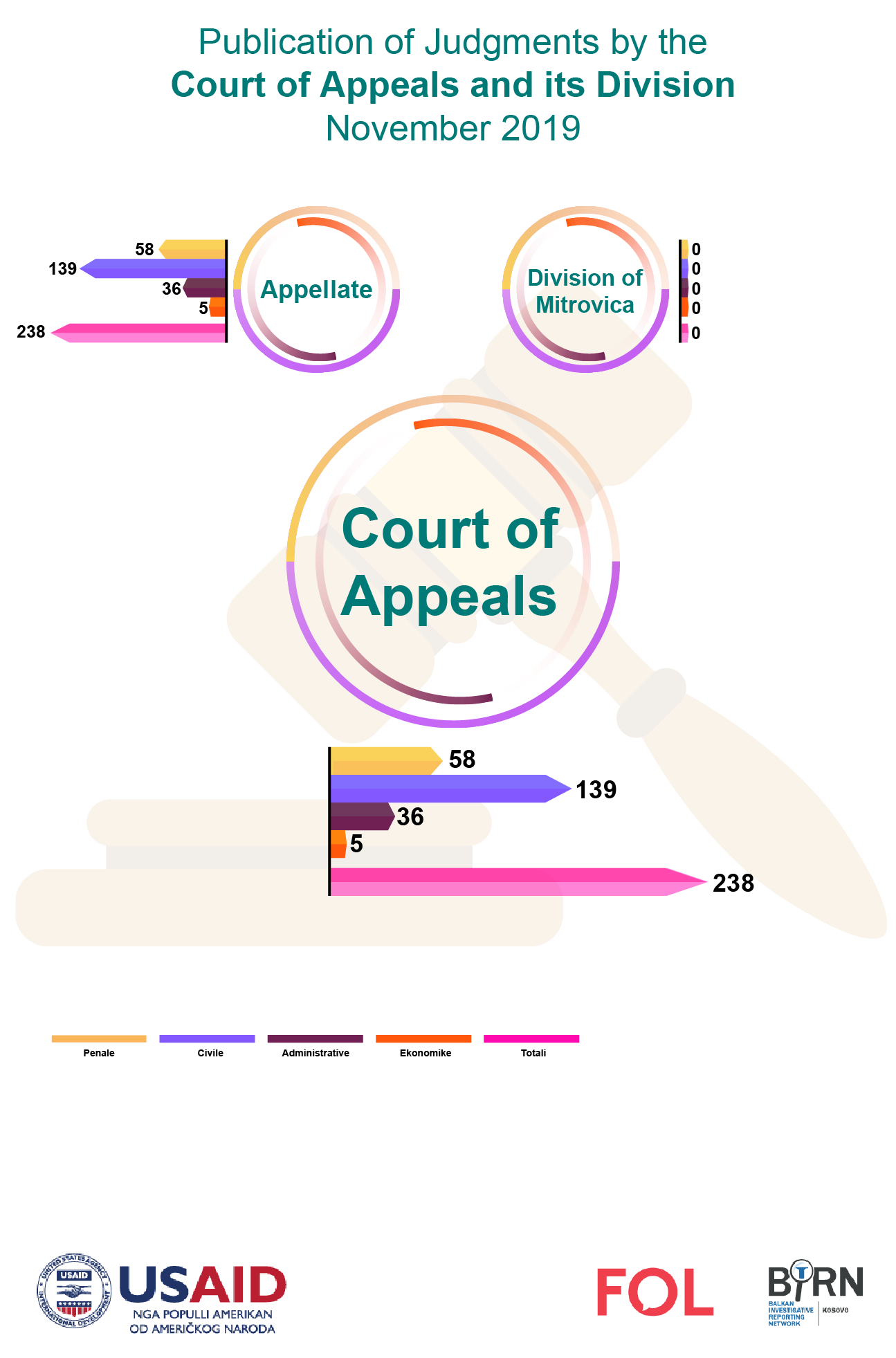
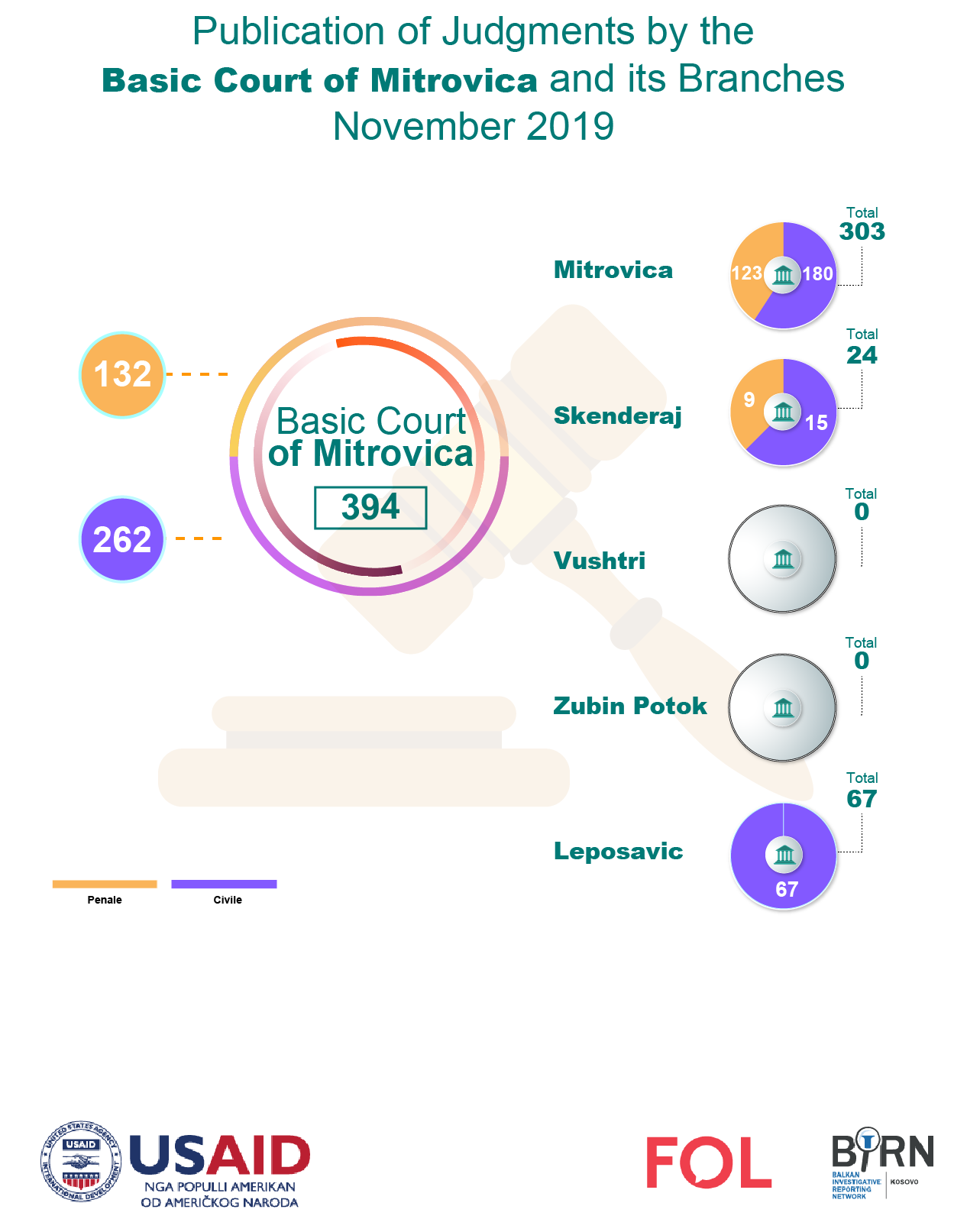
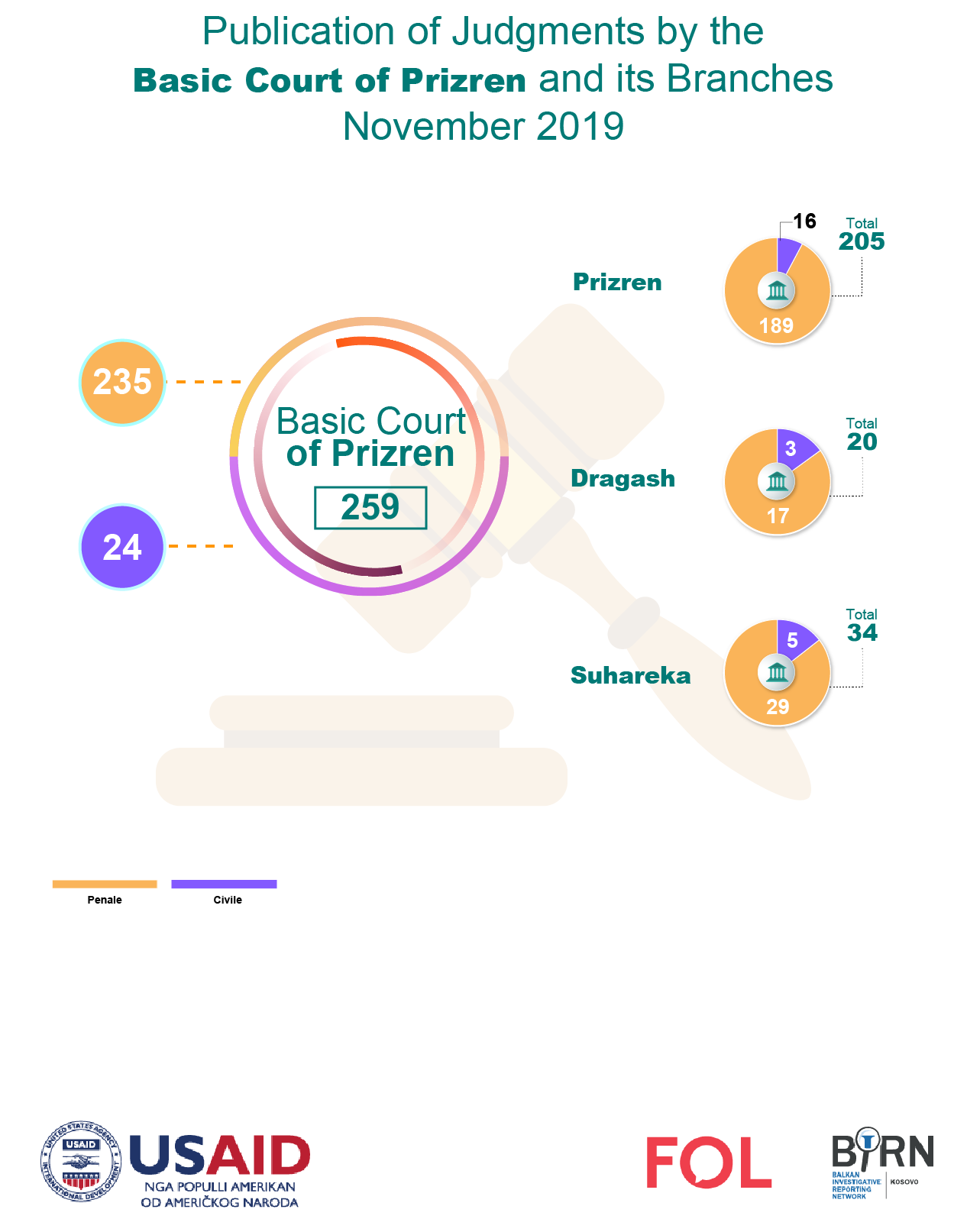
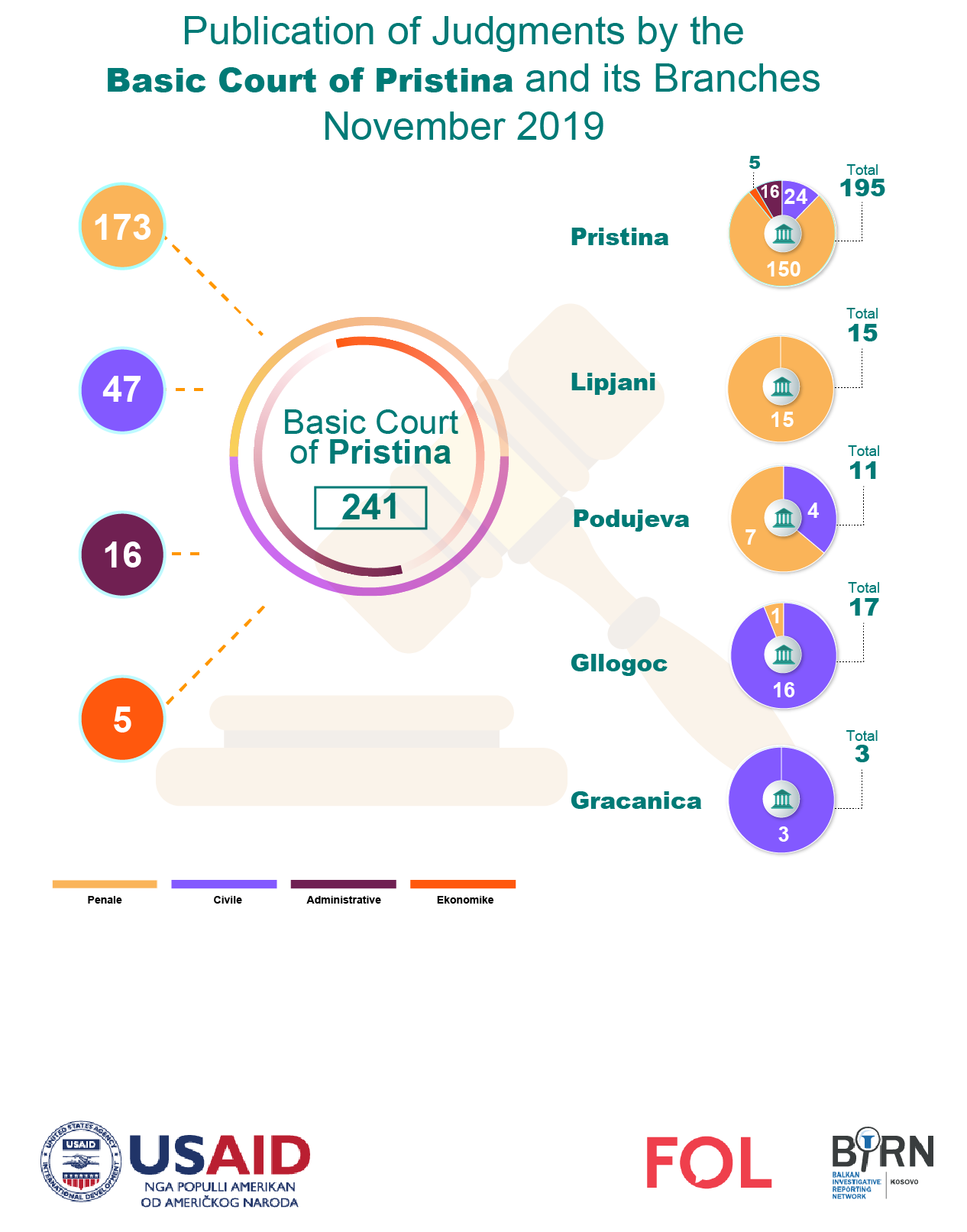
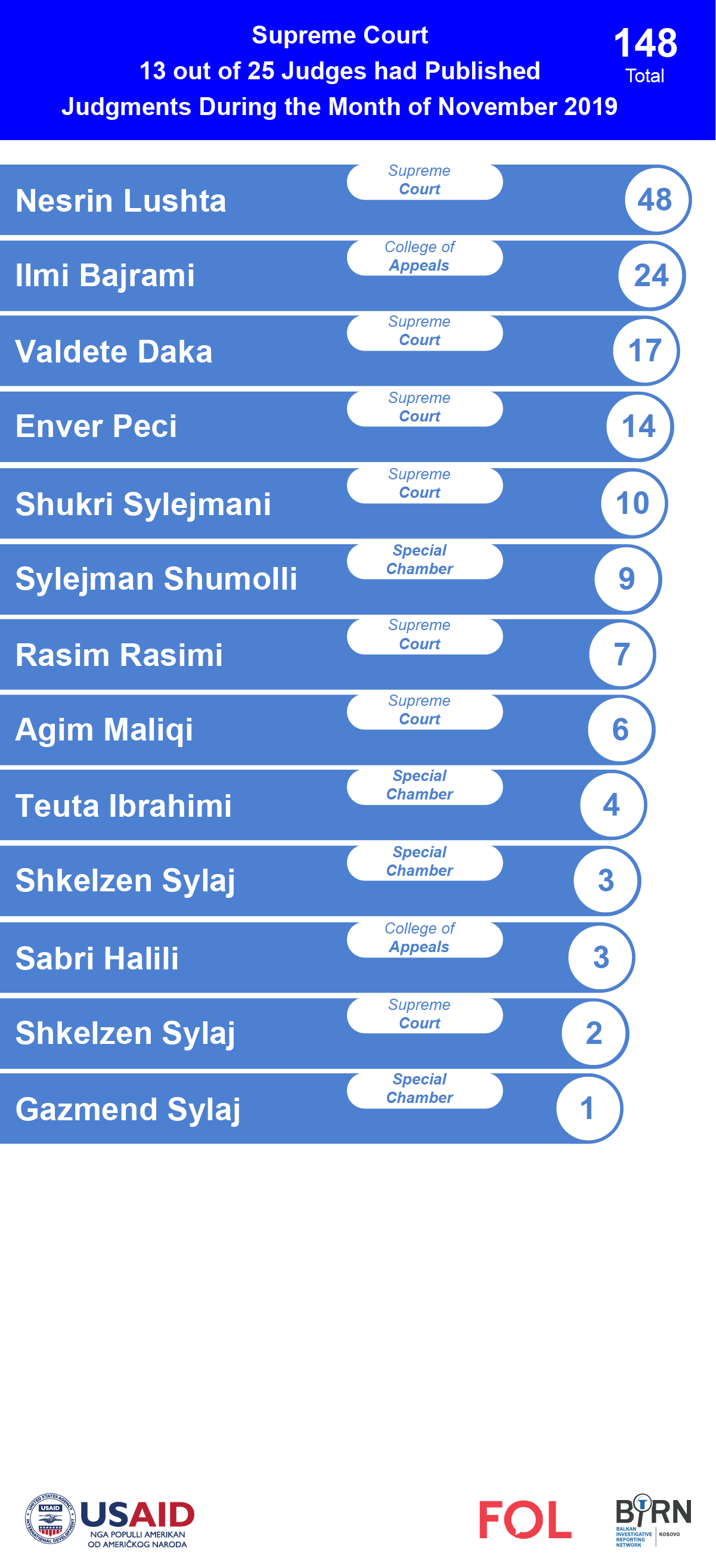
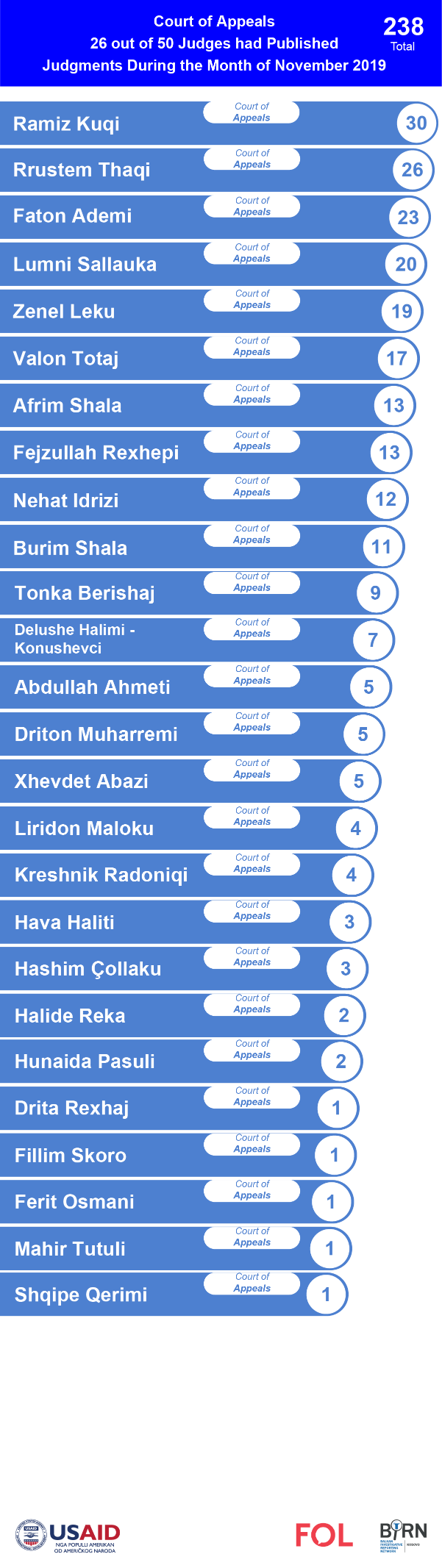
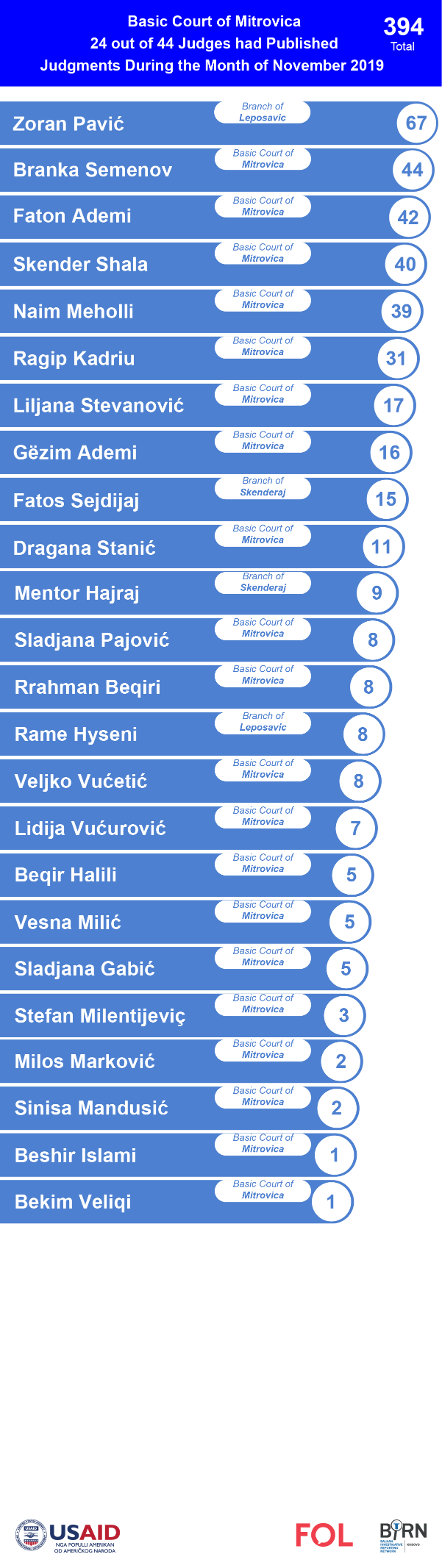
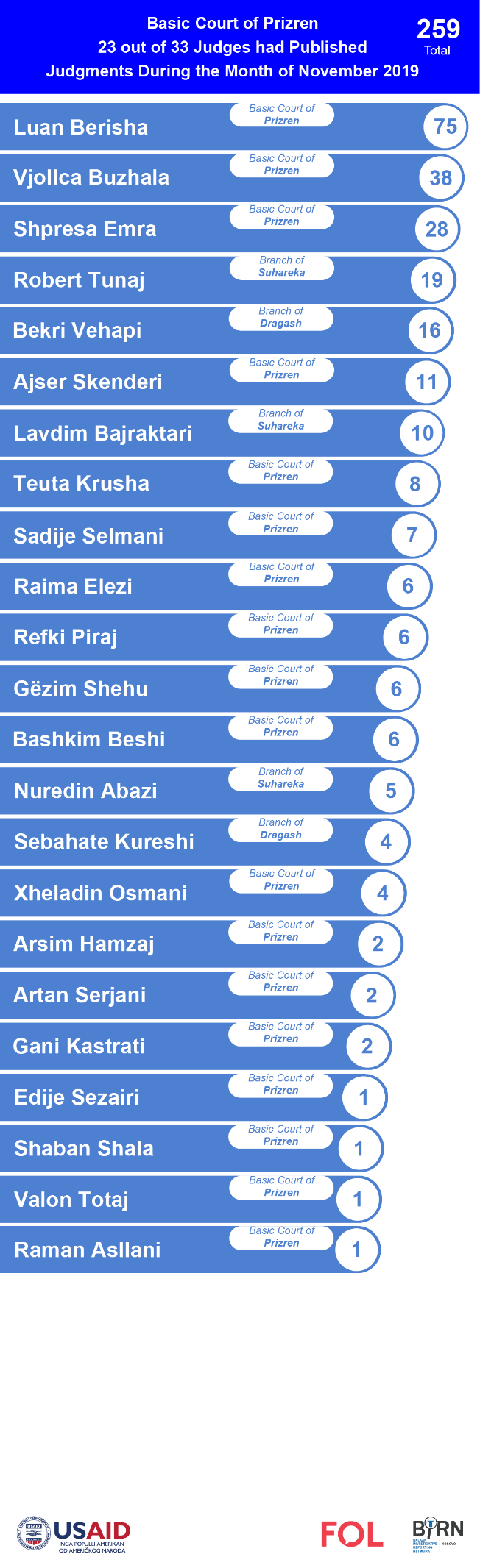
The number of verdicts published in November increased

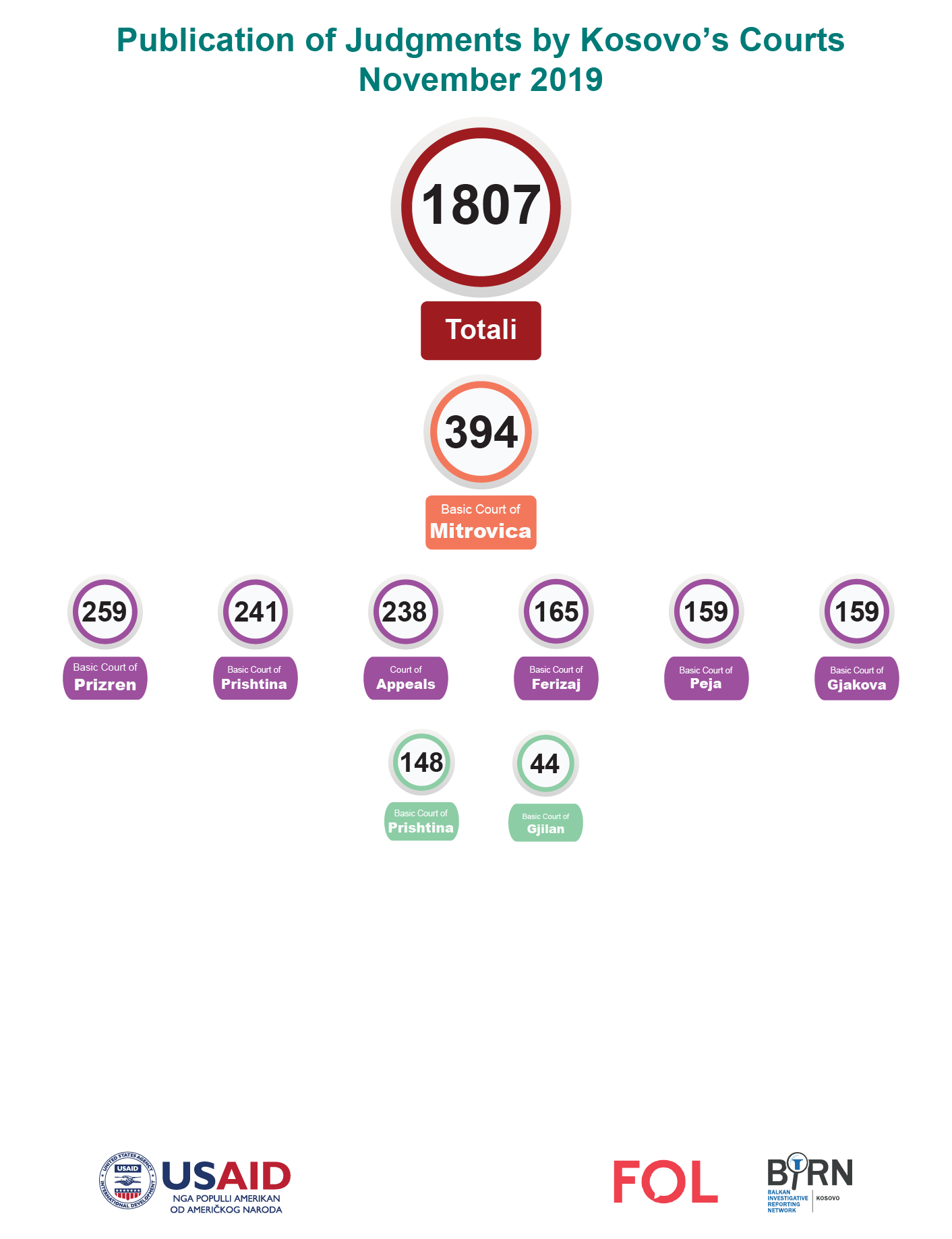
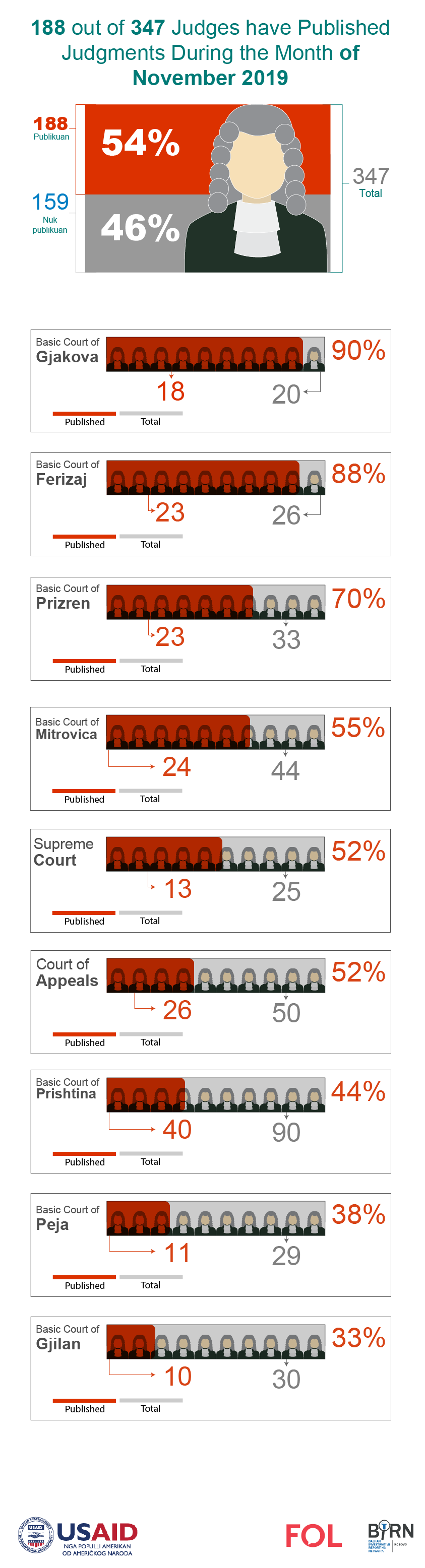
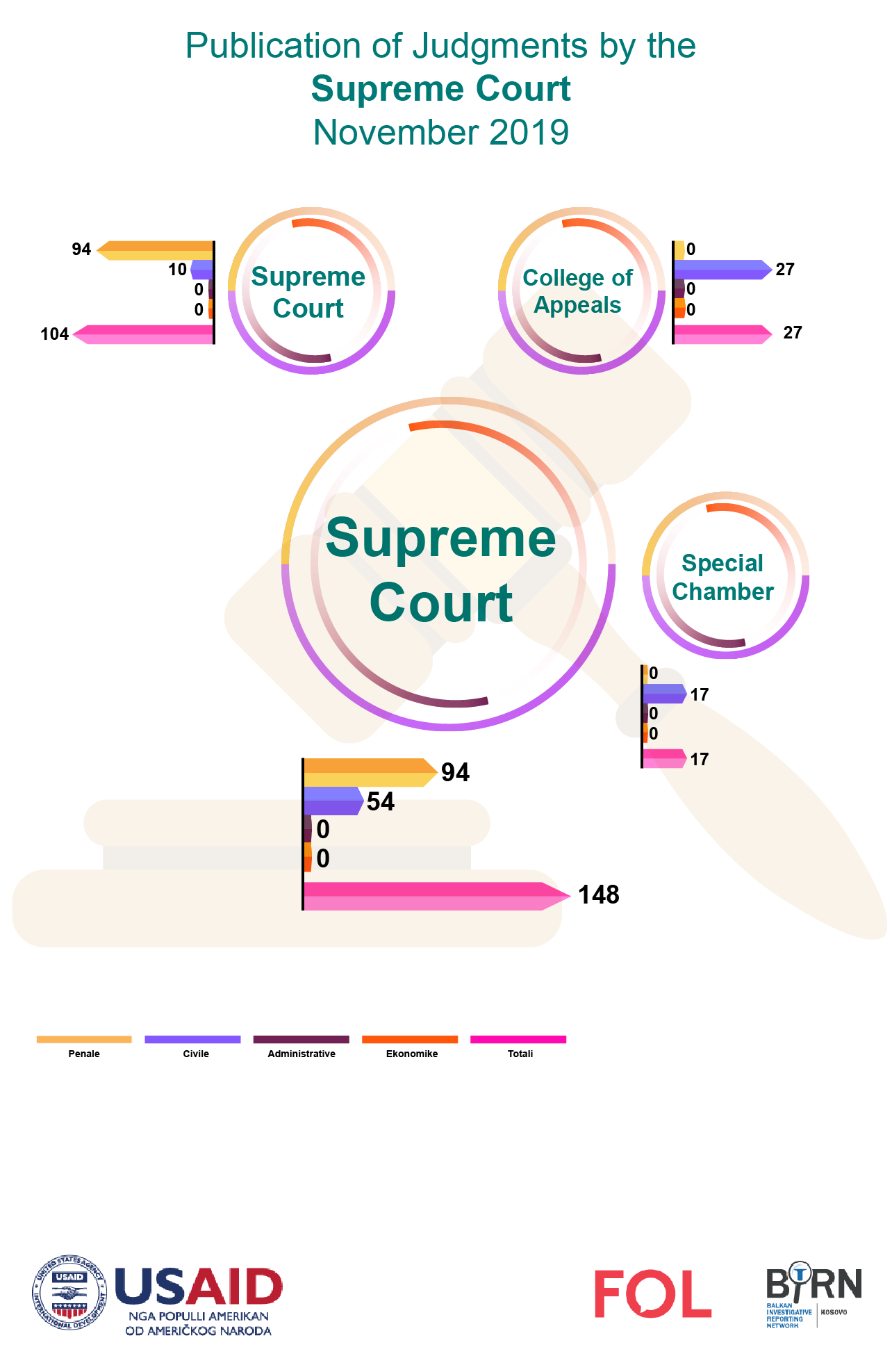
Pristina, December 23, 2019 – FOL Movement and BIRN Kosovo today present data from monitoring the publication of judgments in all Kosovo Courts. Through the following infographics you can see the publication of all judgments by all Kosovo courts for October 2019.

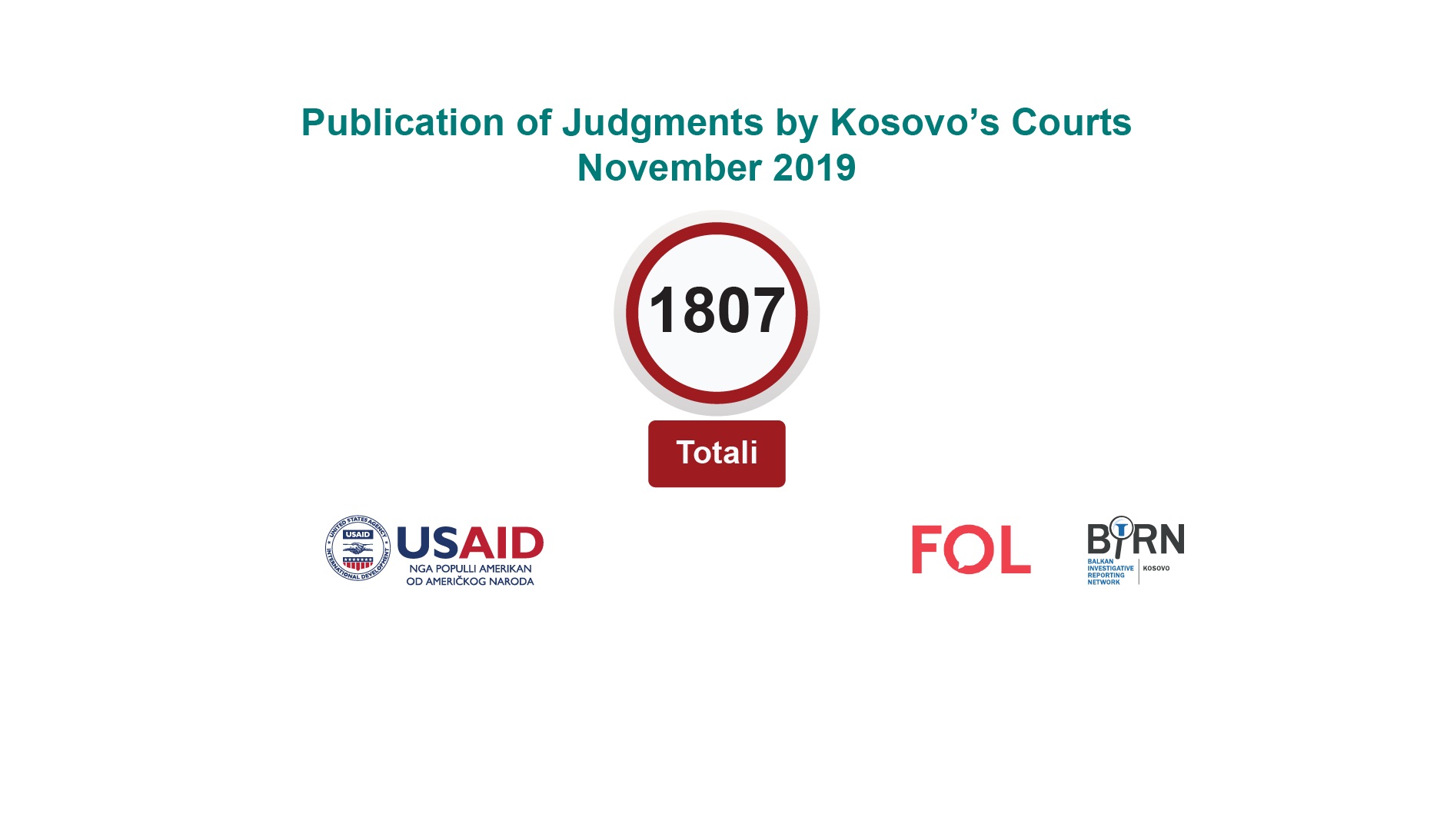
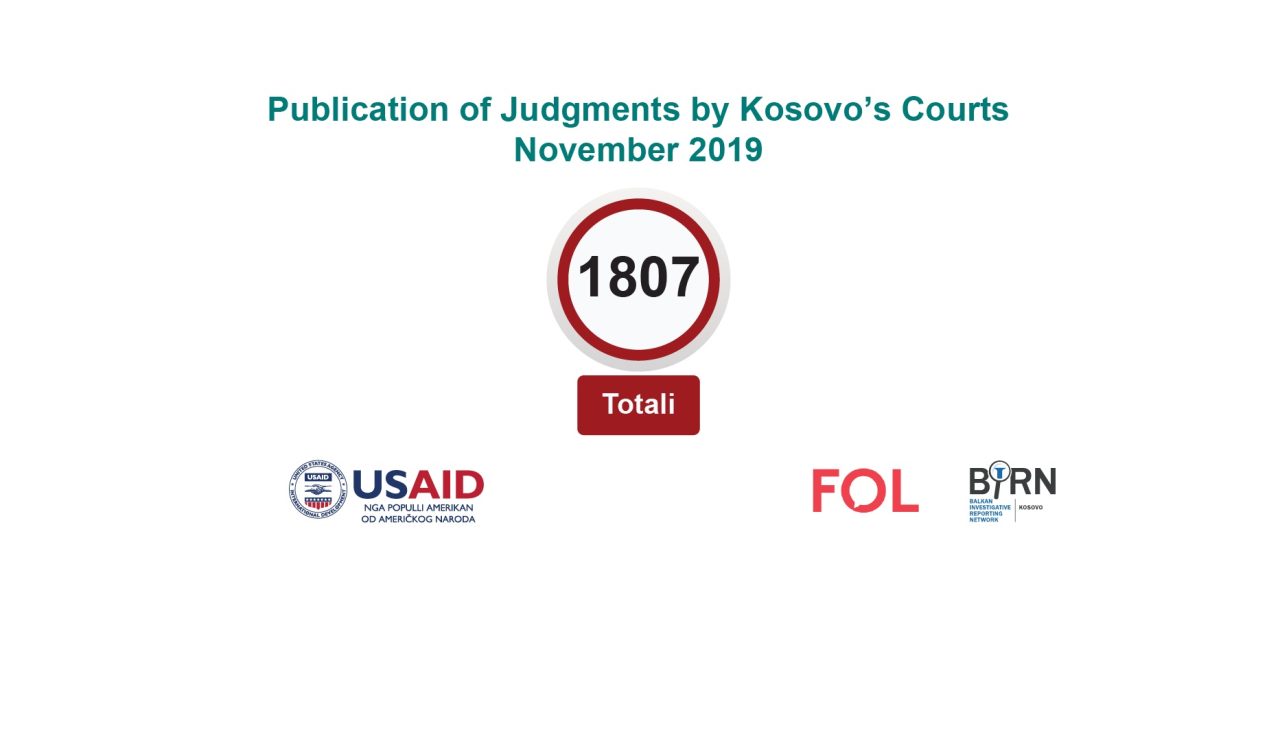
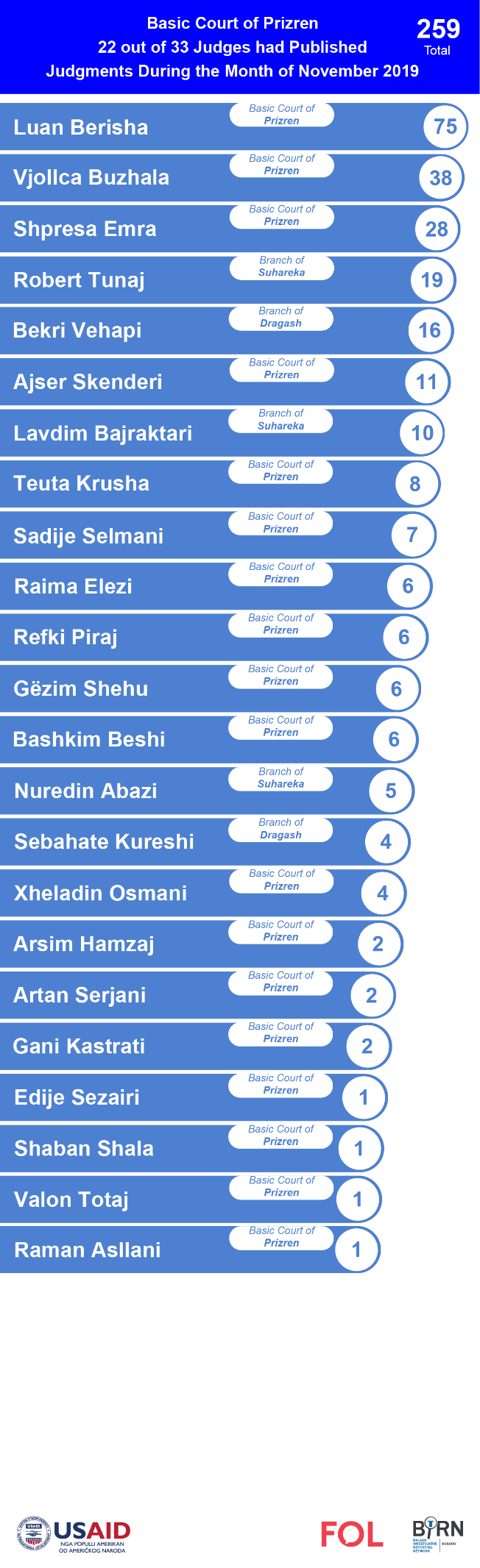
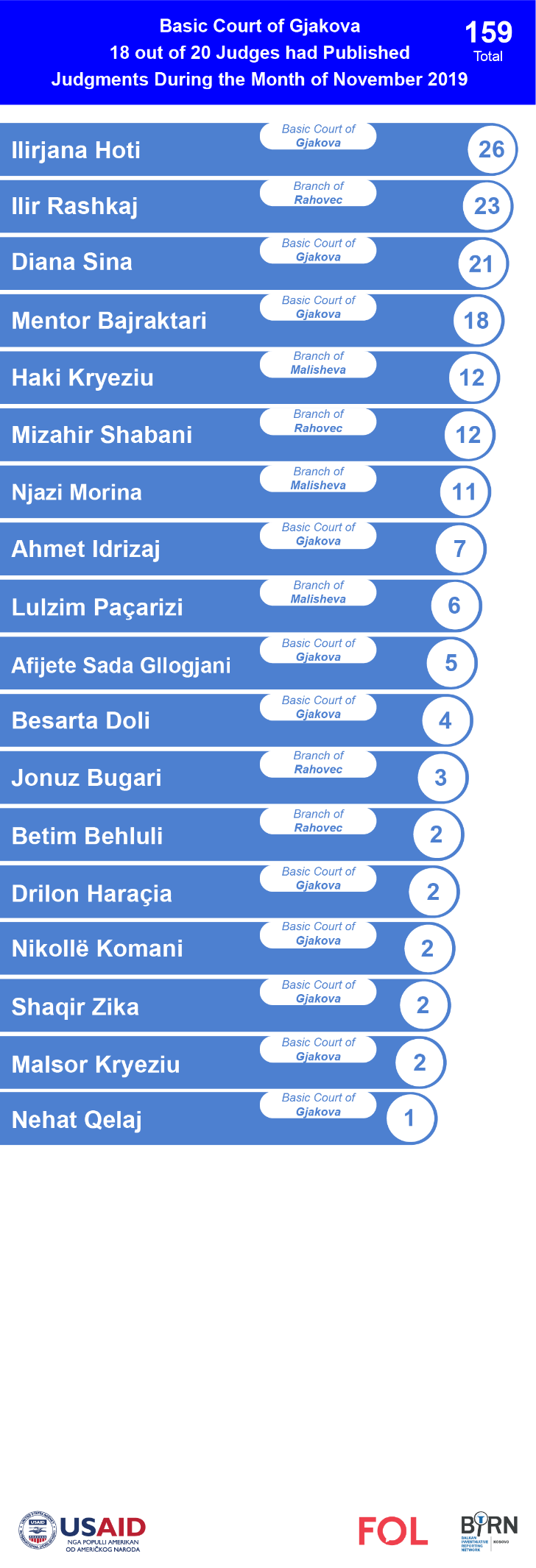
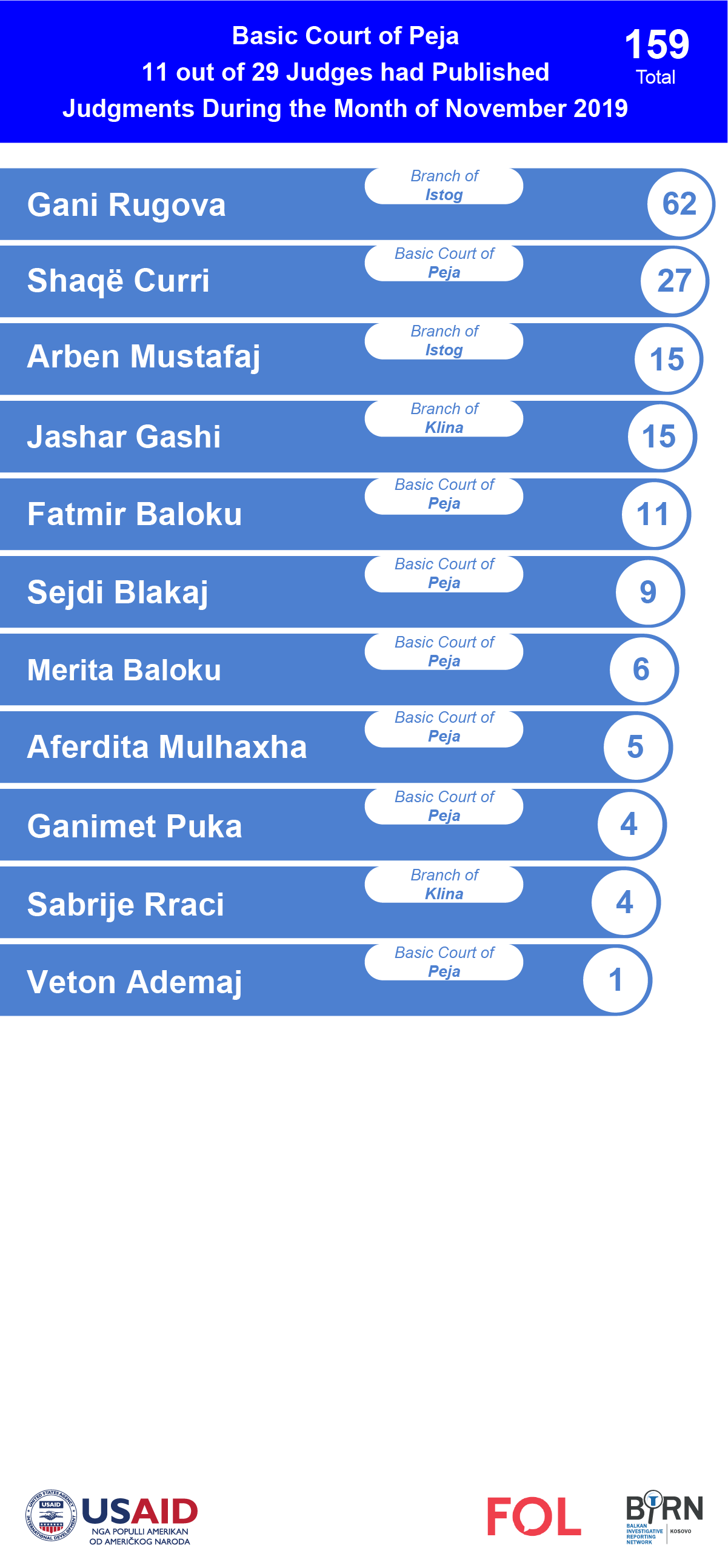
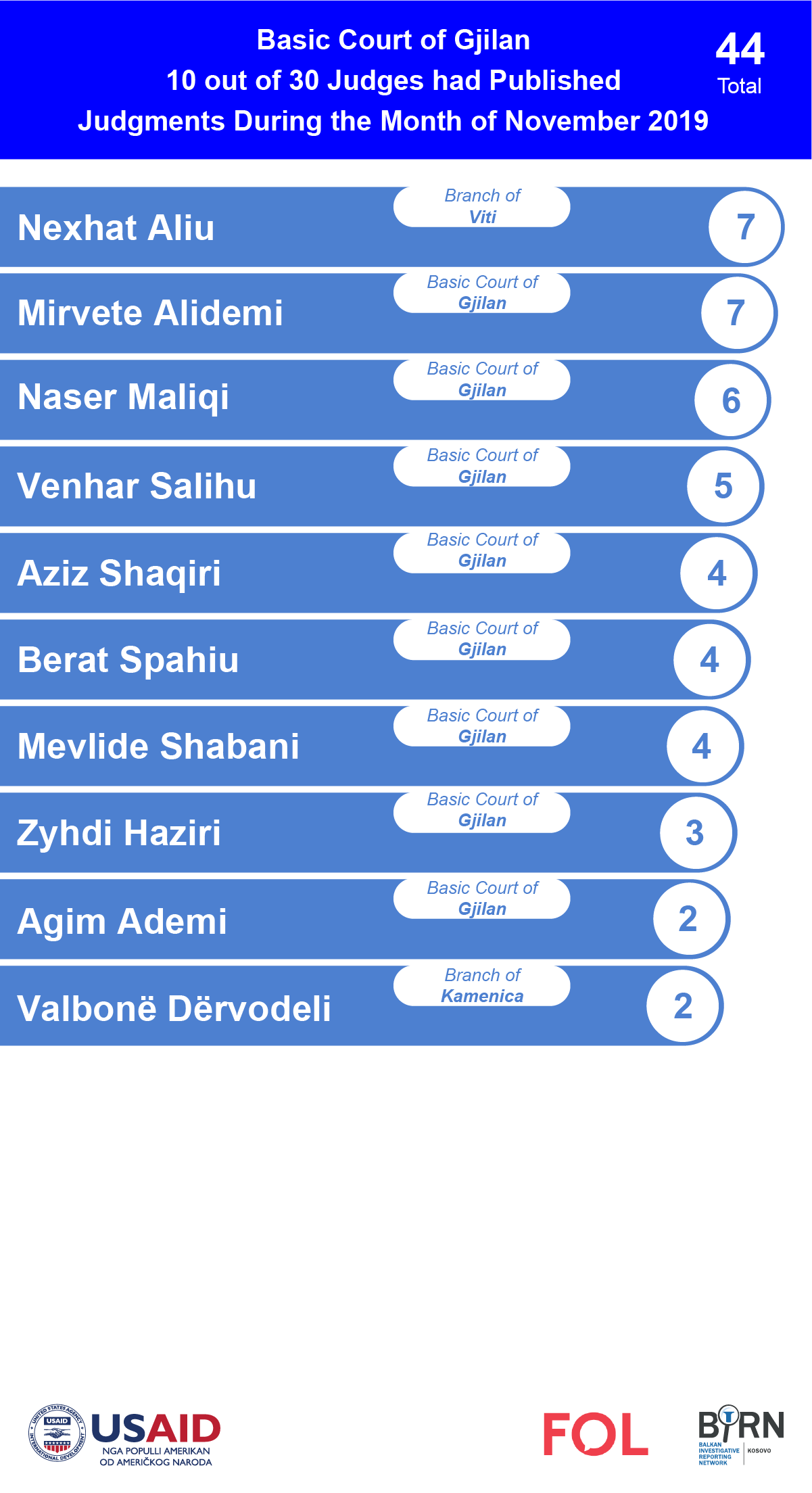
Publication of Judgments by All Courts of Kosovo – November 2019.


Clarification: The publication of judgments during the period of Novemver 1 to November 30, 2019 was monitored for all Kosovo’s courts focusing on criminal, civil, commercial, and administrative departments. Additionally, this monitoring covered the publication of judgments according to judges from all courts (including their branches) for the abovementioned departments. The President of the Supreme Court; President of the Court of Appeals; Presidents of the Basic Courts; and the Judges from the Division for Minor Offences are not included in this monitoring.

During the monitoring of judgments published in the Kosovo Judicial Council’s website, for the above-mentioned period, it has been noted that there is a total of 1835 judgments published, or 28 more than BIRN and FOL have in their database. This difference in is due to publication of decisions.

Additionally, during the month of November, it has been noticed that courts have published judgments made by judges who have been promoted to more senior positions, have been transferred to Minor Offence Division, or have retired. These shortcomings were noted during a detailed verification by BIRN and FOL.

*Disclaimer: This monitoring was made possible by the support of the American People through the United States Agency for International Development (USAID). The content of this article is the sole responsibility of FOL Movement and BIRN Kosova and does not necessarily reflect the views of the United States Agency for International Development or the United States Government.


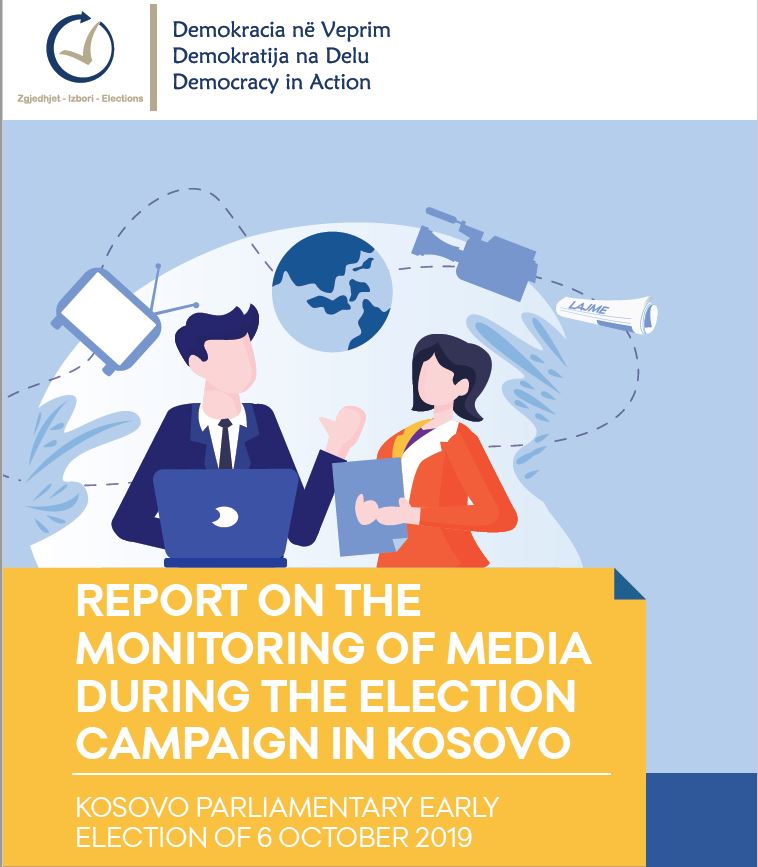
Report on the Monitoring of Media during the Election Campaign in Kosovo 2019

Prishtinë, December 17 2019 – Report on the Monitoring of Media during the Election Campaign in Kosovo. Kosovo Parliamentary Election of 6 October 2019. Raporti i Monitorimit te Mediave gjate fushates zgjedhore ENG


MONITORING OF KOSOVO JUDICIAL COUNCIL

Between May 1 and November 15, 2019, FOL Movement, supported by the USAID Justice System Strengthening Program, has monitored meetings and decisions by the Kosovo Judicial Council (KJC) to assess the level of transparency and compliance with the Law on Kosovo Judicial Council.  Direct monitoring methods have been performed by attending KJC meetings, assessing their
procedures, and observing KJC’s official website – thereby monitoring whether minutes, decisions, and regulations are published after meetings of the Council.

MONITORING THE PUBLICATION OF JUDGMENTS 2019

Prishtinë, 12 dhjetor 2019 – FOL MOVEMENT, with the support of the USAID/JSSP Program and in partnership with BIRN Kosovo, is implementing the “Demanding Transparency in Kosovo’s Judicial System” project. By working in close cooperation with USAID/JSSP, FOL and BIRN aim to improve efficiency, transparency, accountability, and public trust in the judicial system.

The purpose of this monitoring report is to present the current state of publication of judgments, considering basic elements that should be in line with laws, regulations, and administrative instructions. Through this report we also aim to further strengthen the judicial system by promoting courts’ commitment to transparency, accountability, and efficiency of courts in publishing judgments.

Monitoring the Publication of Court Judgments_JSSP_BIRN-FOL_ENG

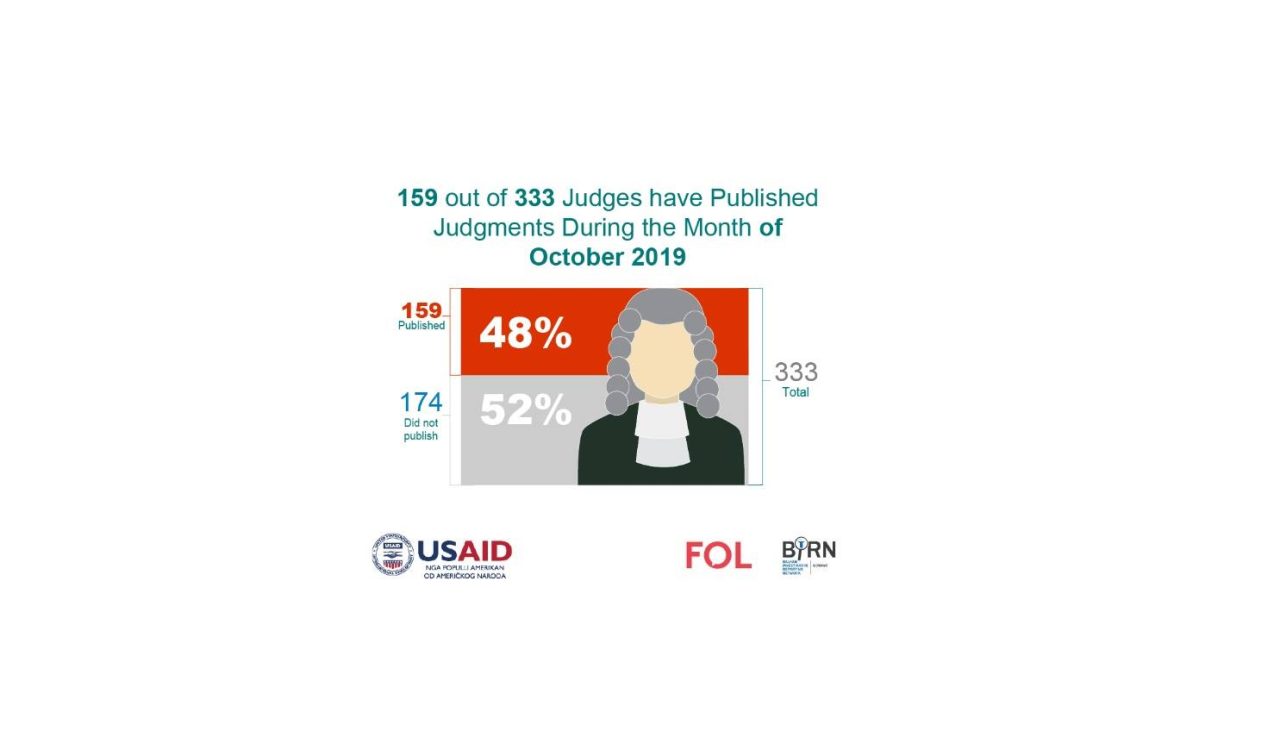
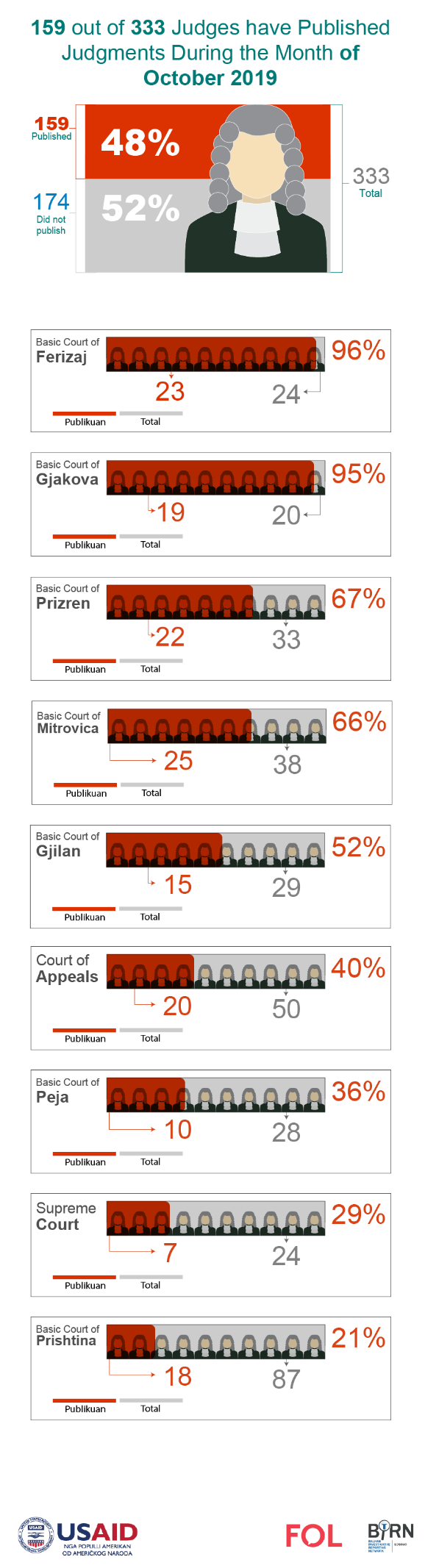
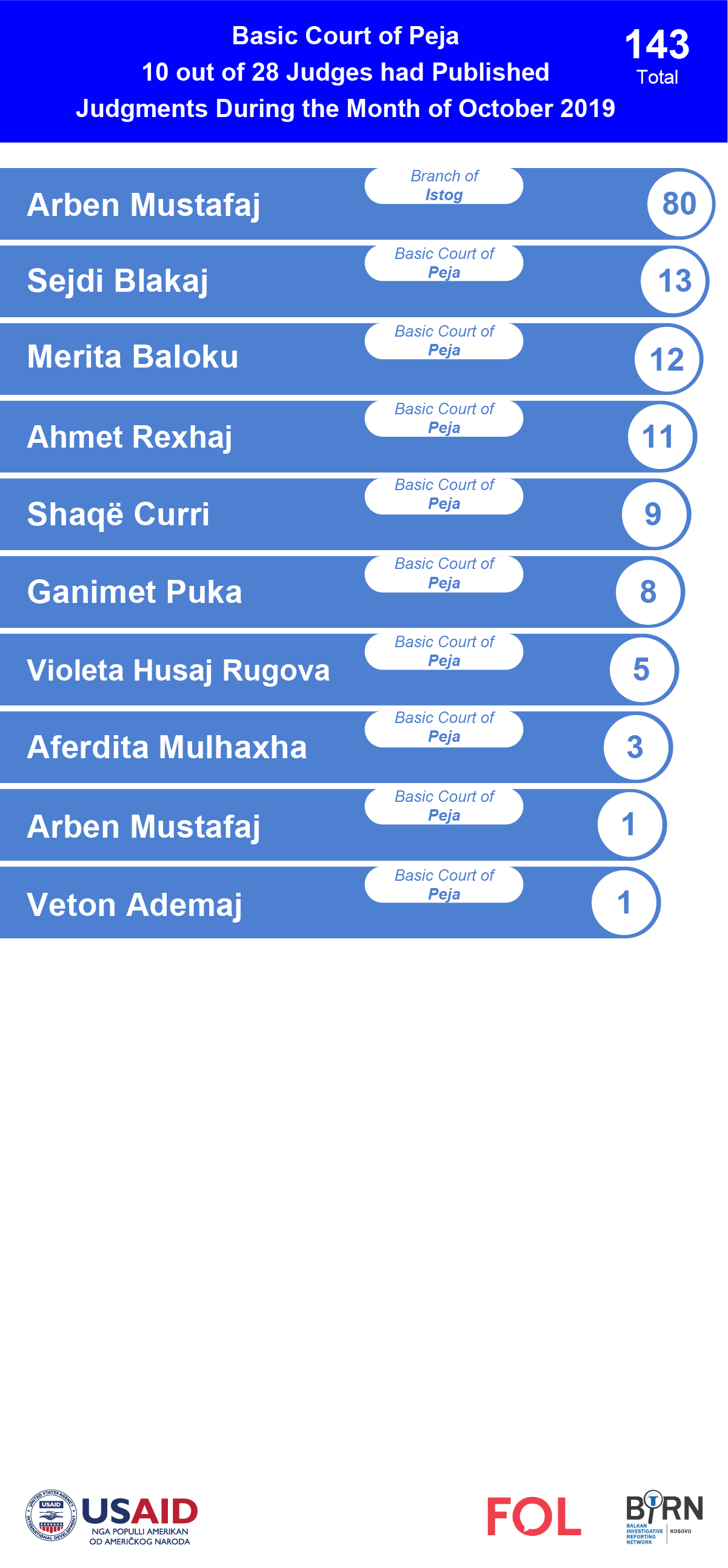
The number of judges who have issued verdicts during October has increased

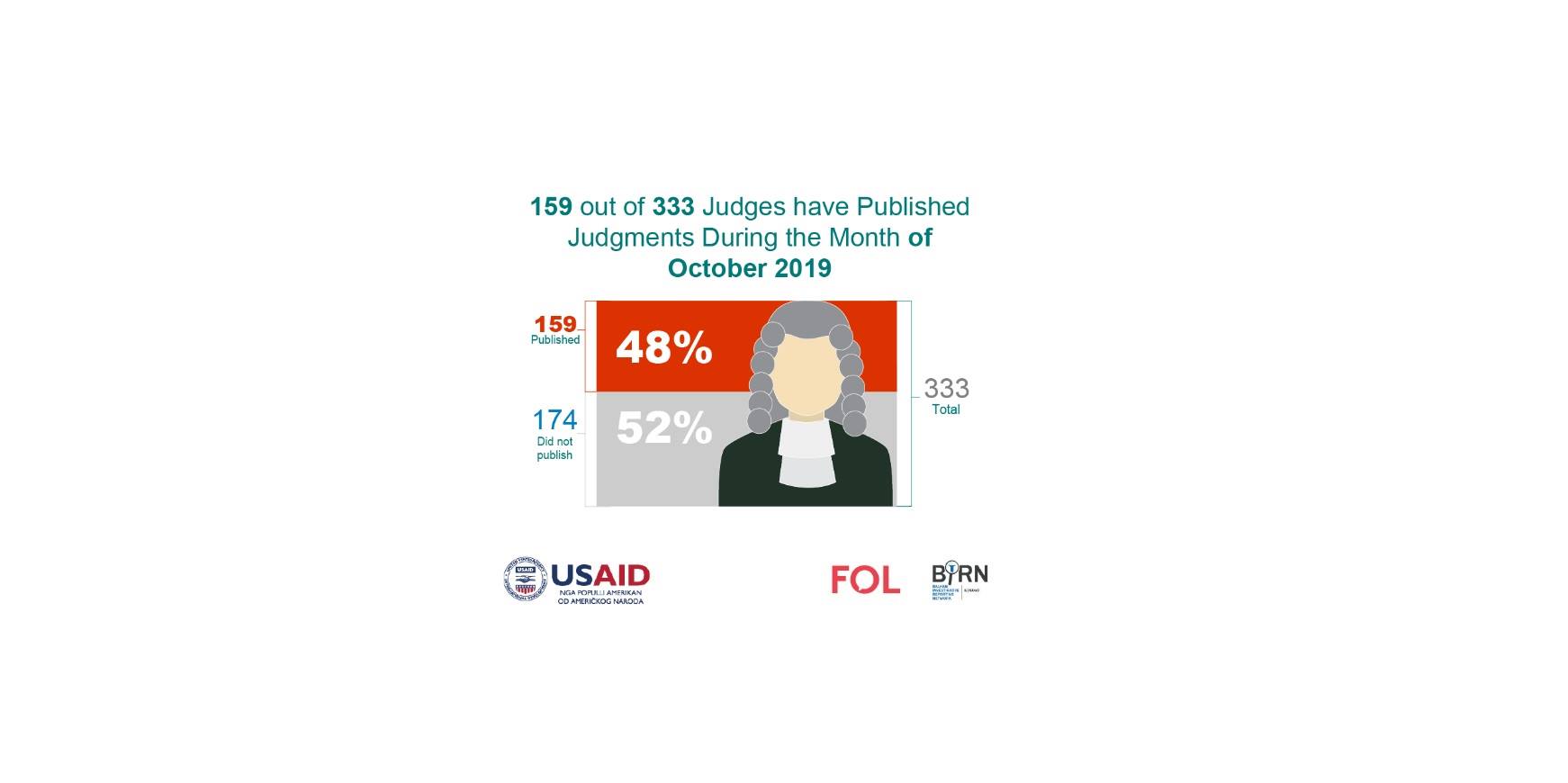
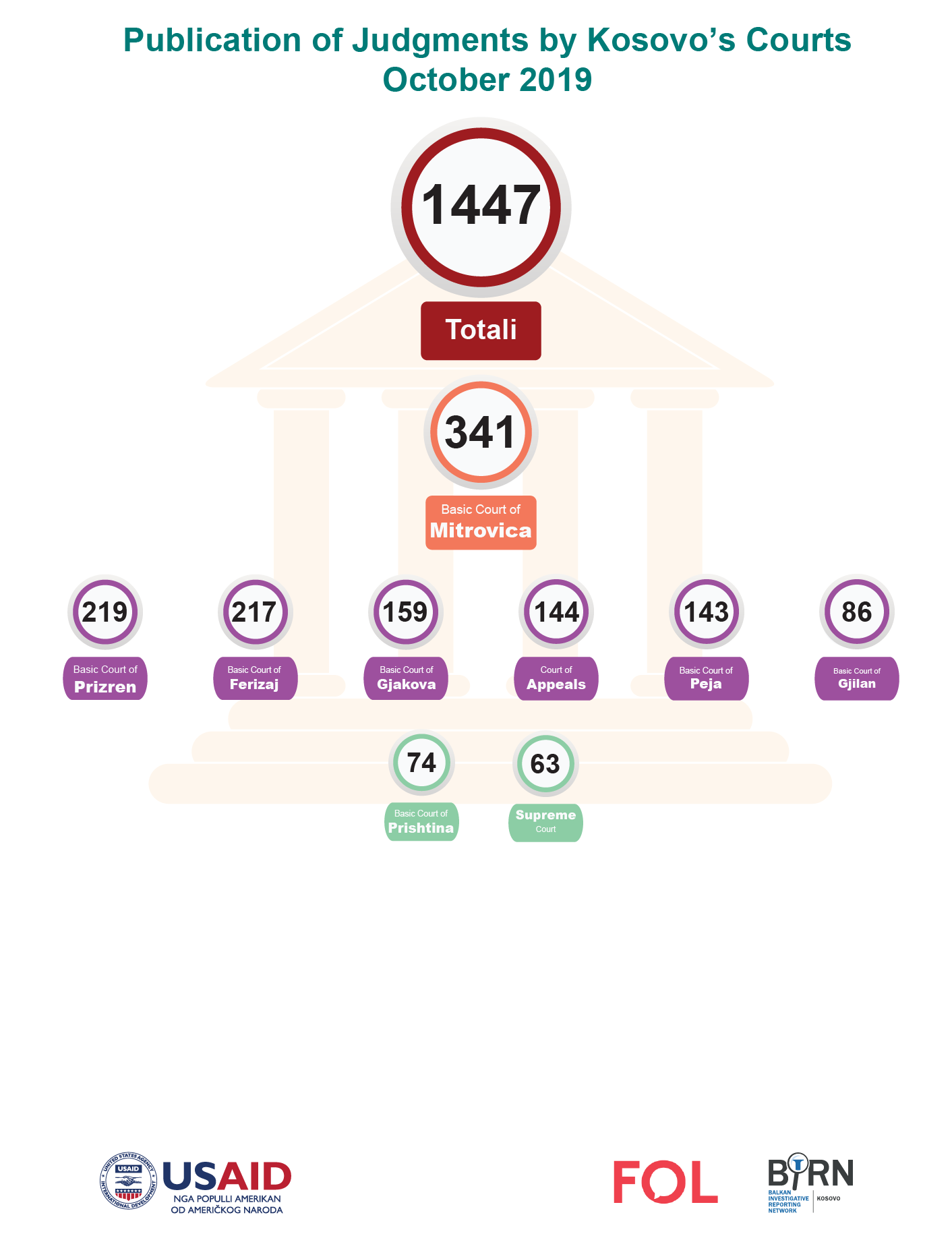
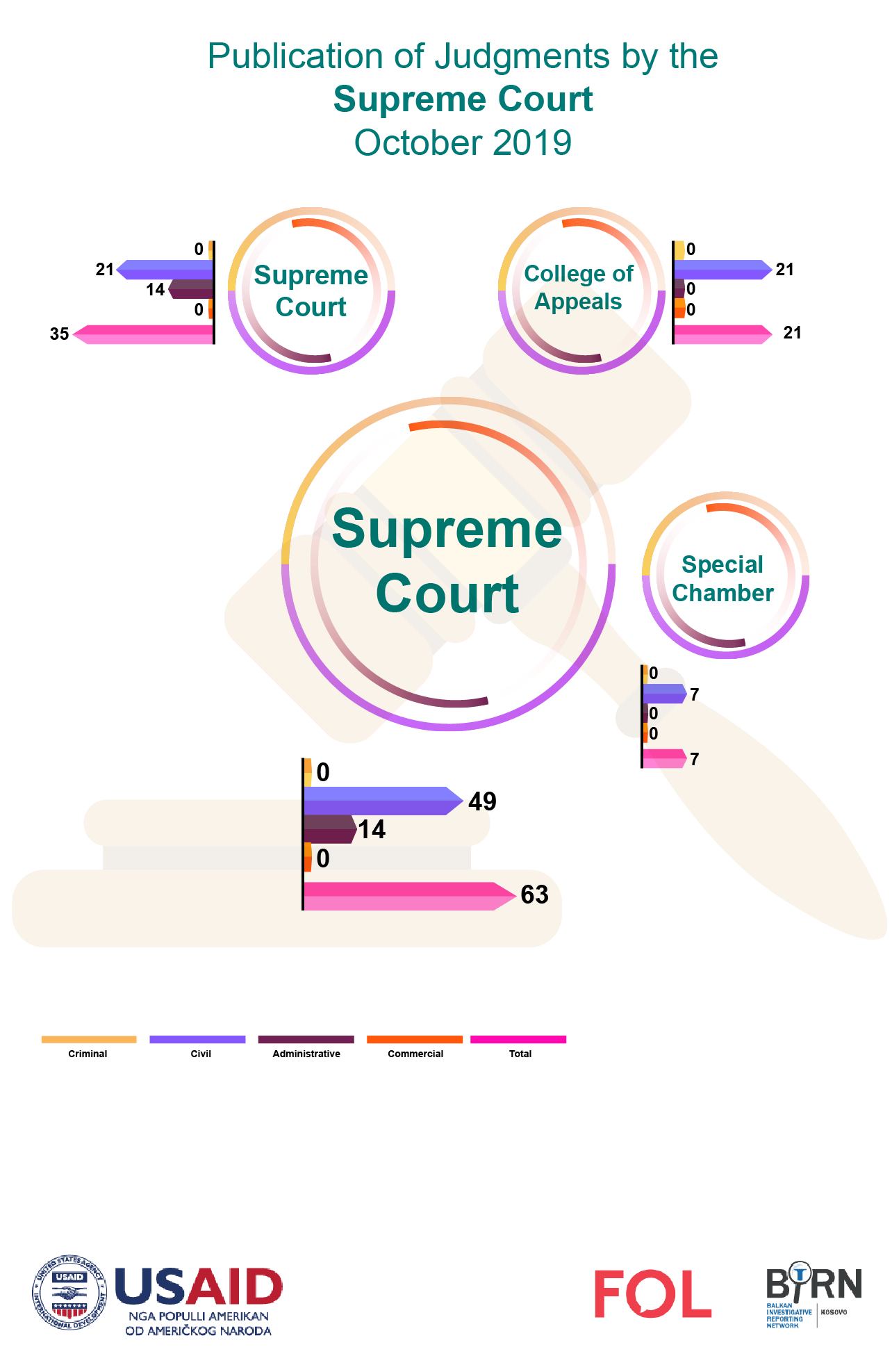
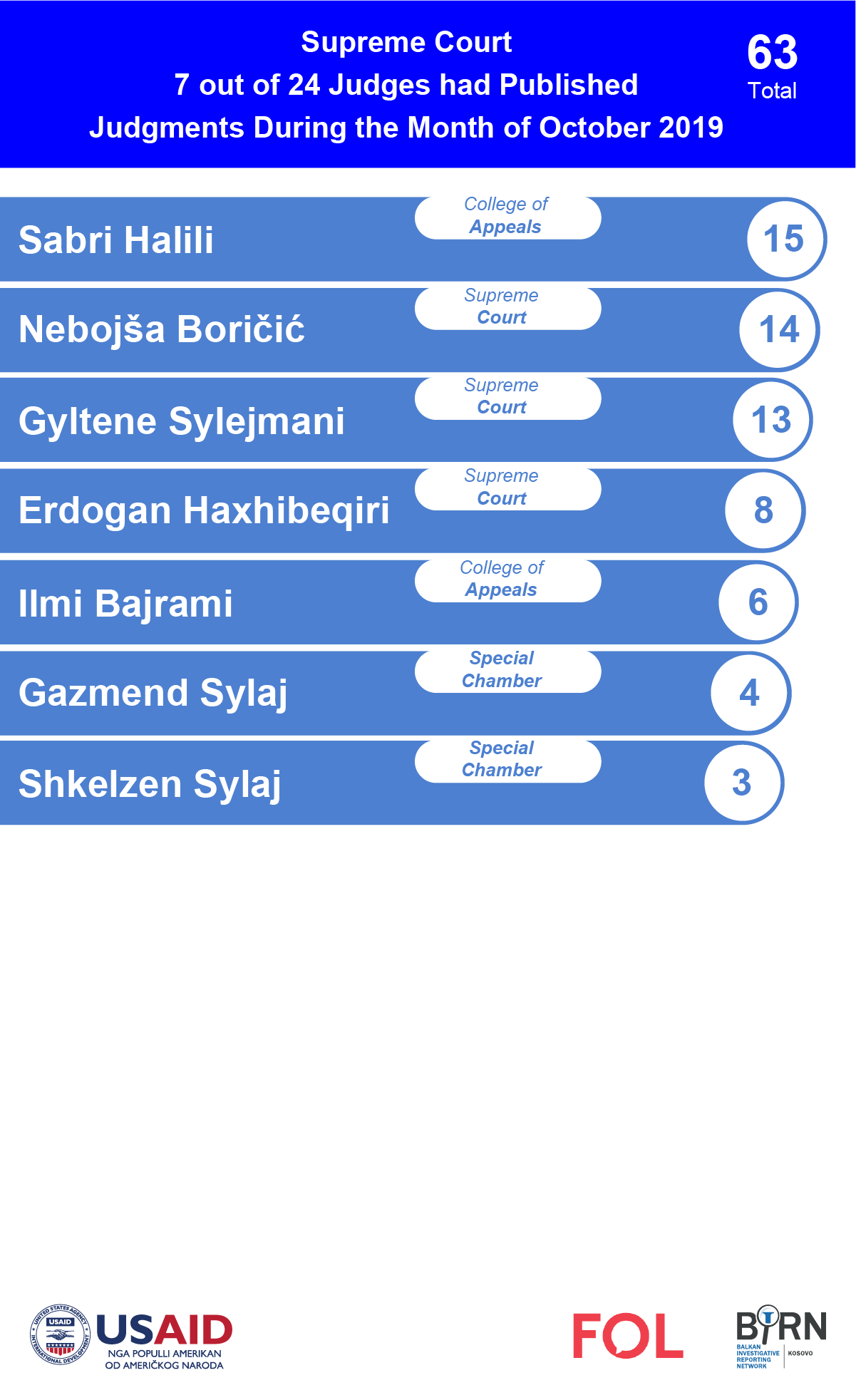
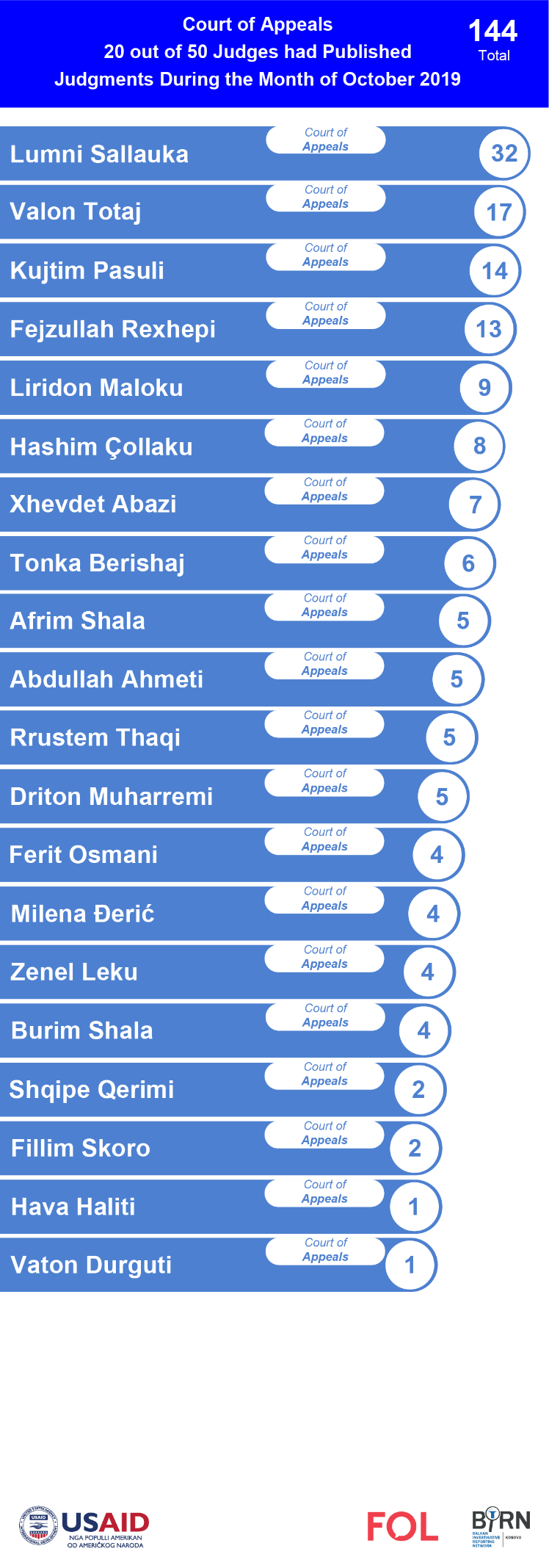
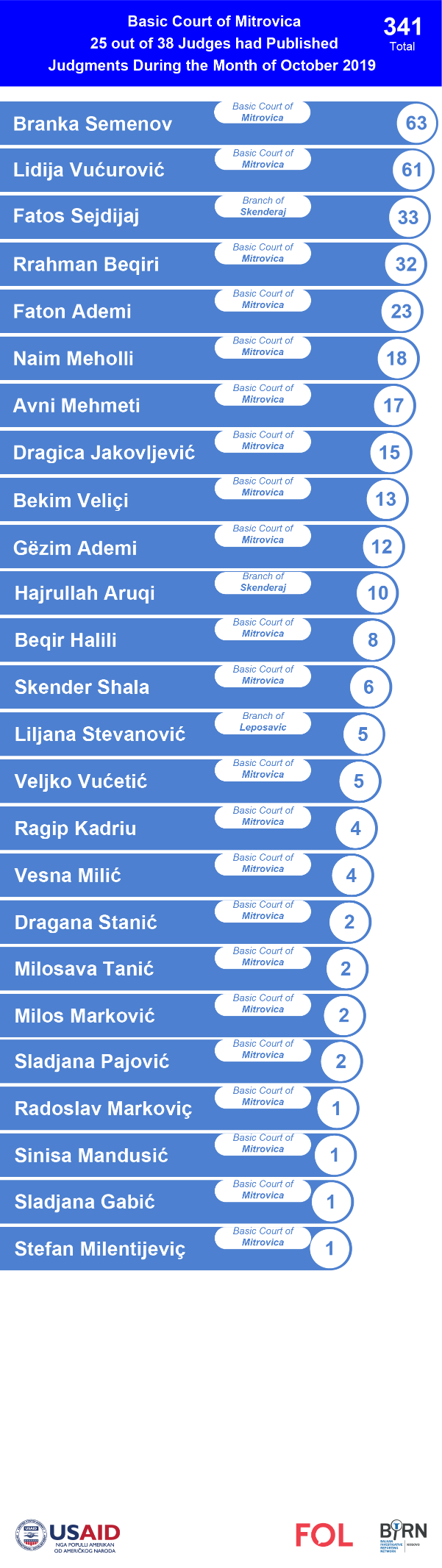
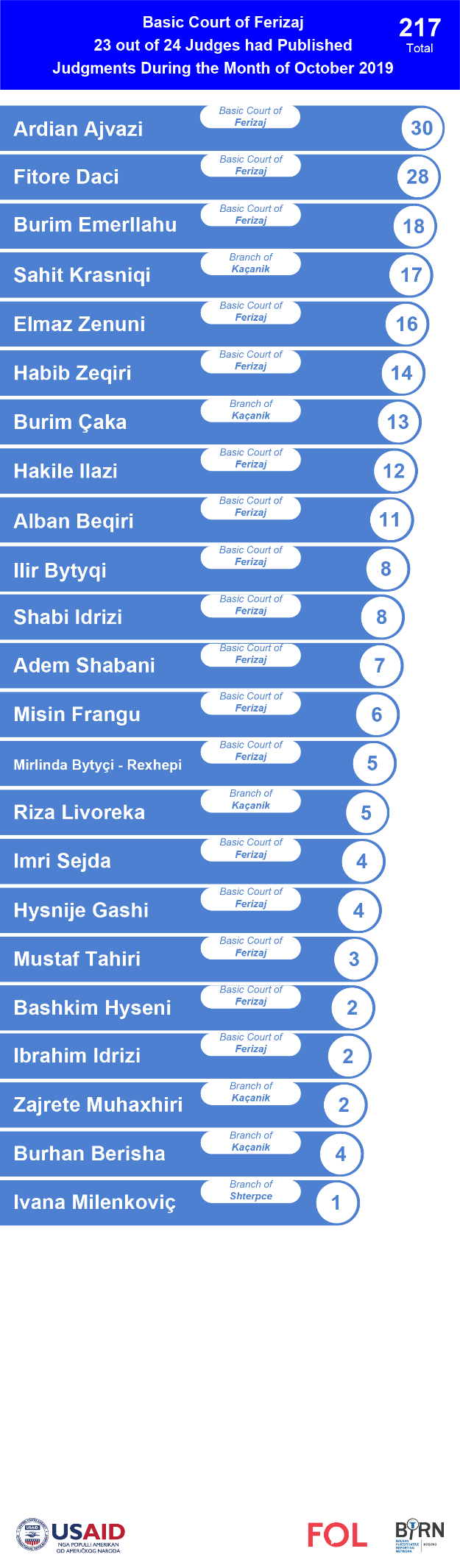
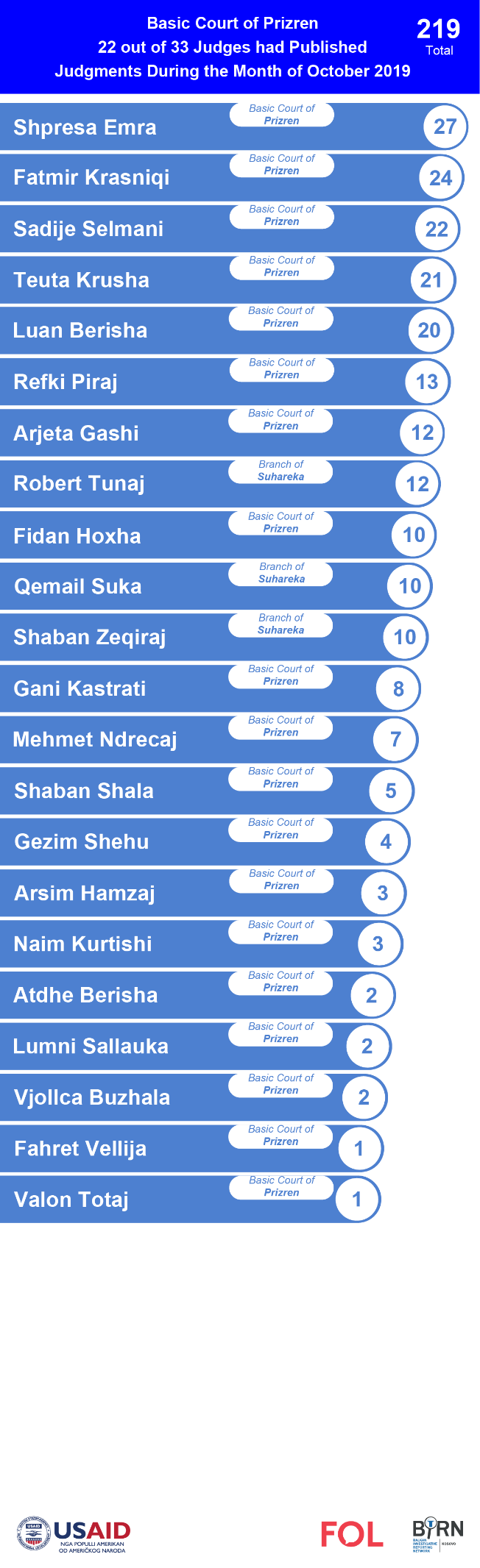
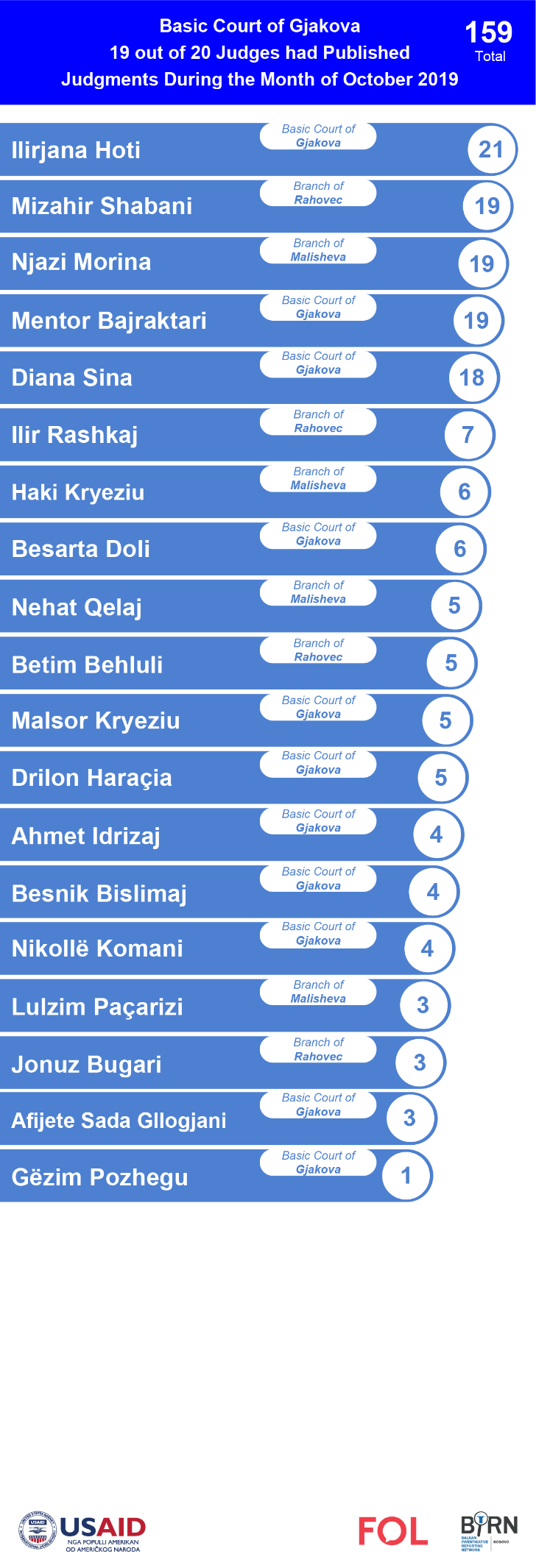
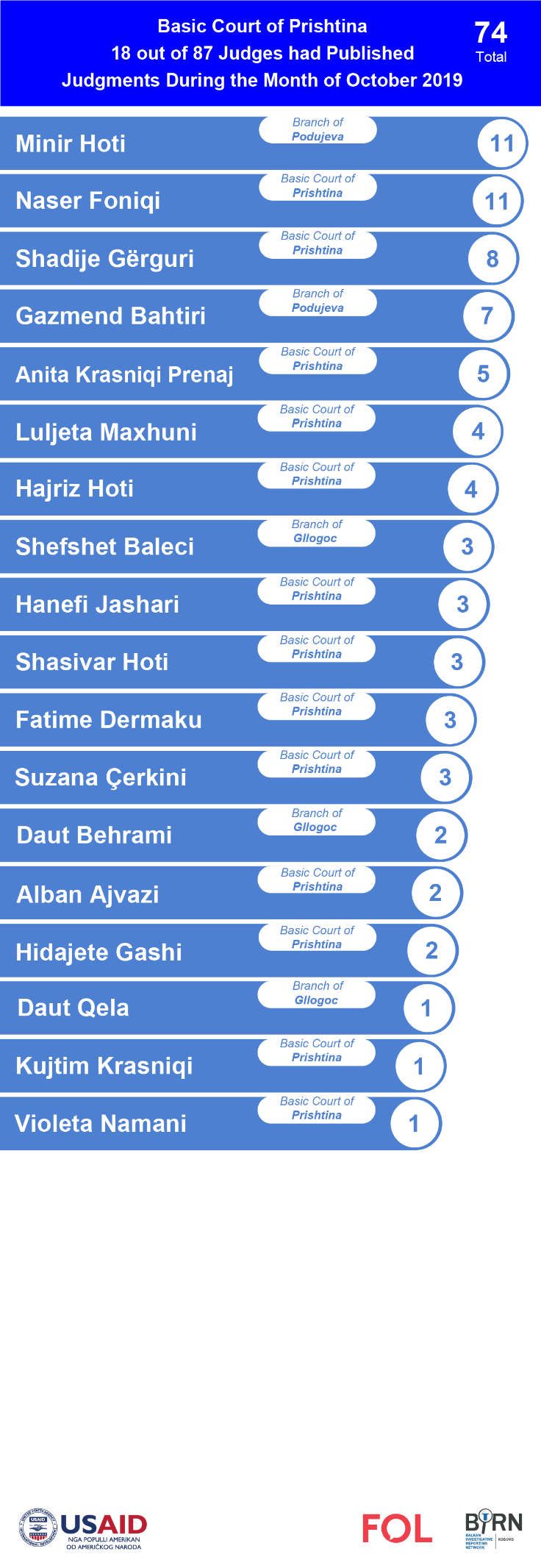
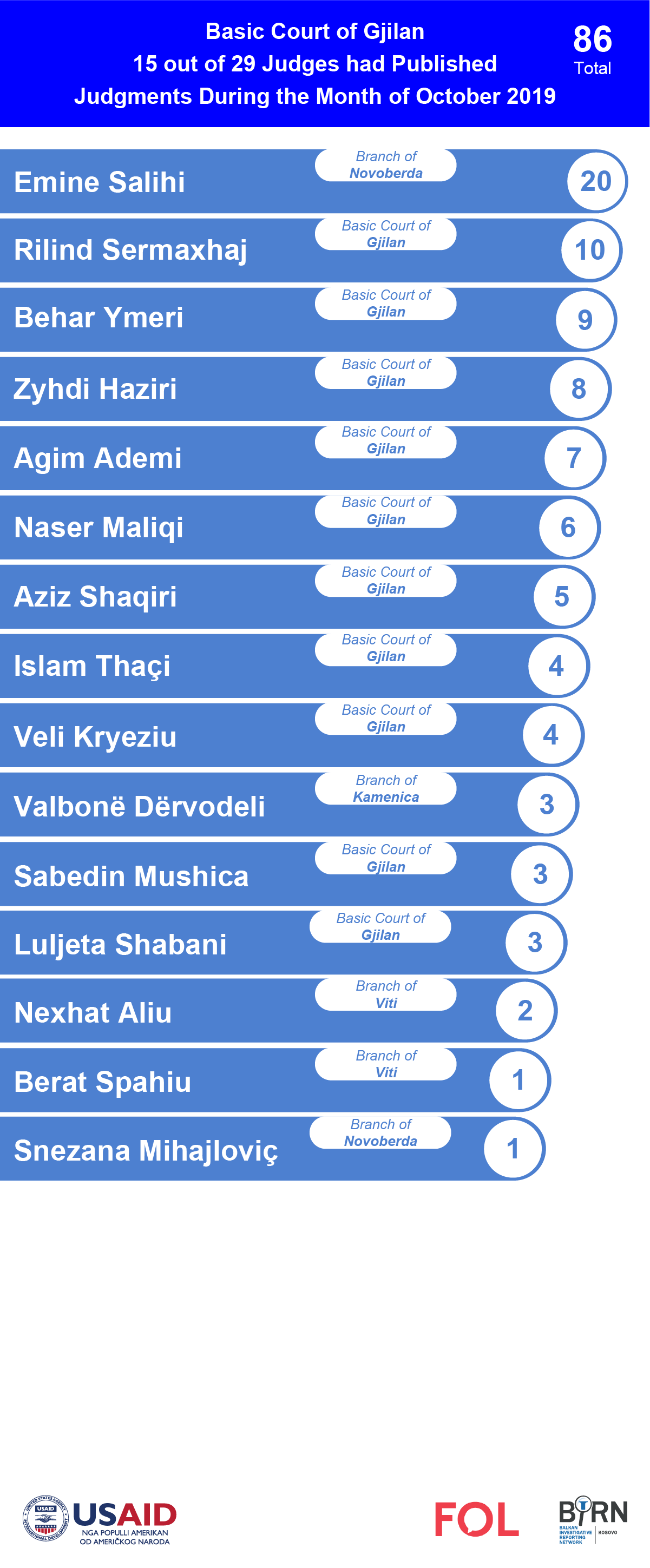
Pristina, 20 November 2019 – FOL Movement and BIRN Kosovo present today the data from monitoring the publication of judgments in all Kosovo Courts. Through the following infographics you can see the publication of all judgments by all Kosovo courts for October 2019.

Publication of Judgments by All Courts of Kosovo – October 2019.


Clarification: The publication of judgments during the period of October 1st to October 31st, 2019 was monitored for all Kosovo’s courts focusing on criminal, civil, commercial, and administrative departments. Additionally, this monitoring covered the publication of judgments according to judges from all courts (including their branches) for the abovementioned departments. The President of the Supreme Court; President of the Court of Appeals; Presidents of the Basic Courts; and the Judges from the Division for Minor Offences are not included in this monitoring.

During the monitoring of judgments published in the Kosovo Judicial Council’s website, for the abovementioned period, it has been noted that there is a total of 1617 judgments published, or 173 more than BIRN and FOL have in their database. This difference in is due to double publication of judgments or publication of court decisions. Additionally, during the month of October, it has been noticed that courts have published judgments made by judges who have been promoted to more senior positions, have been transferred to Minor Offence Division, or have retired. These shortcomings were noted during a detailed verification by BIRN and FOL.

*Disclaimer: This monitoring was made possible by the support of the American People through the United States Agency for International Development (USAID). The content of this article is the sole responsibility of FOL Movement and BIRN Kosova and does not necessarily reflect the views of the United States Agency for International Development or the United States Government.

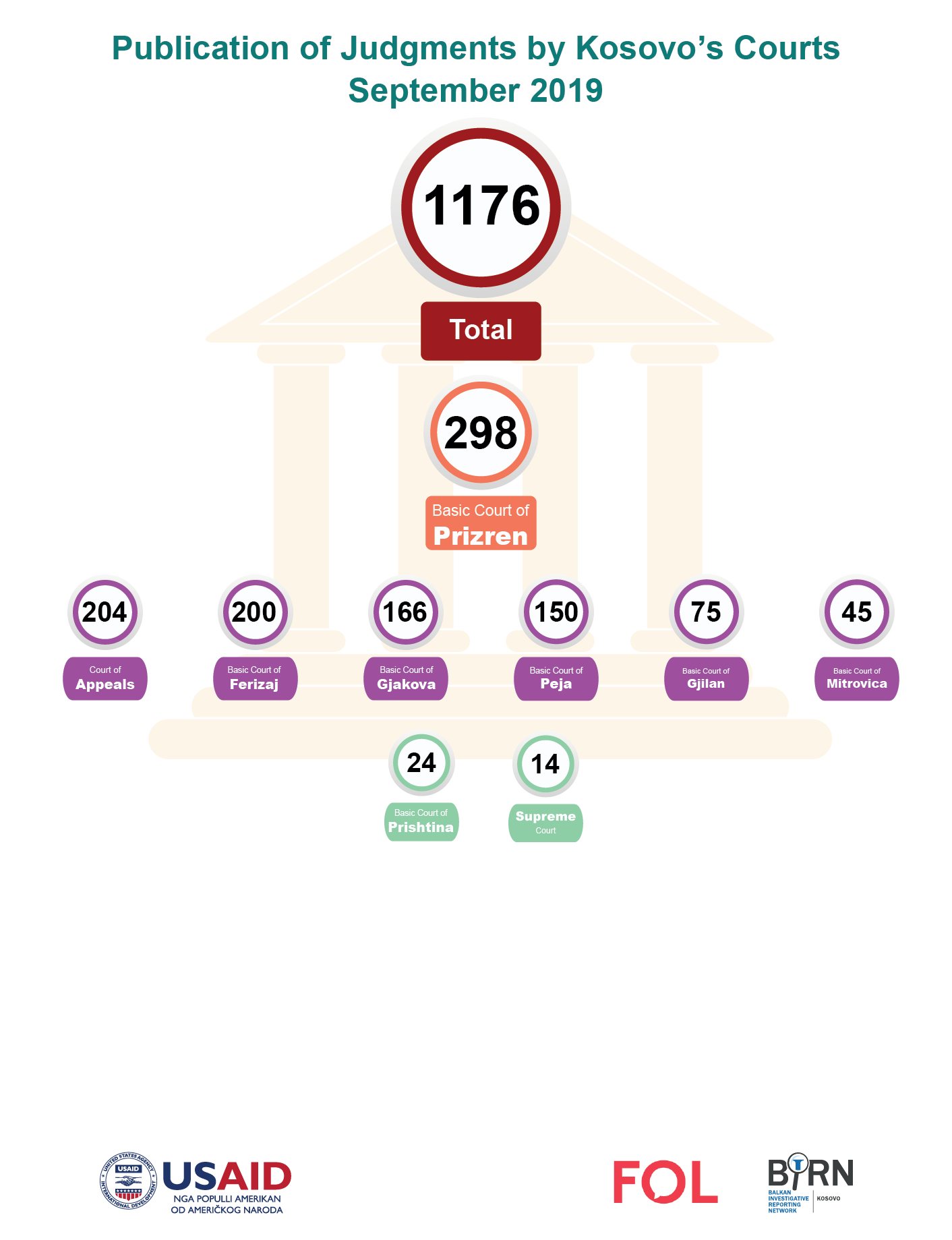
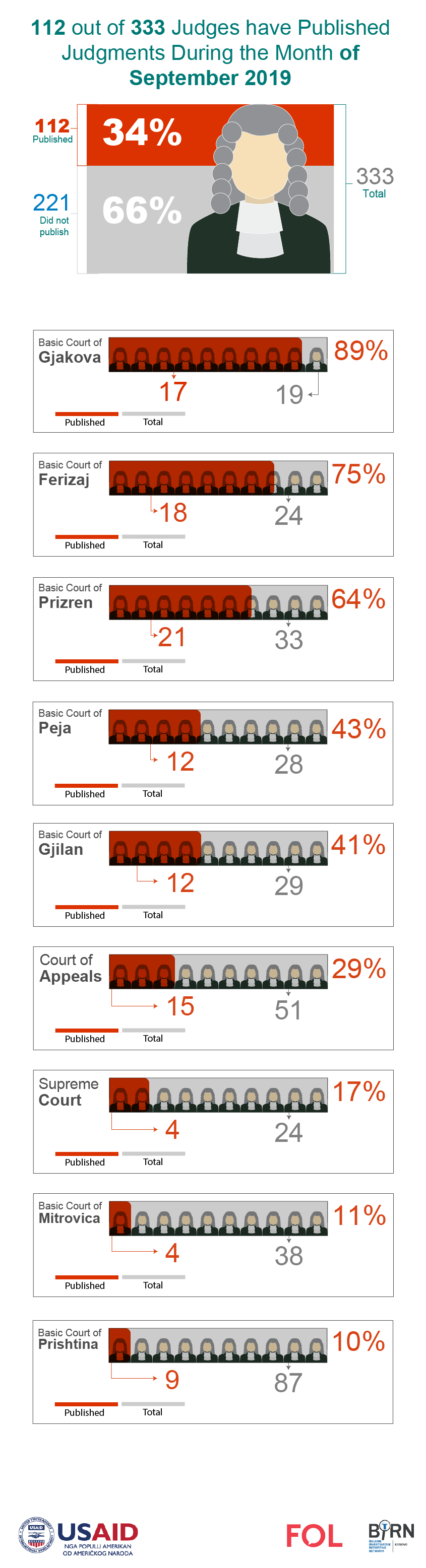
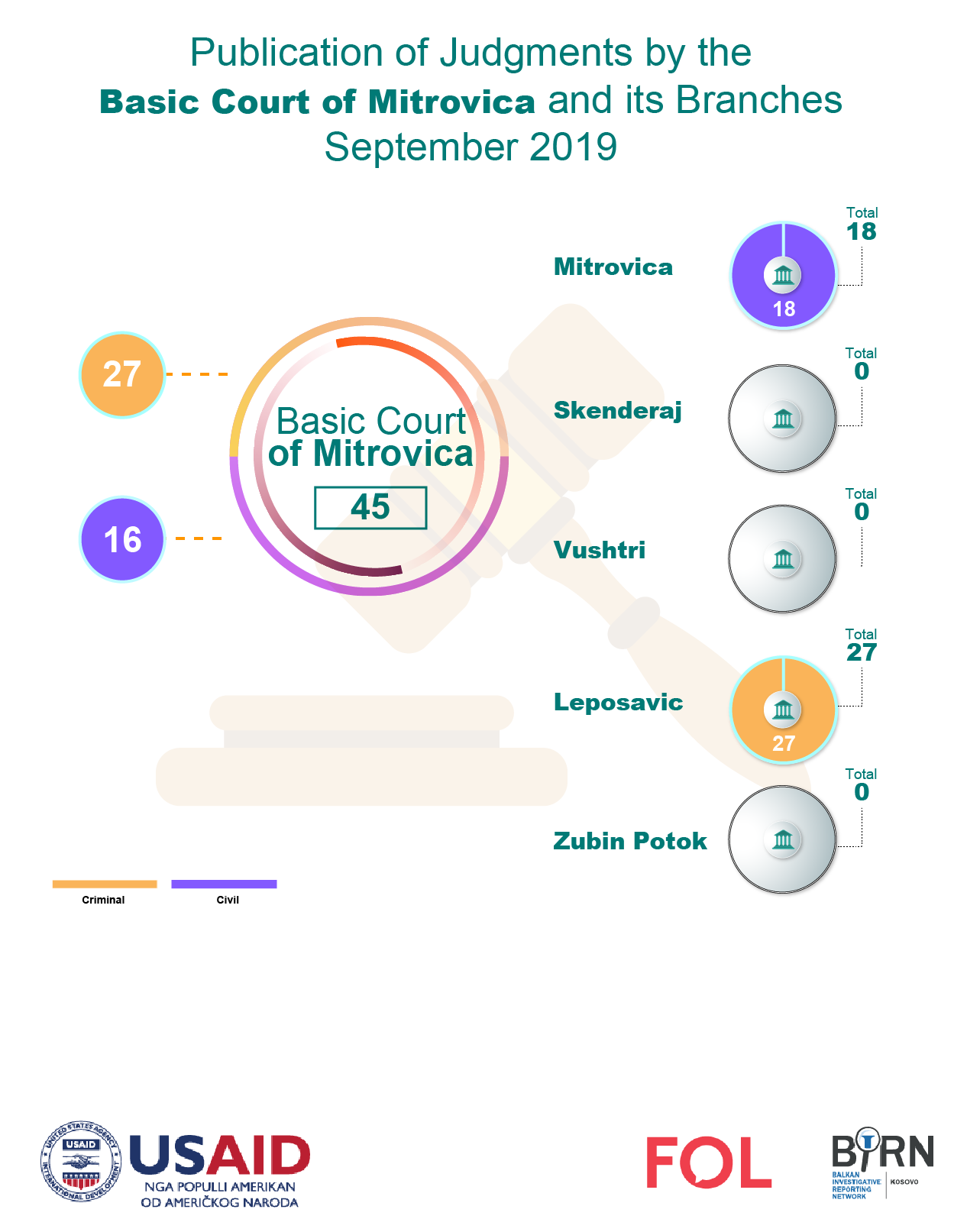
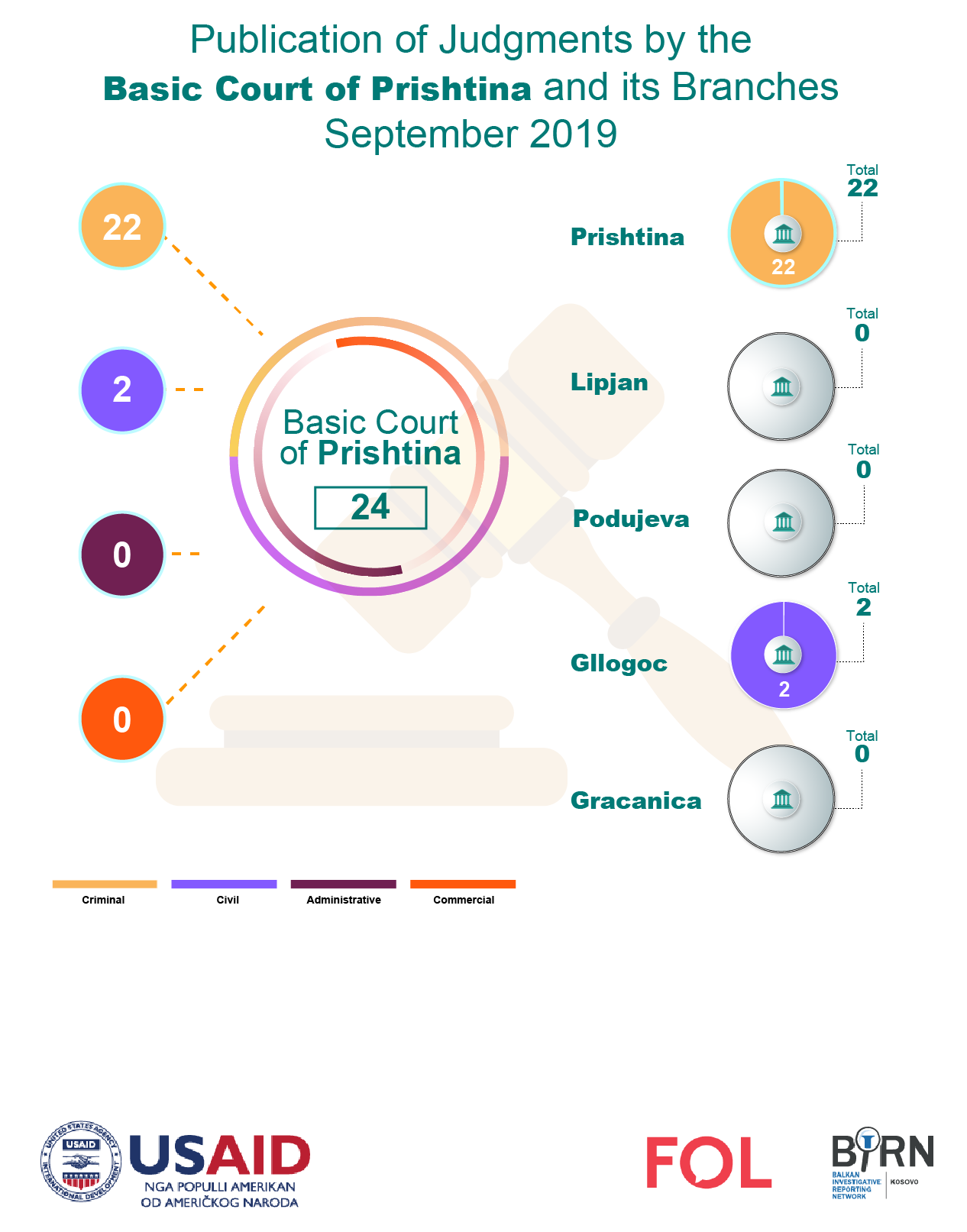
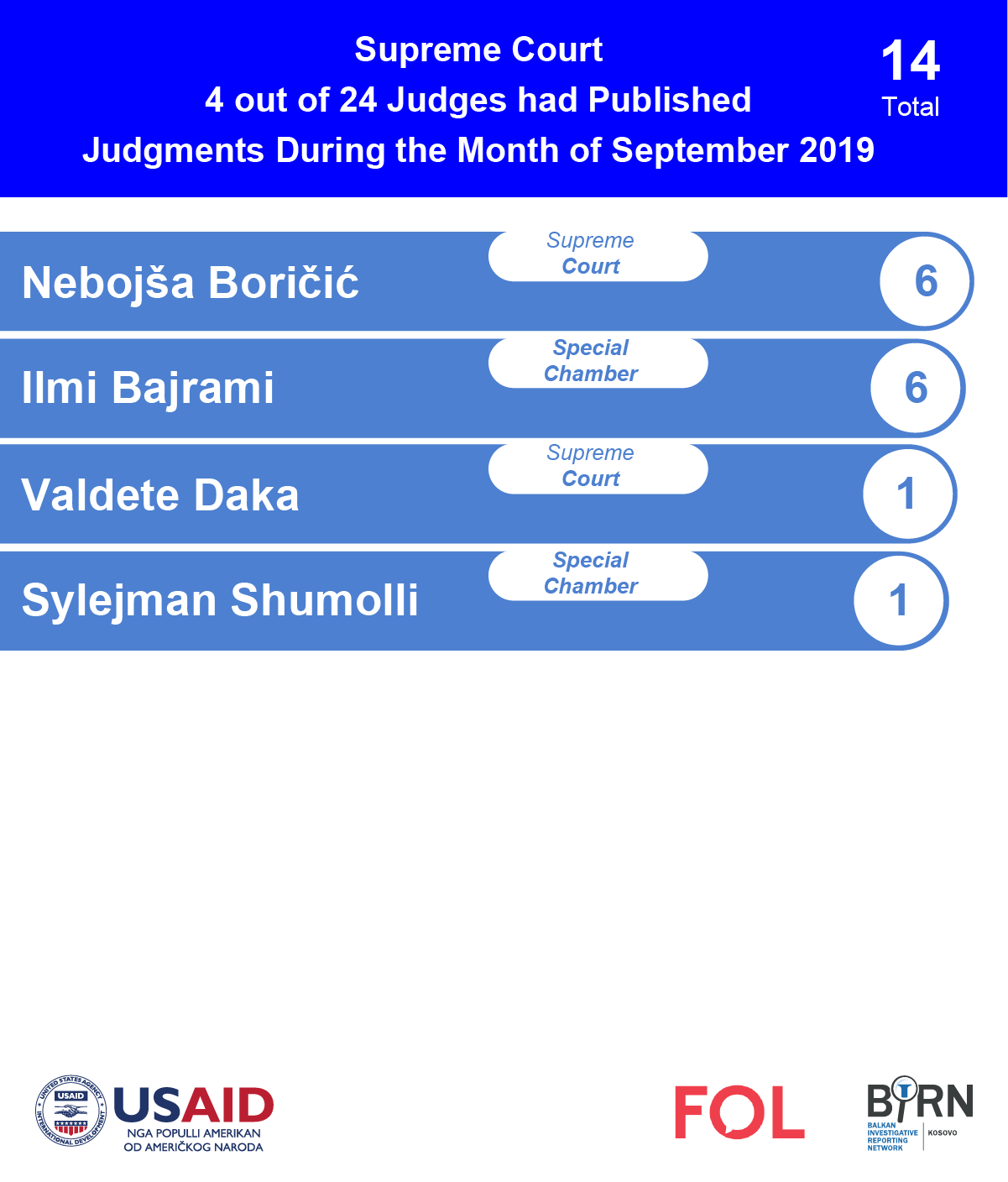
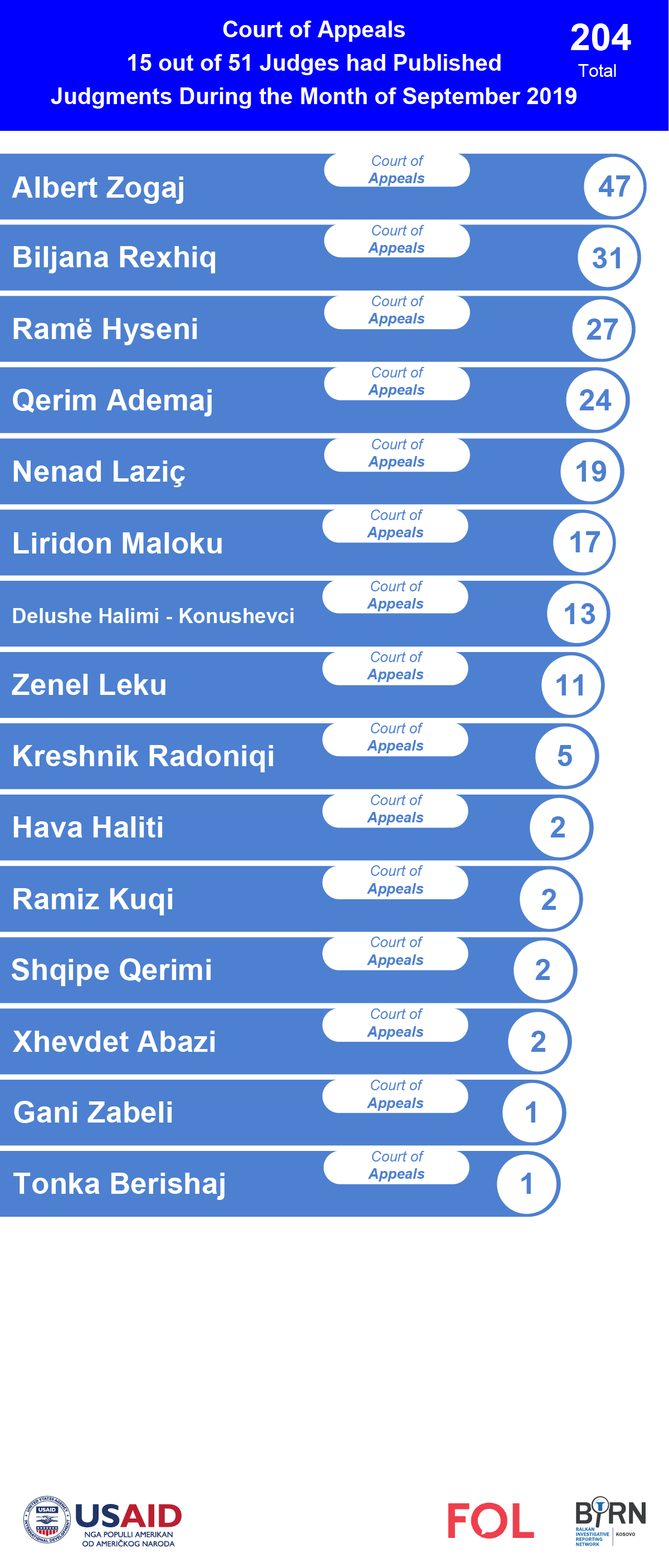
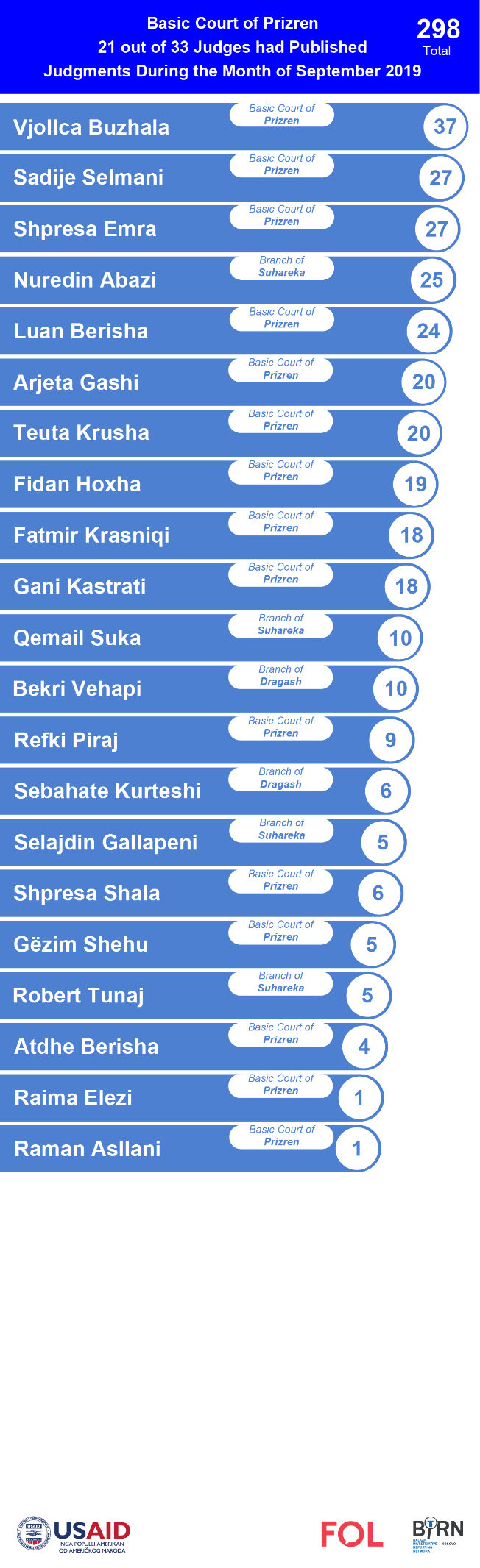
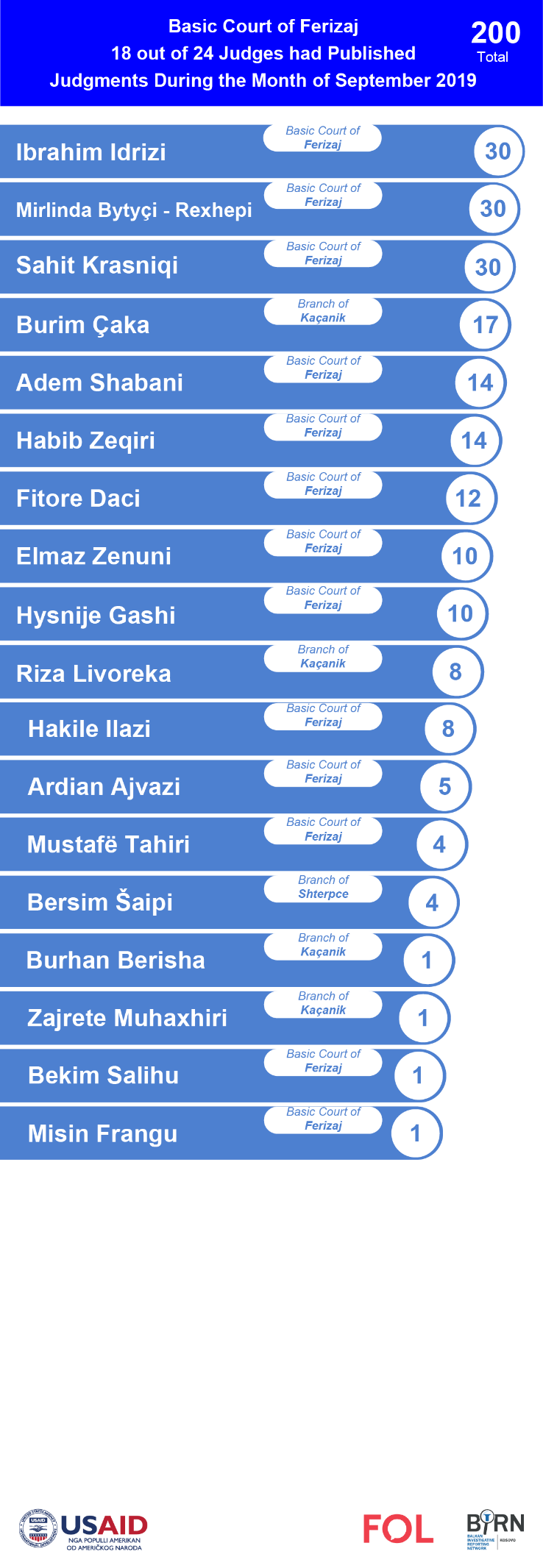
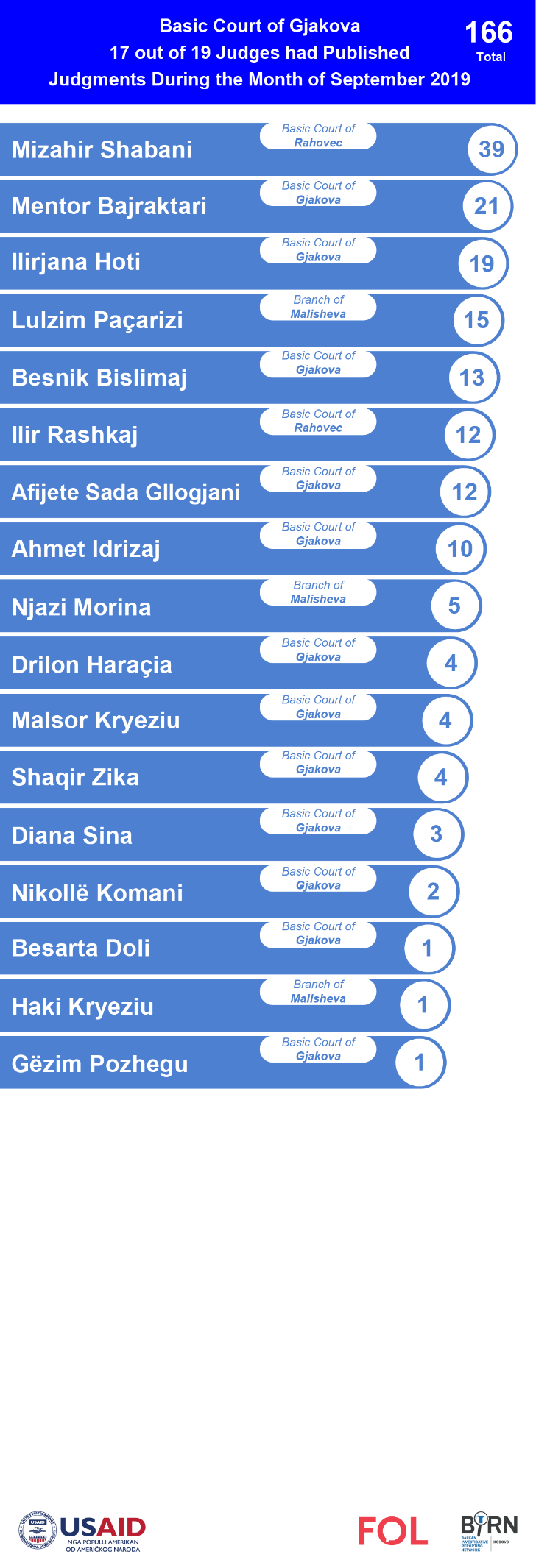
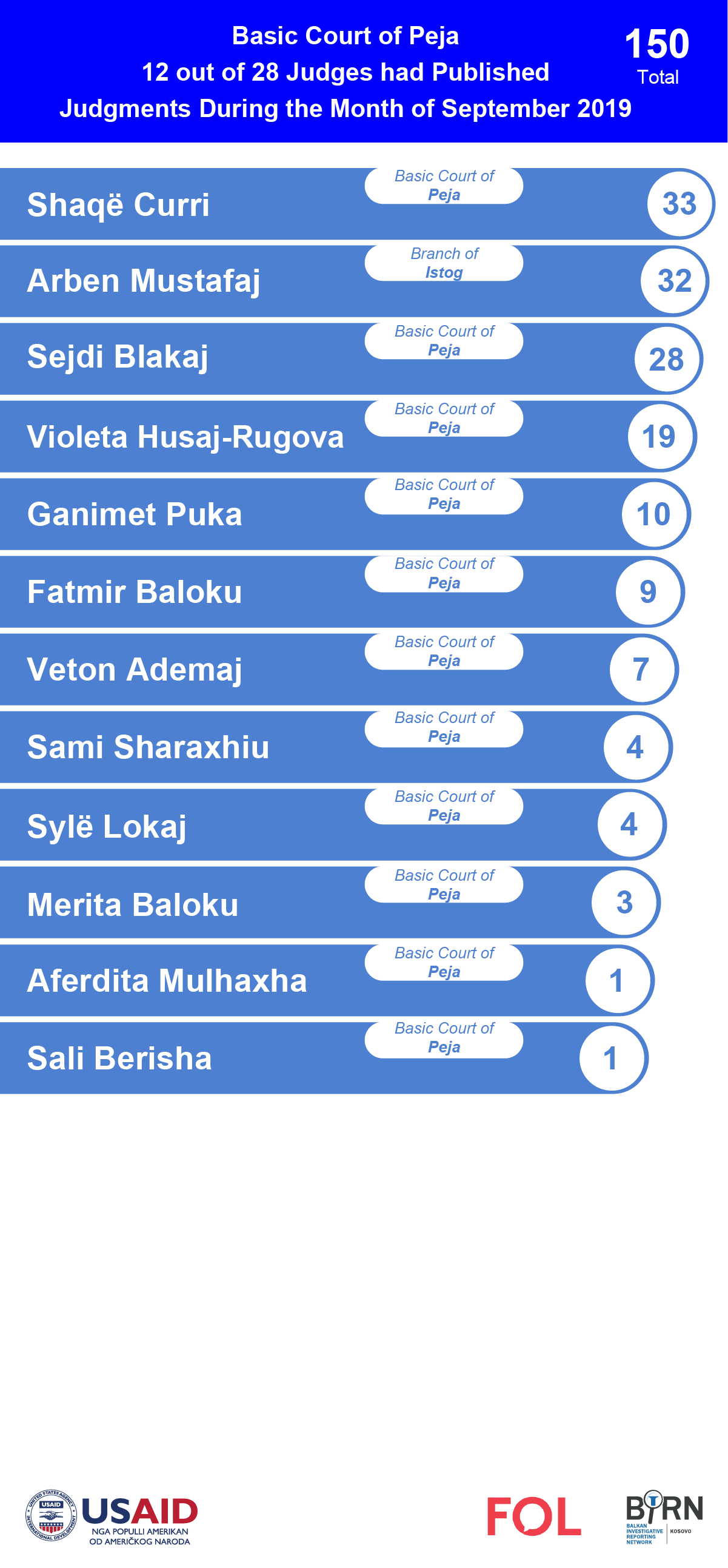
The number of judgments published has increased, 112 judges have issued judgments during September

Pristina, 21 October 2019 – FOL Movement and BIRN Kosovo present today the data from monitoring the publication of judgments in all Kosovo Courts. Through the following infographics you can see the publication of all judgments by all Kosovo courts for September 2019.


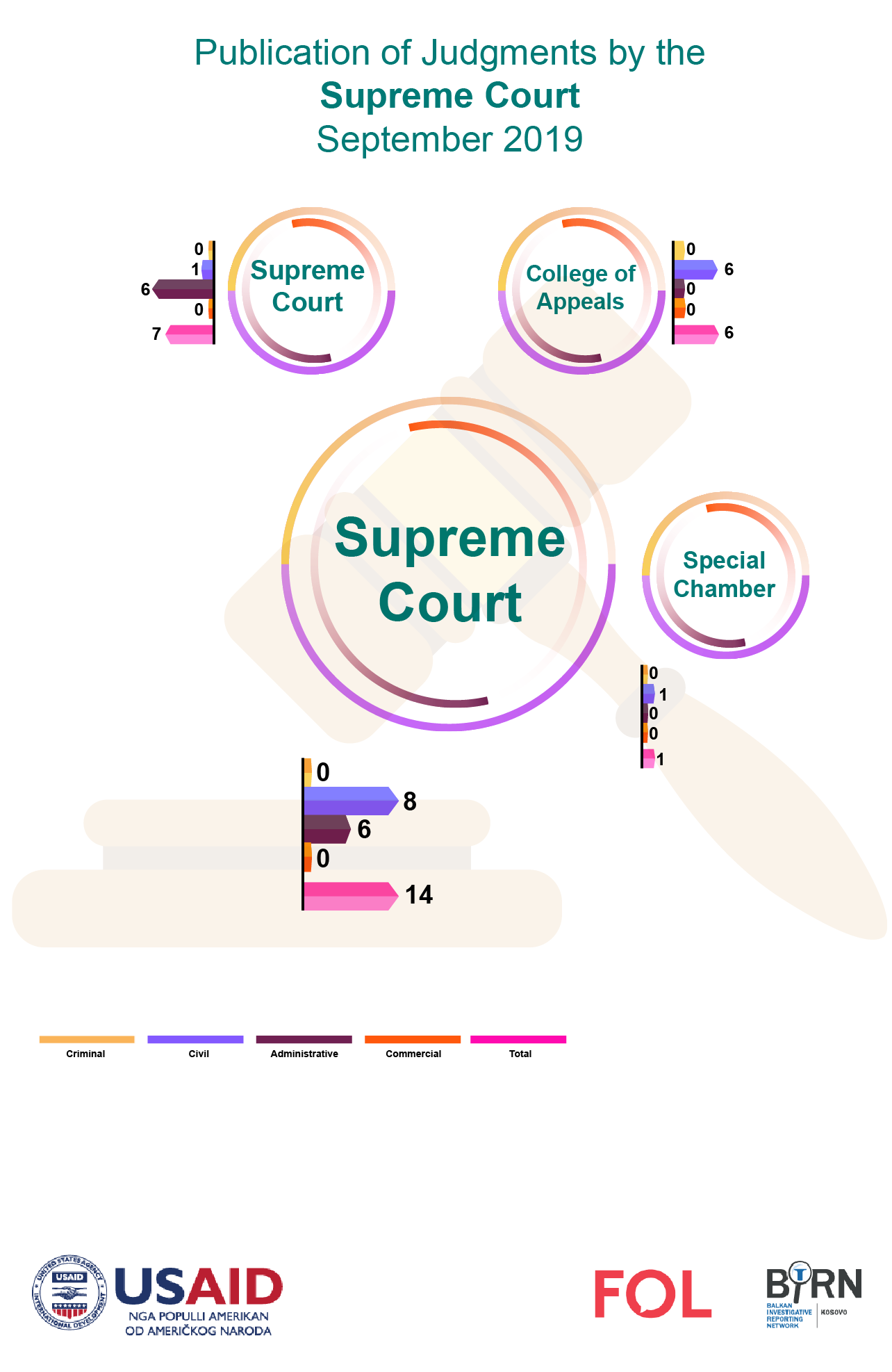
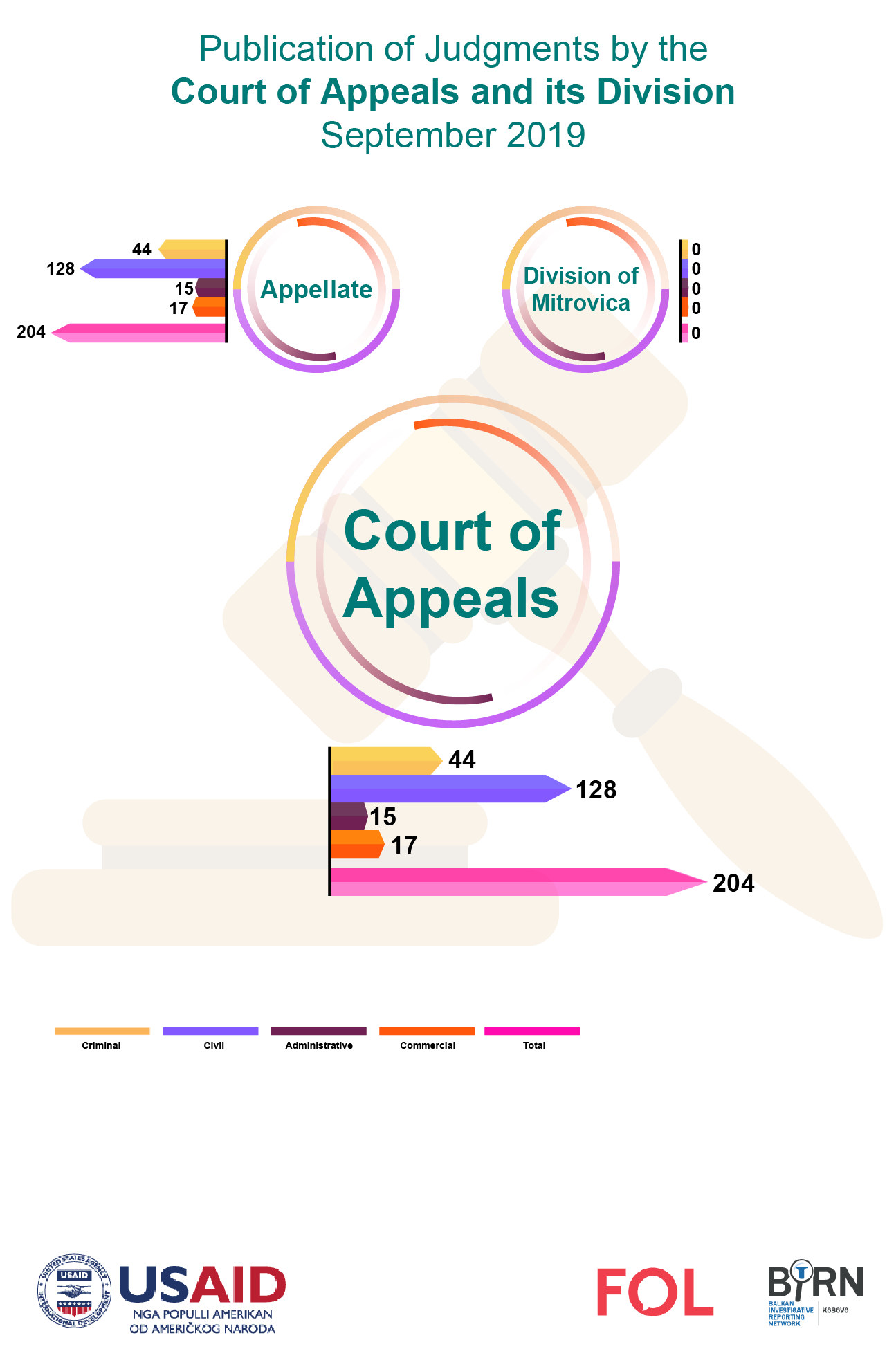
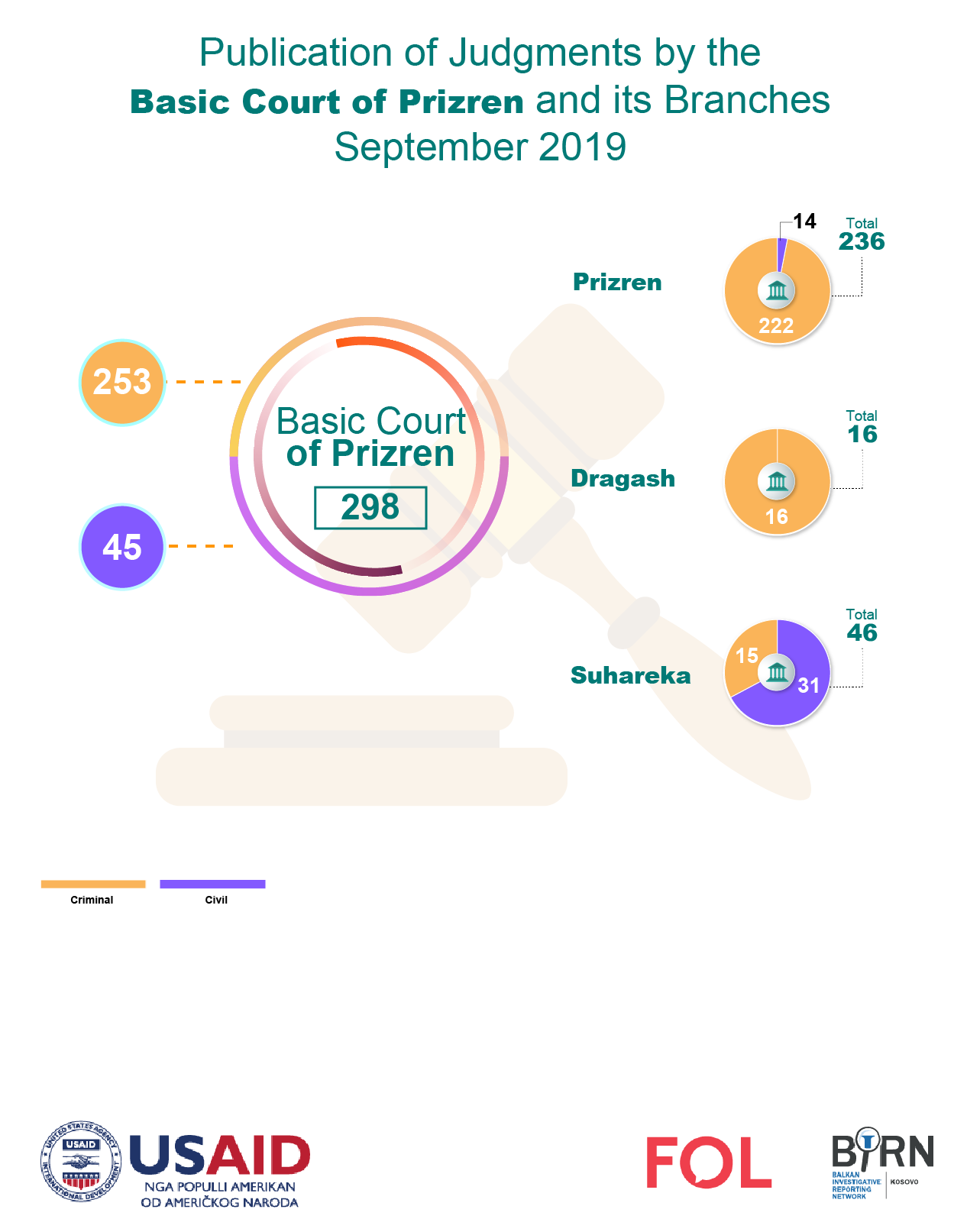
Publication of Judgments by All Courts of Kosovo – September 2019.


Clarification: The publication of judgments during the period of September 1 to September 30, 2019 was monitored for all Kosovo’s courts focusing on criminal, civil, commercial, and administrative departments. Additionally, this monitoring covered the publication of judgments according to judges from all courts (including their branches) for the abovementioned departments. The President of the Supreme Court; President of the Court of Appeals; Presidents of the Basic Courts; and the Judges from the Division for Minor Offences are not included in this monitoring.

During the monitoring of judgments published in the Kosovo Judicial Council’s website, for the above-mentioned period, it has been noted that there is a total of 1185 judgments published, or 9 more than BIRN and FOL have in their database. This difference in is due to double publication of judgments.

Additionally, during the month of June, it has been noticed that courts have published judgments made by judges who have been promoted to more senior positions, have been transferred to Minor Offence Division, or have retired. These shortcomings were noted during a detailed verification by BIRN and FOL.

*Disclaimer: This monitoring was made possible by the support of the American People through the United States Agency for International Development (USAID). The content of this article is the sole responsibility of FOL Movement and BIRN Kosova and does not necessarily reflect the views of the United States Agency for International Development or the United States Government.

Civil society welcomes international appeals not to appoint any notary

Prishtine October 14 2019 – We, civil society organizations listed below, welcome international reactions on the process of selecting notaries led by the outgoing Justice Minister Abelard Tahiri.

Following a number of reactions from civil society, last week a number of international institutions and organizations were clear in their appeals to the outgoing Minister of Justice Mr. Tahiri not to appoint the notaries that result from the last selection process.

The first reaction came from International Union of Notaries and German Federal Chamber of Notaries, followed today an explicit reaction from the EU Office in Kosovo and a reaction of the German Ambassador to Kosovo Mr. Heldt.

Expressing our serious concerns on the statements from the outgoing Minister of Justice Abelard Tahiri that despite all the above he plans to conclude this process, we repeat our requests that:

  1. Outgoing Minister Abelard Tahiri not to appoint any notary from the current list of notary candidates;
  2. The new Minister of Justice urgently to review the process of selection of notaries;
  3. Police and prosecution to begin investigations into possible criminal actions in the process of selecting new notaries.

COHU

Columbus

Democracy for Development (D4D)

Democracy Plus (D+)

FOL Movement

Group for Legal and Political Studies (GLPS)

Initiative for Progress (INPO)

Kosovar Civil Society Foundation (KCSF)

Kosovo Democratic Institute (KDI)

Kosovo Law Institute (IKD)

EPIK Institute


Minister Abelard Tahiri Not to Appoint any Notary

Prishtine, October 8 2019 – We, civil society organizations listed below, are reacting again to the extremely dubious process of selecting notaries led by the outgoing Justice Minister Abelard Tahiri.

The procedure for the selection of new notaries was also carried out at a time when the government lacked the legitimacy to conduct such a process. The selection was made without respecting the minimum standards of transparency to convince the general public that this process is fair, impartial, independent and based on the merits of the candidates.

The candidate selection process has resulted in a list of family members and people affiliated with the Democratic Party of Kosovo, of which outgoing Minister Tahiri himself is a member, as well as of other political parties from across the political spectrum. The list also includes persons closely related to some of the members of the Notary Examination Commission, raising even more doubts about the conflict of interest between commission members and notary candidates and the possibility of leaking information to favor some candidates.

We also trust media reports that some of the candidates have not even met the formal requirements to sit for the notary exam. Election of notary without merit endangers not only the administrative and judicial system in Kosovo but also that of the European Union countries, in which our diaspora uses documents notarized in Kosovo.

It is important to emphasize that in this process, it is also expected to be elected notaries from the minority communities in Kosovo. However, by selecting them in a dubious manner, the outgoing justice minister will cause irreparable damage to communities, which are usually allocated a smaller number of notaries.

In the end, former Minister Tahiri has no legitimacy to make such an important decision with long-term consequences in the very last days of his term.

Taking into consideration the above, we request that:

  1. Outgoing Minister Abelard Tahiri not to appoint any notary from the current list of notary candidates;
  2. The new Minister of Justice urgently to review the process of selection of notaries;
  3. Police and prosecution to begin investigations into possible criminal actions in the process of selecting new notaries;
  4. The European Union Office in Kosovo, Quint member states and the international community to react and monitor the process of notaries due to the consequences in their own countries.

Current notary legislation states that the notary service is a public service and notaries must be independent and impartial in exercising the notary service. The notaries selected in this process will be known as the ‘PDK notaries’ and will never enjoy the status of being independent and impartial.

COHU

Columbus

Democracy for Development (D4D)

Democracy Plus (D+)

FOL Movement

Group for Legal and Political Studies (GLPS)

Initiative for Progress (INPO)

Kosovar Civil Society Foundation (KCSF)

Kosovo Democratic Institute (KDI)

Kosovo Law Institute (IKD)

EPIK Institute


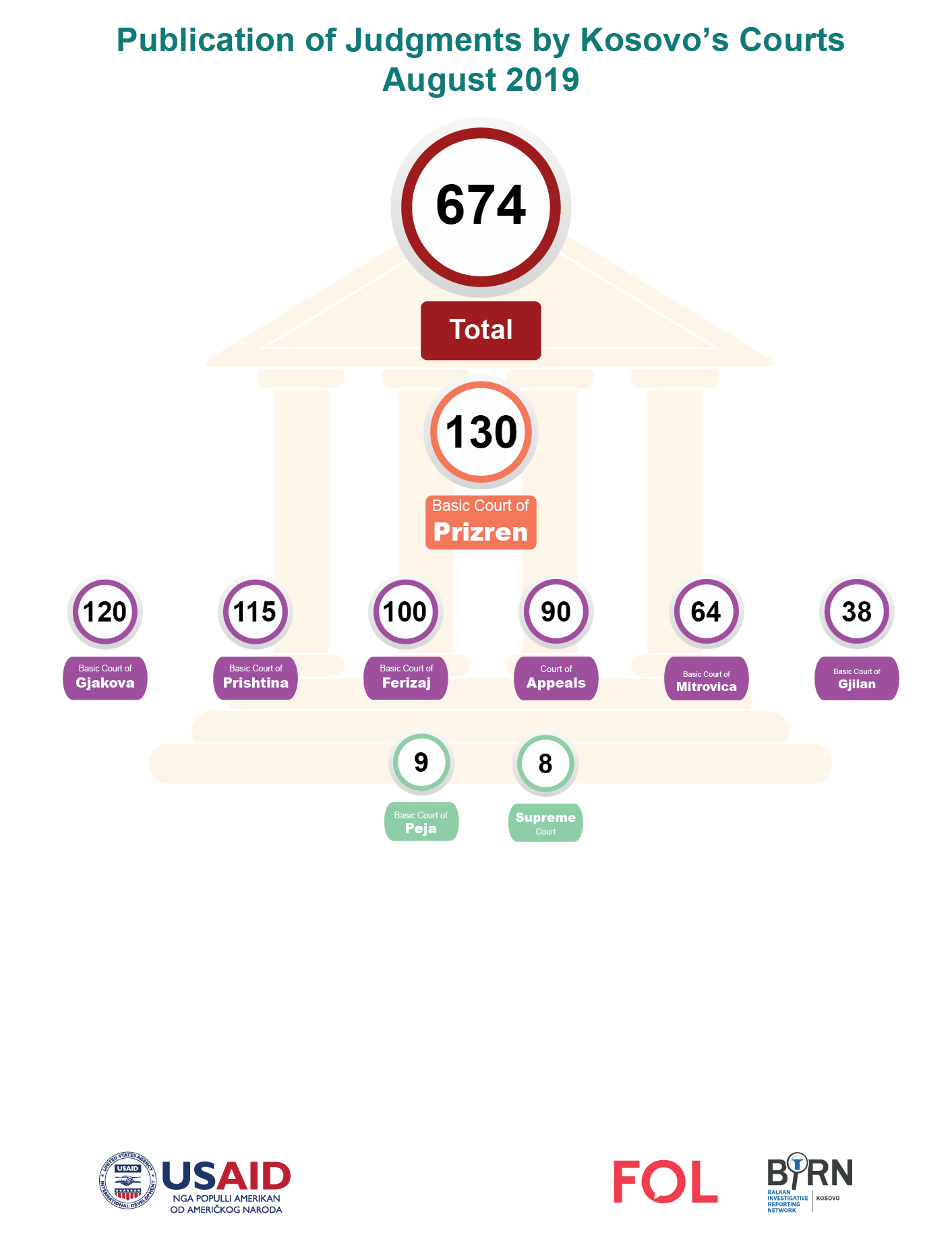
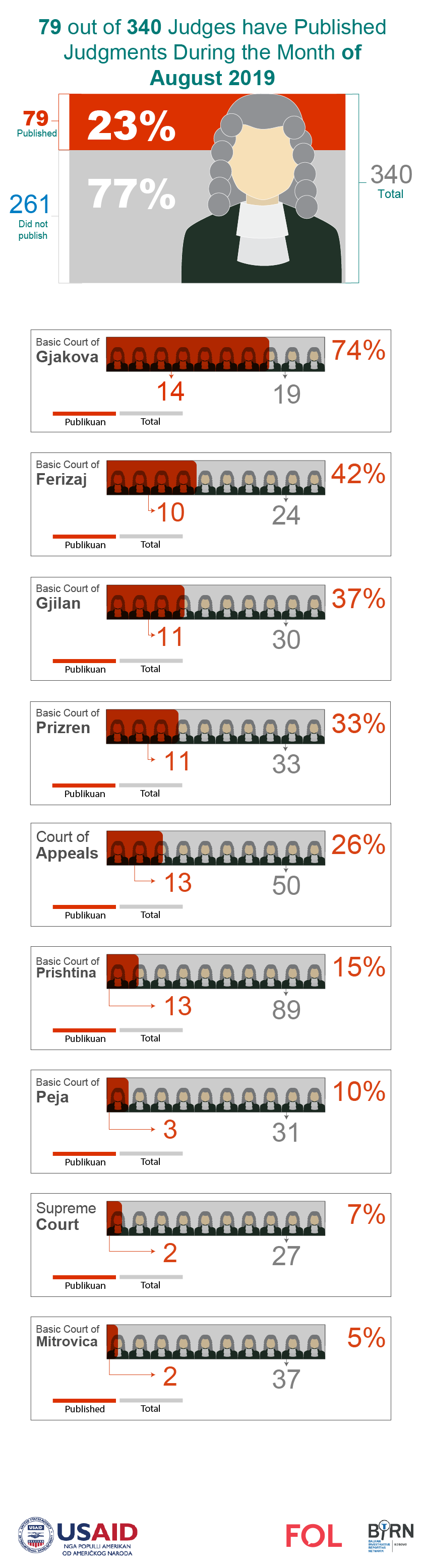
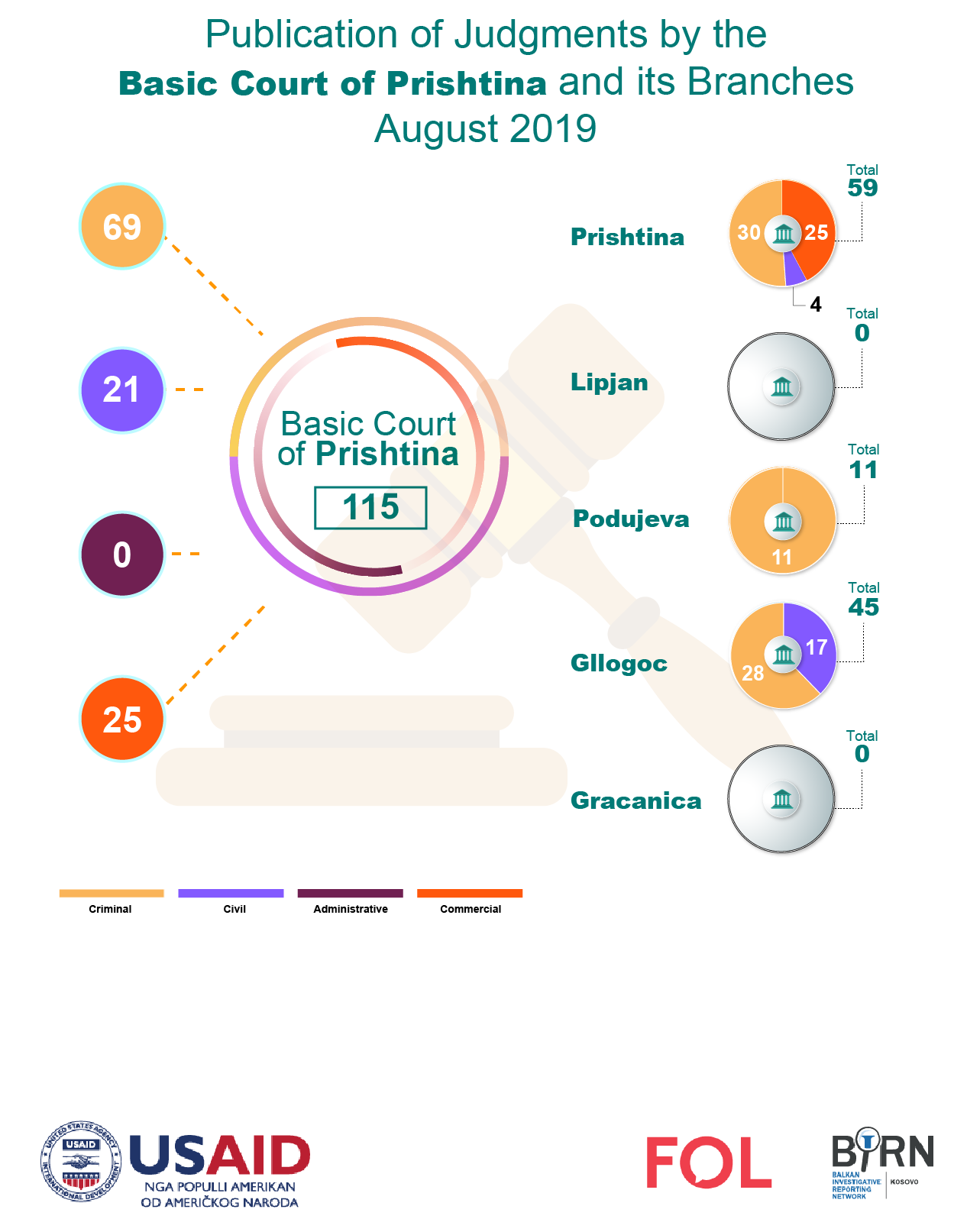
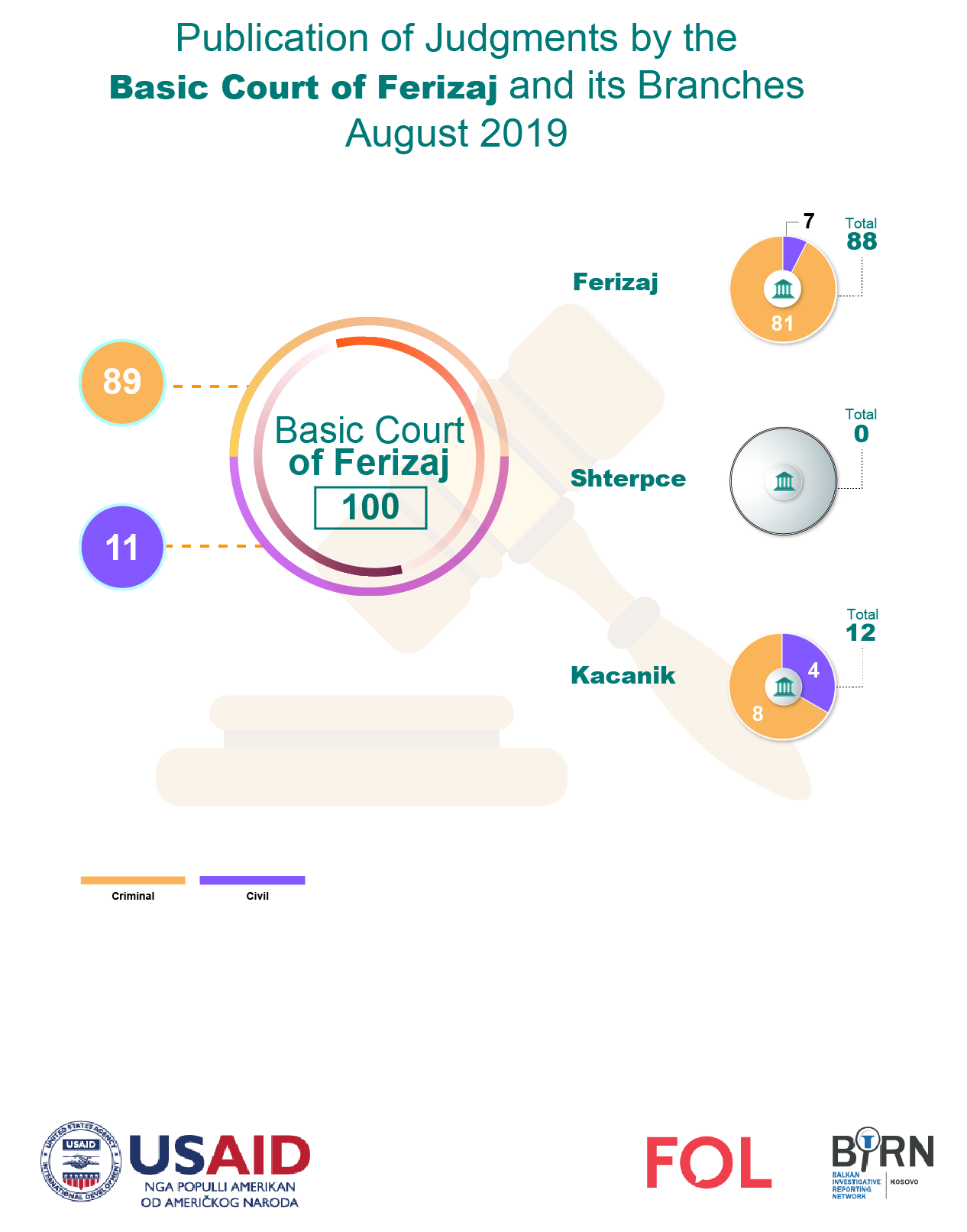
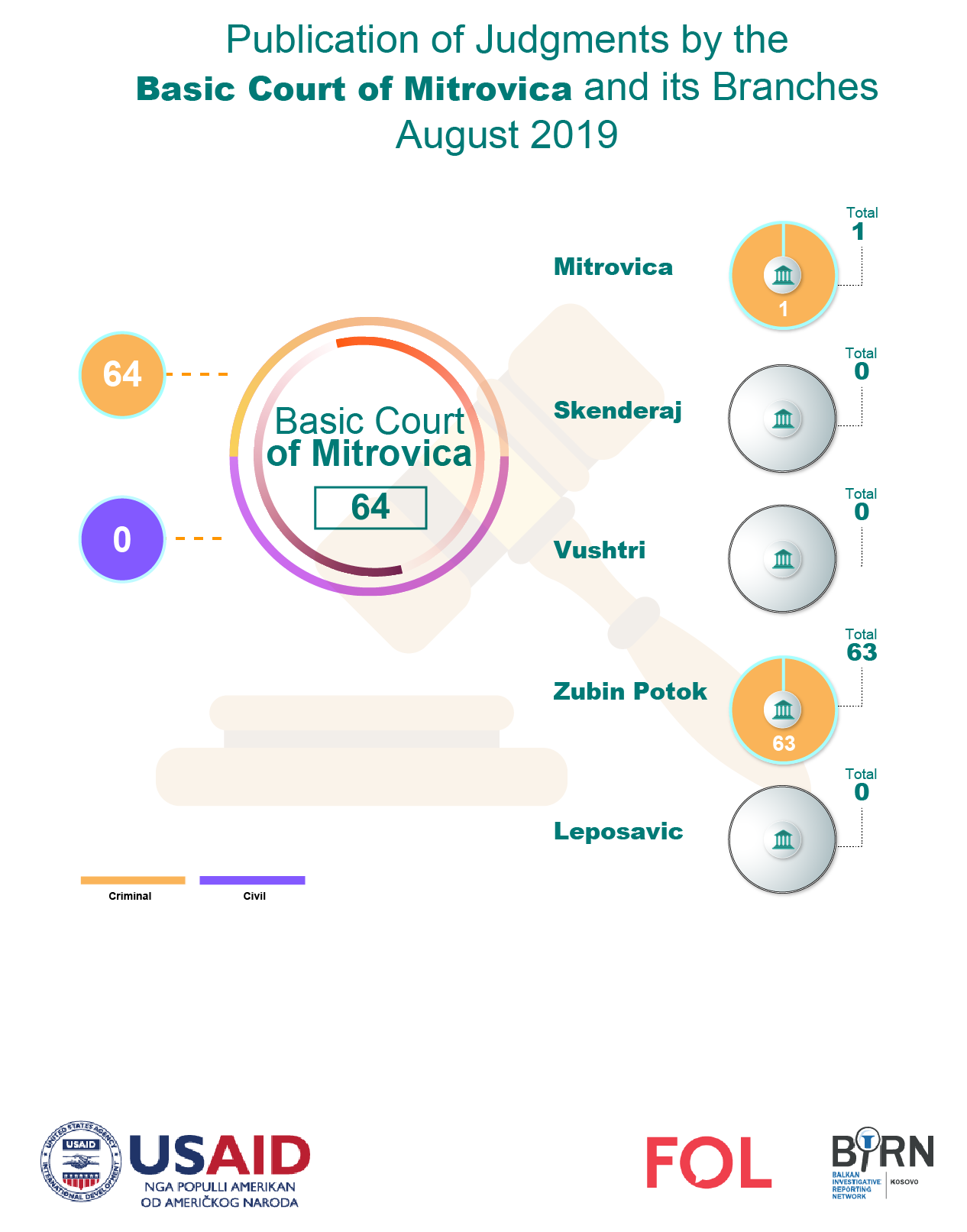
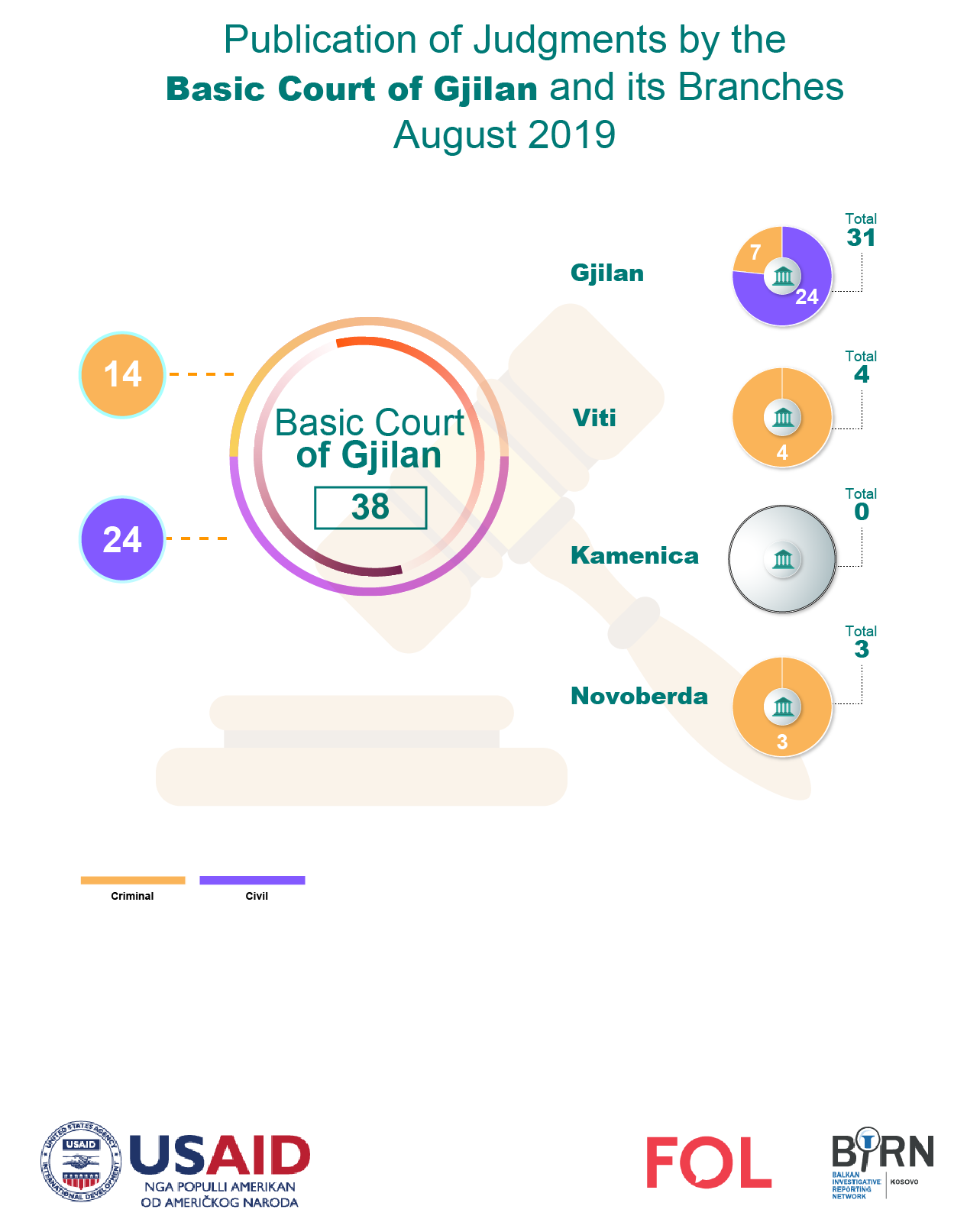
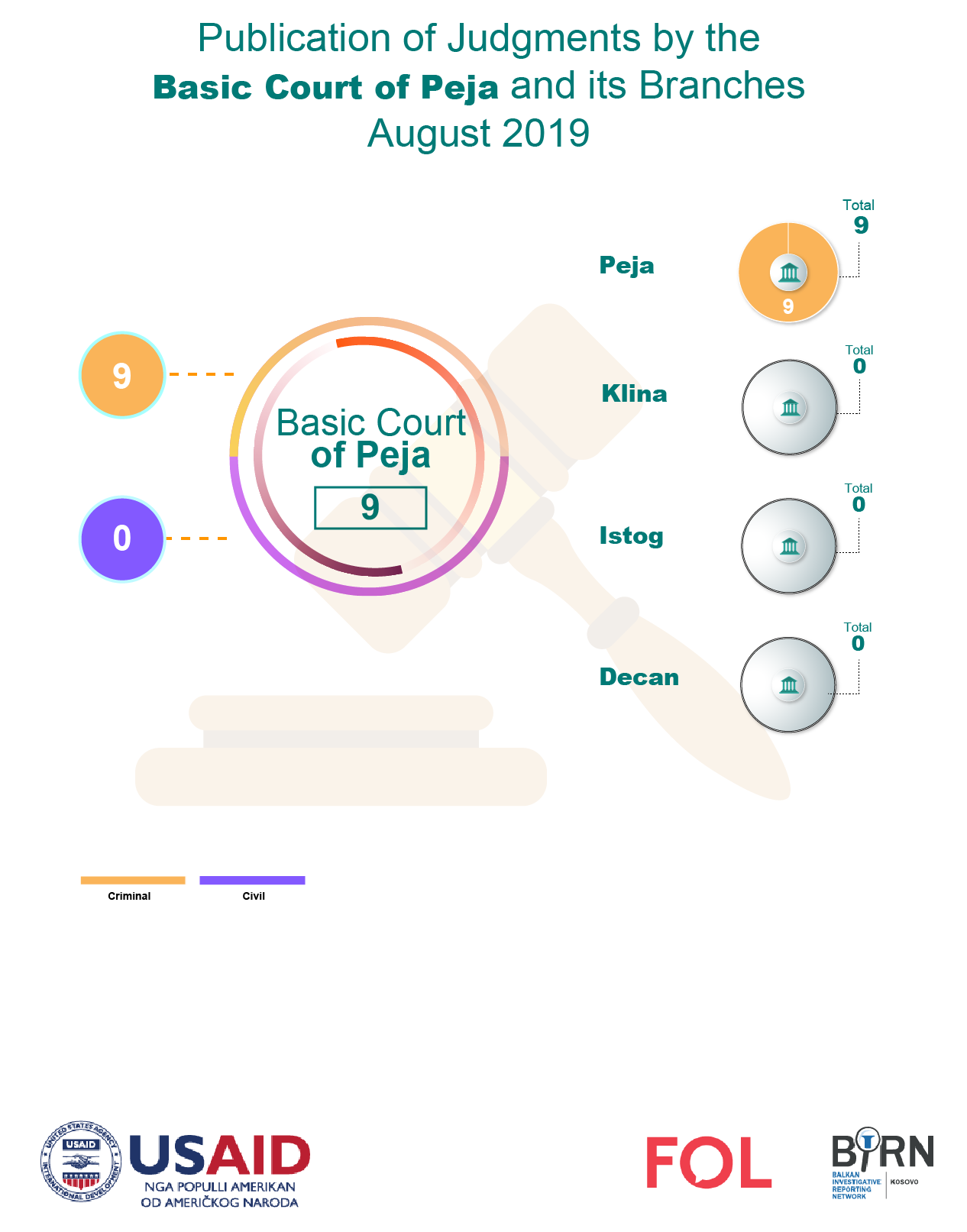
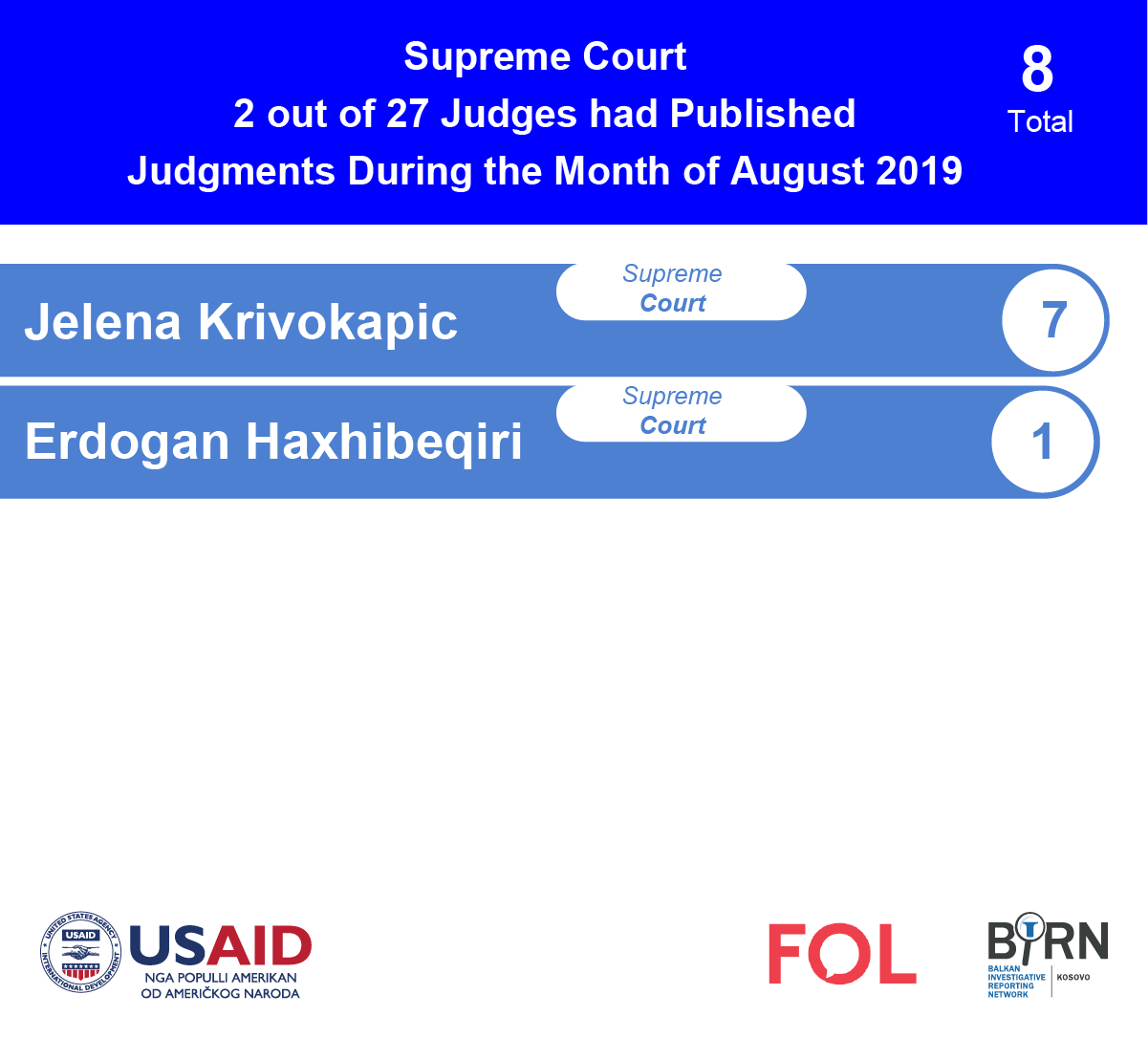
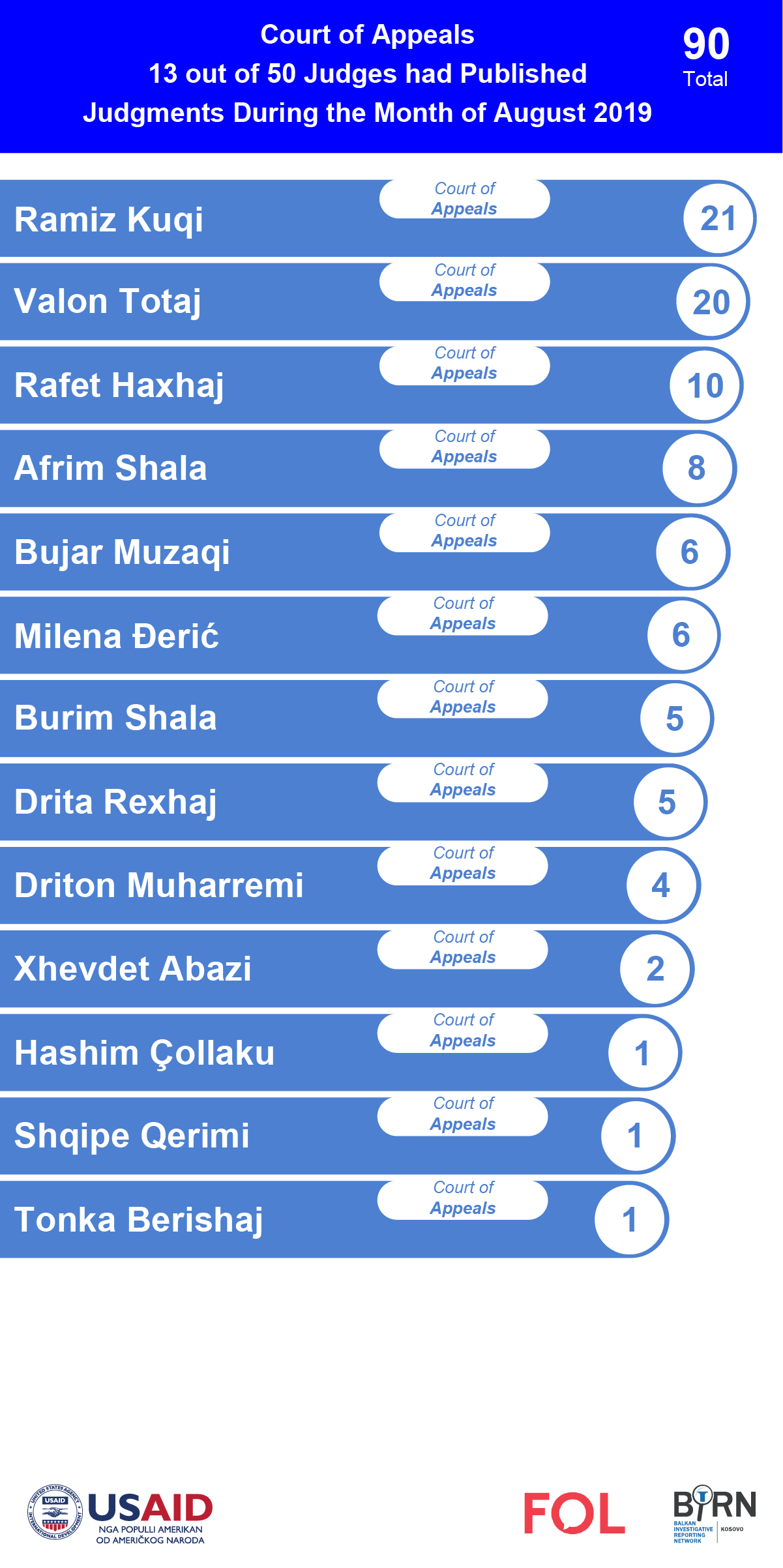
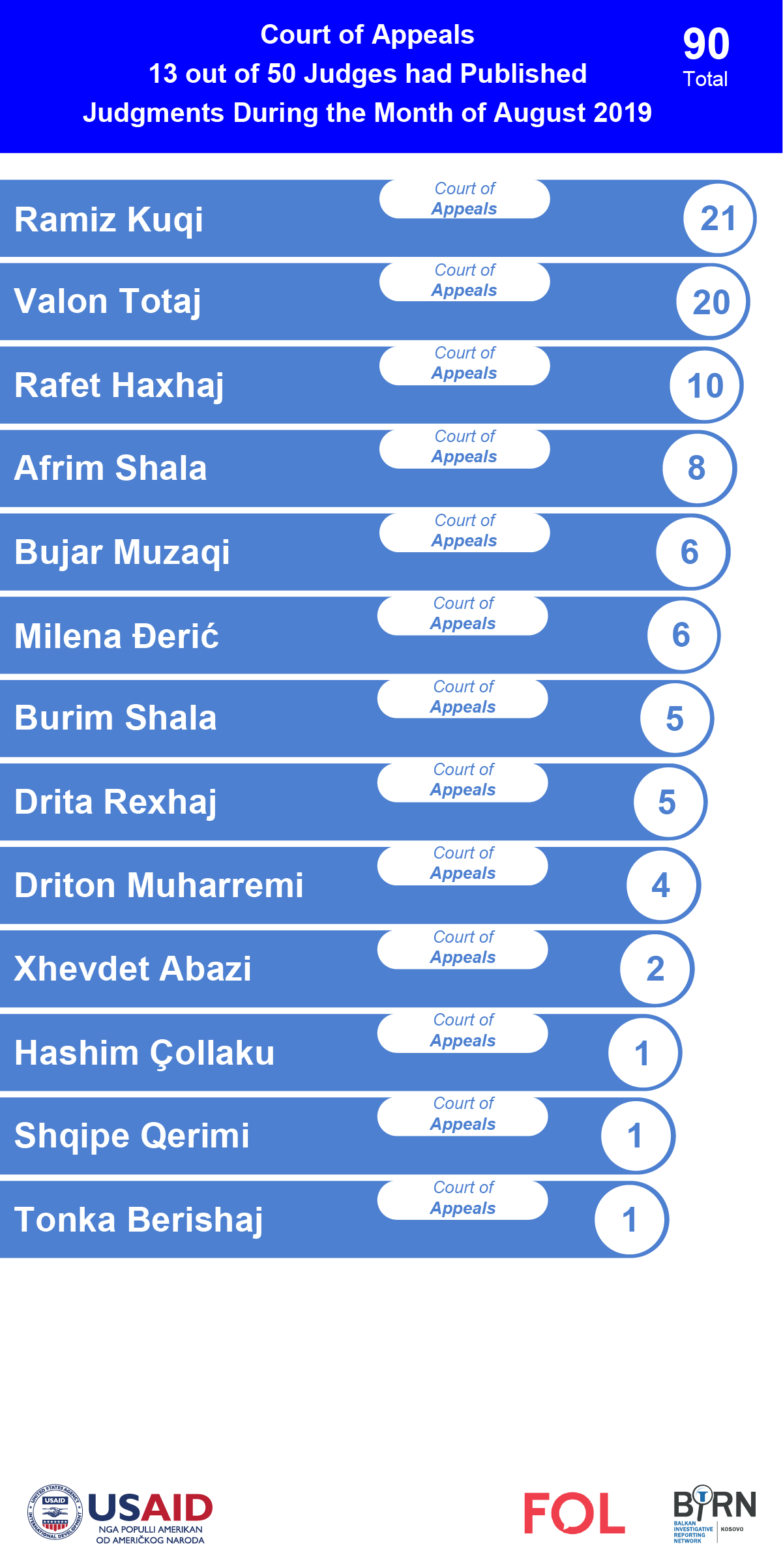
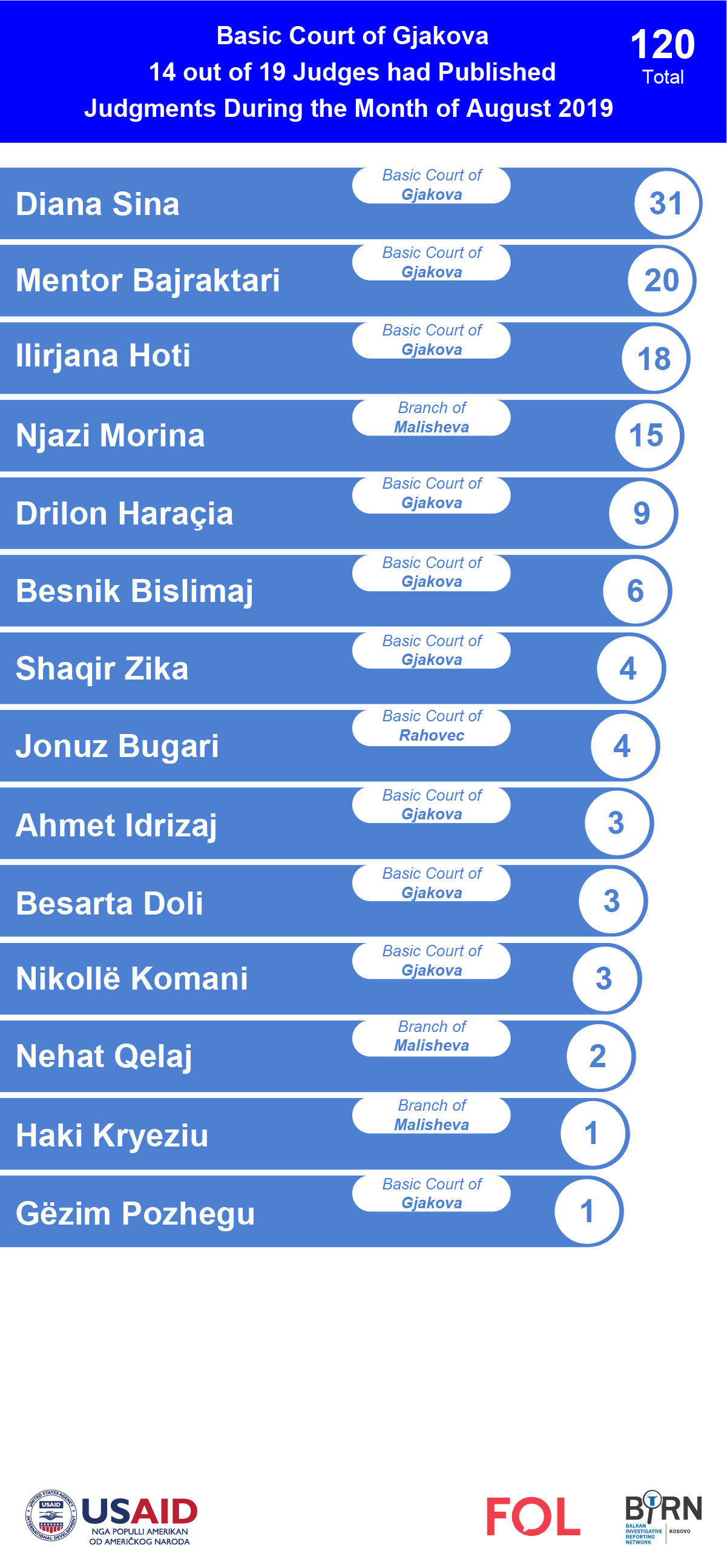
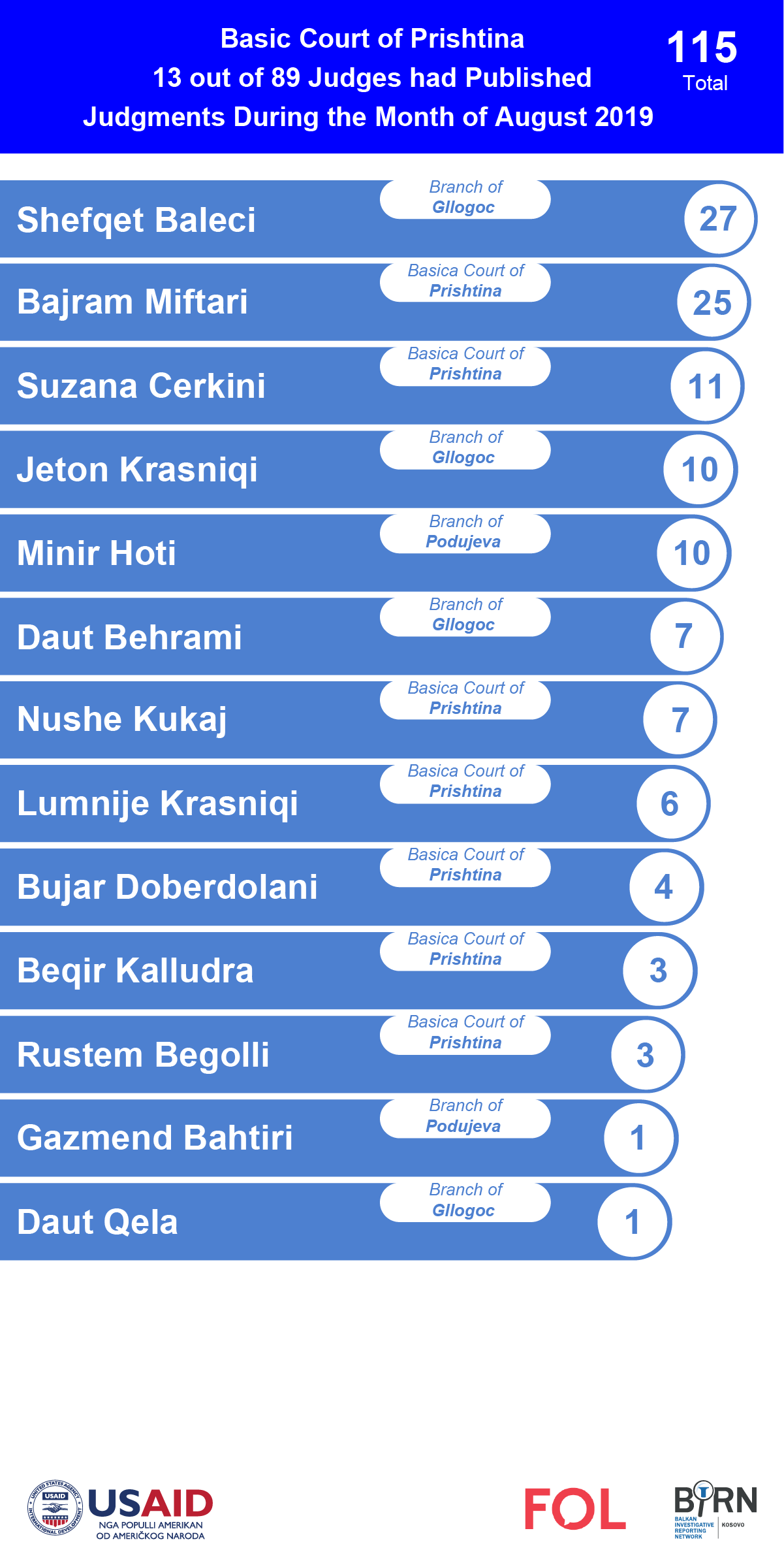
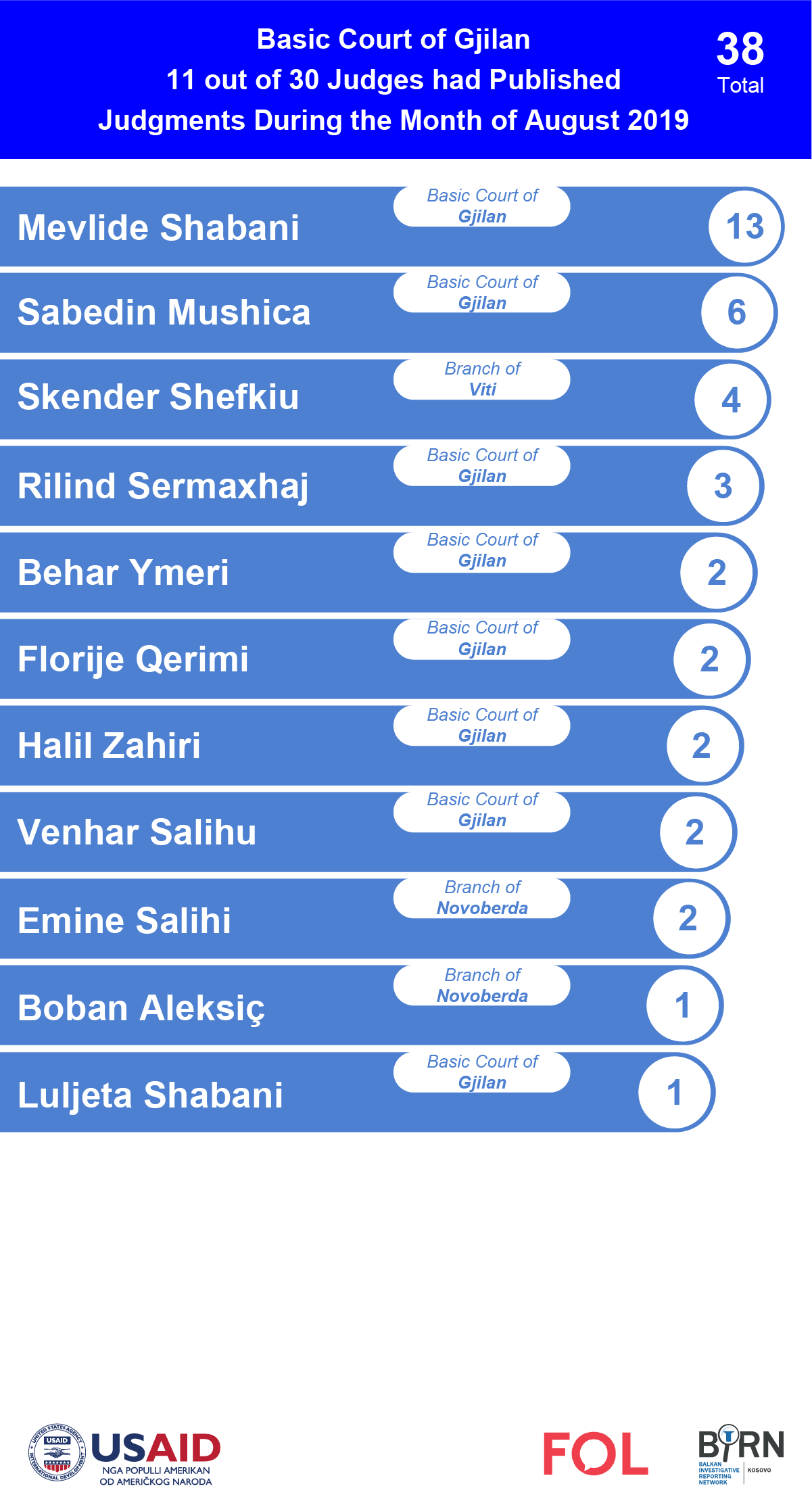
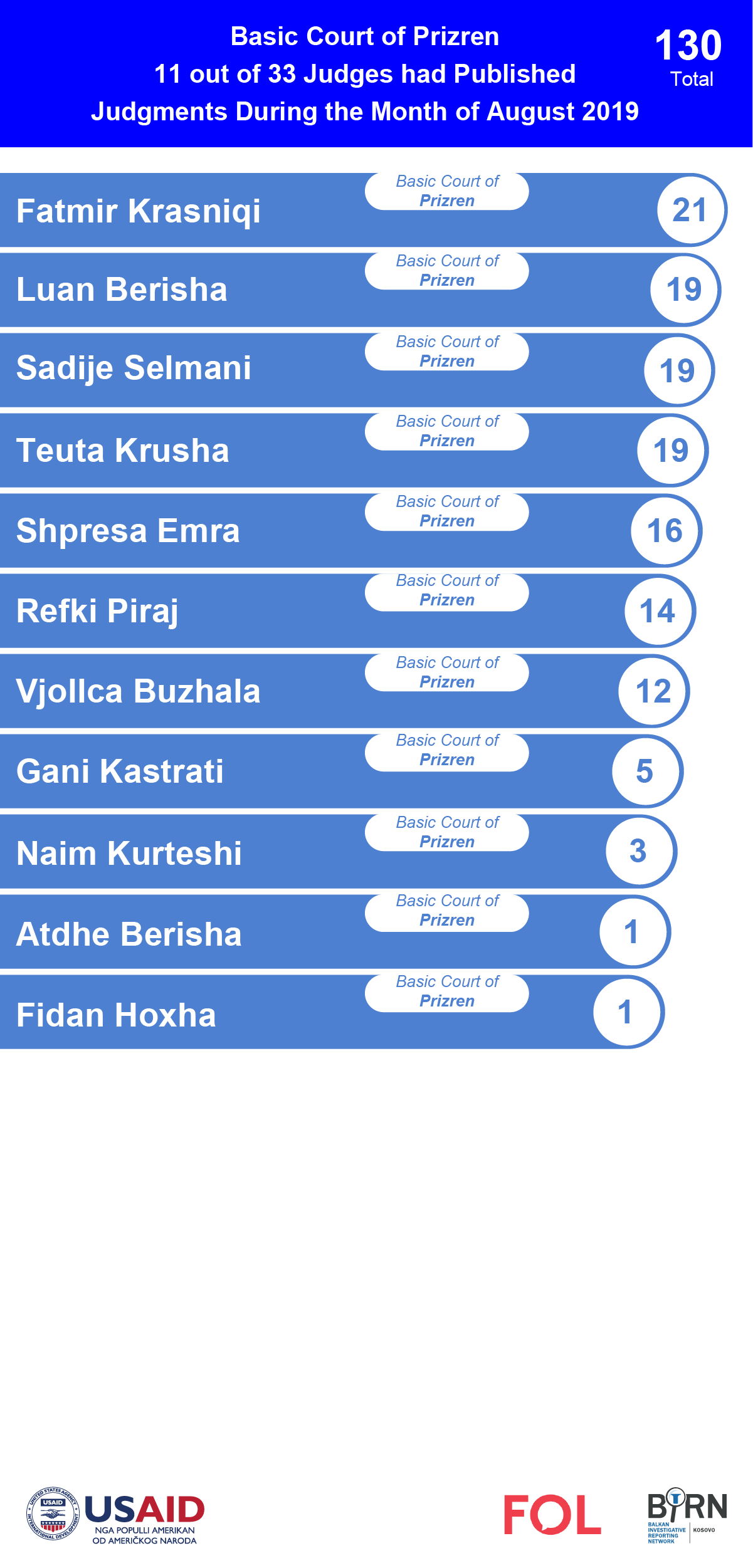
Prizren Basic Court first published verdicts, 130 published for August

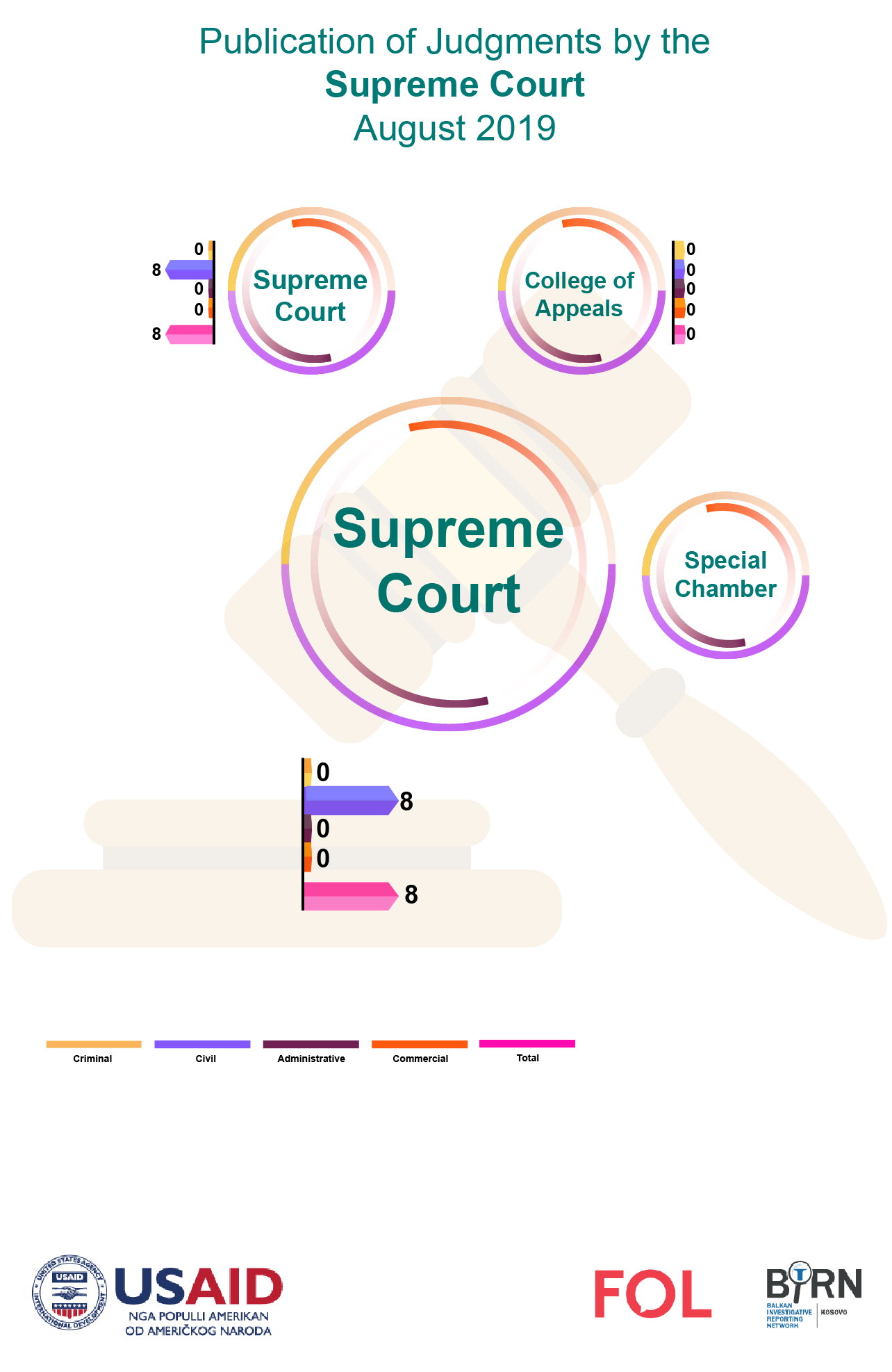
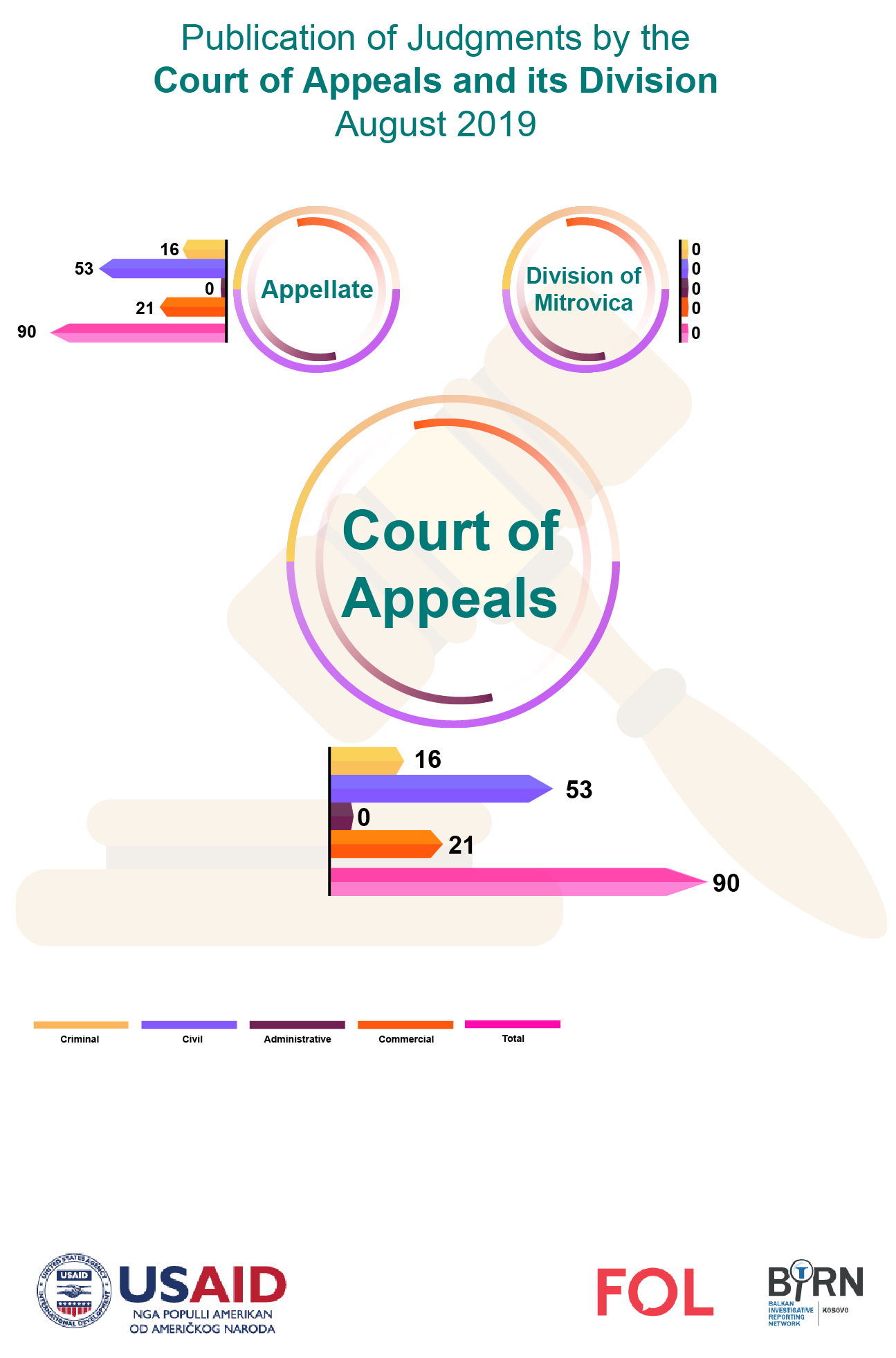
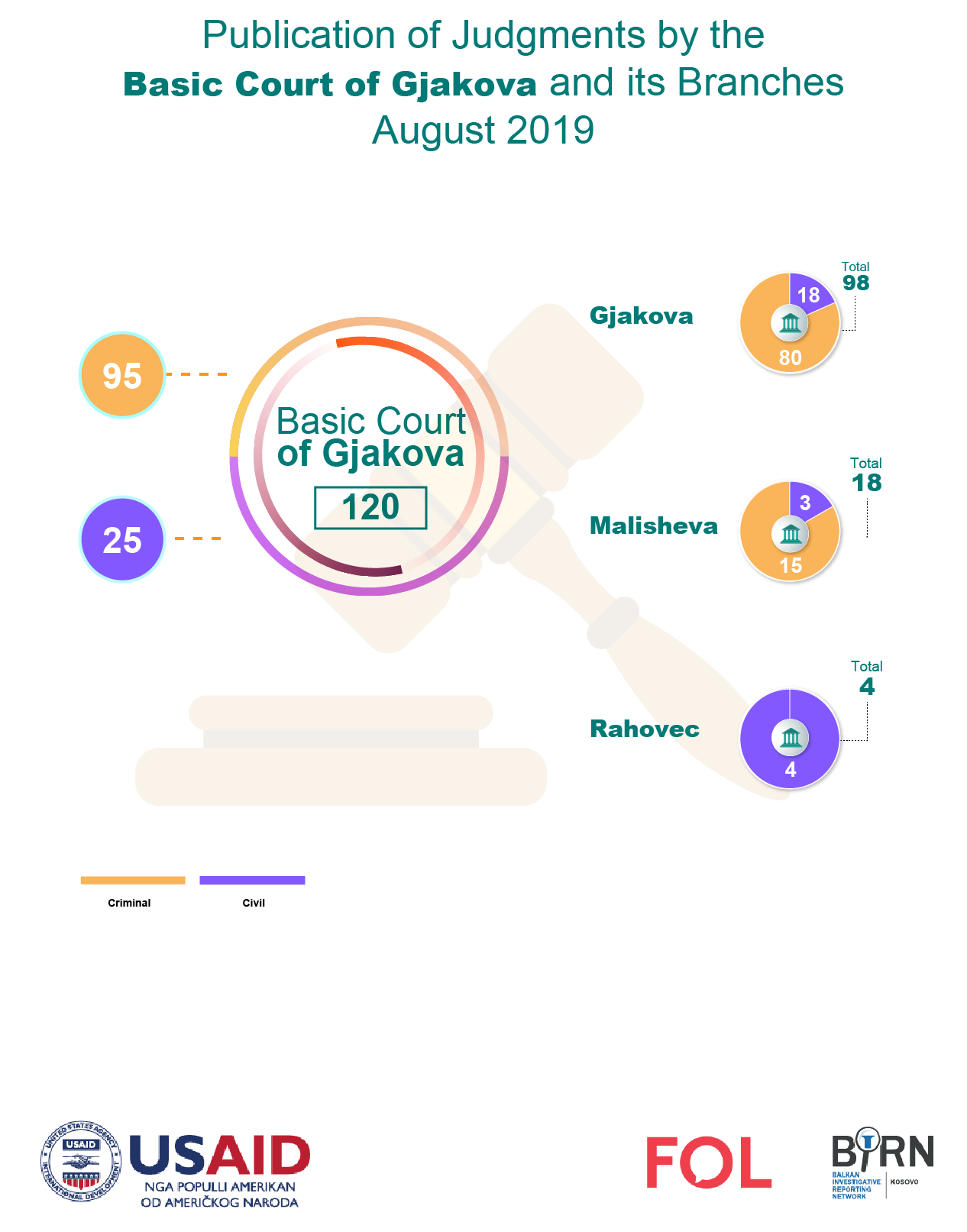
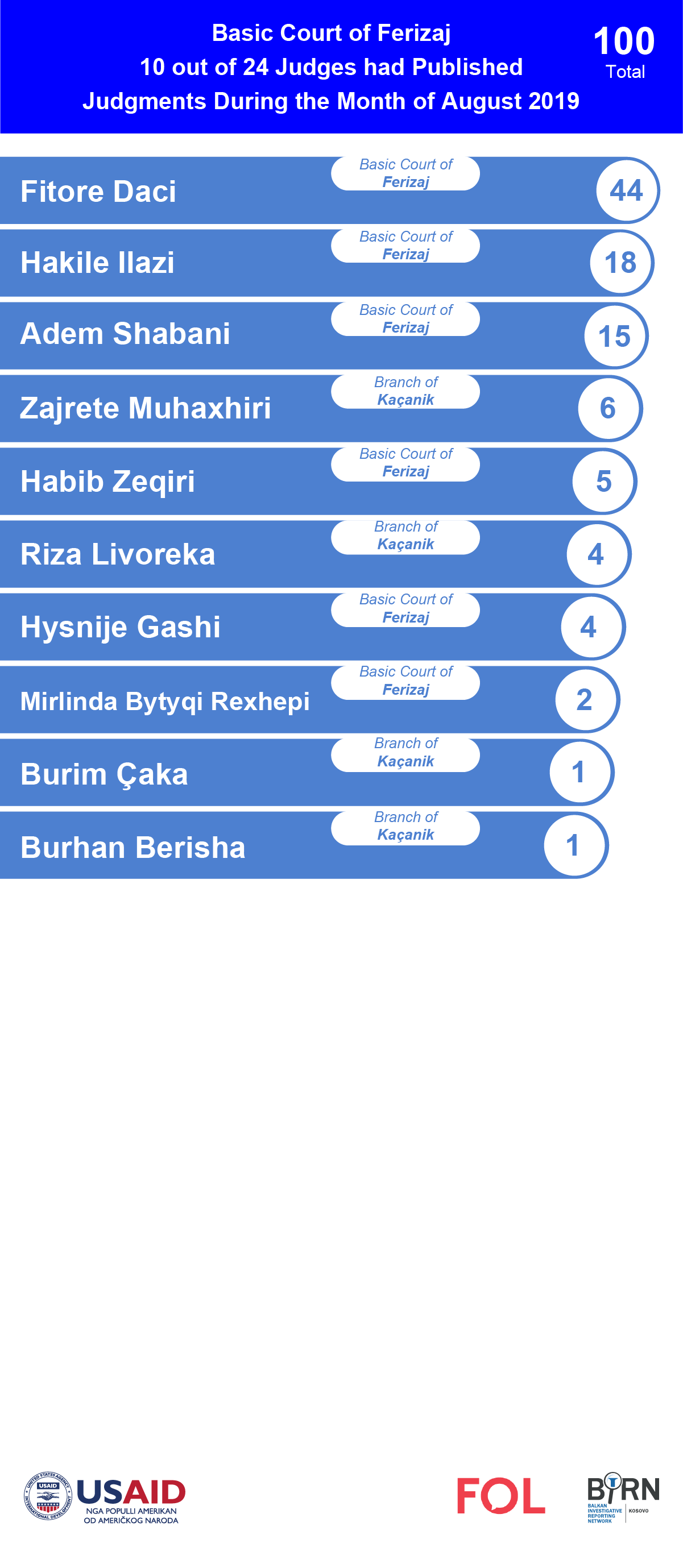
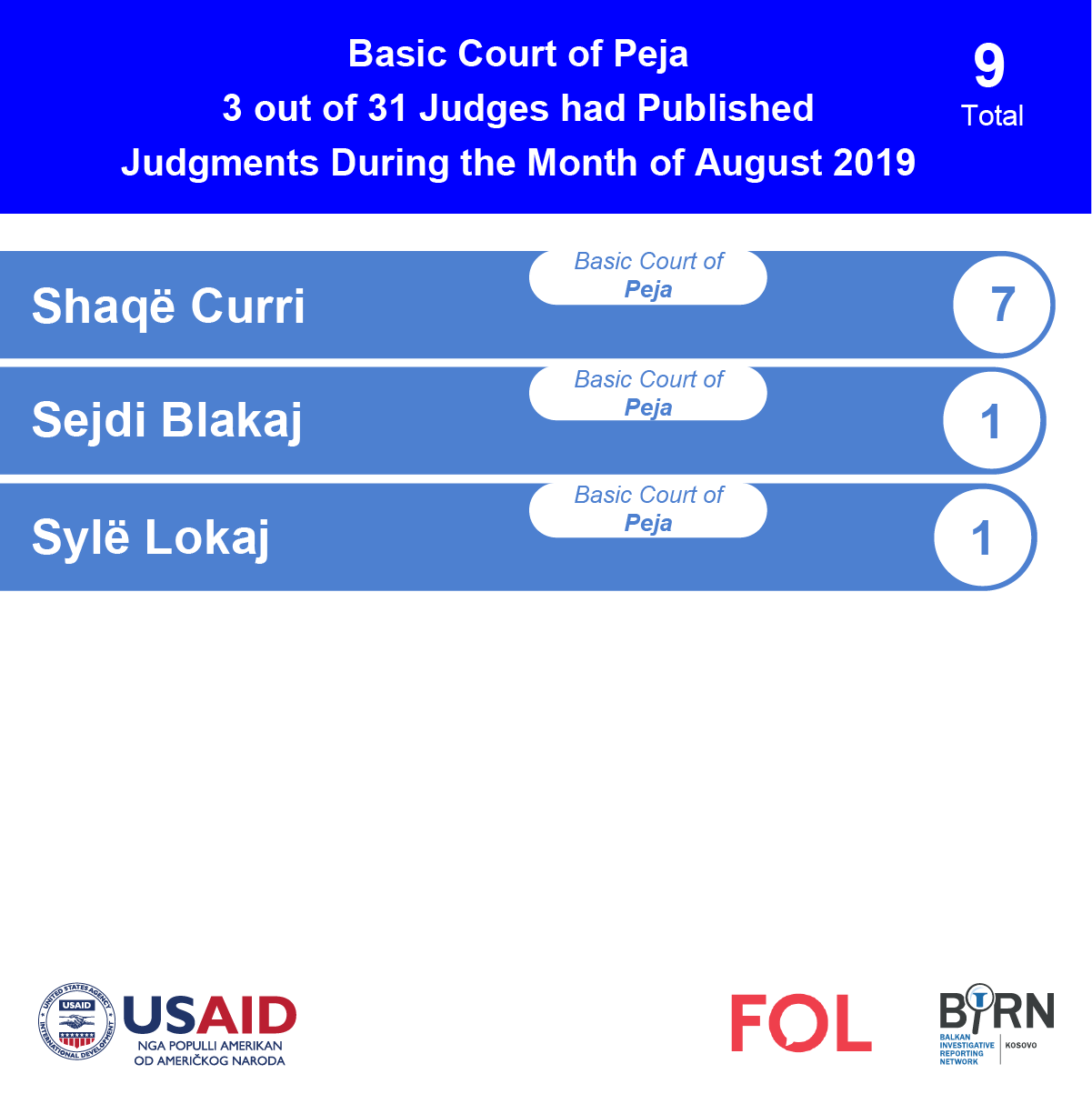
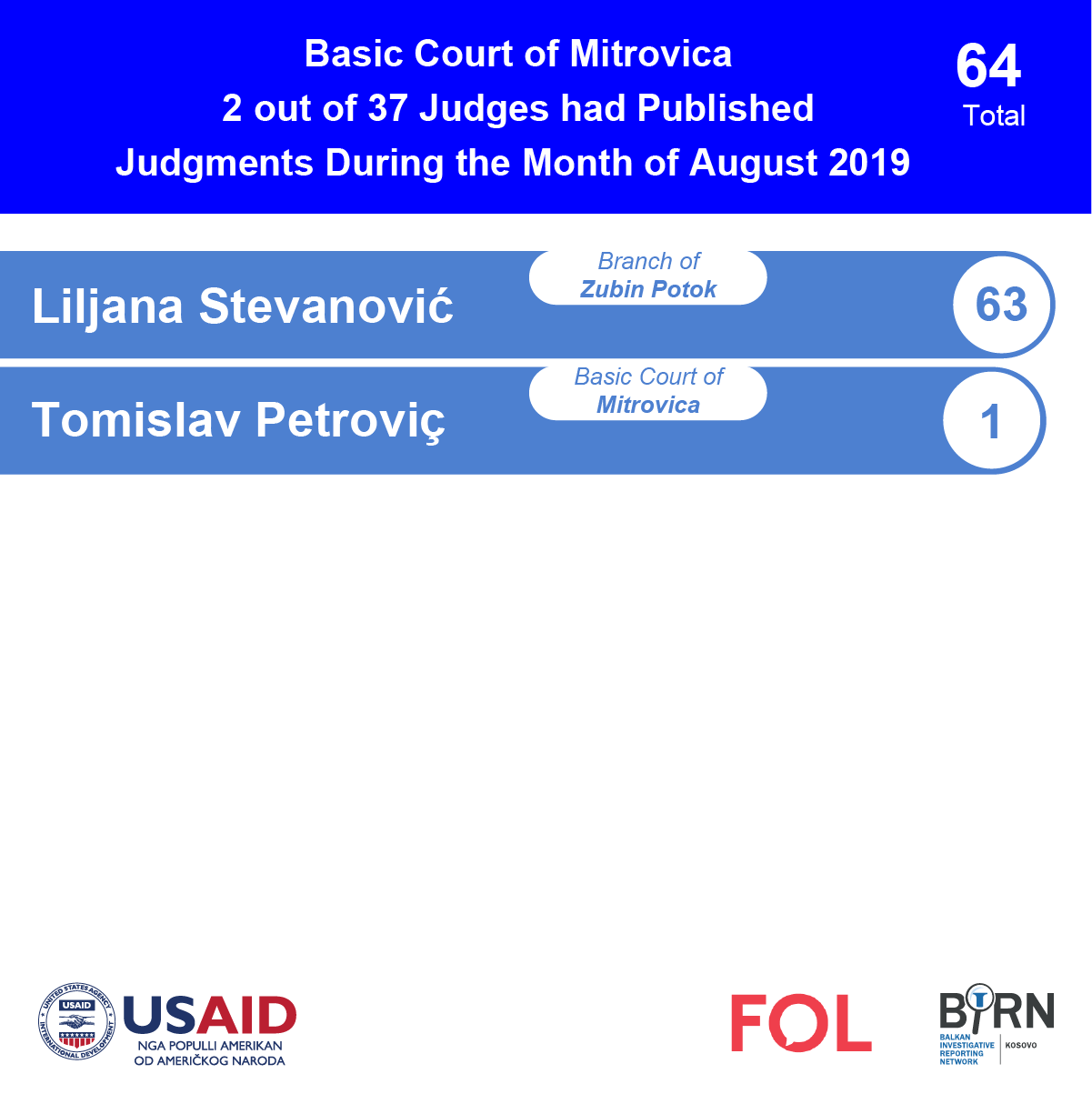
Pristina, September 23, 2019 – FOL Movement and BIRN Kosovo today present data from monitoring the publication of judgments in all Kosovo Courts. Through the following infographics you can see the publication of all judgments by all Kosovo courts for August 2019.


Publication of Judgments by All Courts of Kosovo – August 2019.


Clarification: The publication of judgments during the period of August 1 to August 31, 2019 was monitored for all Kosovo’s courts focusing on criminal, civil, commercial, and administrative departments. Additionally, this monitoring covered the publication of judgments according to judges from all courts (including their branches) for the abovementioned departments. The President of the Supreme Court; President of the Court of Appeals; Presidents of the Basic Courts; and the Judges from the Division for Minor Offences are not included in this monitoring.

During the monitoring of judgments published in the Kosovo Judicial Council’s website, for the above-mentioned period, it has been noted that there is a total of 776 judgments published, or 102 more than BIRN and FOL have in their database. This difference in numbers (especially noticed at the Basic Court of Prizren, the Basic Court of Mitrovica, and the Court of Appeals) is due to double publication of judgments.

Additionally, during the month of June, it has been noticed that courts have published judgments made by judges who have been promoted to more senior positions, have been transferred to Minor Offence Division, or have retired. These shortcomings were noted during a detailed verification by BIRN and FOL.


*Disclaimer: This monitoring was made possible by the support of the American People through the United States Agency for International Development (USAID). The content of this article is the sole responsibility of FOL Movement and BIRN Kosova and does not necessarily reflect the views of the United States Agency for International Development or the United States Government.


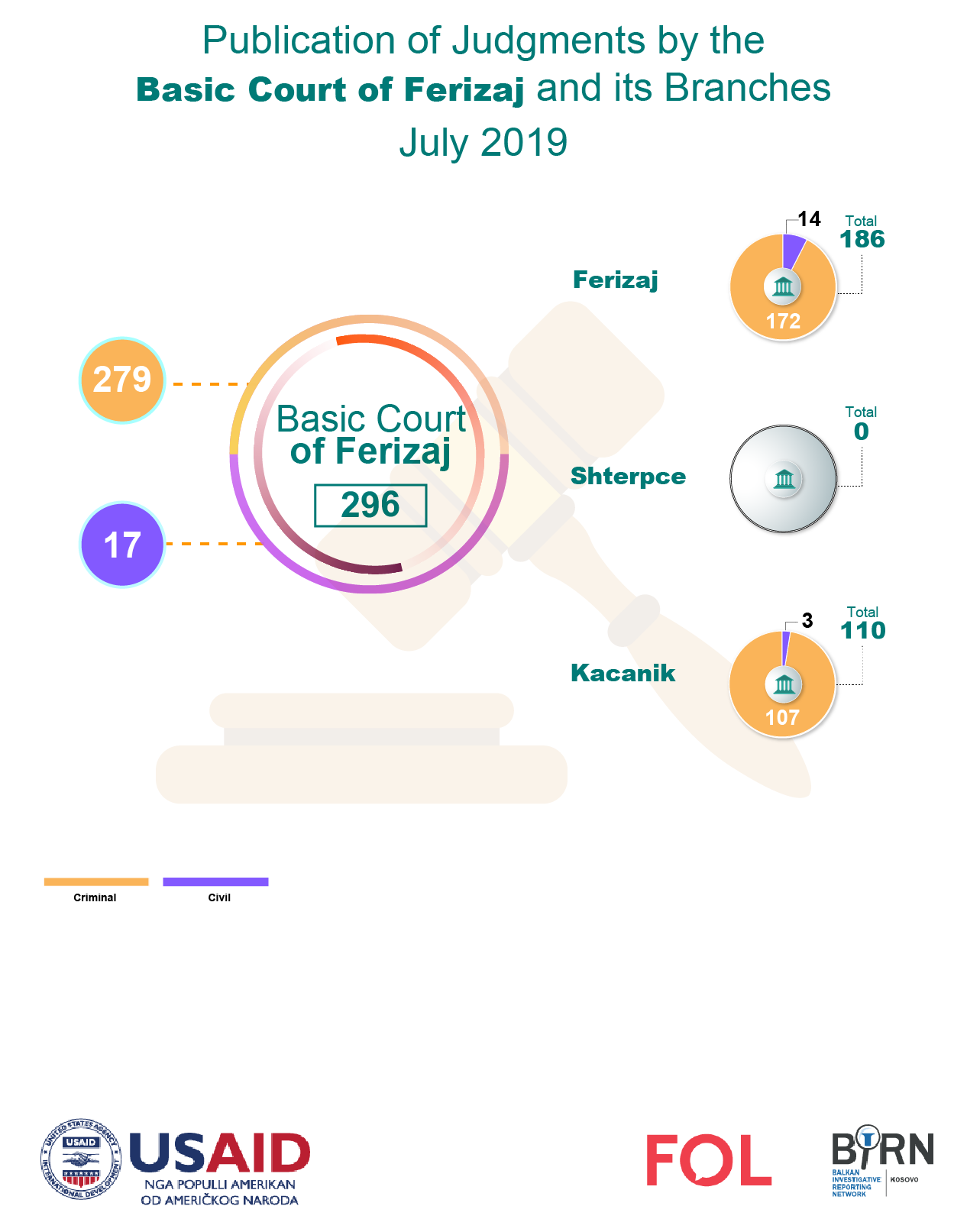
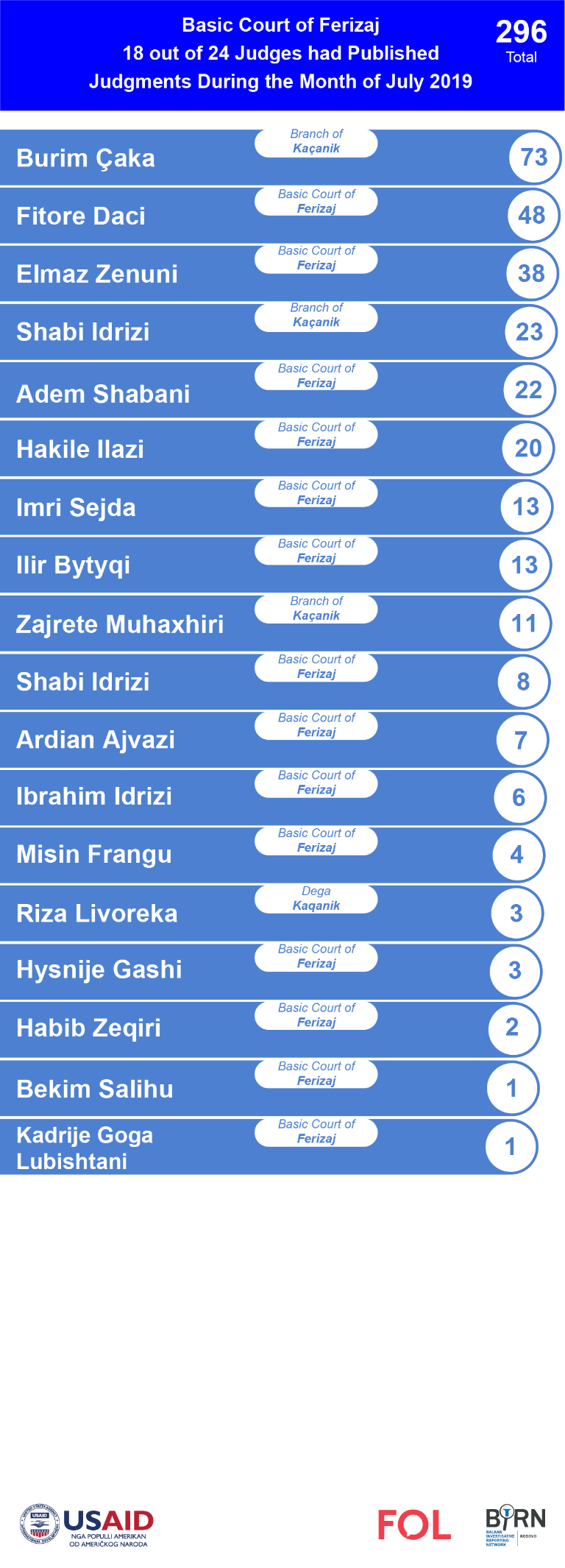
The Basic Court of Ferizaj is due to publish its verdicts for July 2019 as well

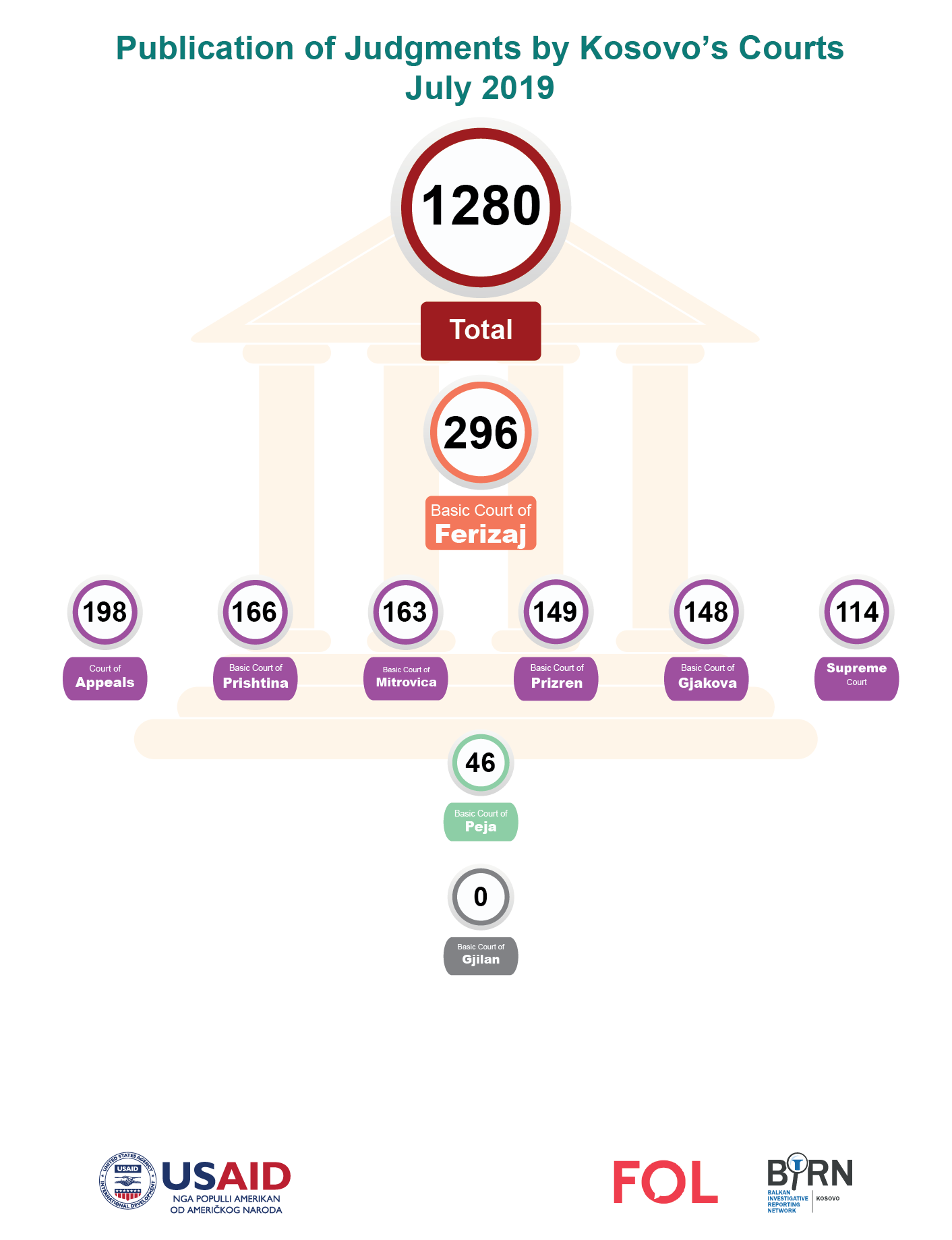
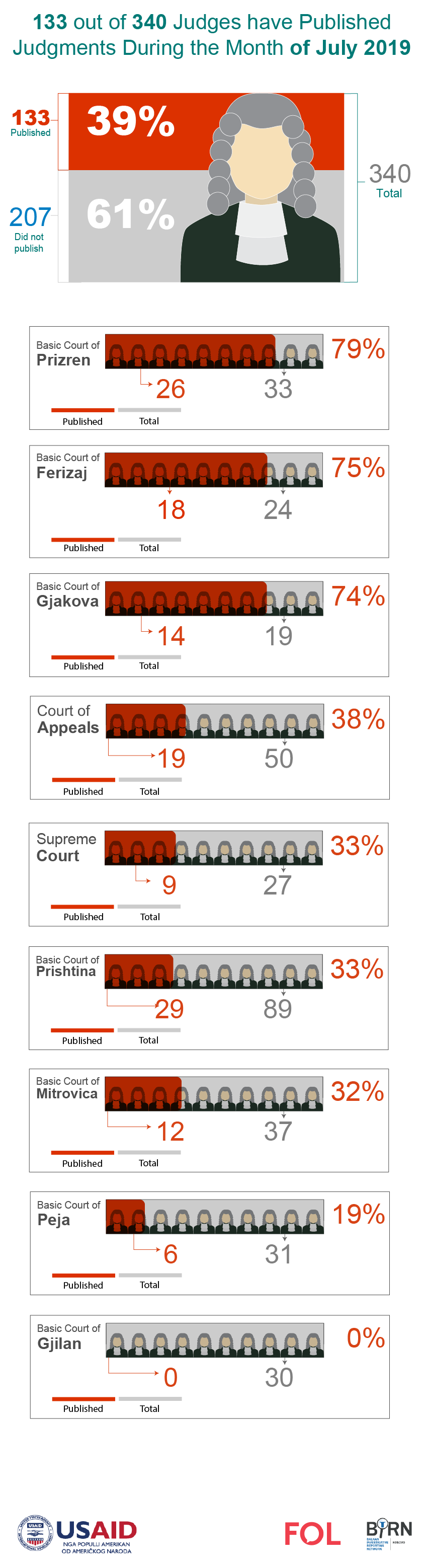
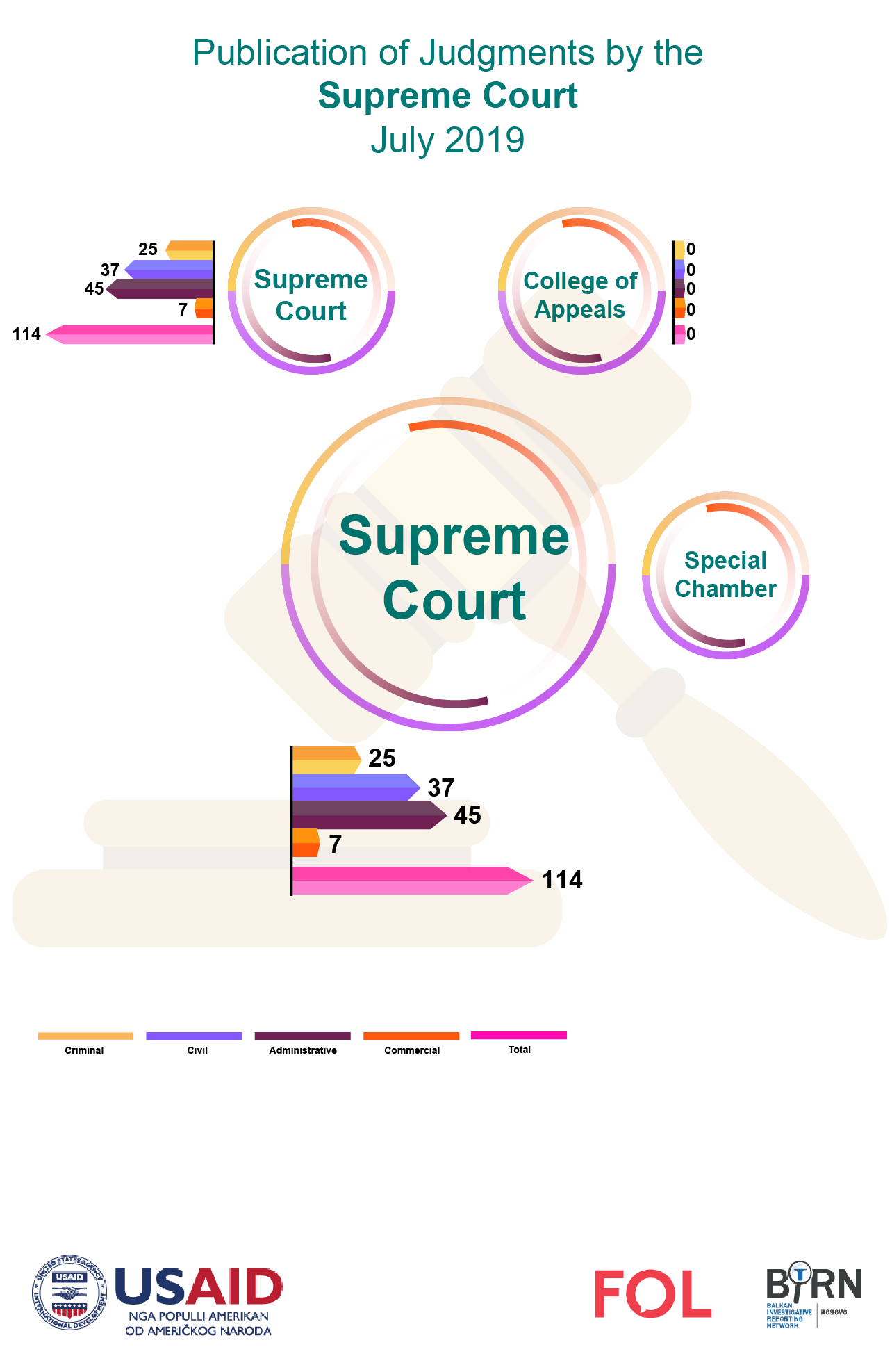
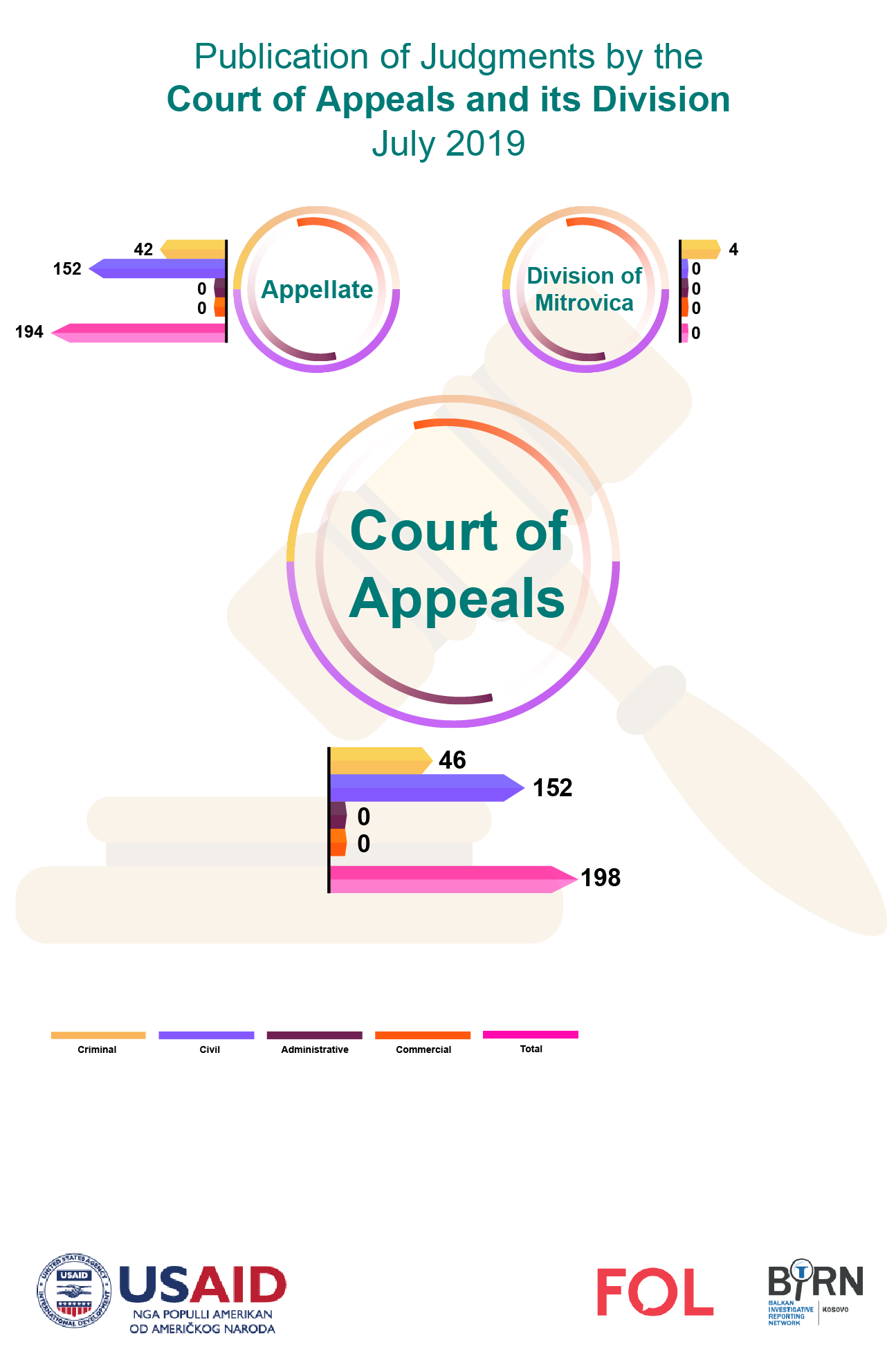
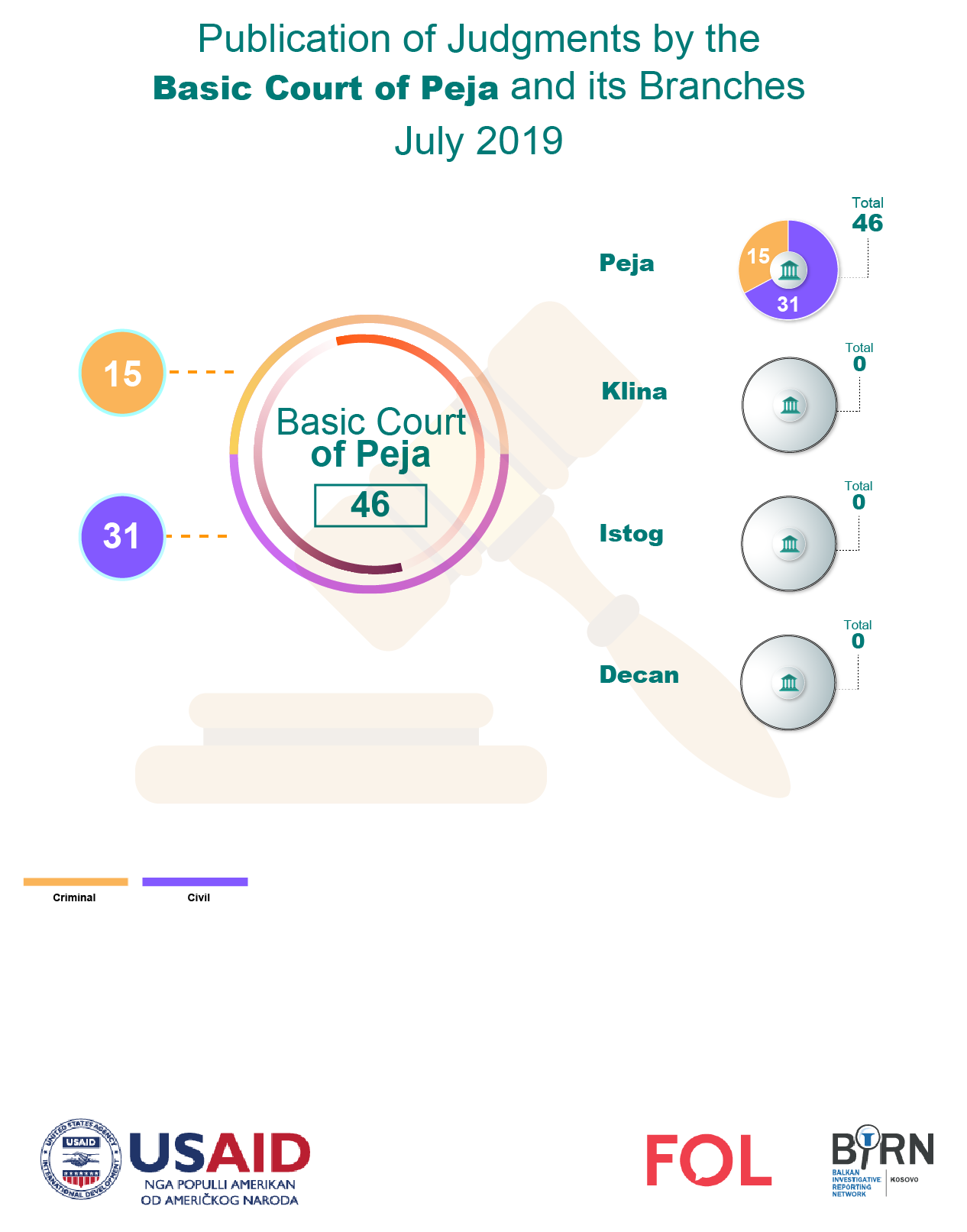
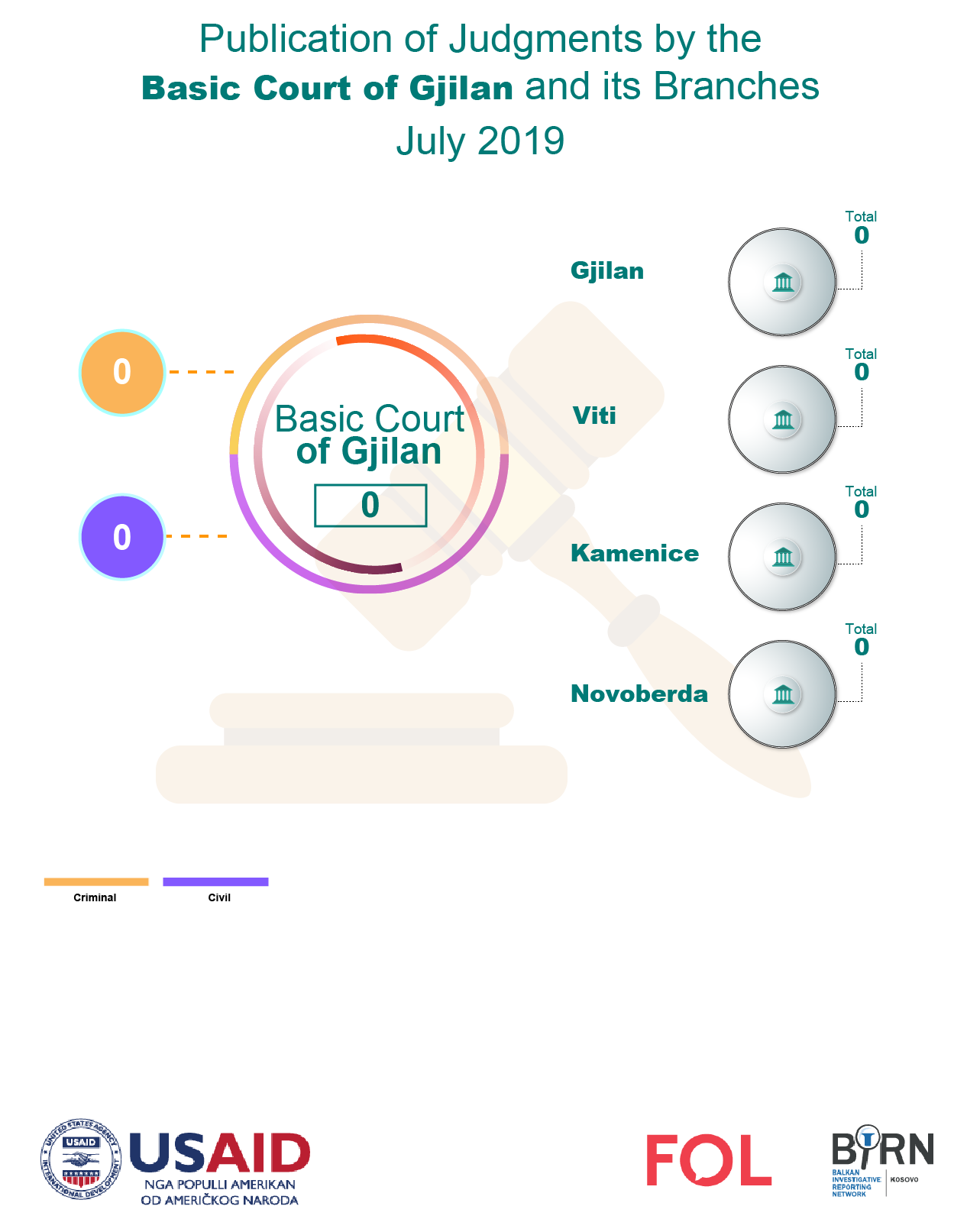
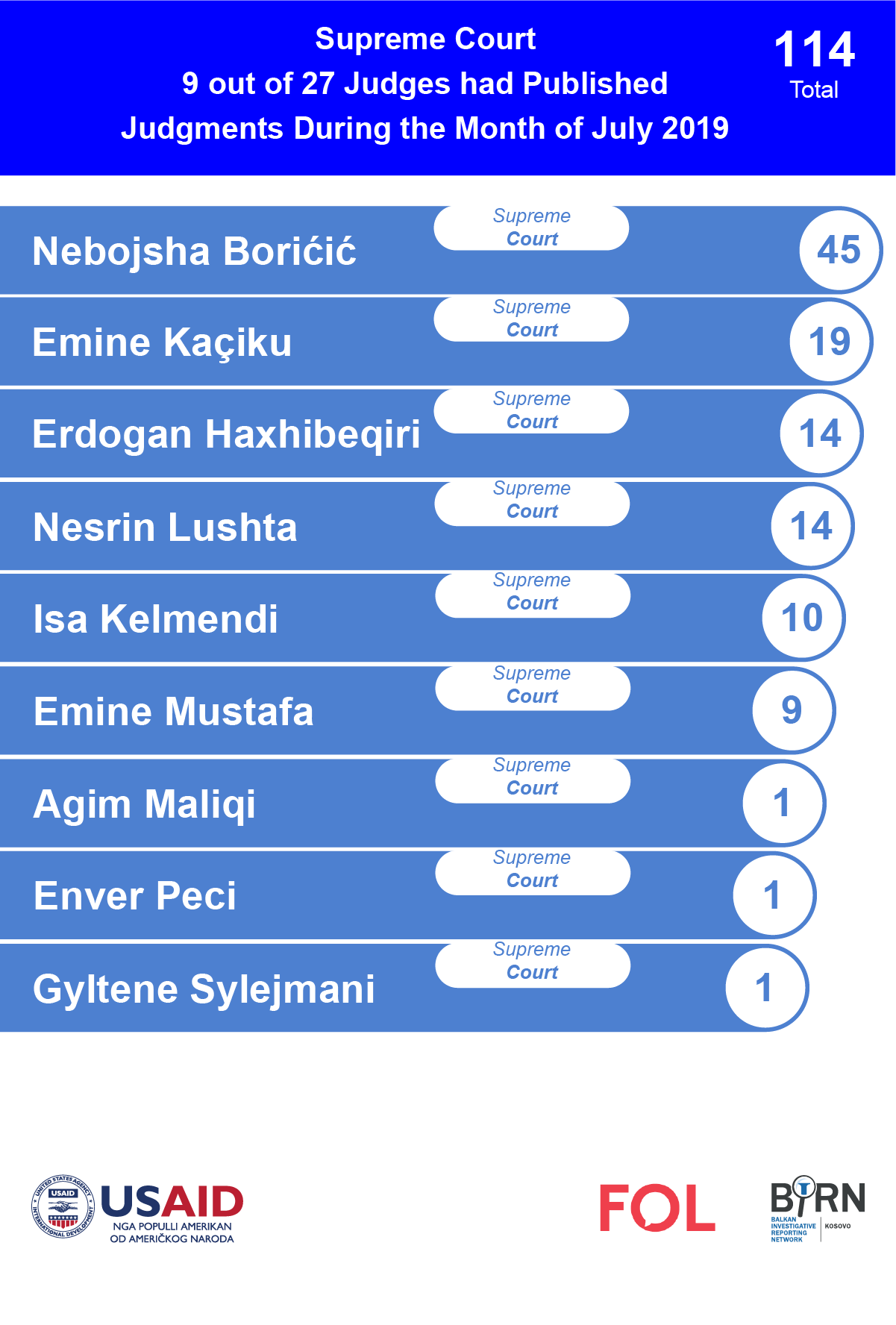
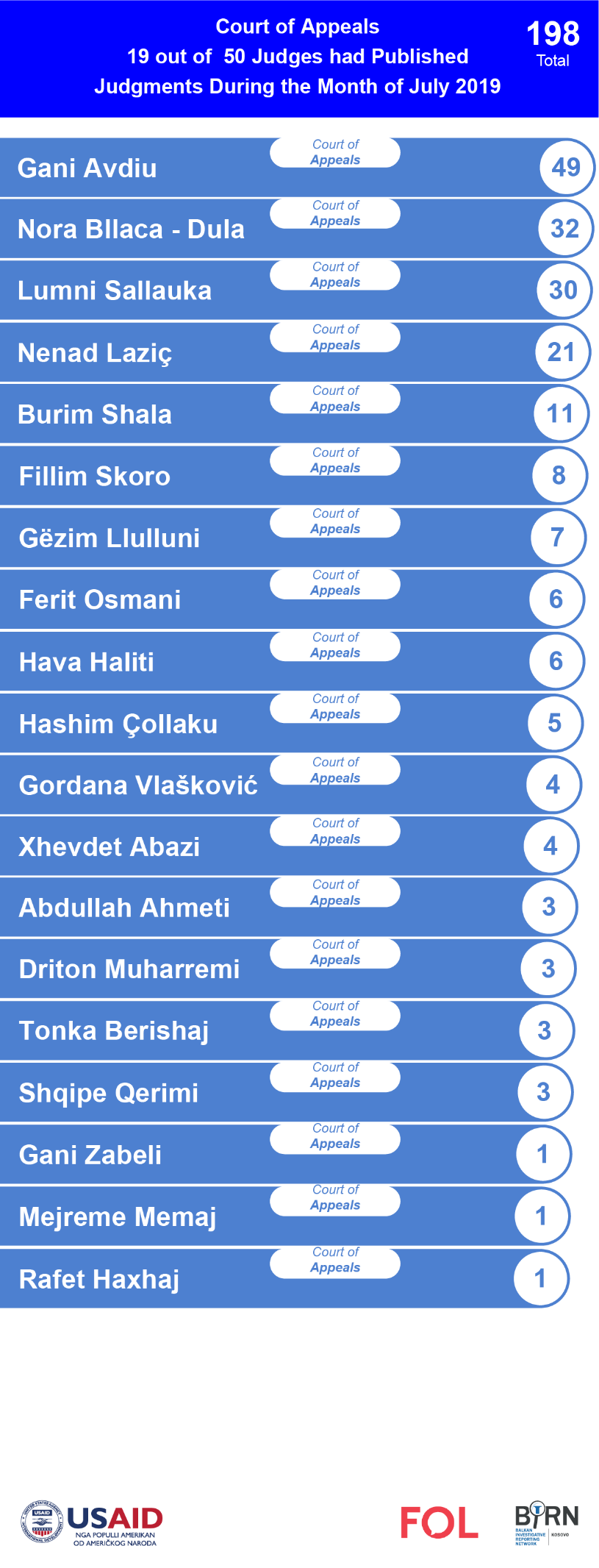
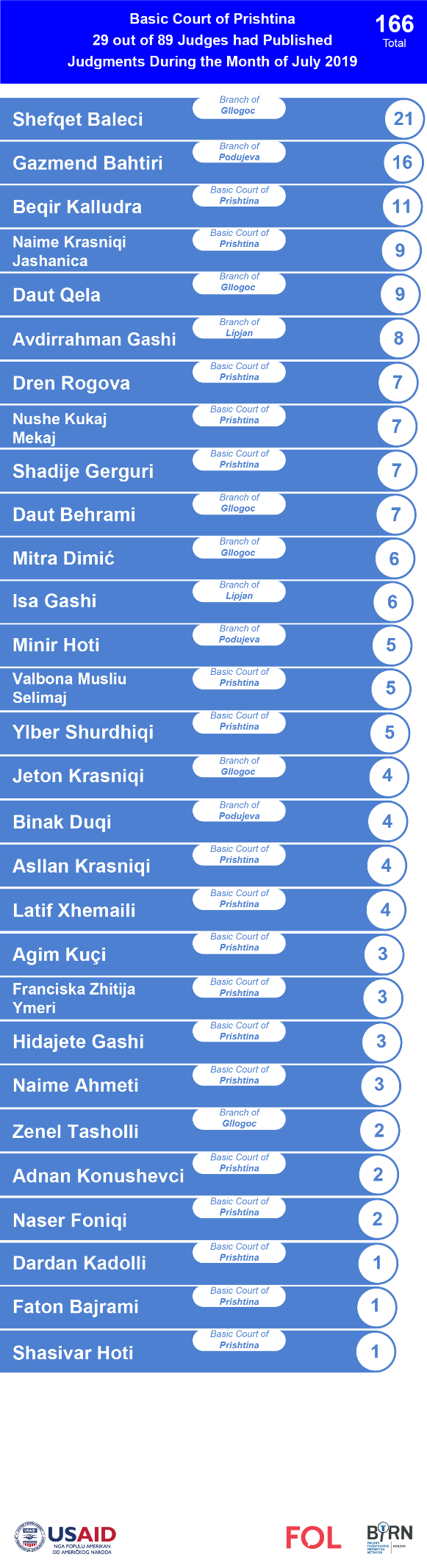
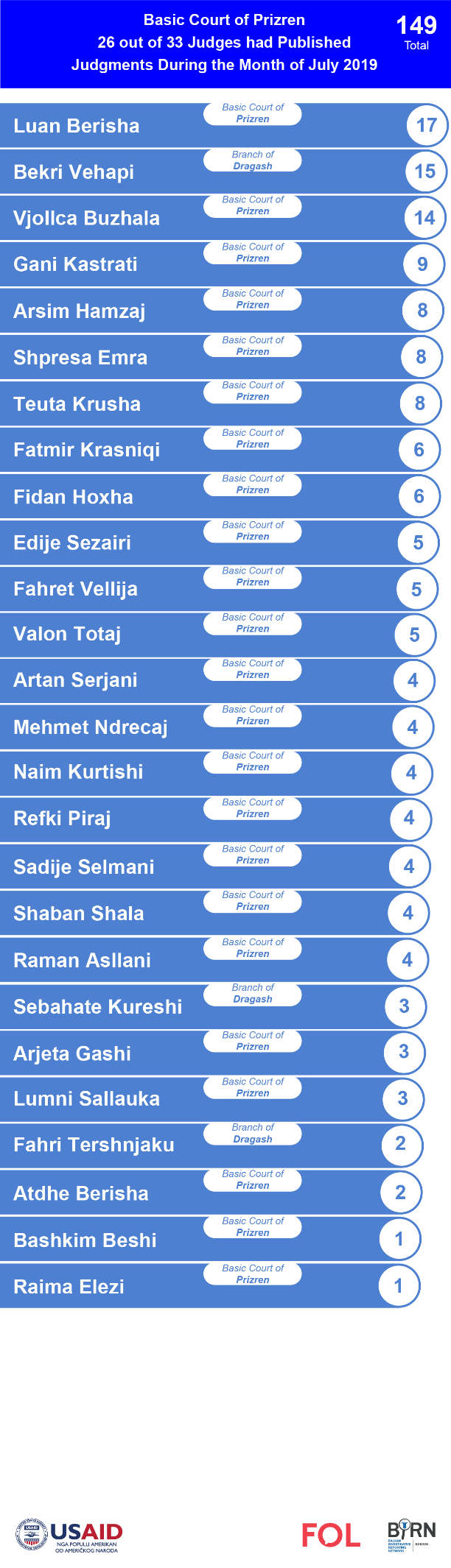
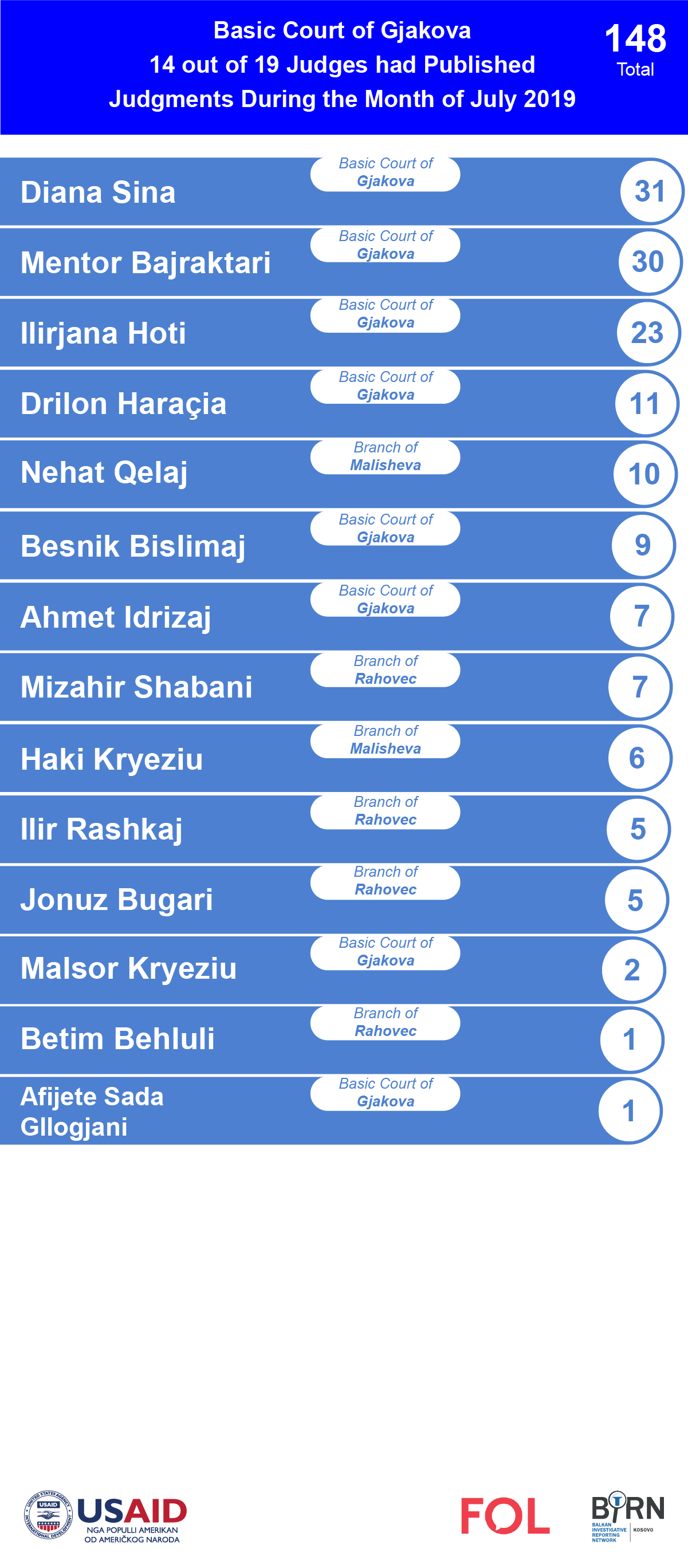
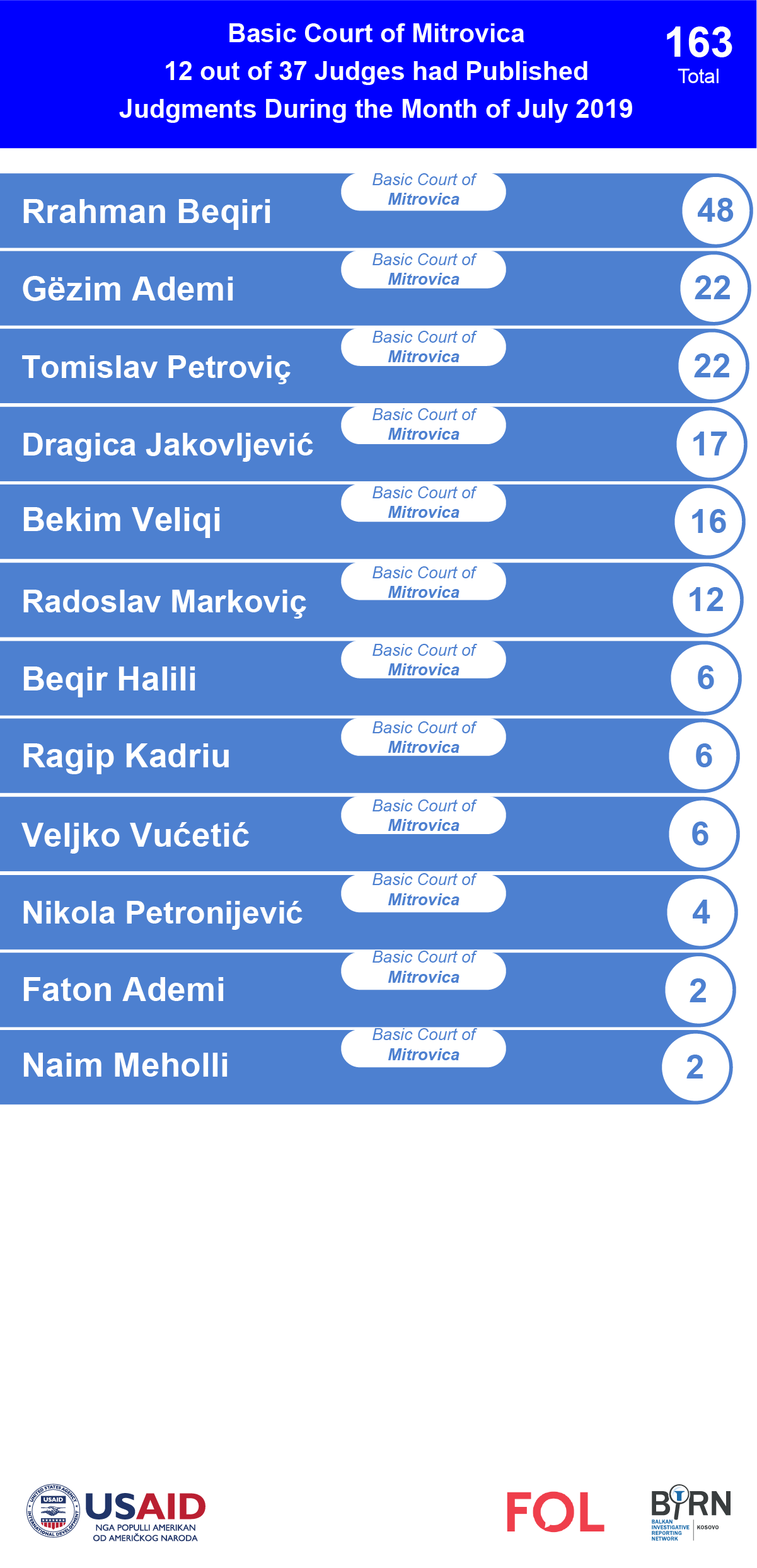
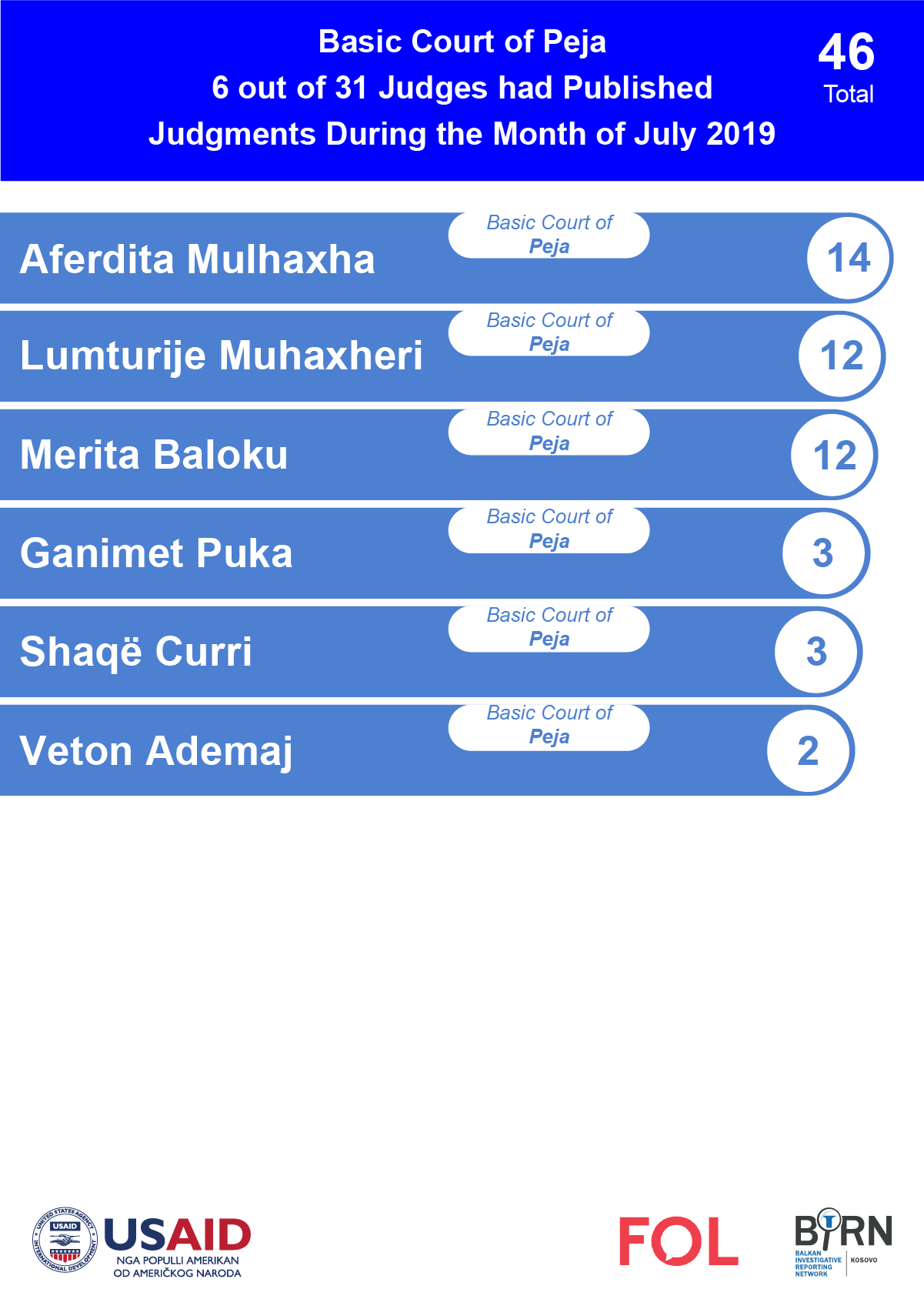
Prishtinë, 27 august 2019 – FOL Movement and BIRN Kosovo today present data from monitoring the publication of judgments in all Kosovo Courts. Through the following infographics you can see the publication of all judgments by all Kosovo courts for July 2019.

Publication of judgments by all Kosovo courts – July 2019


Clarification: The publication of judgments during the period of July 1 to July 31, 2019 was monitored for all Kosovo’s courts focusing on criminal, civil, commercial, and administrative departments. Additionally, this monitoring covered the publication of judgments according to judges from all courts (including their branches) for the abovementioned departments. The President of the Supreme Court; President of the Court of Appeals; Presidents of the Basic Courts; and the Judges from the Division for Minor Offences are not included in this monitoring.
During the monitoring of judgments published in the Kosovo Judicial Council’s website, for the above-mentioned period, it has been noted that there is a total of 1296 judgments published, or 16 more than BIRN and FOL have in their database. This difference in numbers (especially noticed at the Basic Court of Prizren and the Court of Appeals) is due to double publication of judgments, and the publication of one decision.

Additionally, during the month of June, it has been noticed that courts have published judgments made by judges who have been promoted to more senior positions, have been transferred to Minor Offence Division, or have retired. These shortcomings were noted during a detailed verification by BIRN and FOL.


*Disclaimer: This monitoring was made possible by the support of the American People through the United States Agency for International Development (USAID). The content of this article is the sole responsibility of FOL Movement and BIRN Kosova and does not necessarily reflect the views of the United States Agency for International Development or the United States Government.


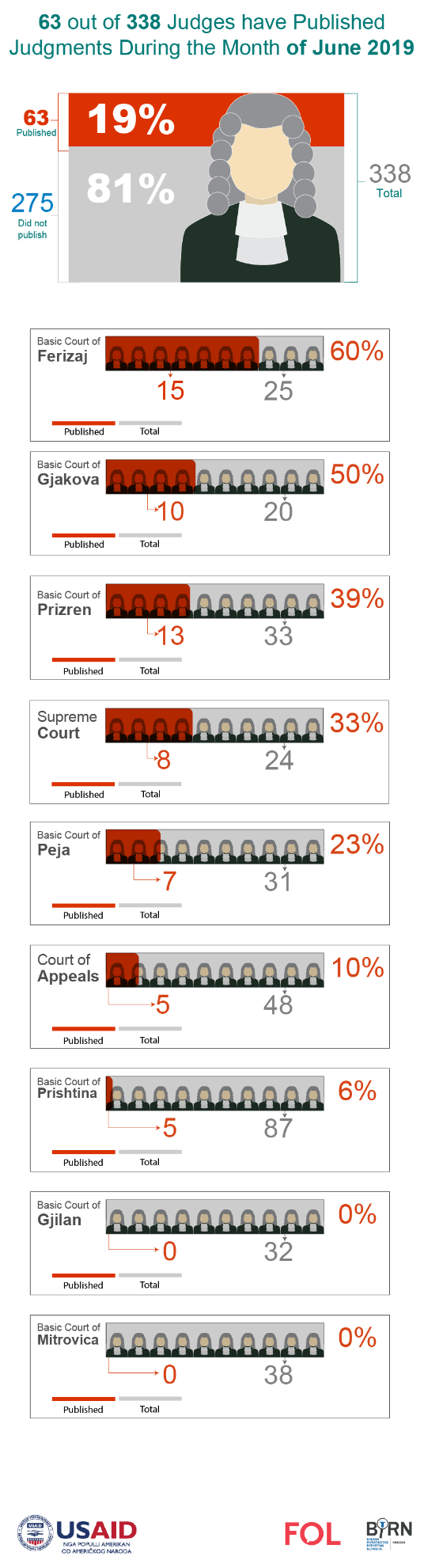
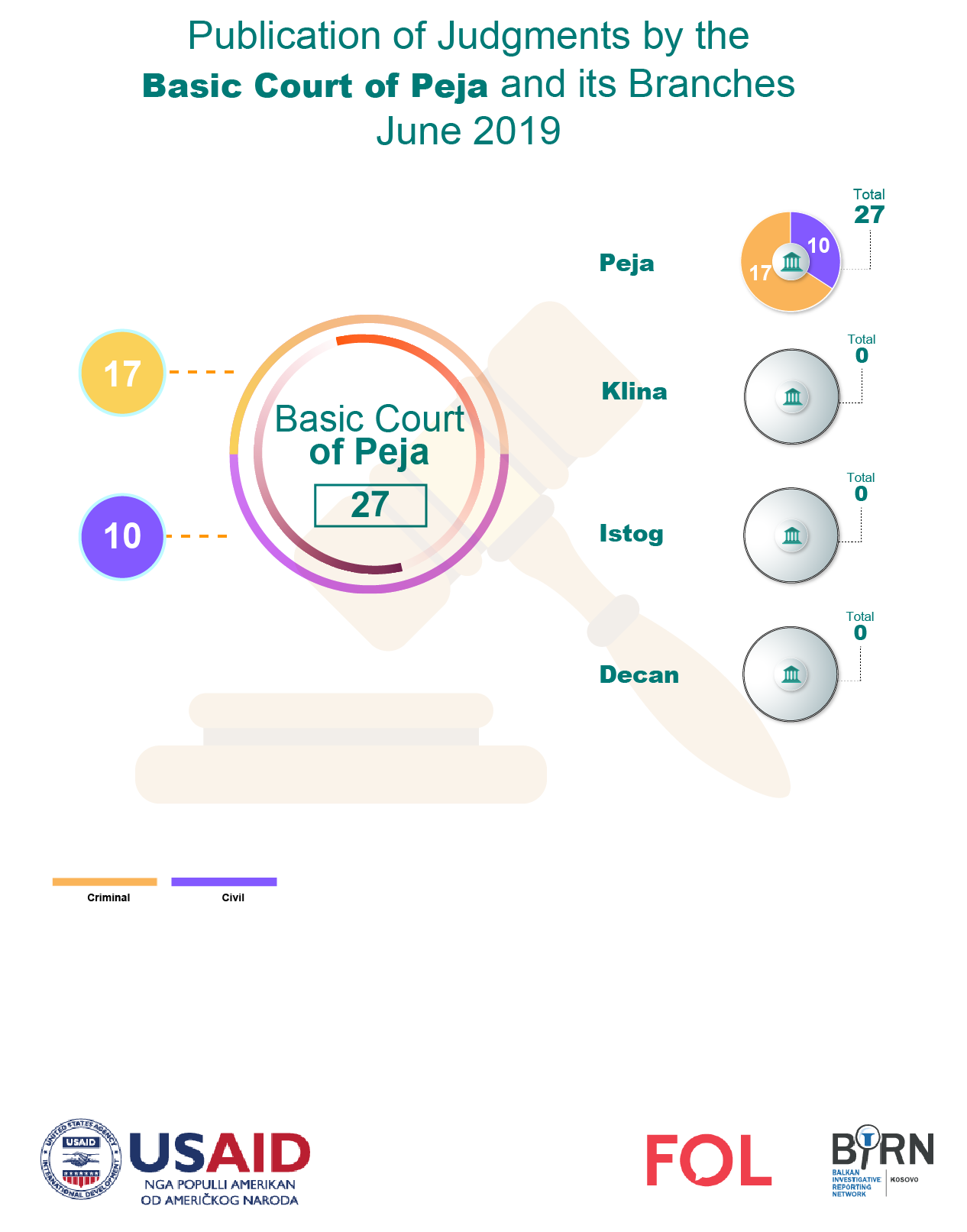
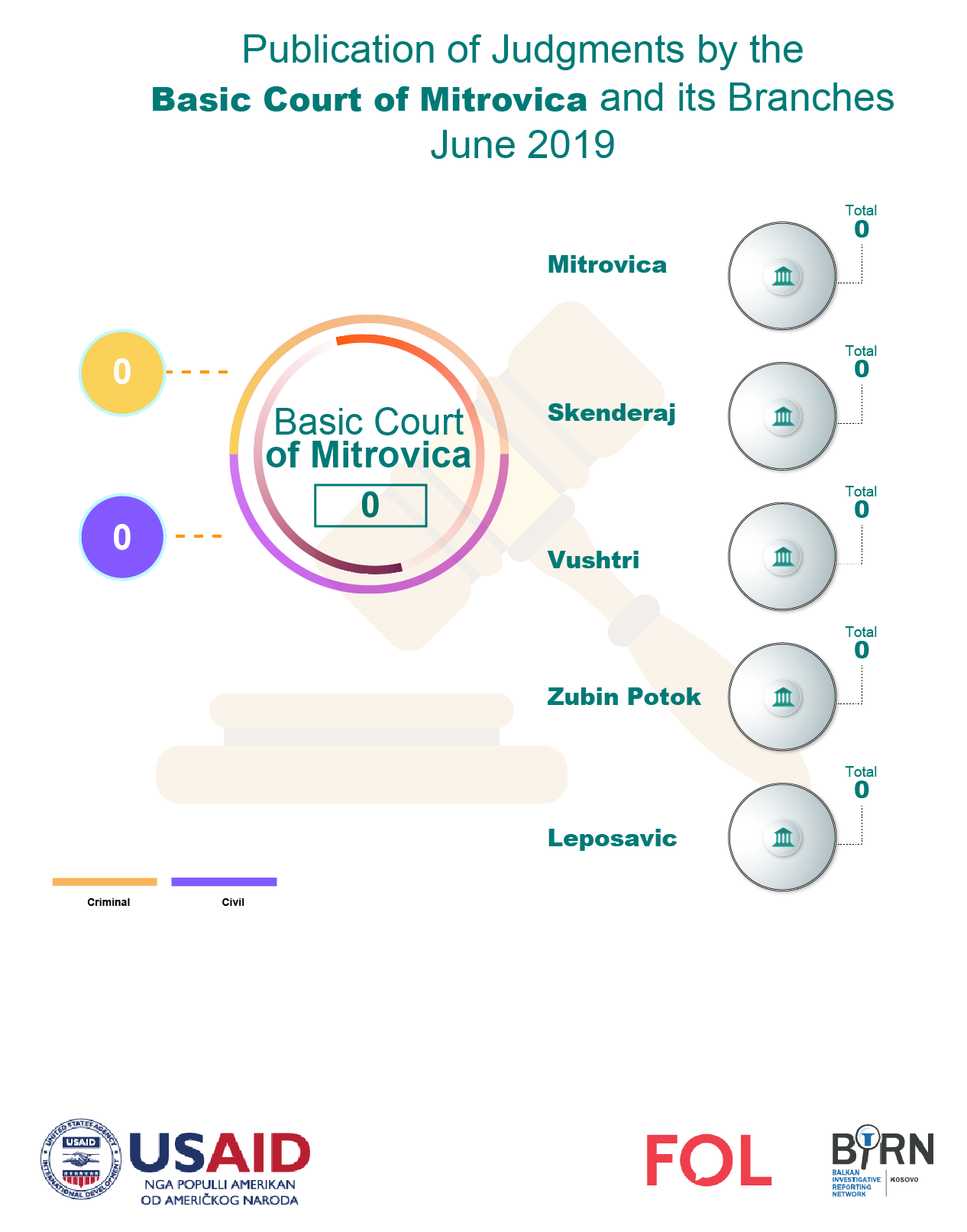
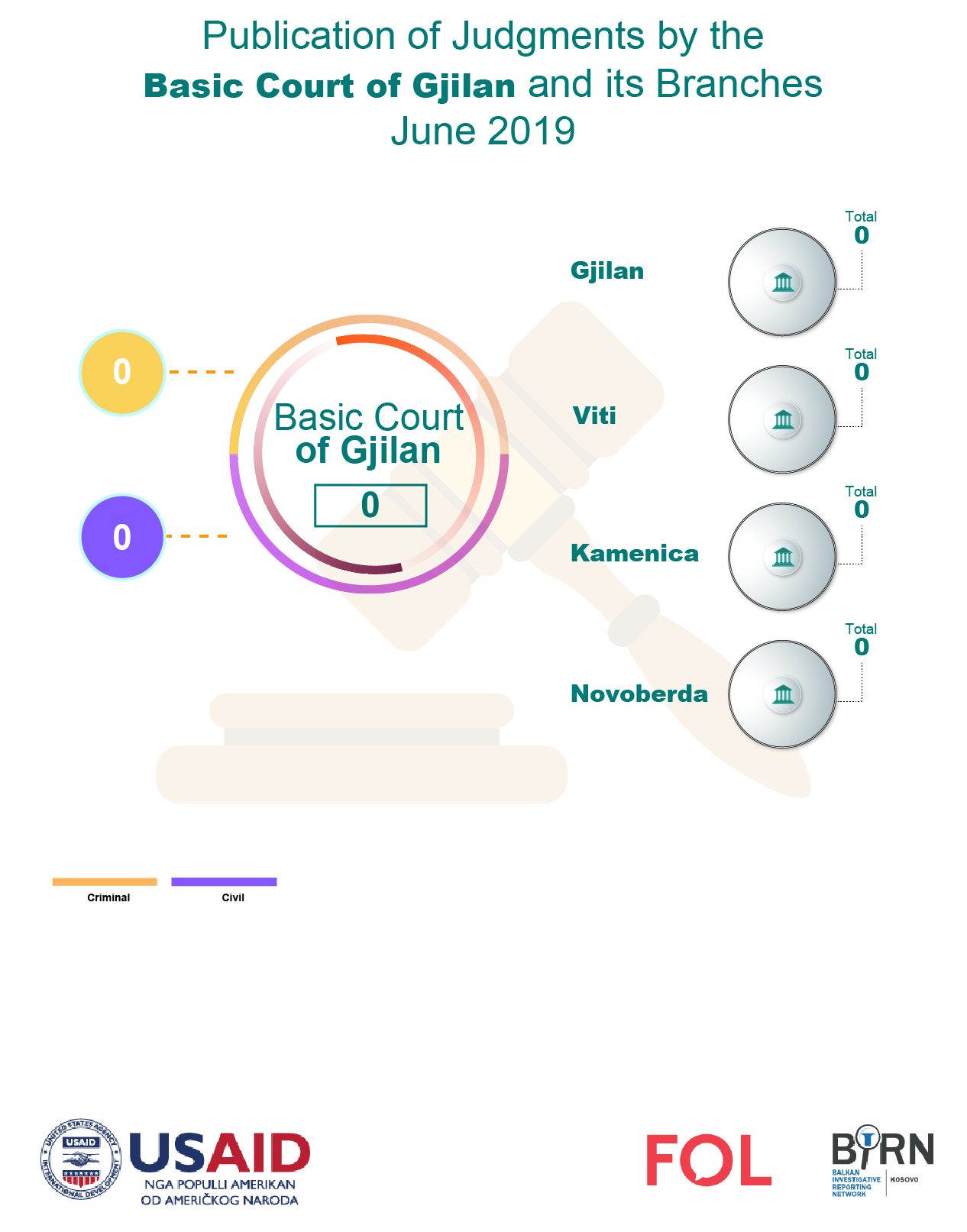
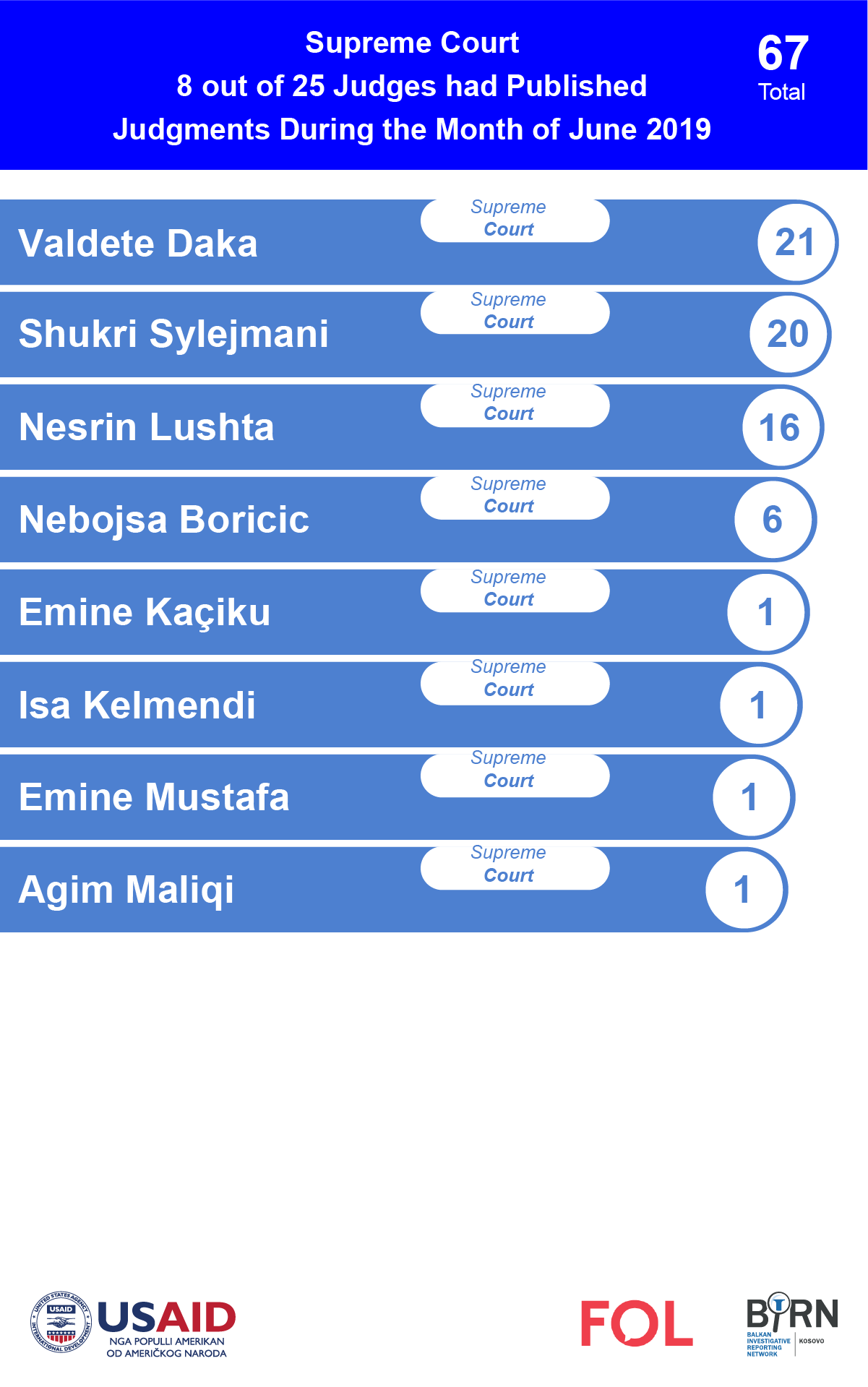
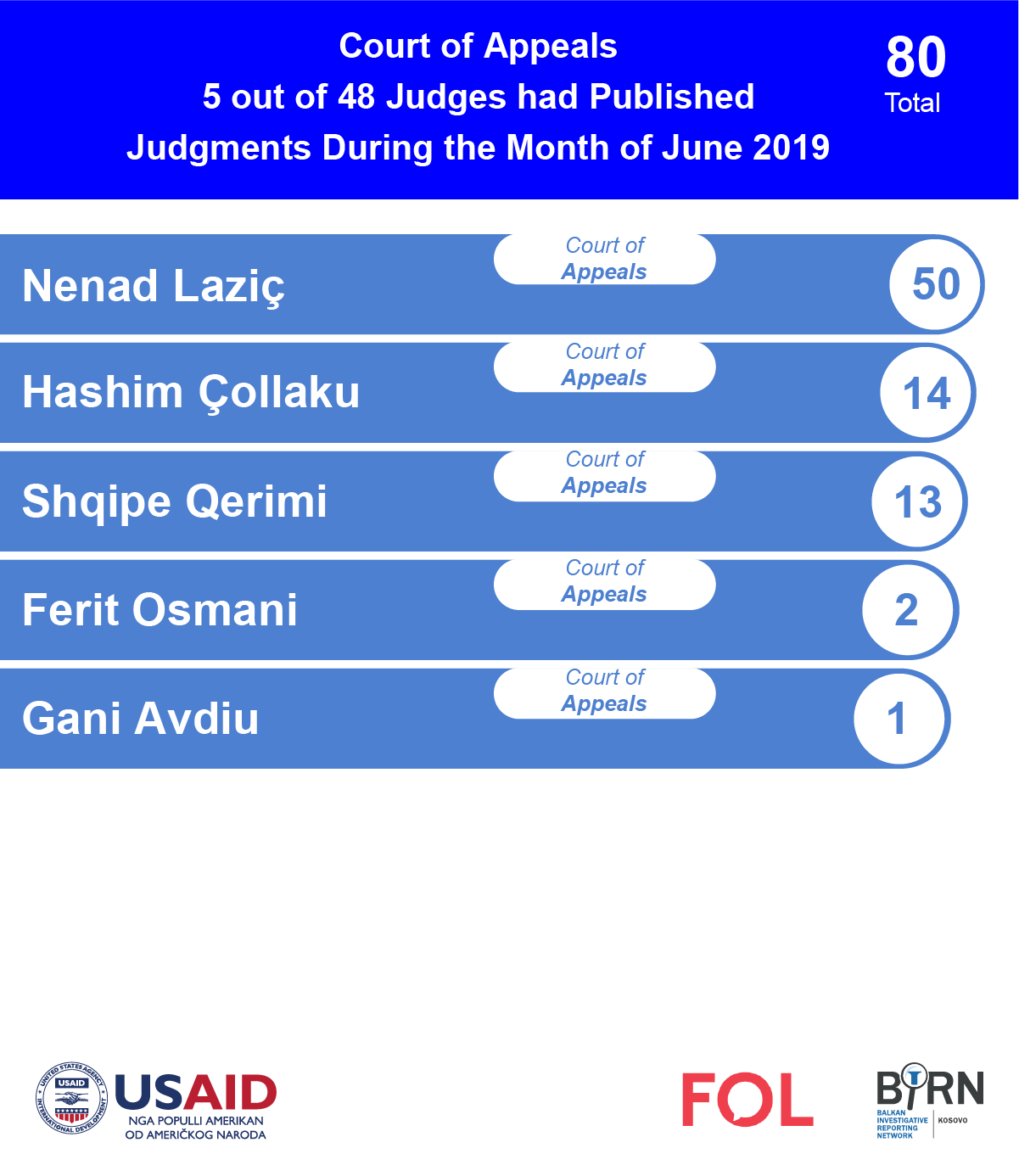
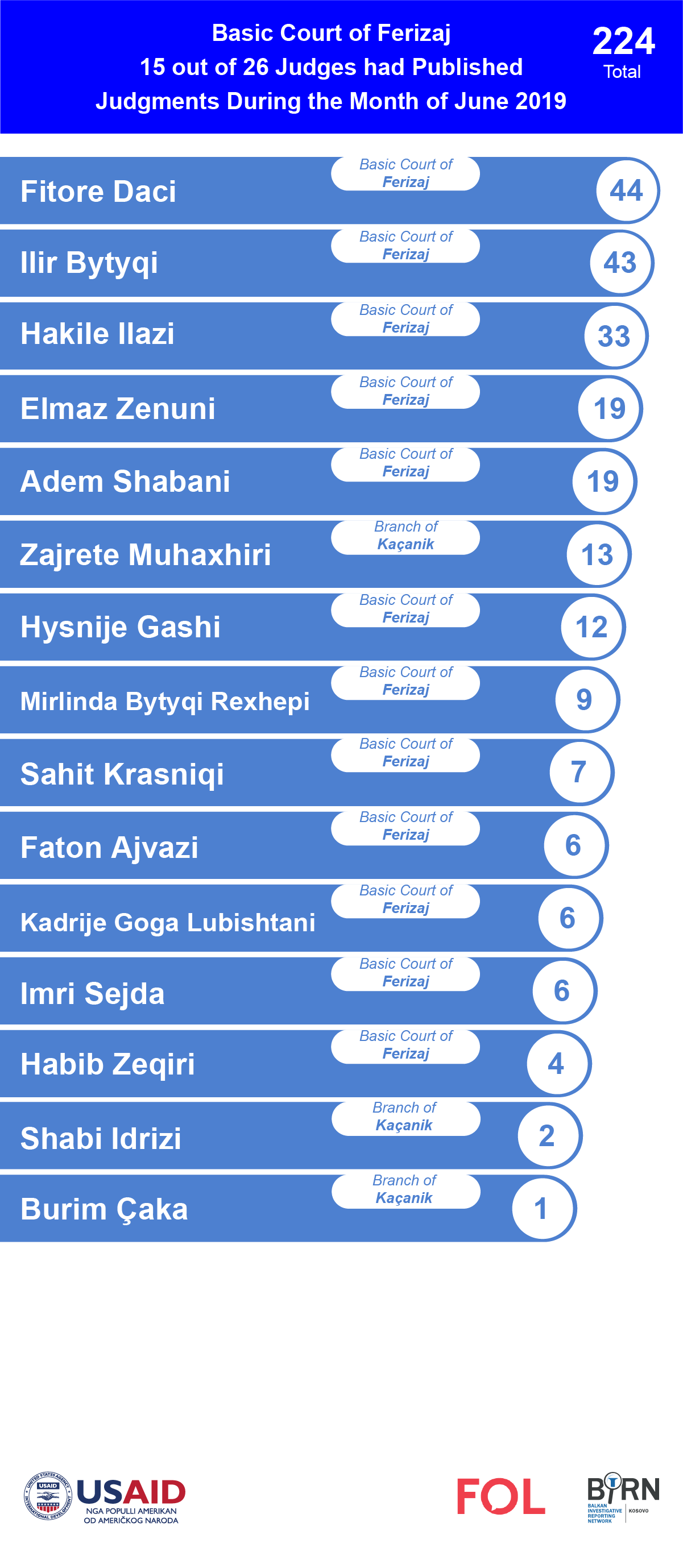
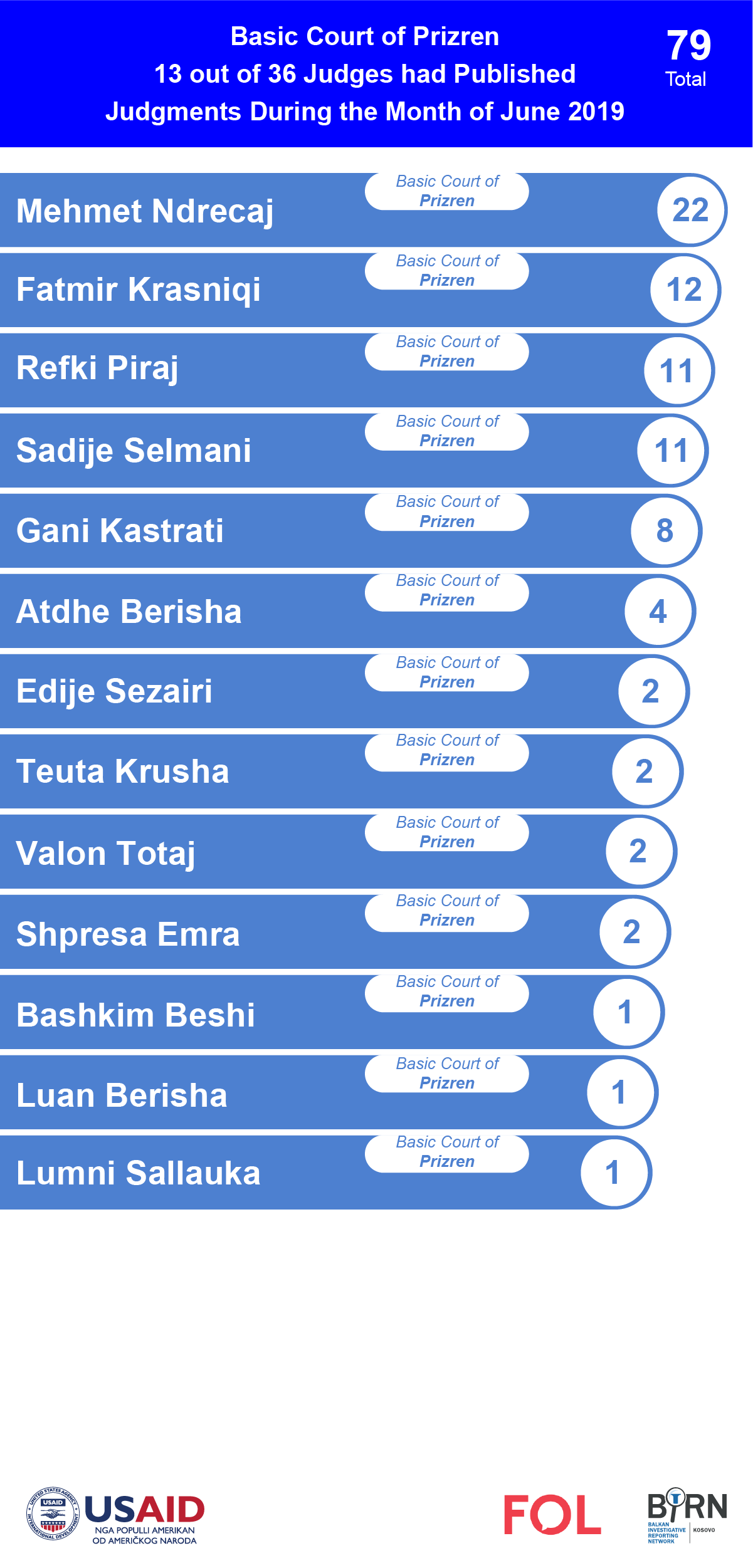
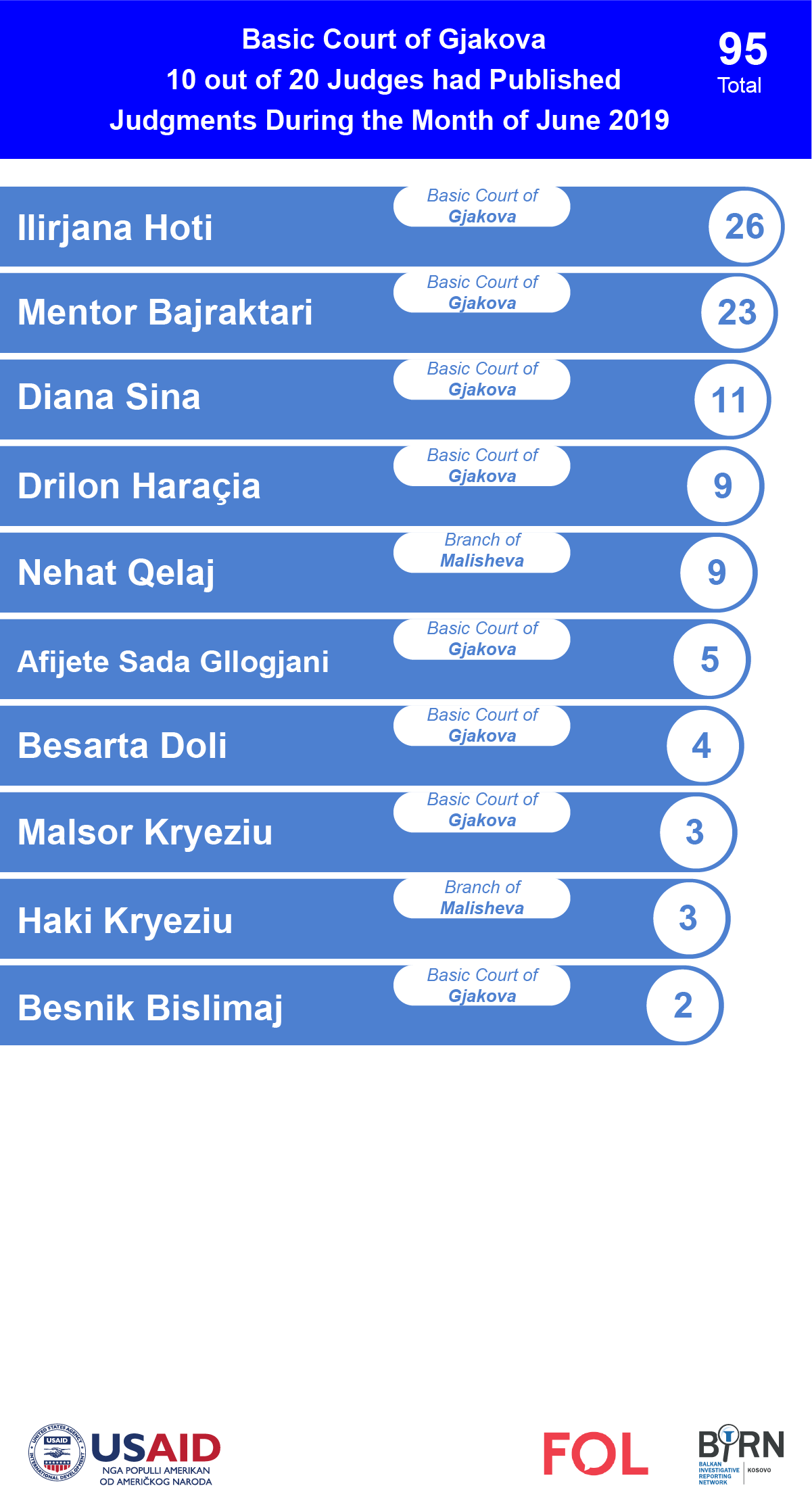
63 of the 338 judges issued judgments during June 2019

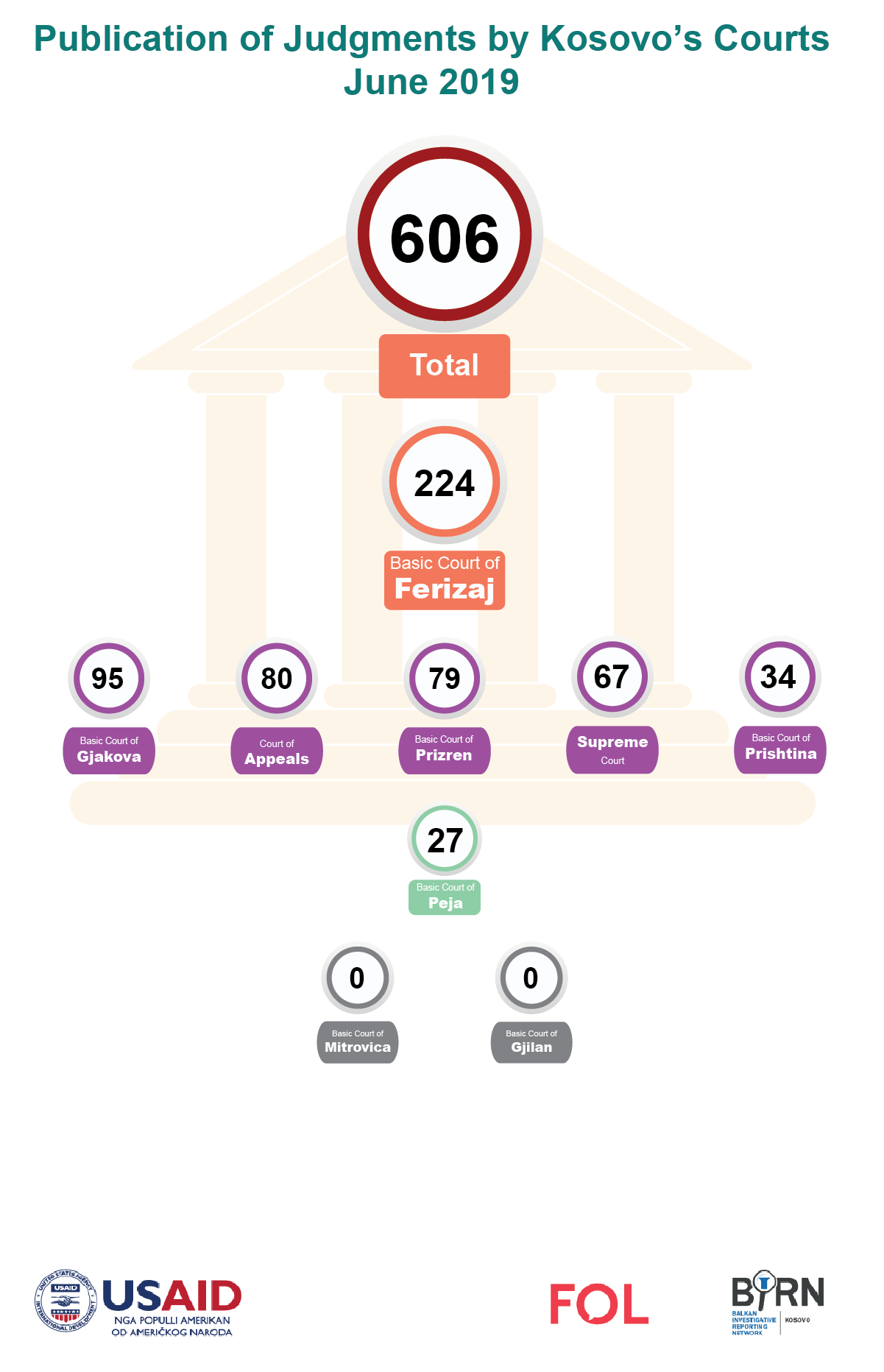
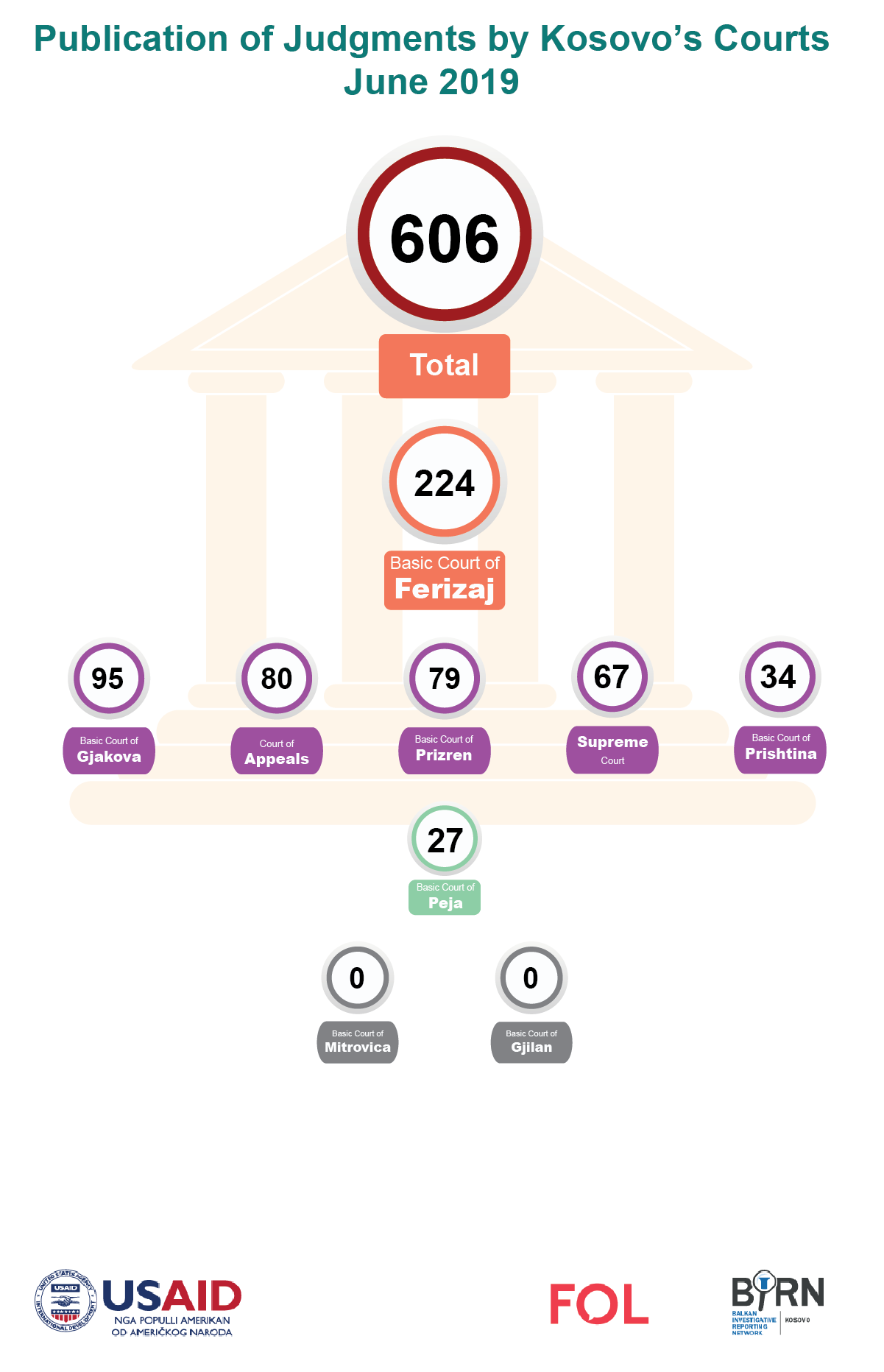
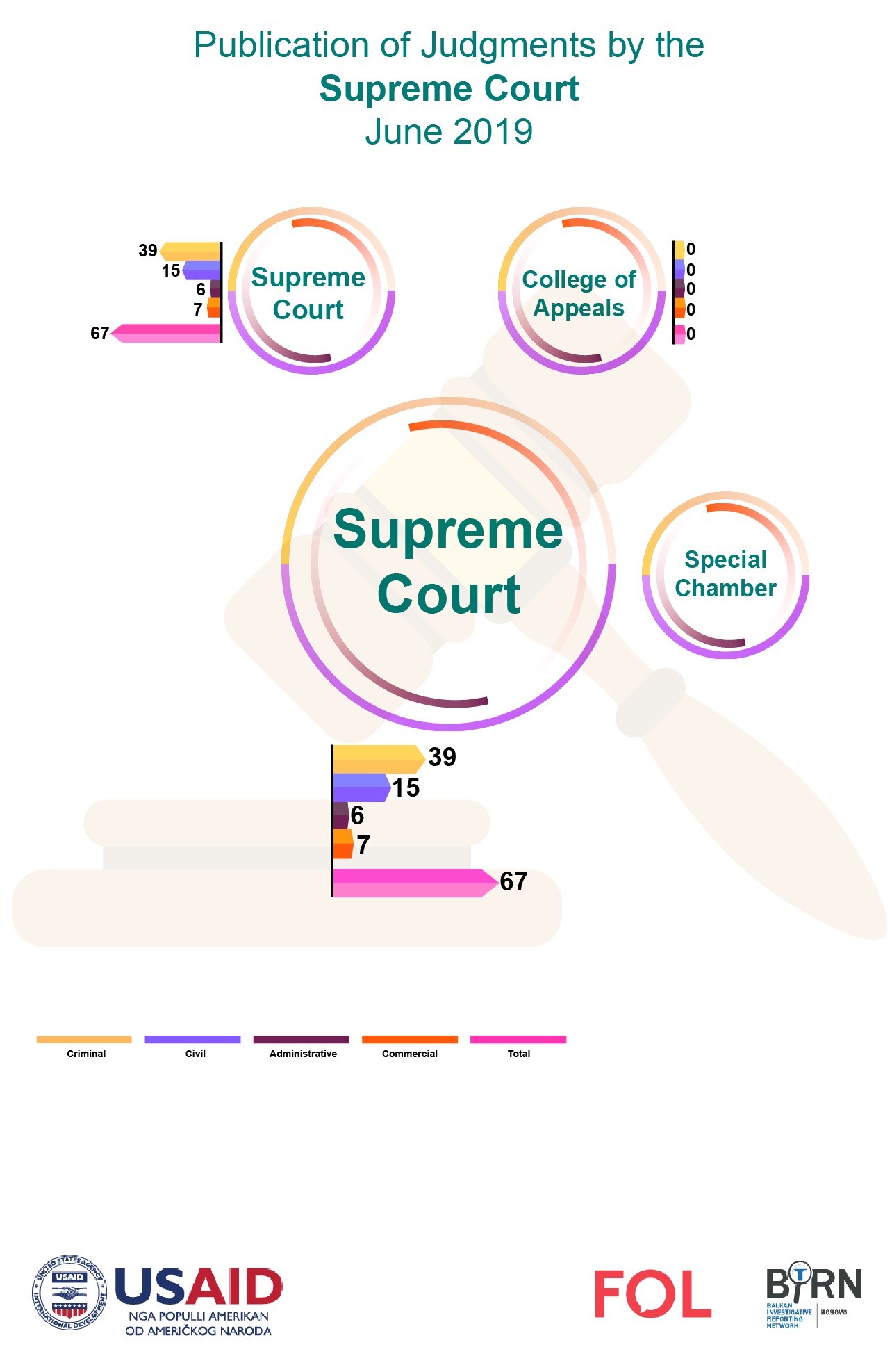
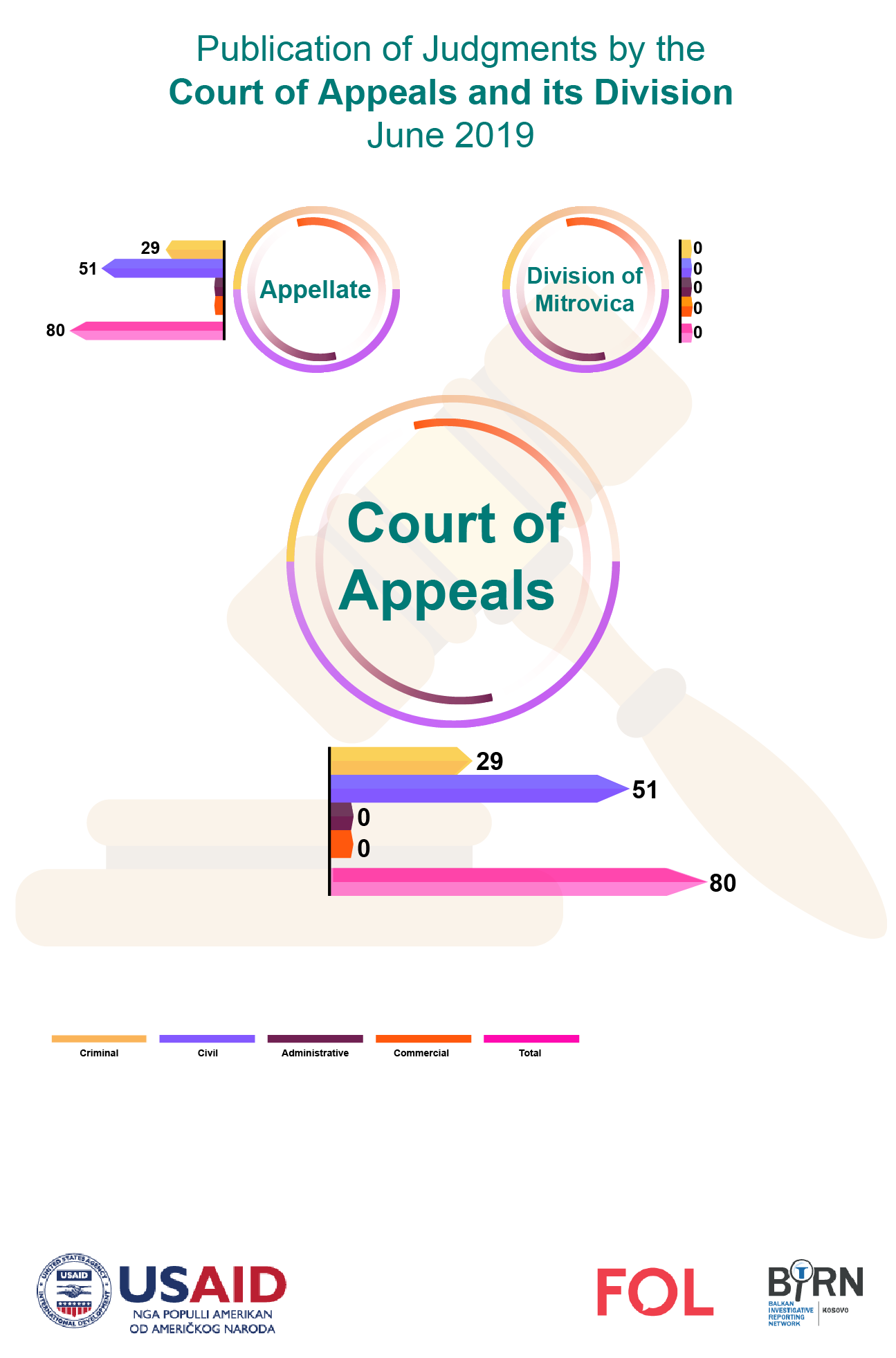
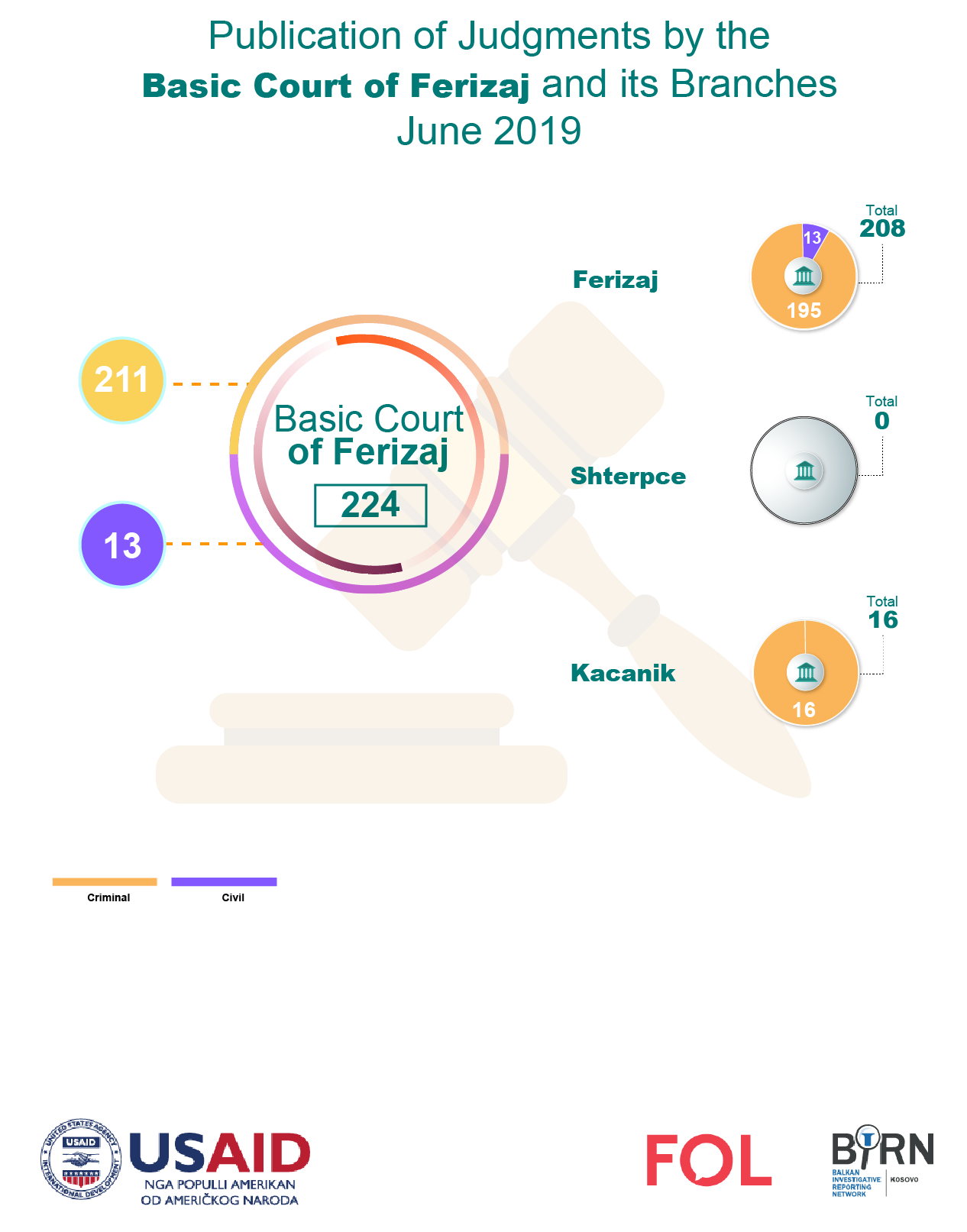
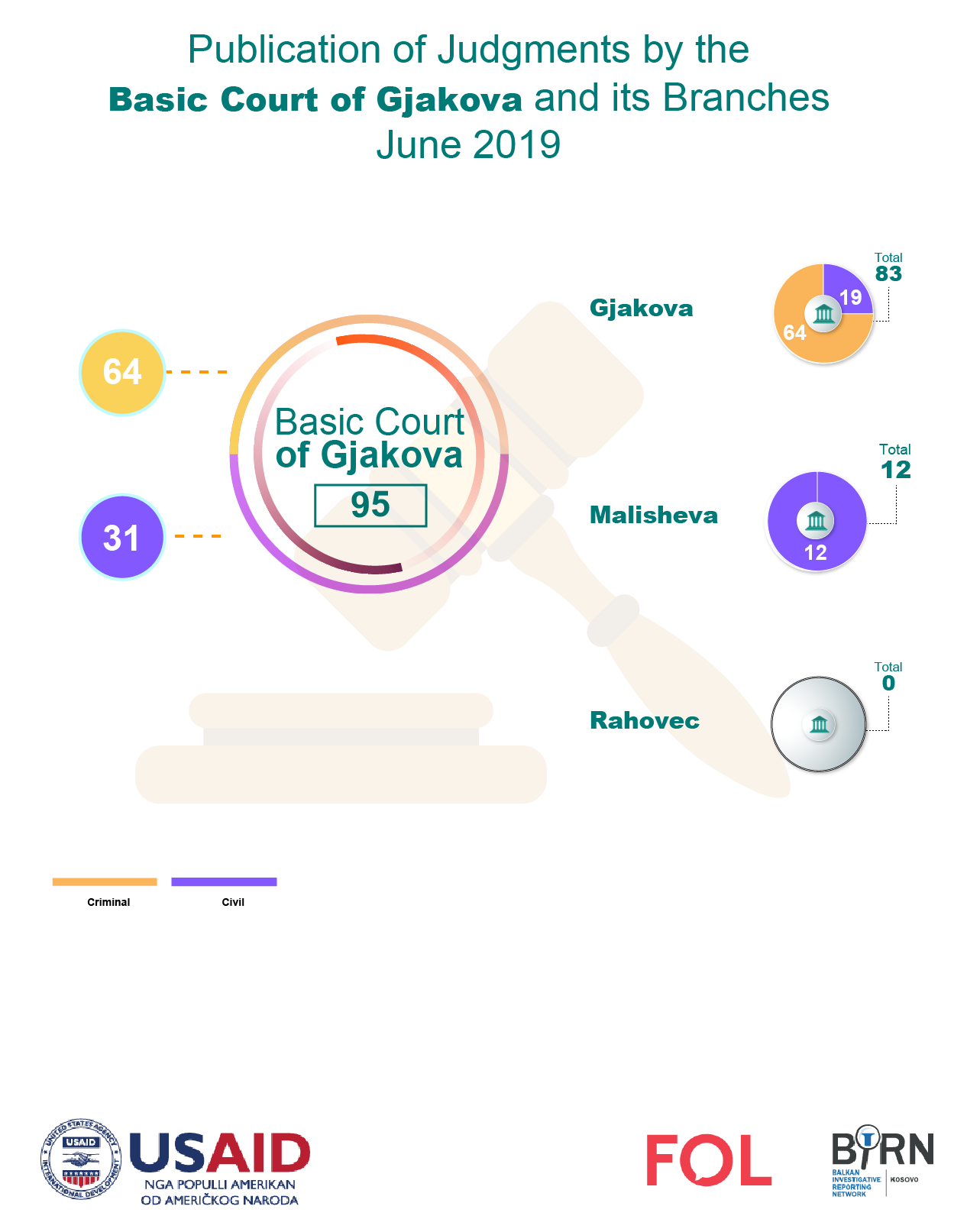
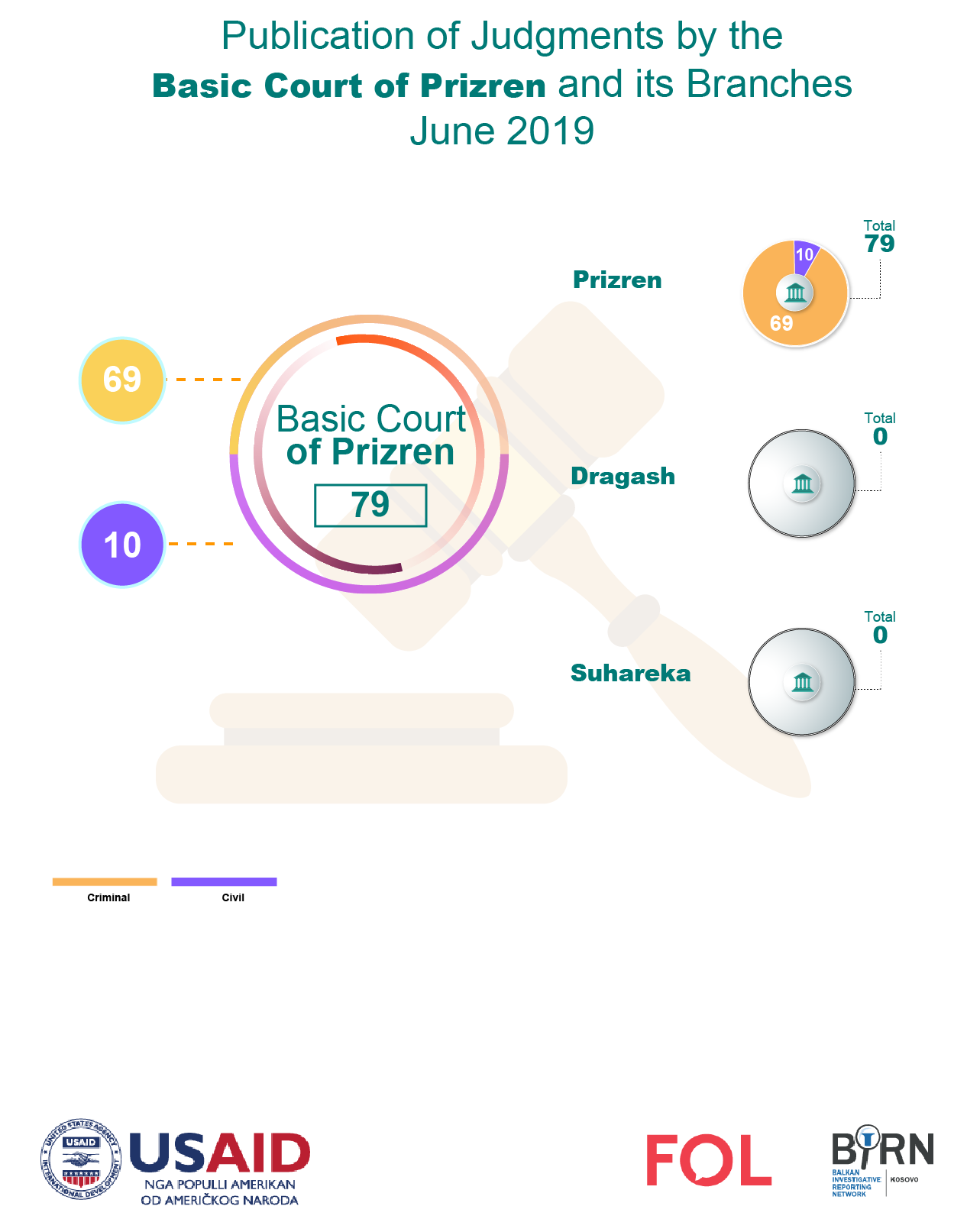
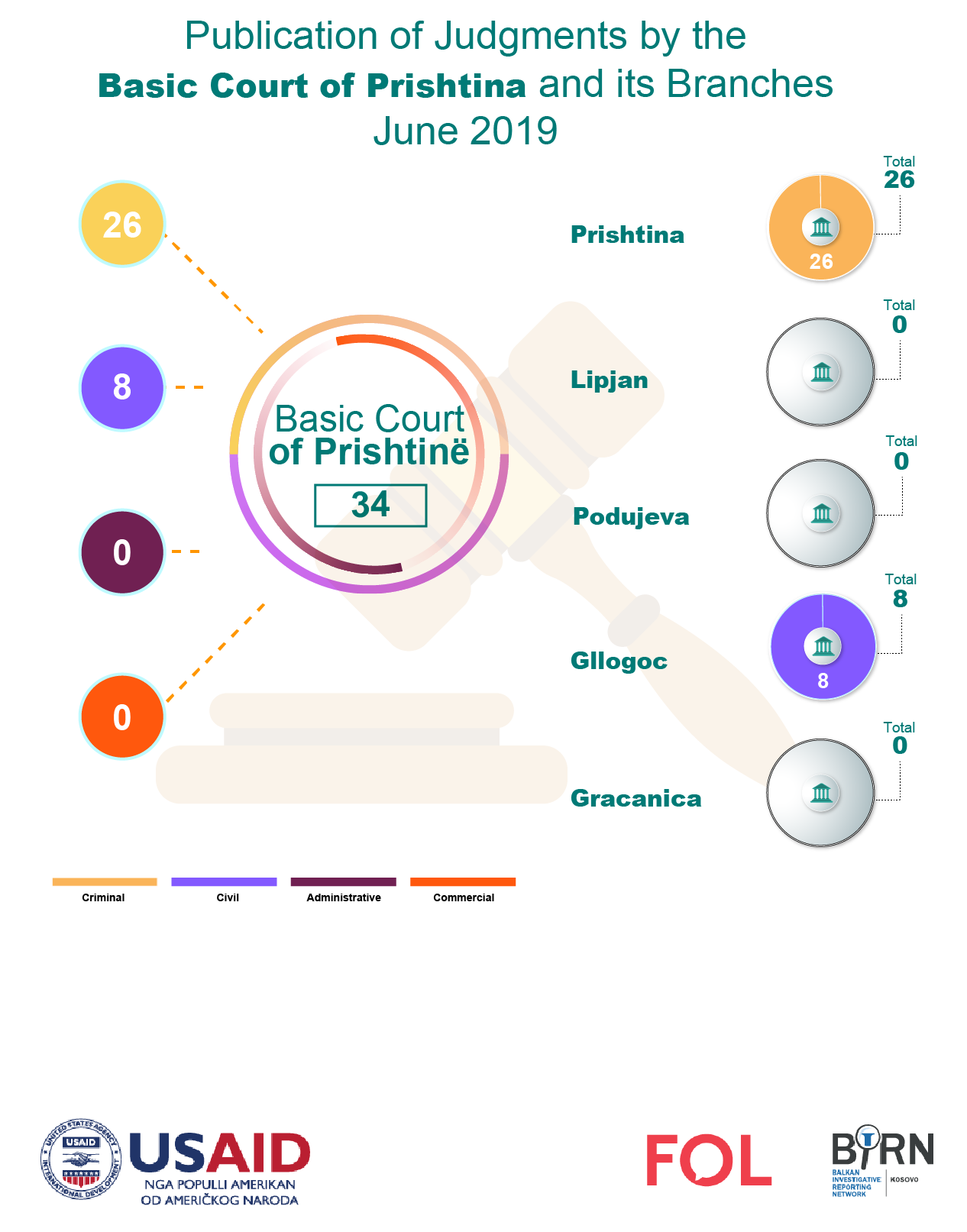
Prishtinë, 19 gusht 2019 – FOL Movement and BIRN Kosovo today present data from monitoring the publication of judgments in all Kosovo Courts. Through the following infographics you can see the publication of all judgments by all Kosovo courts for June 2019.

Publication of judgments by all Kosovo courts – June 2019


Clarification: The publication of judgments during the period of June 1 to June 30, 2019 was monitored for all Kosovo’s courts focusing on criminal, civil, commercial, and administrative departments. Additionally, this monitoring covered the publication of judgments according to judges from all courts and the abovementioned departments. The Division for Minor Offences judges were not monitored.

During the monitoring of judgments published in the Kosovo Judicial Council’s website, for the above-mentioned period, it has been noted that there is a total of 642 judgments published, or 36 more than BIRN and FOL have in their database. This difference in numbers is due to double publication of judgments, and other problems in the Council’s web portal when translating the site into Serbian. Additionally, during the month of June, it has been noticed that courts have published judgments made by judges who have been promoted to more senior positions, have been transferred to Minor Offence Division, or have retired. These shortcomings were noted during a detailed verification by BIRN and FOL.

*Disclaimer: This monitoring was made possible by the support of the American People through the United States Agency for International Development (USAID). The content of this article is the sole responsibility of FOL Movement and BIRN Kosova and does not necessarily reflect the views of the United States Agency for International Development or the United States Government.

Publication of Judgments by all Courts of Kosovo, May 2019

Pristina, 2 August 2019 – FOL Movement and BIRN Kosovo are monitoring the publication of judgments in all Kosovo courts.

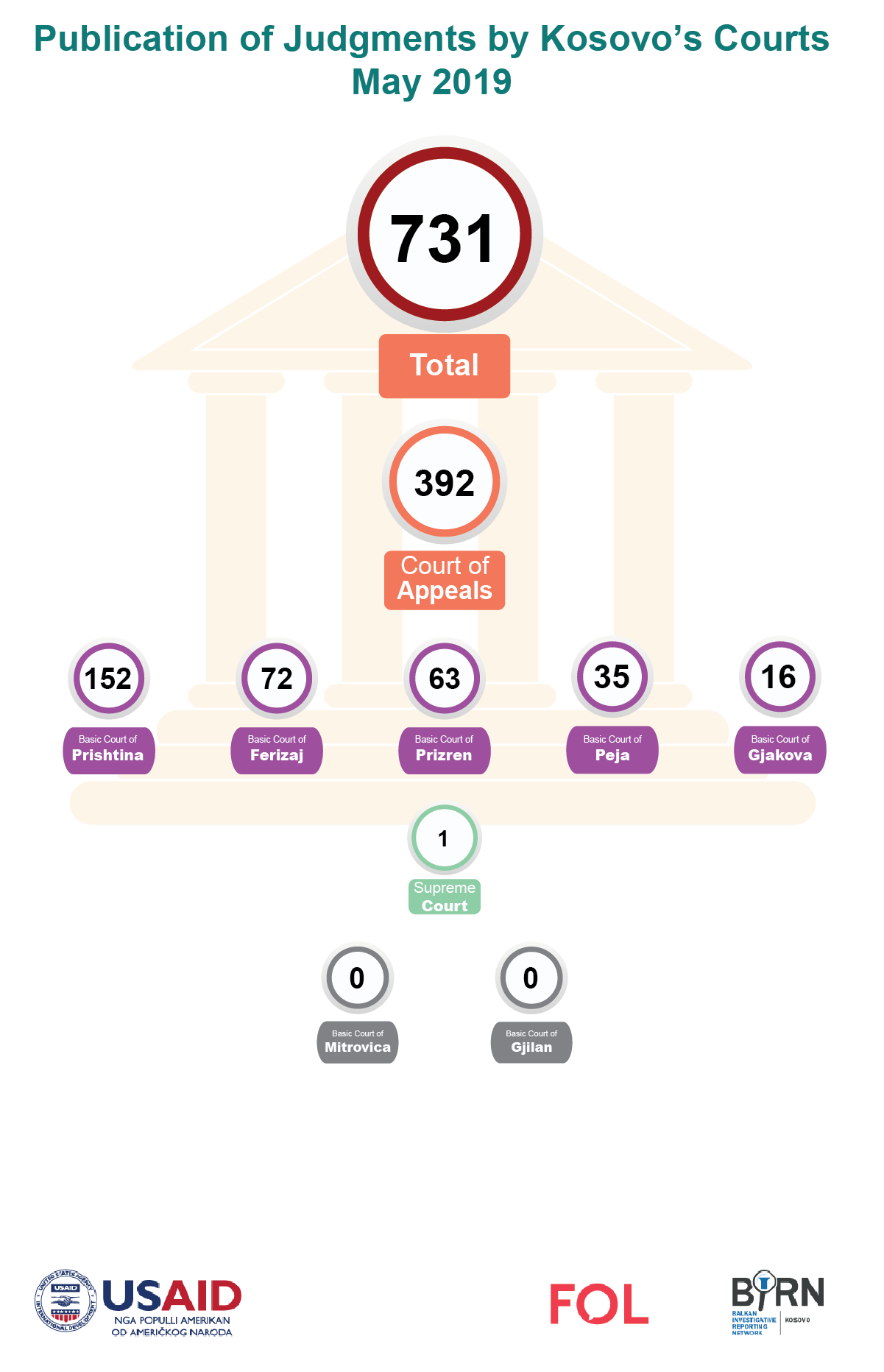
Through the following infographics you can see the publication of all judgments by all Kosovo courts for May 2019.

1. Publication of Judgments by Kosovo’s Courts

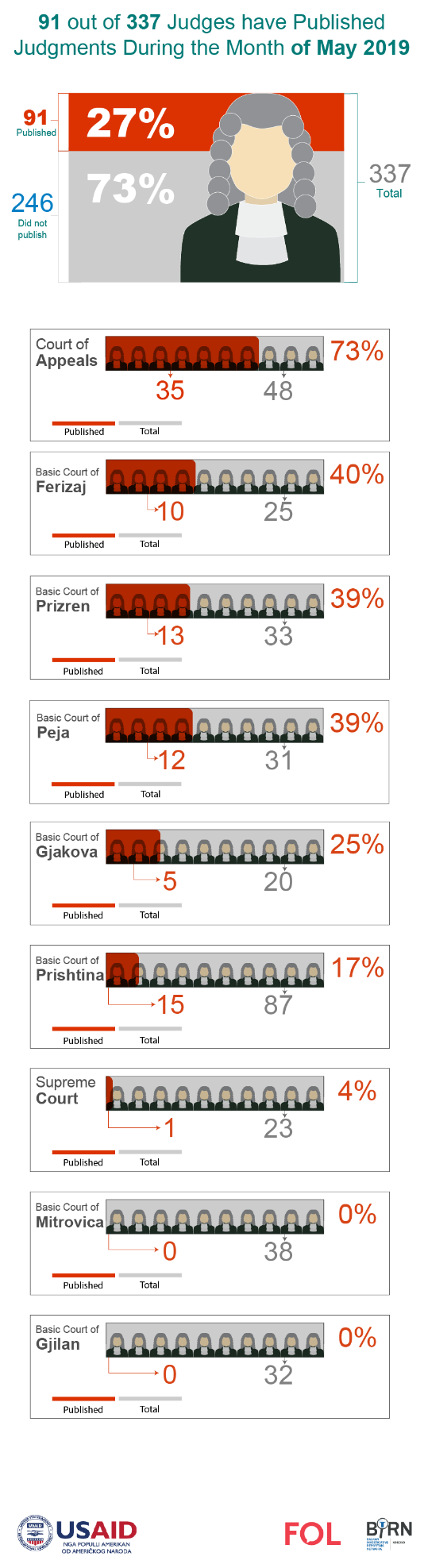
2. 91 out of 337 Judges have Published Judgments During the Month of May 2019


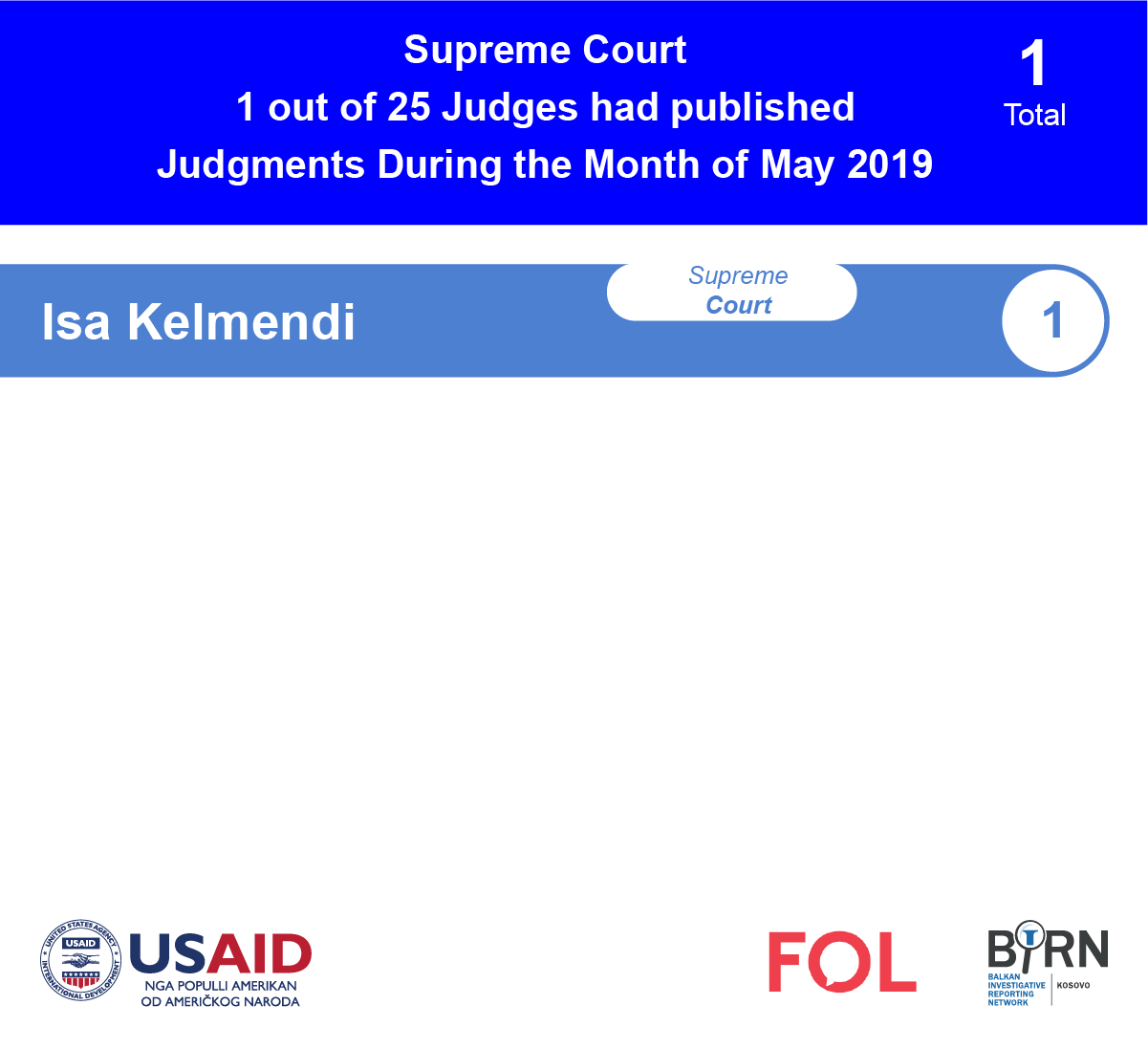
3. Publication of Judgments by the Supreme Court

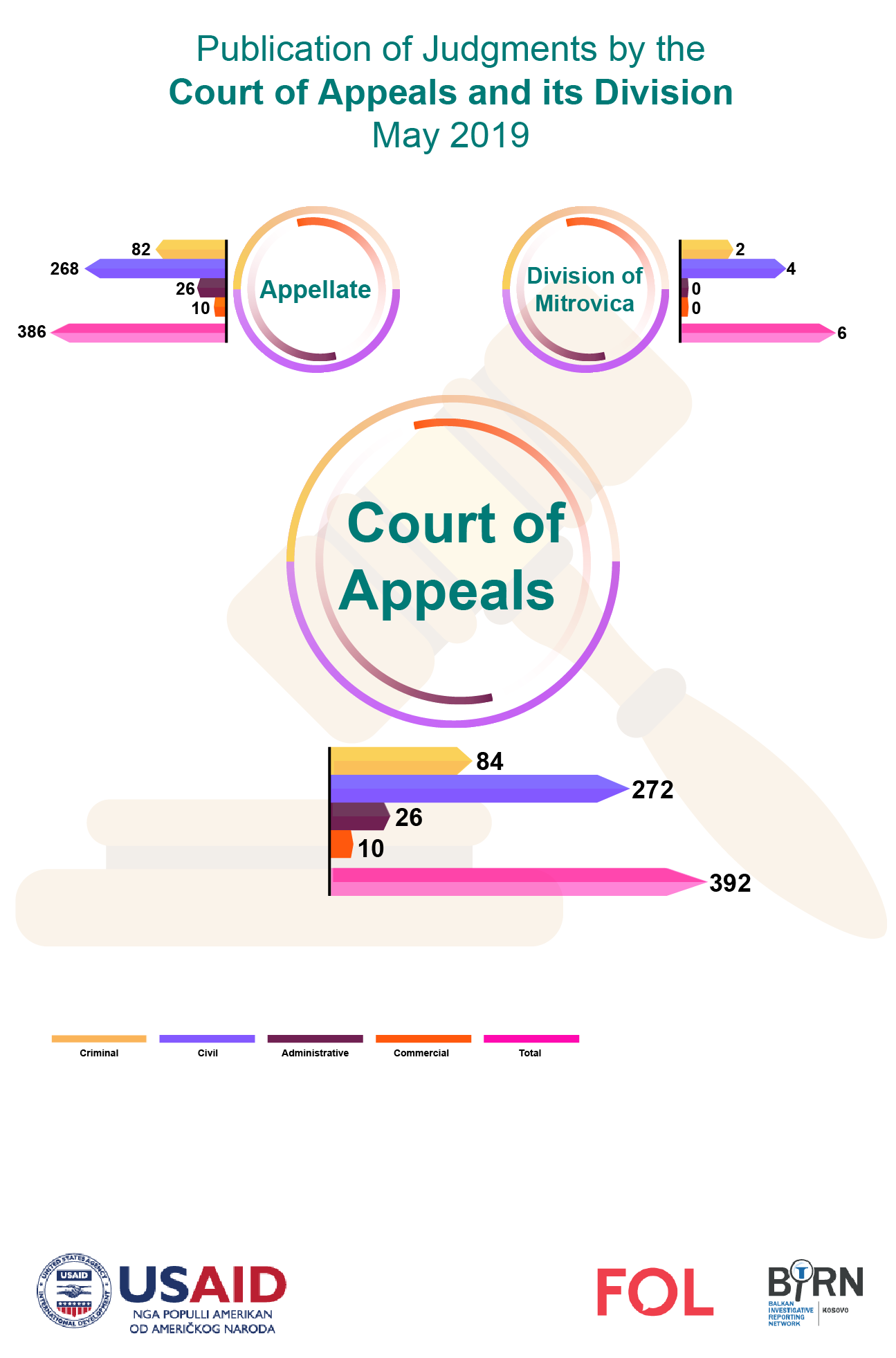
4. Publication of Judgments by the Court of Appeals and its Division

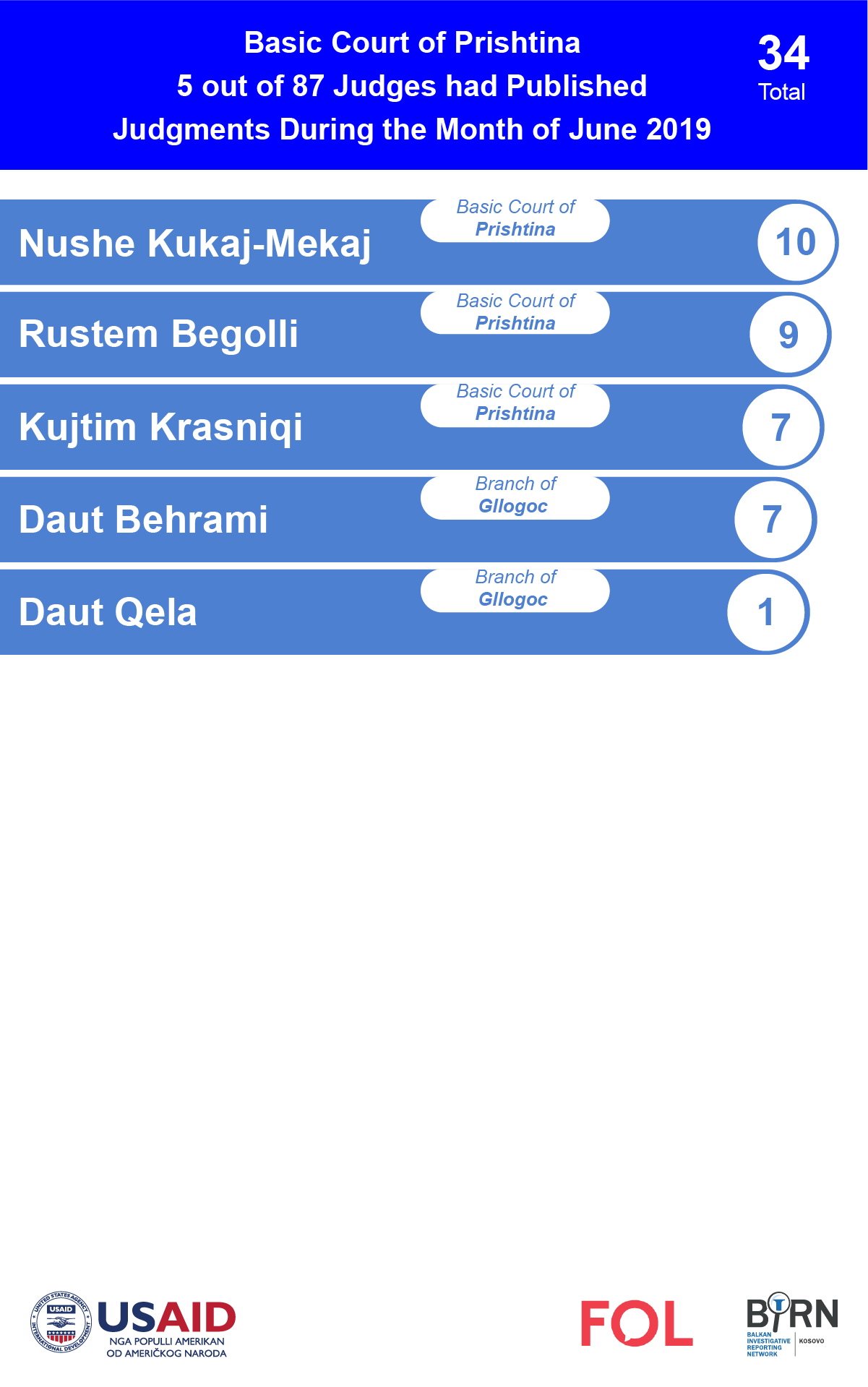
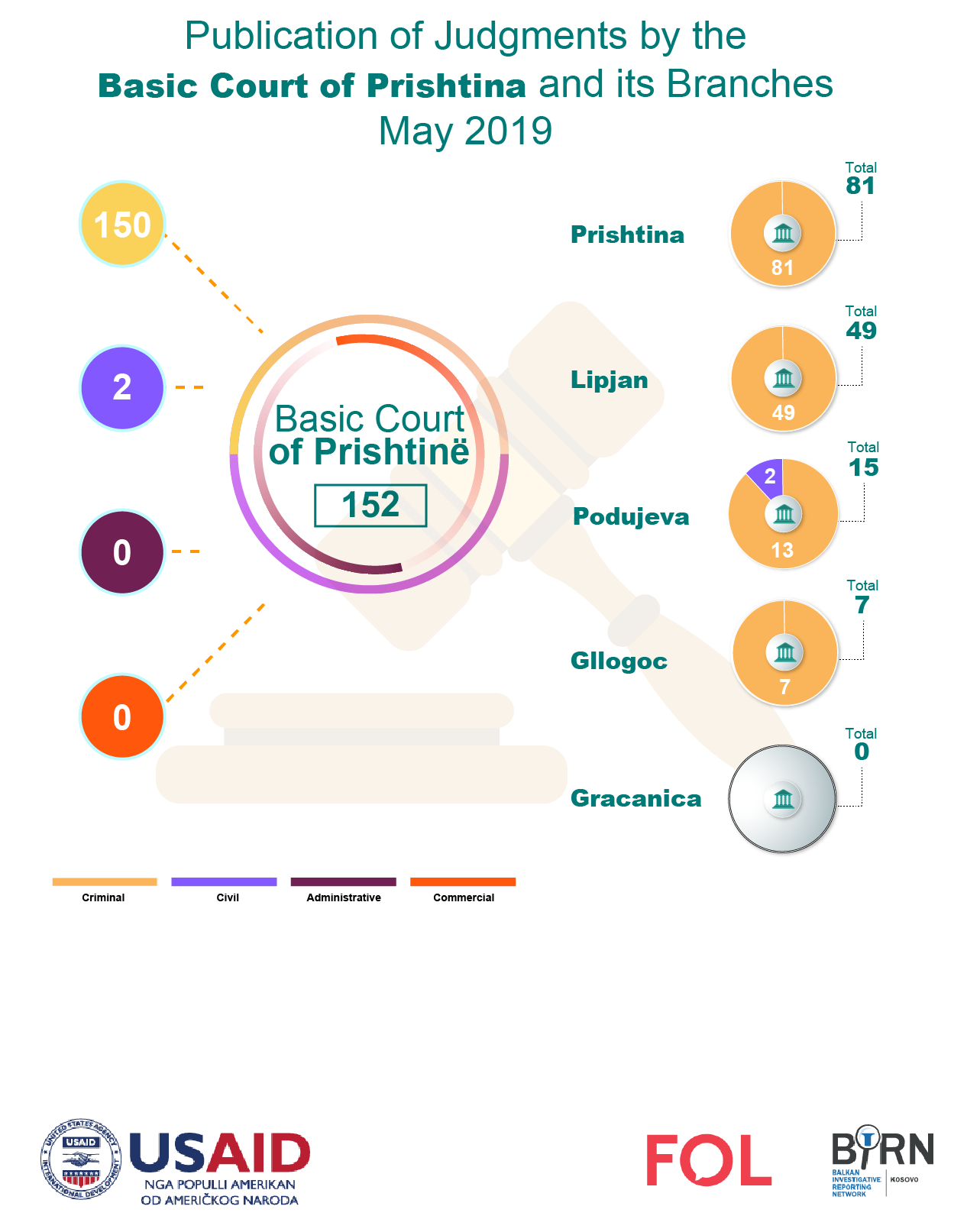
5. Publication of Judgments by the Basic Court of Prishtina and its Branches

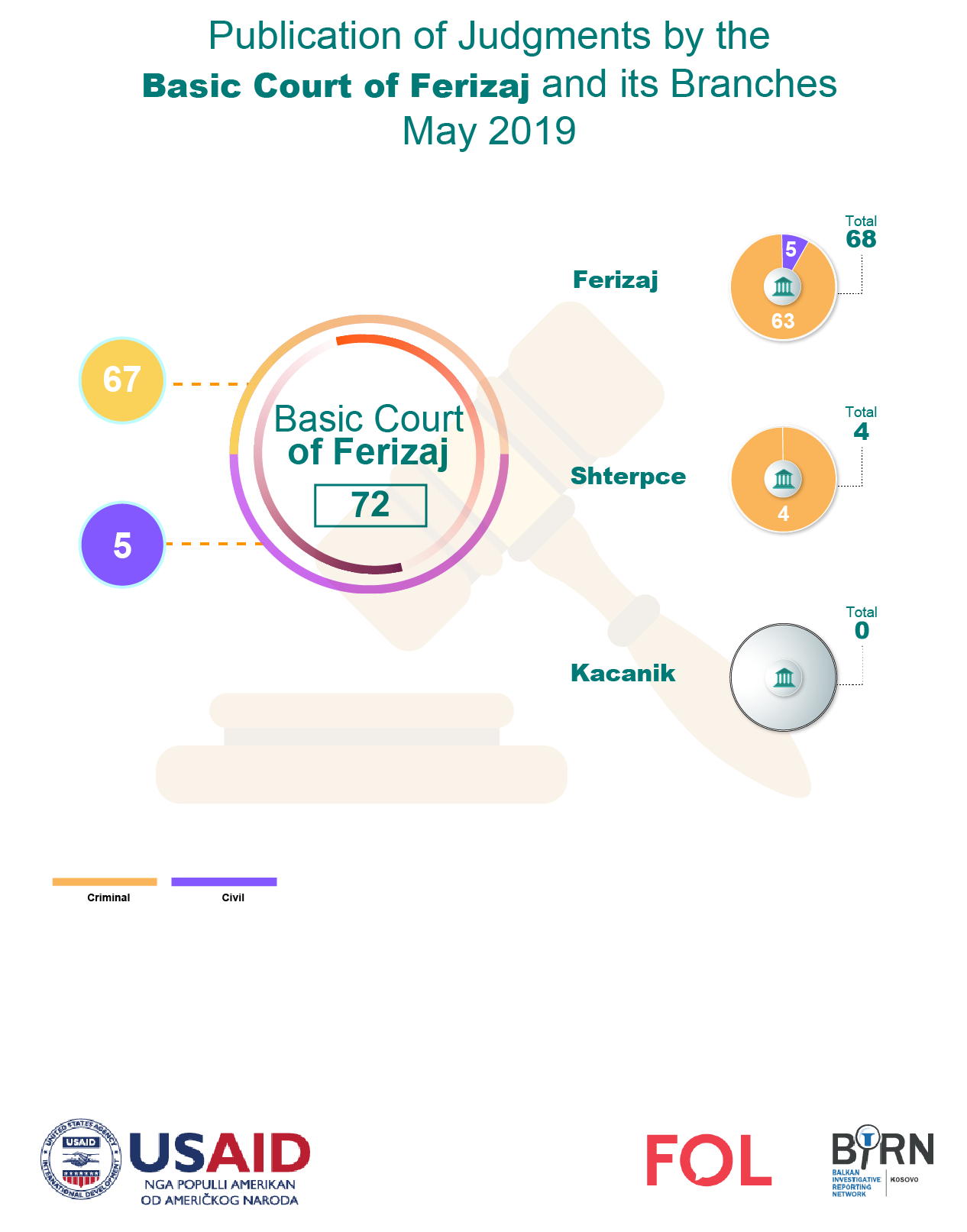
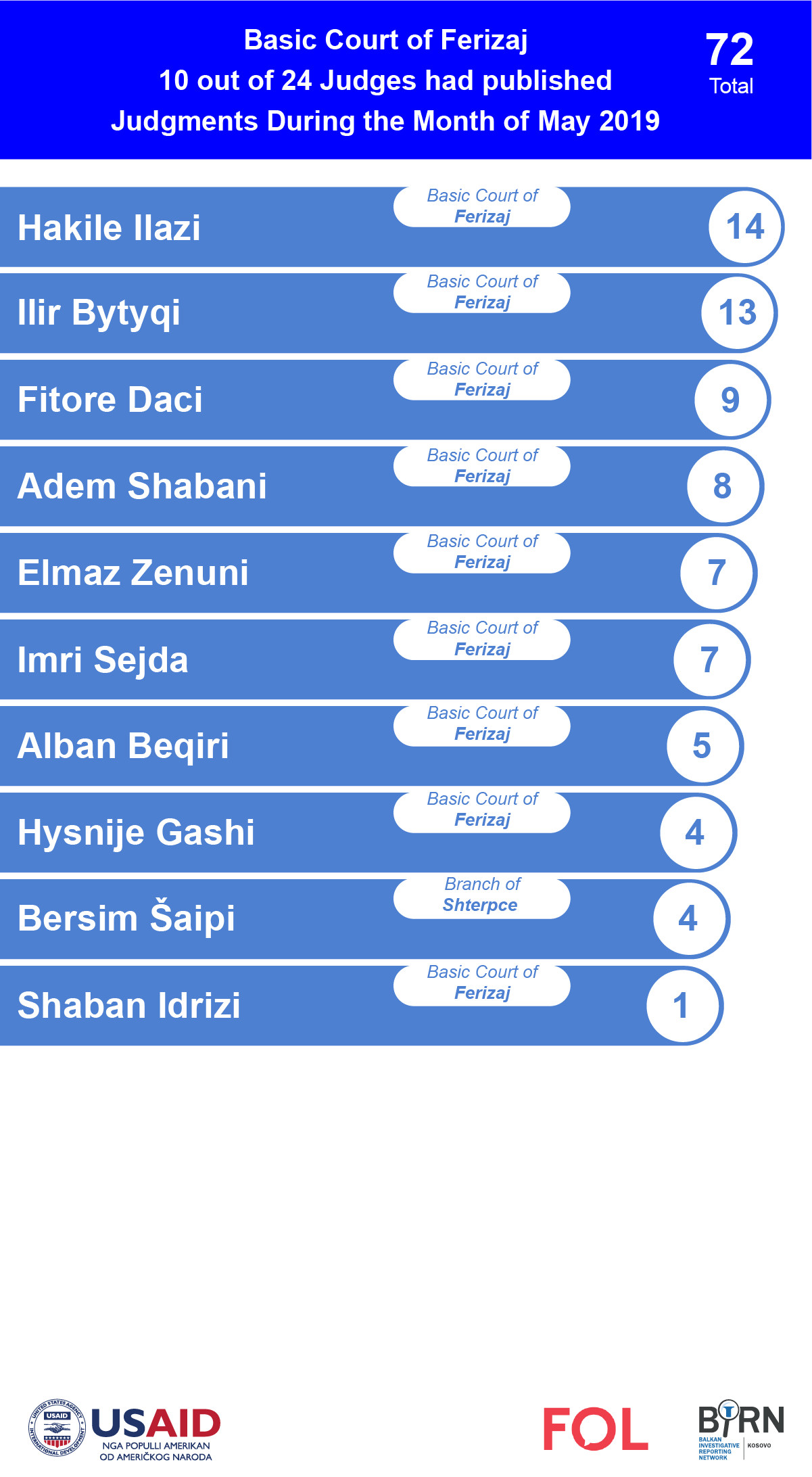
6. Publication of Judgments by the Basic Court of Ferizaj and its Branches

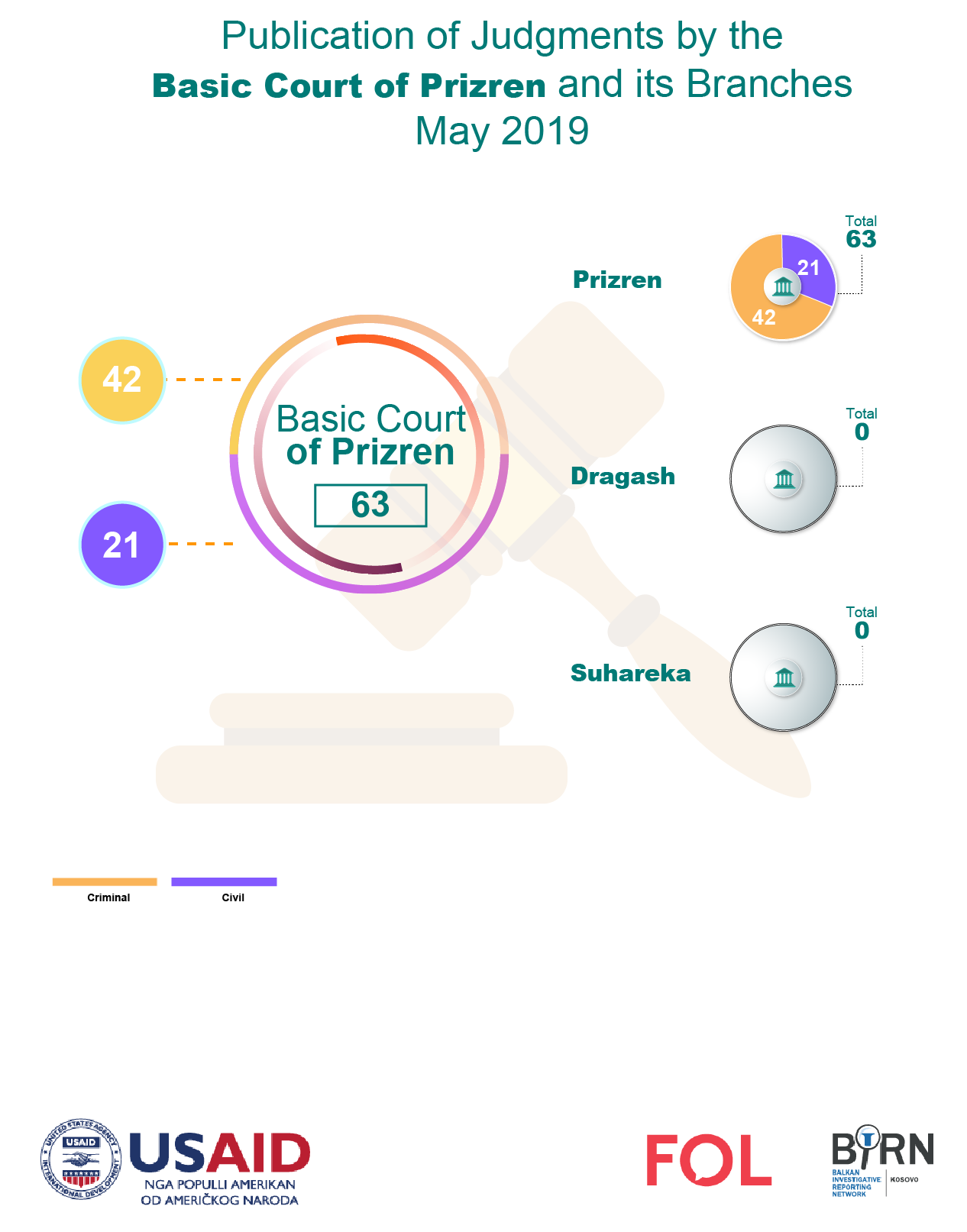
7. Publication of Judgments by the Basic Court of Prizren and its Branches

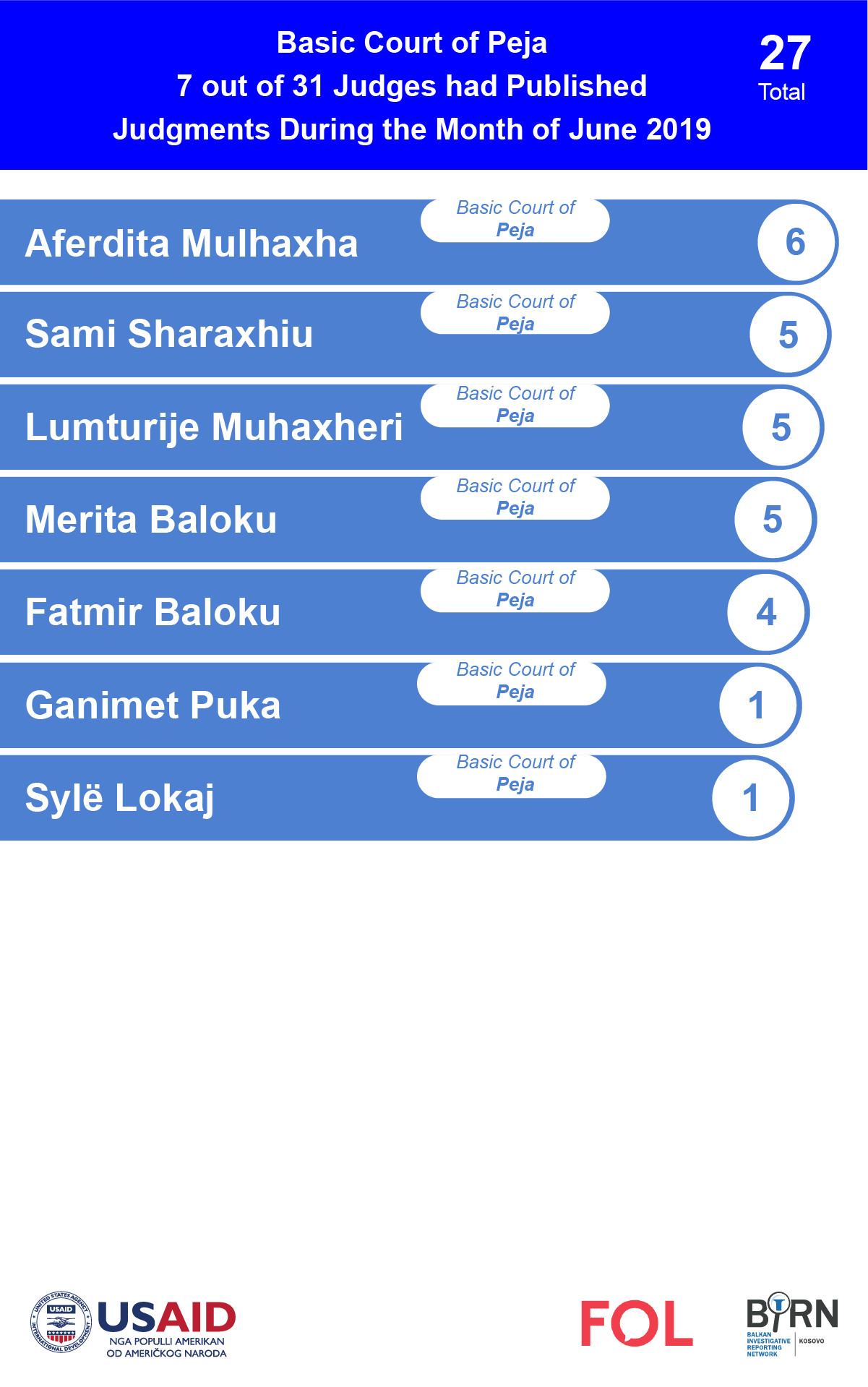
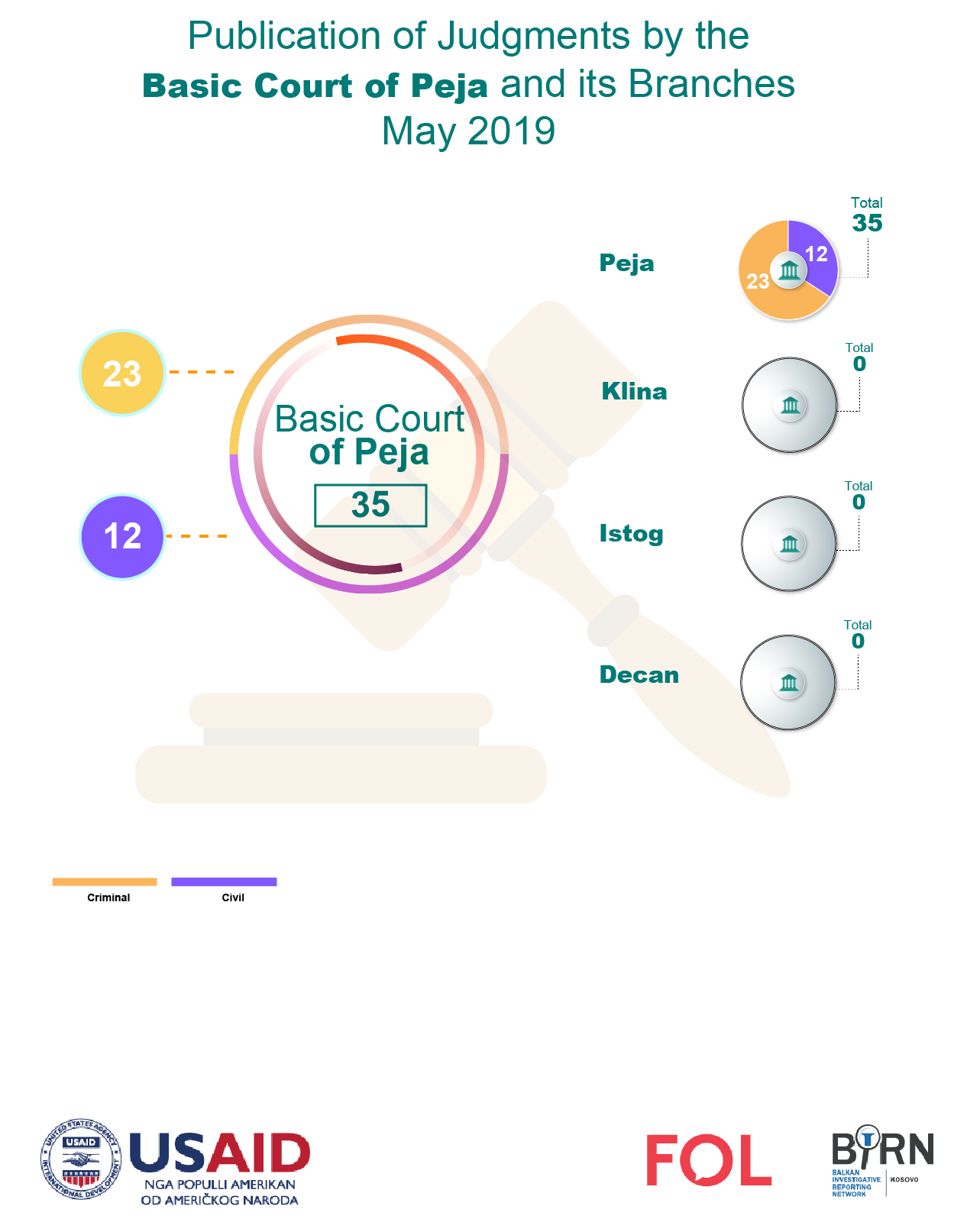
8. Publication of Judgments by the Basic Court of Peja and its Branches

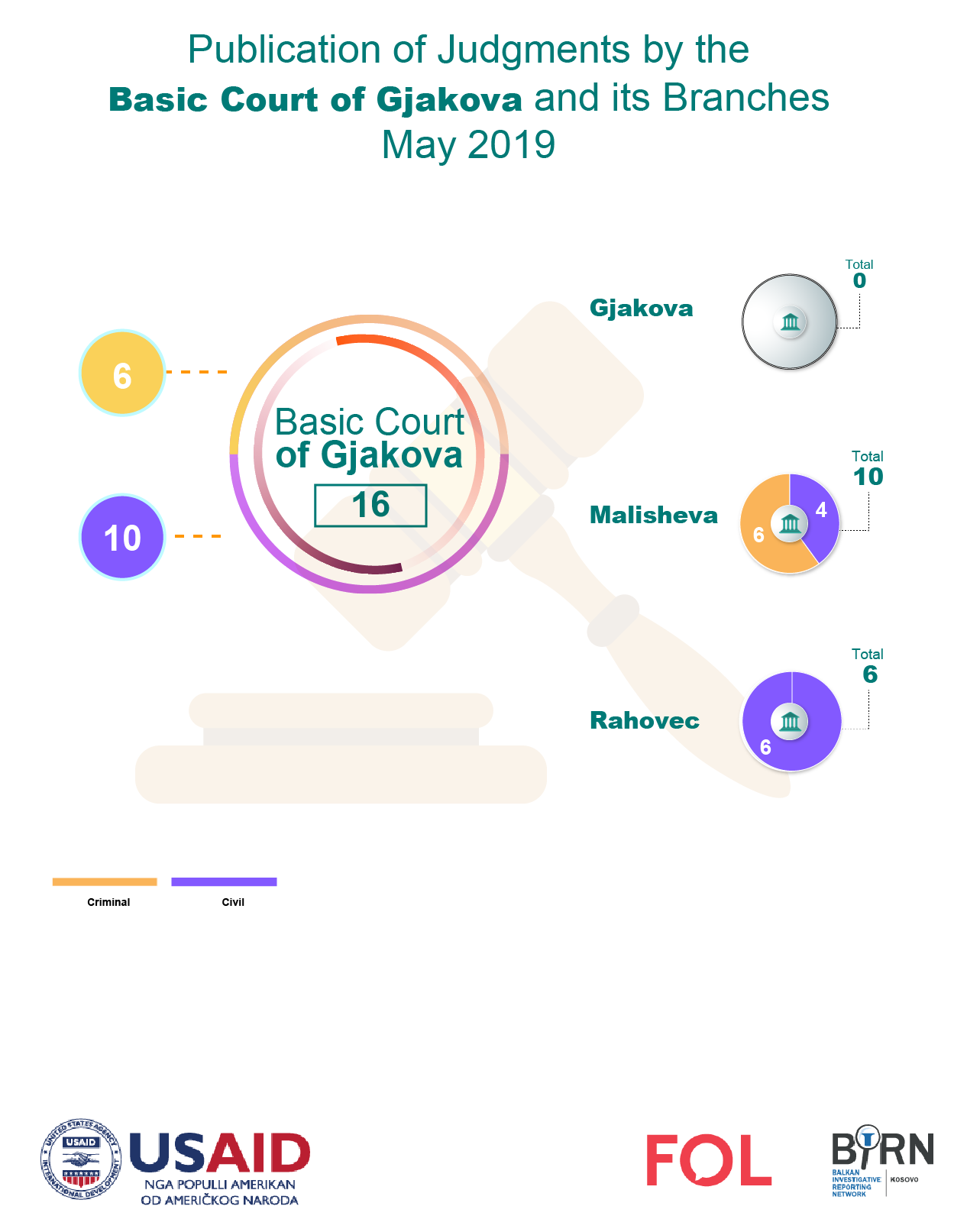
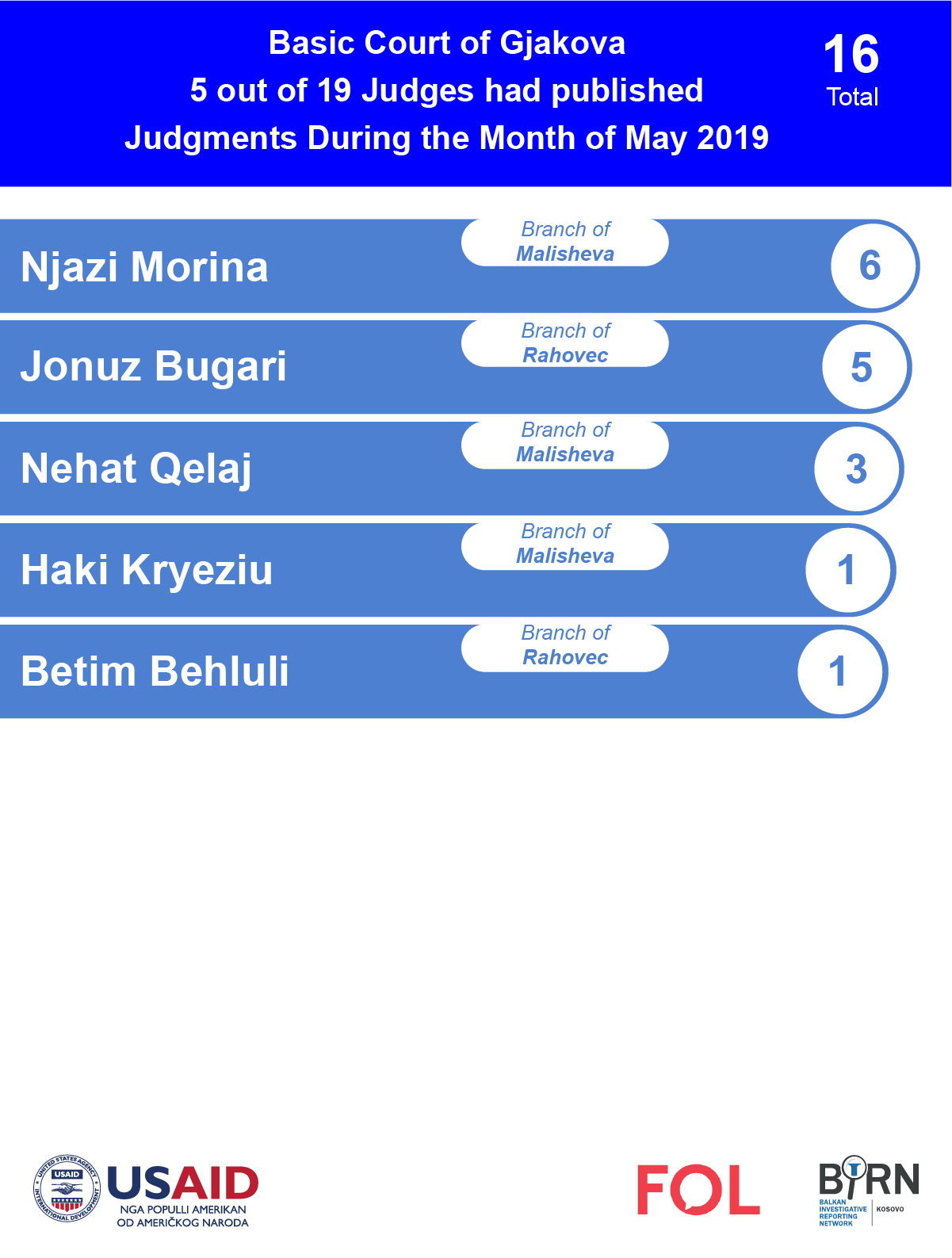
9. Publication of Judgments by the Basic Court of Gjakova and its Branches

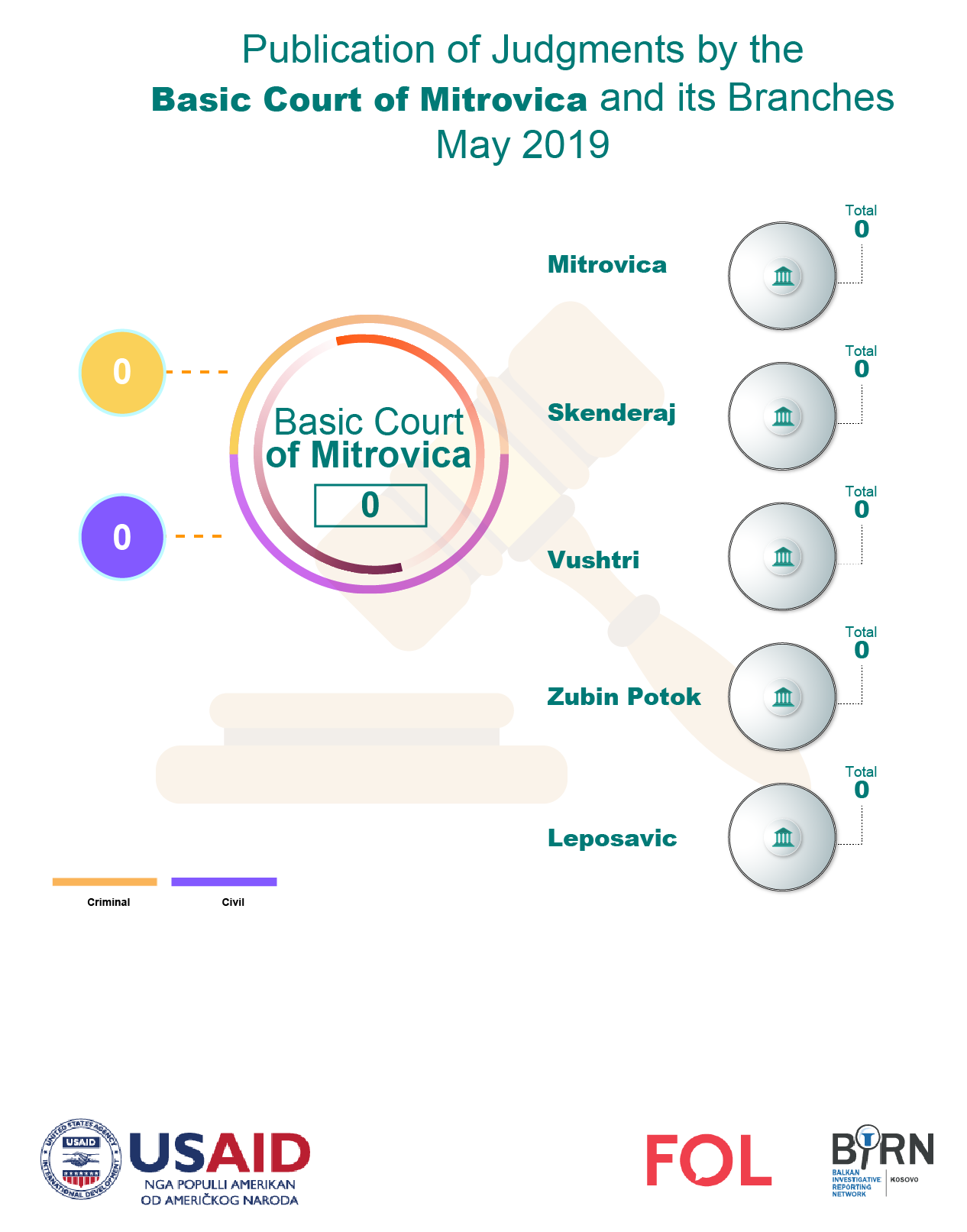
10. Publication of Judgments by the Basic Court of Mitrovica and its Branches

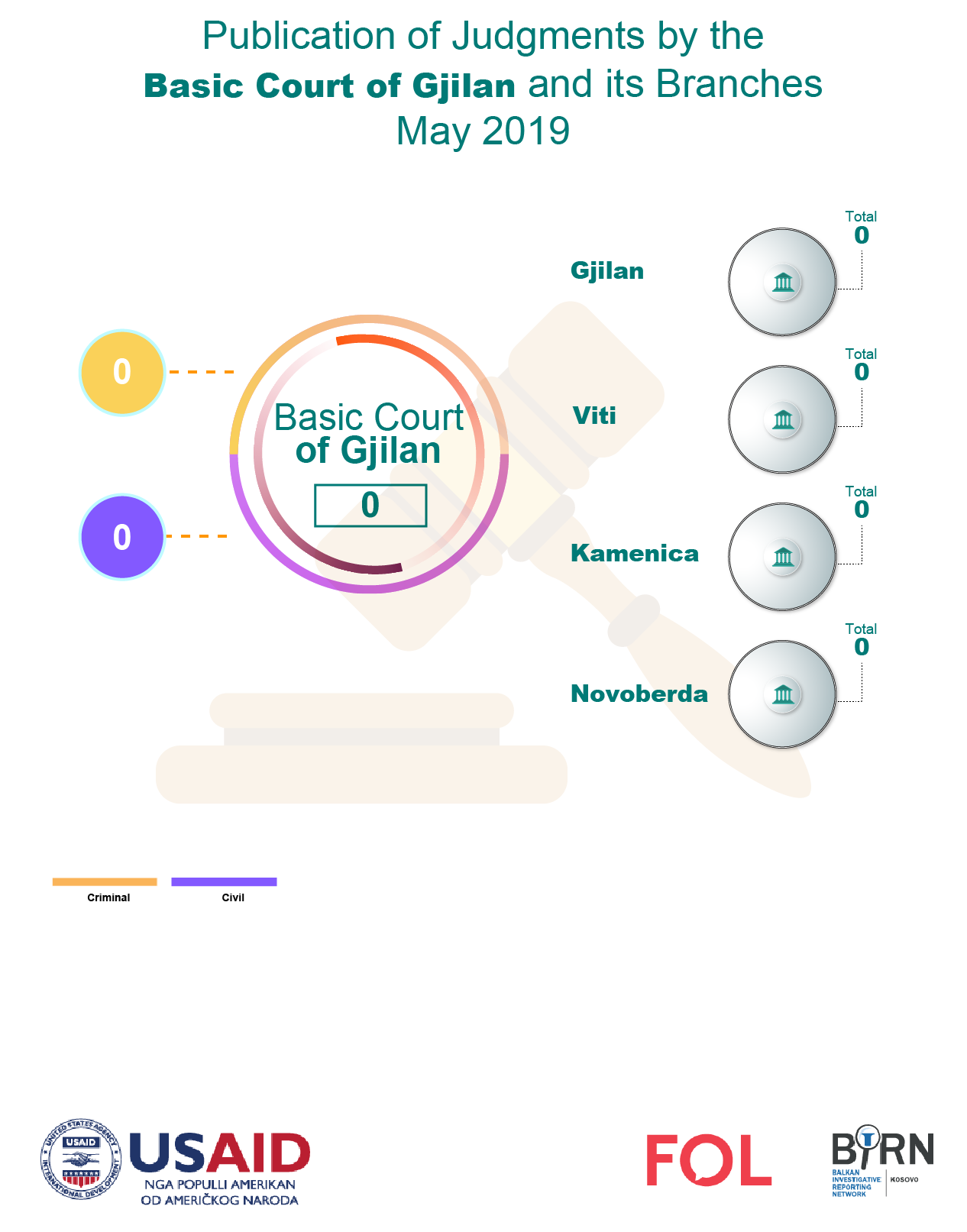
11. Publication of Judgments by the Basic Court of Gjilan and its Branches

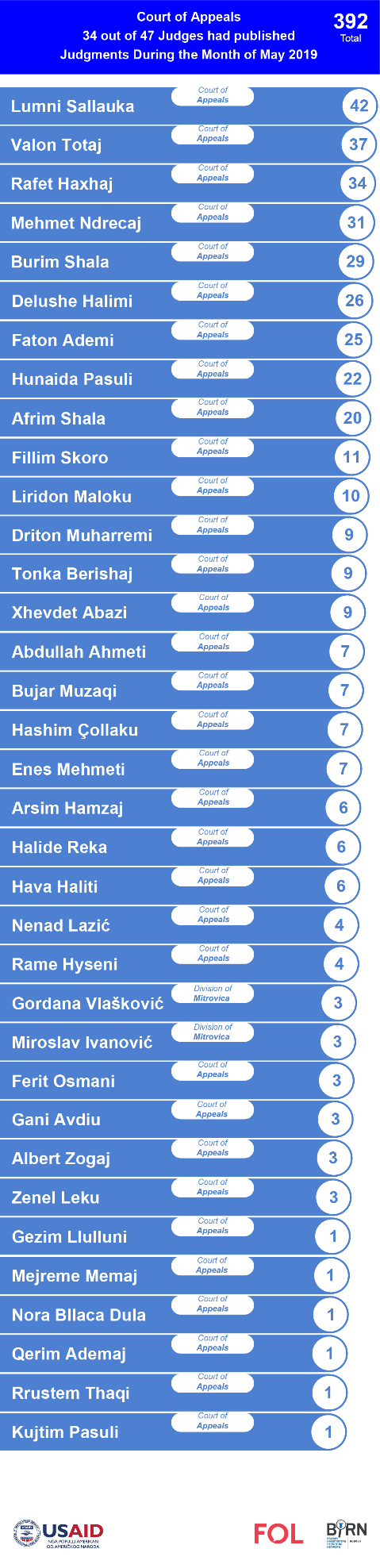
12. Court of Appeals, 34 out of 47 Judges have Published Judgments During the Month of May 2019

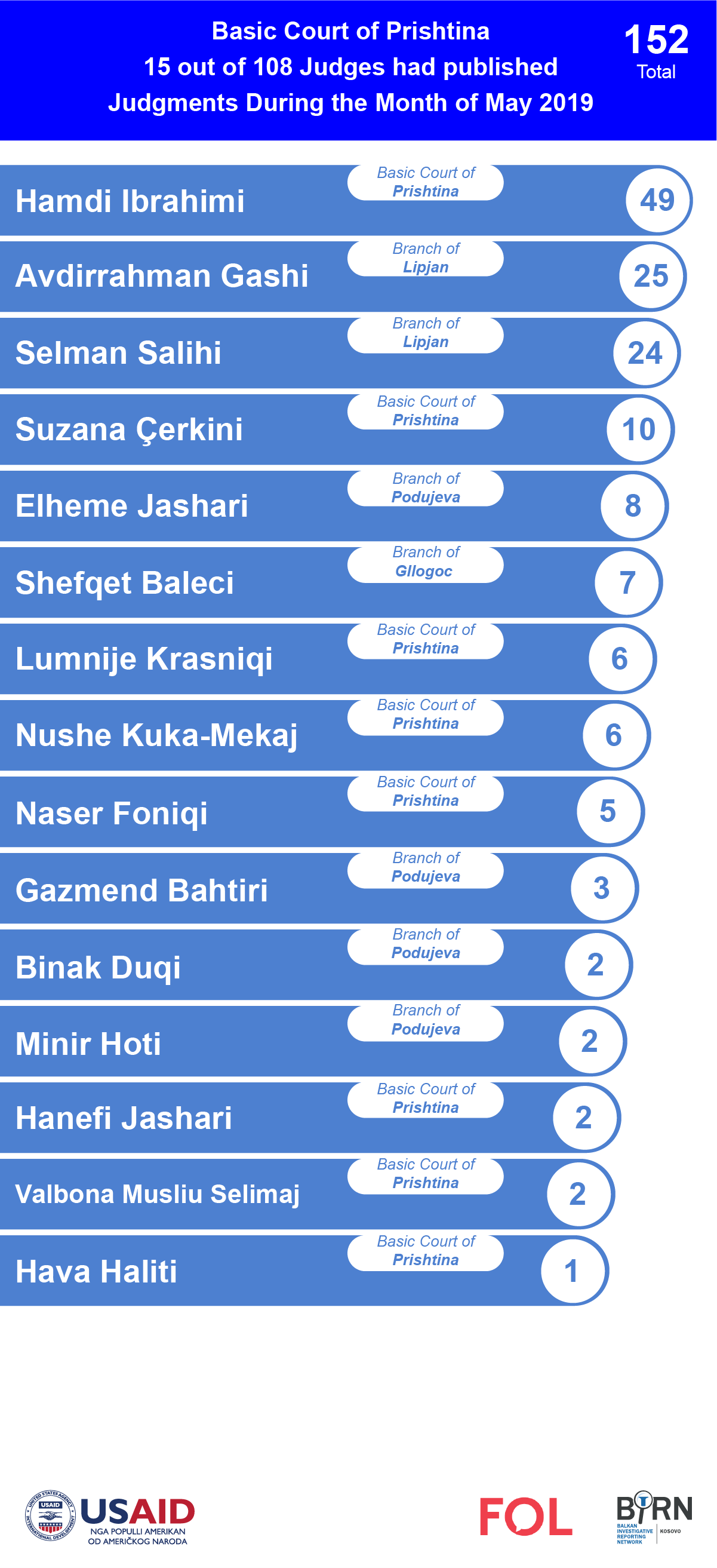
13. Basic Court of Prishtina, 15 out of 108 Judgments During the Month of May 2019

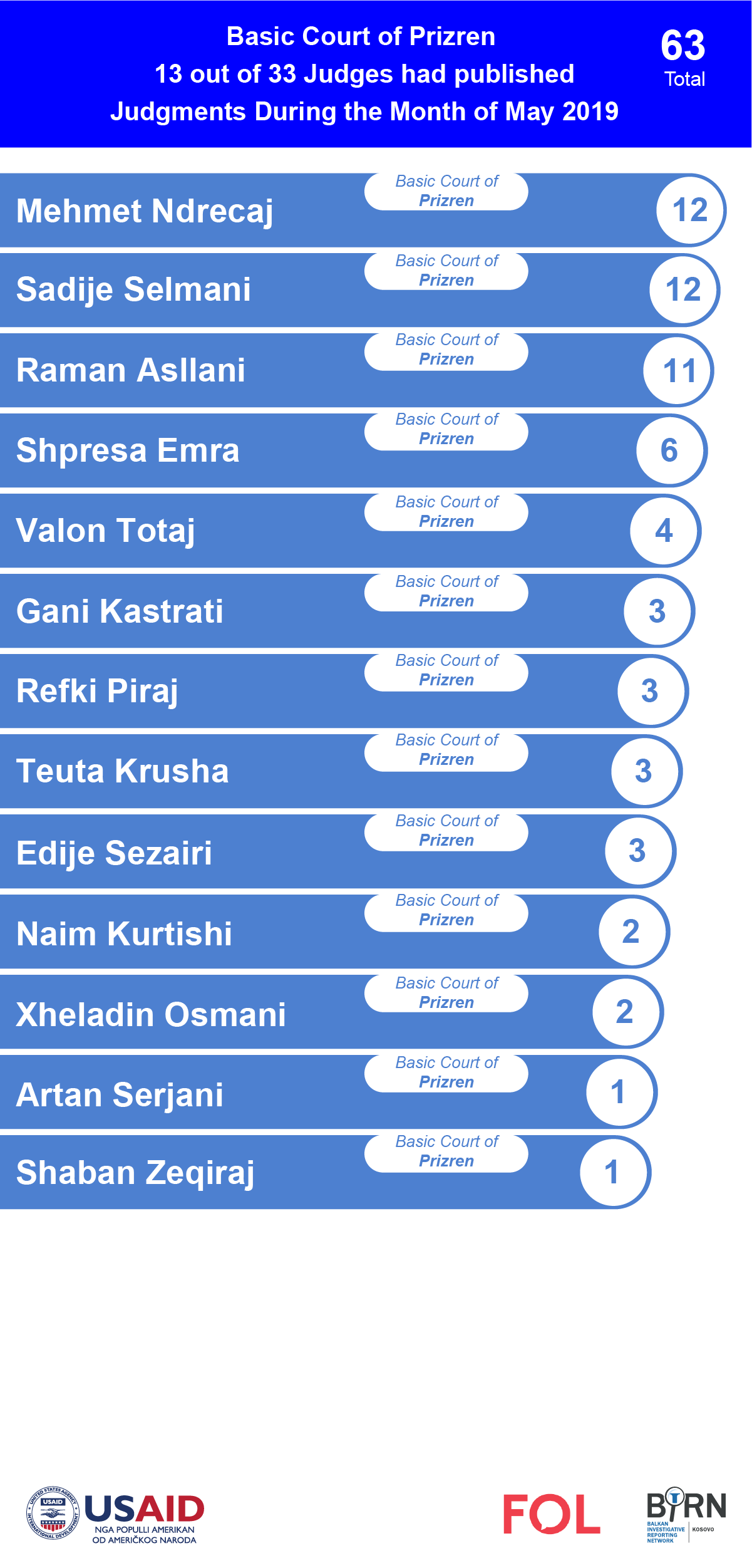
14. Basic Court of Prizren, 13 out of 33 Judges had Published Judgments During the Month of May 2019

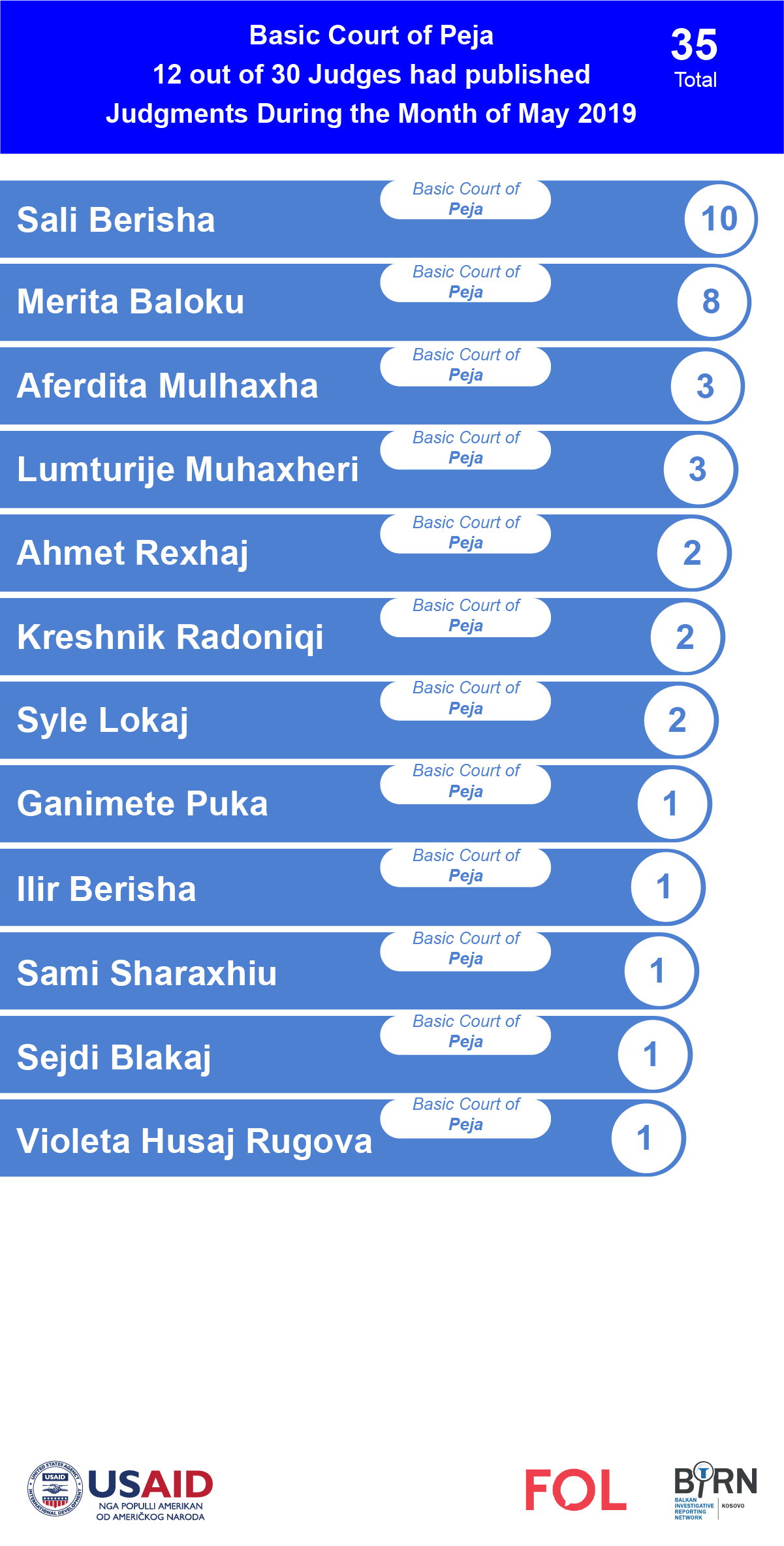
15. Basic Court of Peja, 12 out of 30 Judges had Published Judgments During the Month of May 2019

16. Basic Court of Ferizaj, 10 out of 24 Judges had Published Judgments During the Month of May 2019

17. Basic Court of Gjakova, 5 out of 19 Judges had Published Judgments During the Month of May 2019

18. Supreme Court, 1 out of 25 Judges had Published Judgments During the Month of May 2019


Clarification: The publication of judgments during the period of May 1 to May 31, 2019 was monitored for all Kosovo’s courts focusing on criminal, civil, economic and administrative departments. Additionally, this monitoring covered the publication of judgments according to judges from all courts and the abovementioned departments. The Division for Minor Offences judges were not monitored.

During the monitoring of judgments published in the Kosovo Judicial Council web portal for the aforementioned period, it was observed that there are 753 judgments in total, or 22 more than what BIRN and FOL have in their database. This difference in numbers is due to the double publication of judgments, empty judgments, or there are cases when judgments are missing altogether. These shortcomings were noted during a detailed verification by BIRN and FOL.

*Disclaimer: This monitoring was made possible by the support of the American People through the United States Agency for International Development (USAID). The content of this article is the sole responsibility of FOL Movement and BIRN Kosova and does not necessarily reflect the views of the United States Agency for International Development or the United States Government.


Over 10 Thousand Judgments Published by Kosovo Courts

Publication of judgments on the courts’ websites is a step ahead toward access to information, increasing awareness and public trust in the judicial systems in Kosovo. FOL Movement and BIRN Kosovo are the two leading local organizations that are monitoring this process to ensure compliance with Law on Courts.

Based on the amendment of the 2016 Law on Courts, all courts were required to publish all the final judgments. Publication in this form will continue until the KJC amends/supplements the Administrative Instruction on the Publication of Judgments in accordance with the new Law on Courts (2018), which obliges the judiciary to publish all the judgments.

In order to see if the courts are implementing the law, BIRN and FOL have monitored the publication of judgments from January 1, 2016, to May 31, 2019. The primary purpose of the monitoring is to inform citizens about the progress and the achievements in this regard. By May 31, 2019, the courts have published a total of 10,822 judgments. It is worth noting that while in 2016 the number of published judgments was 632, in 2018 this number had a significant increase, where courts published 5,418 judgments.

The above-mentioned data indicates that since 2016 there has been a rising trend and higher willingness by courts to publish the judgments.  Moreover, a data comparison across the court departments demonstrates that criminal departments of all the courts are publishing more judgments compared to civil, administrative, and commercial departments.

All the aforementioned number of judgments can be found on the webpage of the Kosovo Judicial Council (www.gjyqesori-rks.org). These data can serve to the students and researchers of law, and beyond, for in-depth research and thorough analysis.

USAID Justice System Strengthening Program is supporting BIRN and FOL to monitor the publication of judgments by Kosovo’s basic courts (including their branches), the Court of Appeals and the Supreme Court.

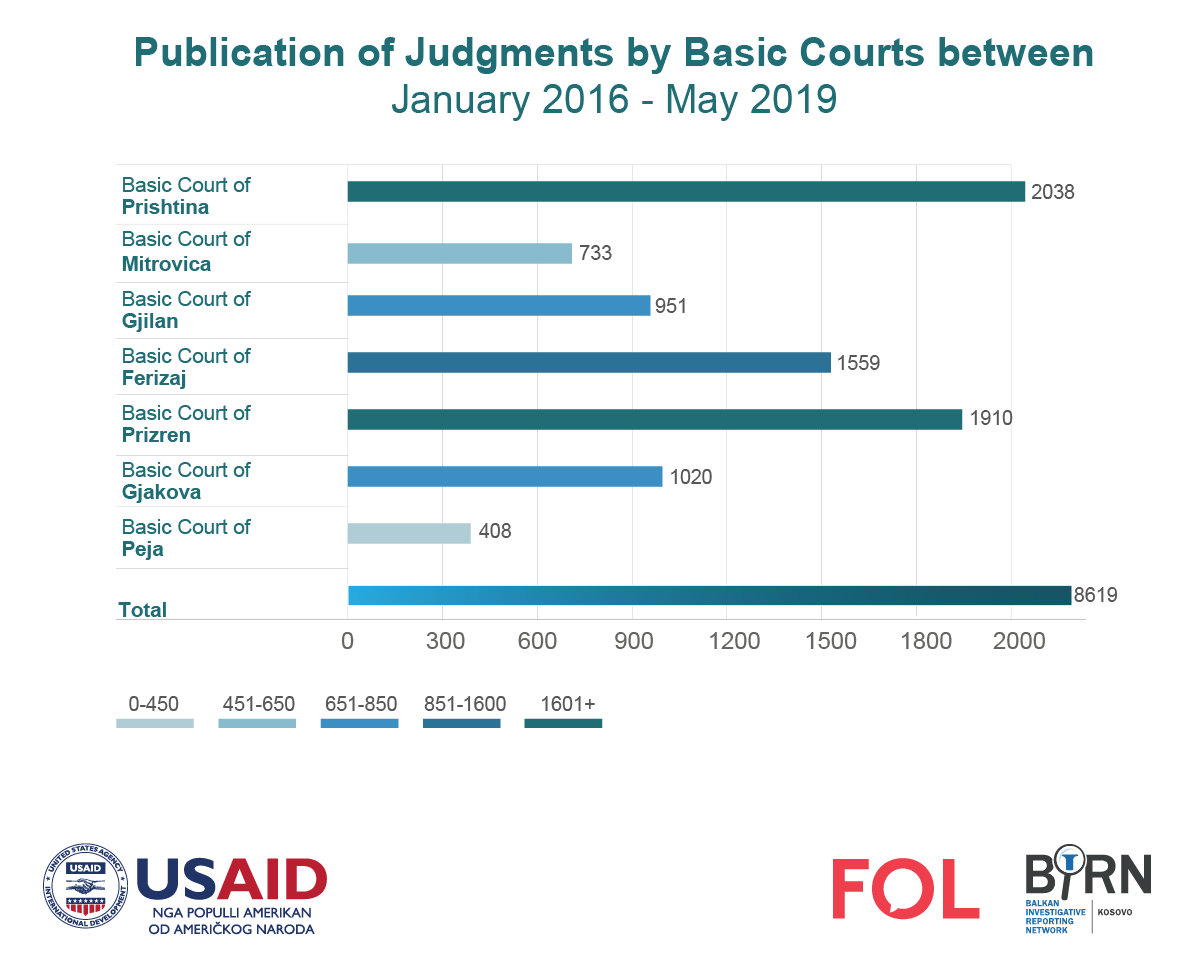
Chart 1: Comparison of judgments published by basic courts

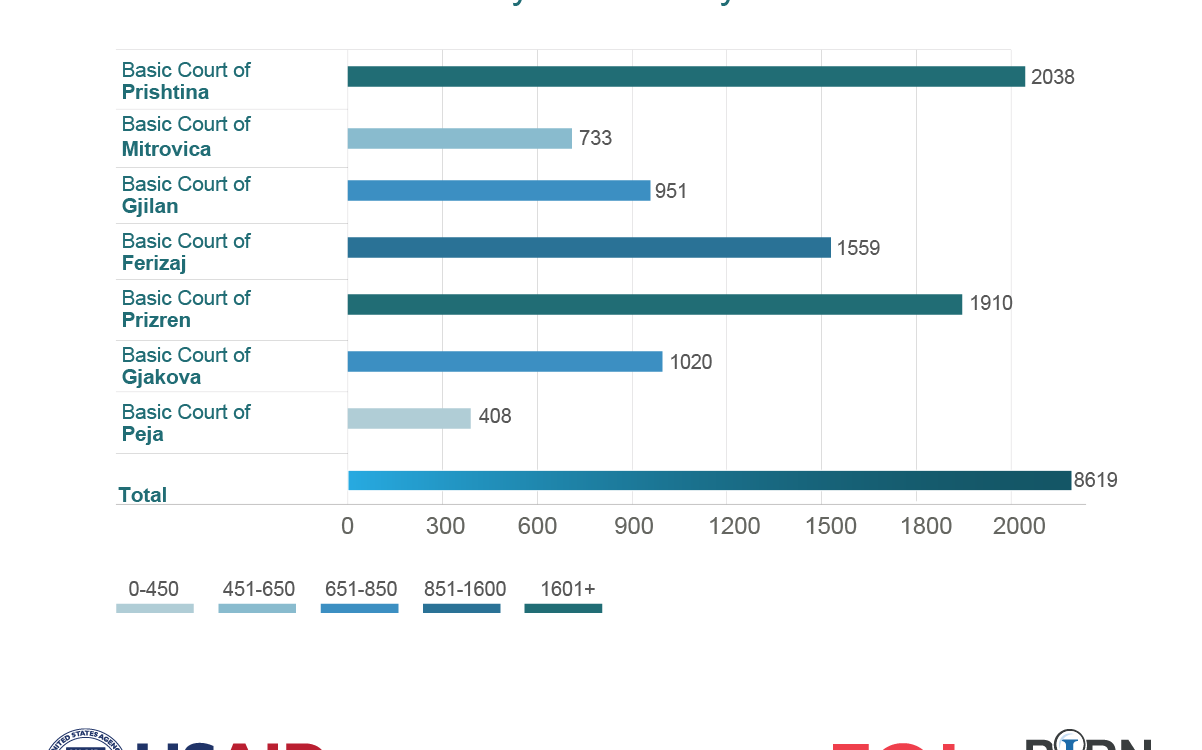
The above infographic shows that the basic courts, including their branches, have published a total of 8,619 judgments by May 31, 2019. The presented data allows us to make a comparison between the basic courts of Kosovo, whereby we note that the Basic Court of Pristina leads in terms of published judgments, followed by the basic courts of Prizren and that of Ferizaj/Uroševac.

On the other hand, the Basic Court of Pejë/Peć has published the smallest number of judgments.

 Chart 2: Judgments published by Pristina Court

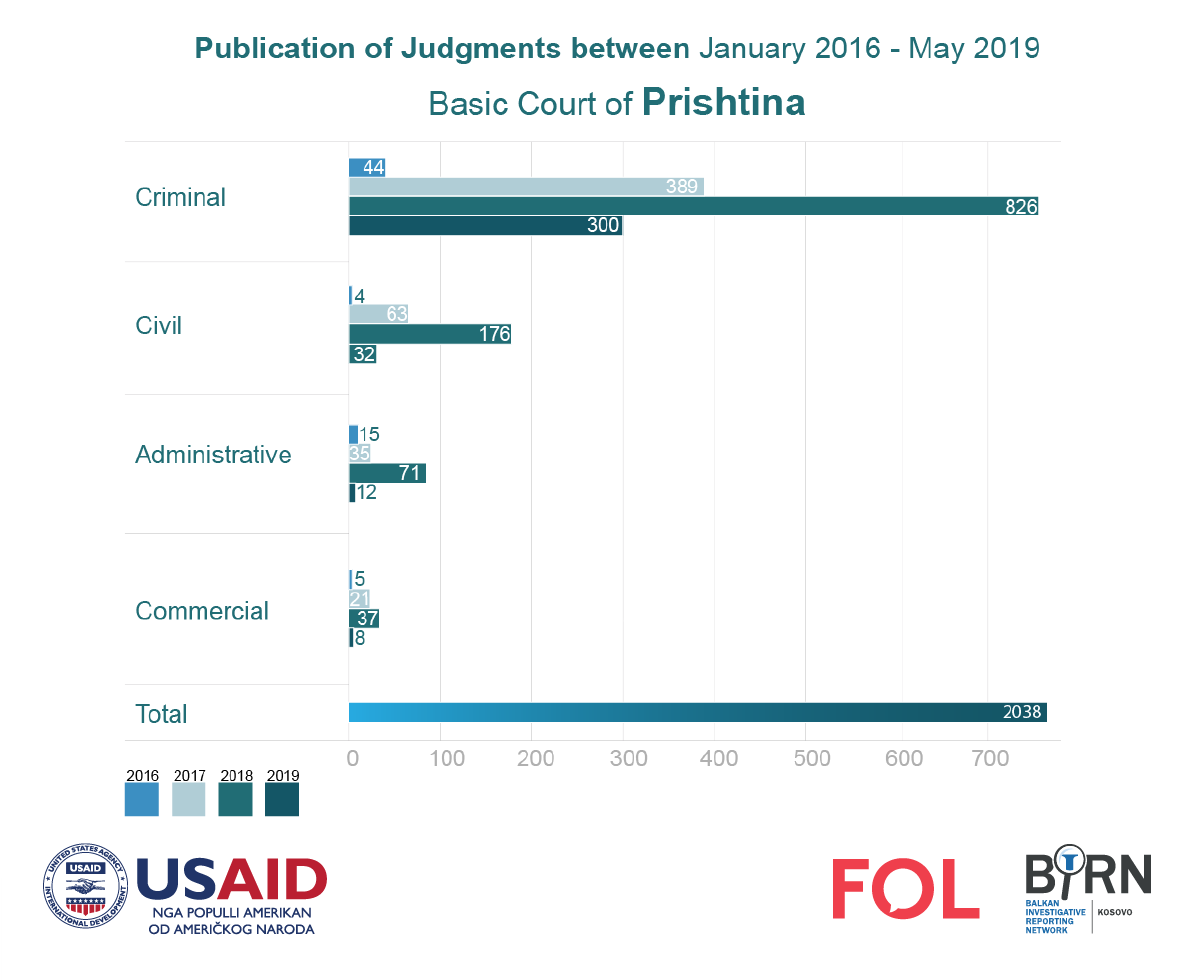
At the basic courts level, Pristina Court is the first court with the highest number of published judgments. The court has published a total of 1,559 criminal judgments, 275 civil judgments, 133 administrative judgments, and 71 commercial judgments. On the other hand, from among the branch courts, the Lipjan /Lipljan branch has published 49 judgments, Podujevë/Podujevo branch 17, Gllogoc/Glogovac 7, and Graçanica/Gračanica have not published any judgment.

Chart 3: Judgments published by Prizren Court

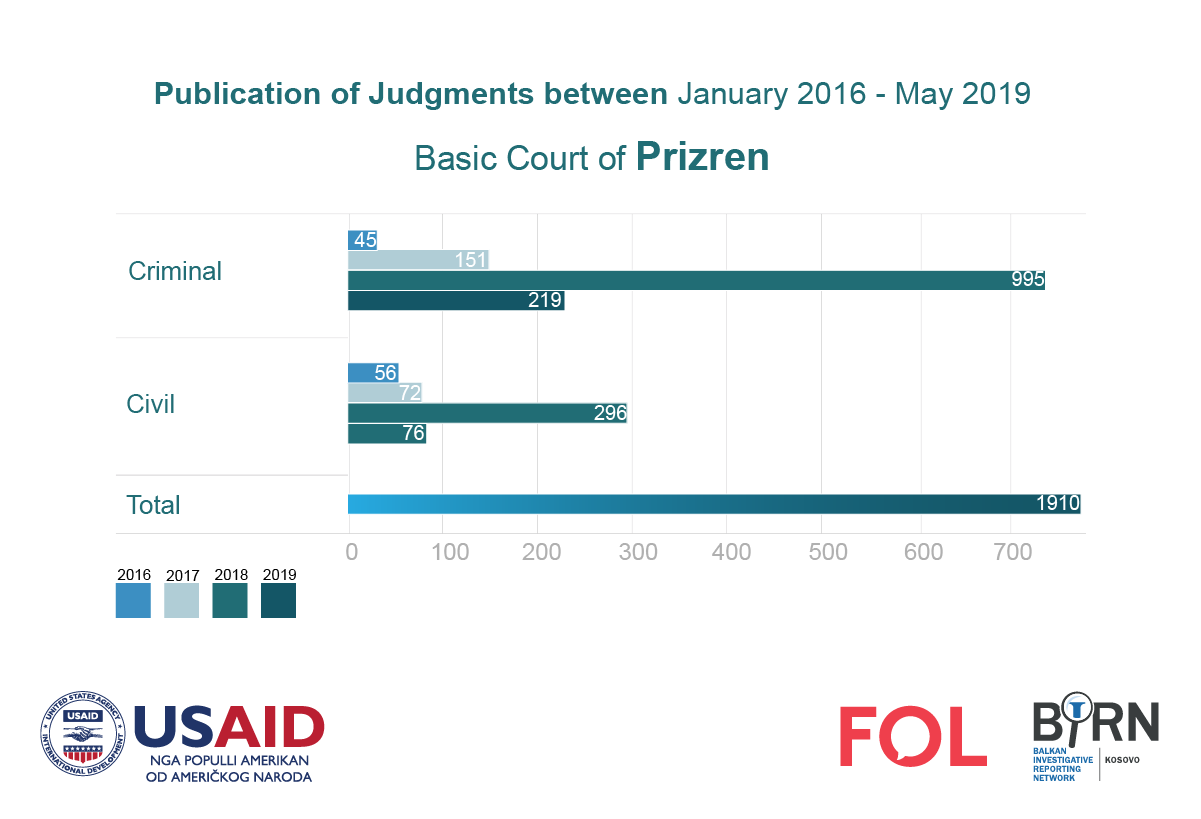
At the level of basic courts, Prizren Court is the second court with the largest number of judgments published. In this court, it is the Criminal Department that deserves the credit for having published the highest number of judgments. This department has published 1,410 judgments. On the other hand, the Dragash/Dragaš branch has published 3 judgments in total for the abovementioned period, while Suharekë/Suva Reka Court has not published any judgment.

Chart 4: Judgments published by Ferizaj/Uroševac Court

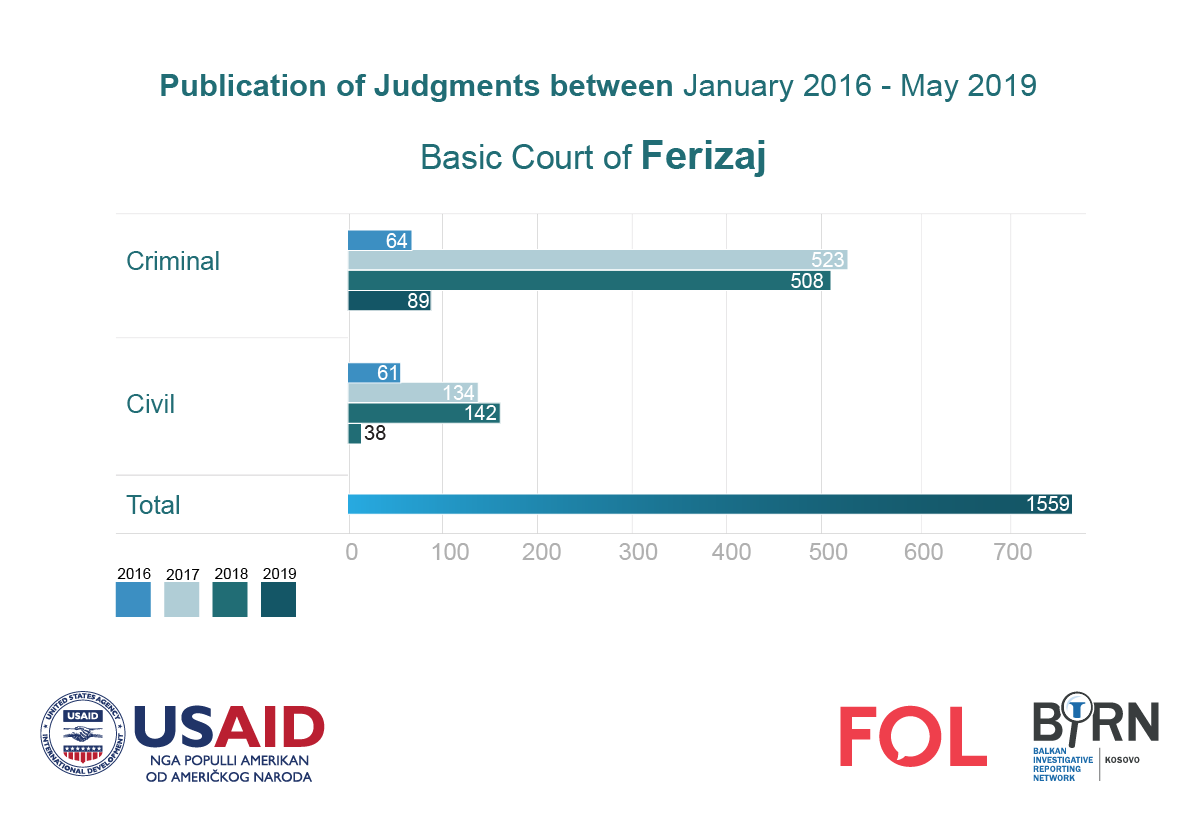
The Ferizaj/Uroševac Court is the third court with the largest number of judgments published at the basic courts level. In this court, the highest number of judgments was published by the Criminal Department, with 1,094 out of a total of 1,559 judgments. Among the branches, the Kaçanik/Kačanik branch leads with 72 published judgments, and the Shtërpcë/Štrpce branch with 57.

Chart 5: Judgments published by Gjakovë/Đakovica Court

The Gjakovë/Đakovica Court is the fourth court with the highest number of published judgments at the level of basic courts. The most meritorious for the high number of published judgments is the Criminal Department with 723 out of a total of 1,020 published judgments. It is worth noting that the Rahovec/Orahovac branch has published 178 judgments, and the Malishevë/Mališevo branch has published 142. Because of these two branches, the Basic Court of Gjakovë/Đakovica is ranked the fourth by the number of published judgments.

Chart 6: Judgments published by Gjilan/Gnjilane Court

The fifth in the list of courts by the number of published judgments is the Gjilan/Gnjilane Court. 951 judgments have been published in this court, and the most praiseworthy in this regard is the Criminal Department with 821 published judgments. Among the branches of this court, Viti/Vitina has published 107 judgments, Novobërdë/Novo Brdo 43, and Kamenicë/Kamenica 31 judgments.

Chart 7: Judgments published by Mitrovicë/a Court

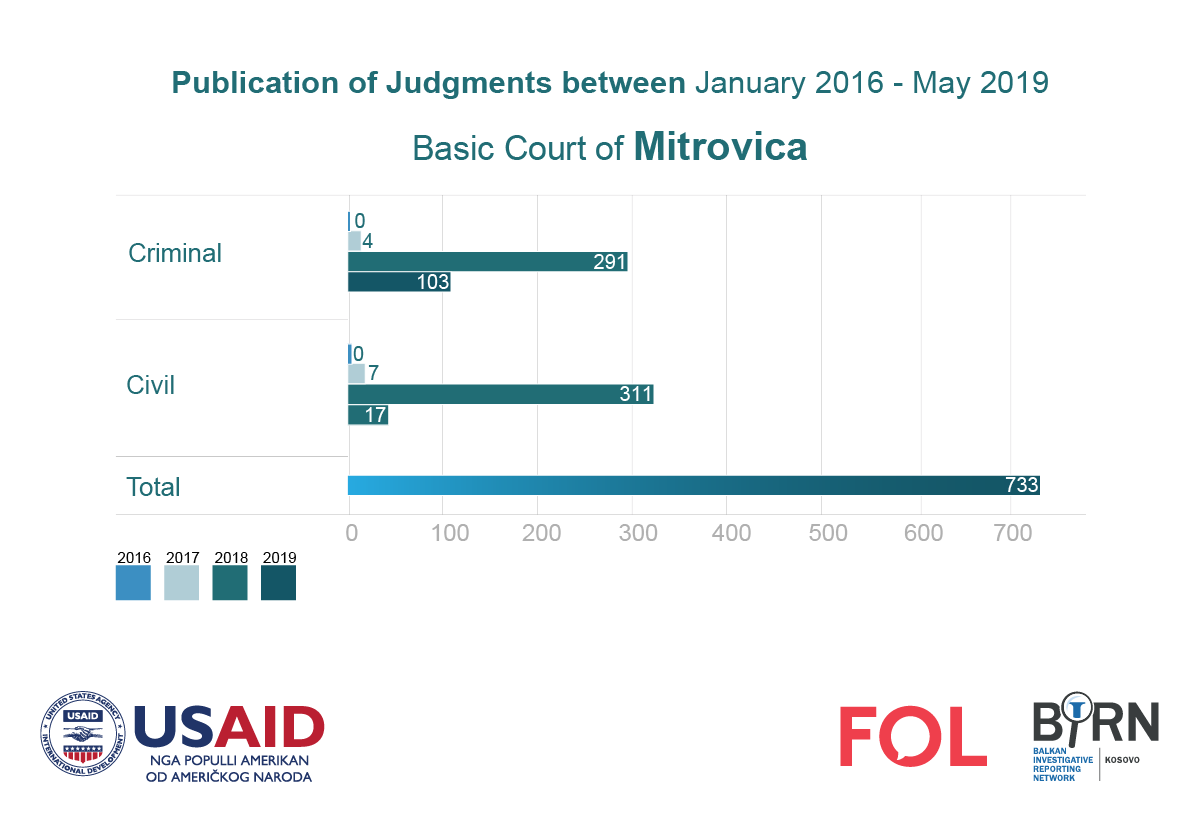
Mitrovicë/a Court is ranked third by the number of published judgments. In this court, the Criminal Department leads with 398 out of 733 judgments. The Skënderaj/Srbica branch leads with 53 judgments, Vushtrri/Vucitrn with 3, whereas Leposaviq/Leposavić and Zubin Potok branches did not publish any judgments.

Chart 8: Judgments published by Pejë/Peć

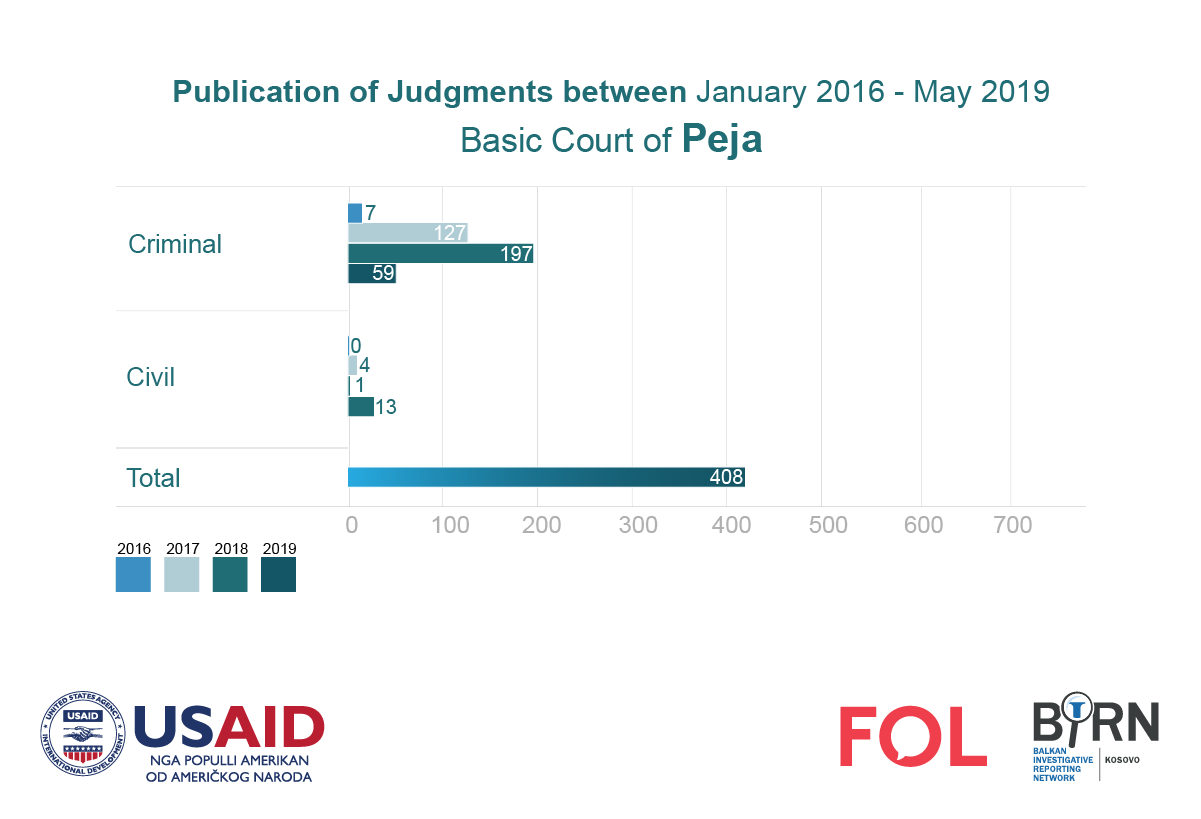
The Pejë/Peć is the court with the smallest number of published judgments. Over the years, this court has only published 408 judgments, where most of them were published by the Criminal Department. On the other hand, it is worth noting that the branches of this court (Klinë/Klina, Istog/Istok and Deçan/Dečani) did not publish any judgments.

It is important to mention that we do not have official information about the number of final judgments that the courts have issued over the years, which would give us a clear idea about judgment publication results and help us check the number of judgments published compared to the number that should have been published.

Chart 9: Judgments published by the Court of Appeals

The Court of Appeals has marked continuous progress in increasing the number of published judgments over the years. From 2016 to May 31, 2019, the court has published a total of 1,580 judgments, 921 of which were published by the Criminal Department. The Mitrovicë/Mitrovica Division of Appeals has published 6 judgments in total.

Chart 10: Judgments published by the Supreme Court

In the Supreme Court, the Civil Department leads in terms of the number of judgments published from among the total of 623. The infographic data indicates that the Department has published 303 judgments over the years. On the other hand, the Special Chamber has published 22 judgments.


Explanation: In monitoring the number of judgments published, we have noticed that 11,059 judgments appear on the Kosovo Judicial Council webpage or 237 judgments more than in the charts shown above, with a total of 10,822 published judgments. This difference in numbers is noticed particularly in the Supreme Court, where the difference amounts to 190 judgments, in the Basic Court of Pristina the difference is 20 judgments, in the Court of Appeals 15, in the Basic Court of Ferizaj/Uroševac 7, in the Basic Court of Mitrovicë/Mitrovica 3 and in those of Gjakovë/Đakovica and Prizren one judgment respectively. Such a discrepancy in numbers in the aforementioned courts appears in 2017 mainly.

*Disclaimer: This article is made possible by the support of the American People through the United States Agency for International Development (USAID). The content of this article is the sole responsibility of FOL Movement and BIRN Kosova and does not necessarily reflect the views of the United States Agency for International Development or the United States Government.

Ambassador Kosnett’s Speech on Justice at Levizje Fol

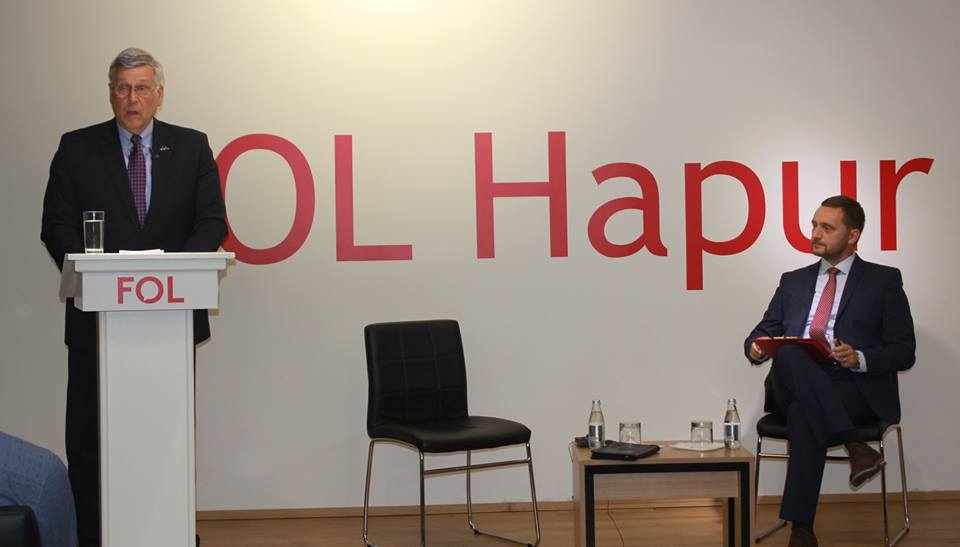
Prishtinë, 25 prill 2019 – The FOL Movement has started the new season of Open Forum FOL, where the first guest for this series was the Ambassador of the United States of America in Kosovo, Philip S. Kosnett. The topic of this forum discussion was “Advancing the Justice System in the Service of all Kosovo Citizens”.

The full speech of the Ambassador:

Ambassador Kosnett’s Speech on Justice at Levizje Fol

Thank you for that introduction, Elbasan, and thank you for the invitation to speak at Levizje Fol. It is a privilege to be here, as a representative of Kosovo’s closest partner, to offer my thoughts on a topic that is vital to Kosovo’s future: how institutions and individual citizens can work together to strengthen the rule of law and make Kosovo a more just society.

First, let’s define the terms.  We often talk about “rule of law” in Kosovo, and I think the dictionary definition is pretty clear: the principle that all people and institutions are subject to and accountable to law that is fairly applied and enforced.

In democracies like the U.S. and Kosovo, writing, interpreting, and enforcing the law is the formal responsibility of the government’s three branches: the legislative, judicial, and executive departments.  But it is also the responsibility of citizens to participate in ensuring that—I will say it again—all people and institutions are subject to and accountable to law that is fairly applied and enforced.

The great American Senator and Attorney General Robert Kennedy said this—more poetically—half a century ago:

“The glory of justice and the majesty of law are created not just by the Constitution – nor by the courts – nor by the officers of the law – nor by the lawyers – but by the men and women who constitute our society – who are the protectors of the law as they are themselves protected by the law.”

But I submit to you that following the law is only one element of justice.  OK, what do I mean by justice?  Try Googling the word, as I did while writing this speech, and you’ll find some vague and unhelpful definitions.  For example:  “Justice is the quality of being just.”

So “justice” is hard to define.  But having lived in many countries, I’ve come to realize that attitudes about justice often deeply reflect history and culture.

In some places, history and culture dictate an emphasis on strict administration of written laws—written by a legislature or perhaps derived from religious texts—to ensure fairness and impartiality.  Citizens are expected to accept a court ruling, even if it negatively affects them.

In other places, people view the law more as a general guideline, but if a court rules against them, they are quick to dismiss the decision and assert their own definition of fairness.  This is frequently true where a minority group believes—perhaps with good reason—that their government does not offer them equal protection under the law, or even that laws were written specifically to disenfranchise them and deny them equal justice.   And in some places, people are raised with the idea that providing opportunities for family or friends is more important than any responsibility to an abstract law or to society as a whole.  I will come back to this point.

This would be a good place for me to say that the United States, a much older republic than Kosovo, is still struggling to build a society where all citizens and residents can be confident of equal protection under the law.  The Constitution and our laws ensure equal protection and promote equal opportunity—the “Pursuit of Happiness”—without regard to race, ethnicity, religion, gender, or sexual orientation. But we argue energetically, in and out of court, about whether this is true in practice and how to balance competing interests.

So I don’t want to give you the impression that building a just society is easy, or that the United States has all the answers.  But we understand the importance of the goal of equality under the law, and we keep fighting to make it a reality.

Let’s talk about Kosovo.  I submit that an expansive view of justice—a concept that includes equal rights and opportunities, equal protection under the law, and confidence that government officials will be held accountable to the people—would create hope for Kosovo’s youth and confidence among Kosovo’s partners.  This view of justice expands benefits to all of society.

What are the benefits of living in a just society with equality for all?

I believe that a just society is a more peaceful society, not without disagreement, but with established, non-violent means for working out differences among groups, and between citizens and government.  In a just society, people feel that justice has been served when they understand how decisions are made, even if they don’t agree with the result.

Finally, a just society is the foundation of a peaceful, prosperous society.  A society in turmoil—a society without the predictability that rule of law brings—is a less attractive place for entrepreneurship and job creation.

First, the good news. As Kosovo enters its second decade of independence, it has capable institutions and sound laws, stemming from its constitution.

Citizens have more access to information on government decision-making than ever before.  Kosovo is impressing the world as a regional leader in public procurement transparency and victim compensation. And in a trail-blazing move, Kosovo passed comprehensive whistleblower legislation before the European Union.   Kosovo’s citizens have much to be proud of on this front.

But you have a lot of work to do as well.  What are the challenges facing Kosovo with regard to the practice—and not the theory—of justice?  And how can Kosovo’s institutions and citizens strengthen both the formal rule of law and the country’s informal commitment to justice?

Let me give you several examples to illustrate what I mean:  specifically, an example where the government is willfully ignoring the law; an example where the law itself may need to be re-examined; and finally an example where the government may have acted legally but not justly.  Then, to give praise where due, I’ll talk about a government agency doing justice right.

Let’s examine the Decani Monastery land case.  The constitutional court, which bases decisions on Kosovo’s constitution, confirmed the Orthodox Church’s ownership of several parcels of land.  But local and central-level cadastral officials refused to implement the decision, with the tacit support of senior officials.

A month from now, we will mark the three-year anniversary of the Constitutional Court’s ruling, with zero progress on its implementation.  And while some of you may not think issues faced by the Serbian Orthodox Church are your concern, if you believe in equality and in a justice system that works for all citizens, you should pay attention to this case. When it comes time for you to rely on a court decision, will you be able to, when the government ignores some rulings and enforces others?

Justice—the kind that protects all citizens equally—requires consistency and predictability, and respecting and implementing court decisions is an obligation of government agencies.  Where rule of law is respected, court decisions are not open to negotiation or personal interpretation.

Let’s move to an example of legislation that was written with good intentions, but has been hampered by politics: the amendment to the 2014 Law on the Status and Rights of the Martyrs, Invalids, Veterans, Members of KLA, and Civilian Victims, which gave official status to survivors of wartime sexual violence.   With the support of leaders like former president Atifete Jahjaga and Dr. Feride Rushiti, and through the courageous testimony of Vasfije Krasniqi Goodman and others, survivors are beginning to come forward, 20 years after the fighting.  And they deserve immense credit for having turned an important idea into legislation.  But this amendment is attached to an existing statute which withholds status from those who were affected after June 1999.

Organizations that work with survivors made all this clear at the time the legislation was passed.  But did the Assembly members who wrote and voted for this law hear from the people most affected or from experts in this field?  Can the Assembly be persuaded to modify the law so it serves all victims? And similarly, will the Assembly extend the social and financial benefits of real and imagined KLA veterans—whose numbers have grown suspiciously high—to the survivors of sexual violence?

Then there is the politicized appointment of unqualified leadership to the Kosovo Property Comparison and Verification Agency. Appointing an unqualified individual who is not trusted by all communities to enforce the law equally, as the Assembly did in this instance, demonstrates an unwillingness to uphold the values of freedom and equality on which this country was founded.

And let’s be honest: there are many reports in Kosovo of people who are given jobs or government appointments, who are not the most qualified candidate but who are connected to influential people.

I know some cultures believe providing opportunities for family or friends is more important than an abstract goal like equal opportunity.  A recent poll noted that only about 20 percent of respondents believe that merit is the key to opportunity in Kosovo.  This is not the path to prosperity.

Let me balance these examples with a more positive one.  At the Ministry of Local Governance, courageous civil servants have committed to hiring practices based on experience and qualifications rather than political connections. I say these civil servants are courageous because their commitment to rule of law has invited intense political pressure and even attempts to intimidate them.  Yet the transparency and accountability of their hiring practices are precisely the reason donors increased their support, making even more resources available for municipal grants.

This respect for rule of law is directly benefitting many citizens in many municipalities, rather than a handful of powerful, wealthy politicians in Pristina.  This illustrates the broad concept of justice I am outlining: one that favors the rights of all citizens over the narrow interests of a privileged few. One where the government—at both national and municipal levels—acts after the Assembly passes laws, to ensure the laws are actually implemented, fairly and in full.

By embracing justice based on equal rights and opportunities, rule of law, and accountability for all of Kosovo’s citizens, you can ensure Kosovo achieves a brighter future. A future in which people succeed based on merit and talent. A future in which all citizens—women, non-majority groups, members of the LGBTI community, and people with disabilities—enjoy equal opportunity.  A future in which no person is above the law, and no person fails to receive the protections of the law.

I believe Kosovo’s international partners have a constructive role to play in shining the spotlight on violations of justice as well as positive steps, as the U.S. Government and others have been doing for some time.  We will continue to do this.  Expect to hear more soon about ways we can help ensure that those who engage in corruption or organized crime experience consequences for their corrupt behavior.  But the primary responsibility for ensuring justice in Kosovo must lie with the people of Kosovo, acting both individually and collectively.

Let’s turn to civil society organizations, like those represented here today, that are making progress as watchdogs and advocates for Kosovo’s citizens.  However, for all the progress you’ve made, there’s more you could do to multiply the impact of your efforts through coordination and mutual support.

For example, it was a civil society group—an inter-ethnic youth organization—that alerted us to the politicized appointment of unqualified leadership to the Property Verification Agency I mentioned earlier.  But once the American Embassy and other international observers spoke publicly against the hiring, why weren’t civil society organizations amplifying the concerns of these youth?

And where was the media in this case?  Its role is crucial in any democracy, and it can be a powerful ally to civil society organizations.  Journalists have a vital role to play in ensuring justice for all of Kosovo’s citizens.  To do so, they need to be protected from undue pressure or threats.  Honest journalism doesn’t mean making up stories or spreading wild rumors to sell papers or collect clicks: it means courageously exposing corruption, revealing discrimination, uncovering inequality, and demanding accountability.  It means covering stories that will help majority communities understand issues faced by minority and other vulnerable groups.  The media plays a role in ensuring that those who are unaffected by injustice are as outraged as those who are affected.

Finally—and here I have saved the most important point for last—every individual citizen has a role to play in upholding the rule of law.

Expect more from your elected officials.  The establishment of democracy in Kosovo was a tremendous achievement; don’t take it for granted.  Vote. Write. Speak out.  Demonstrate peacefully.

Expect politicians, police, prosecutors, and judges to meet their responsibilities of providing justice fairly, equally, and with honor.

Engage in formal legal processes, even if it takes more time and effort.  Invest in justice institutions and hold them accountable to ensure that they live up to the ideals enshrined in Kosovo’s constitution, the bedrock of your rich and multi-ethnic society.

Finally, expect more from your fellow citizens in building a just society.

I thank you for your attention, and look forward to a frank and open discussion of these issues.  Permit me to close with one more quotation from an American hero, Martin Luther King:

“Injustice anywhere is a threat to justice everywhere. We are caught in an inescapable network of mutuality, tied in a single garment of destiny.”

Lëvizja FOL holds two day workshop on “Promoting Open Procurement Transparency Portal”
Suhareka 29 Auggust 2018 – with the support of USAID Transparent, Effective and Accountable Municipalities (USAID TEAM), is holding two days workshop on “Promoting Open Procurement Transparency Portal”. The purpose of this workshop is to introduce and to practice the ways on using the Open Procurement Portal. For more information click on the link: ttps: //www.prokurimihapur.org.

In the workshop are participating representatives from the media and non-governmental organizations.