SPEAK Openly with the Prosecution in the city of Peja and Gjakova

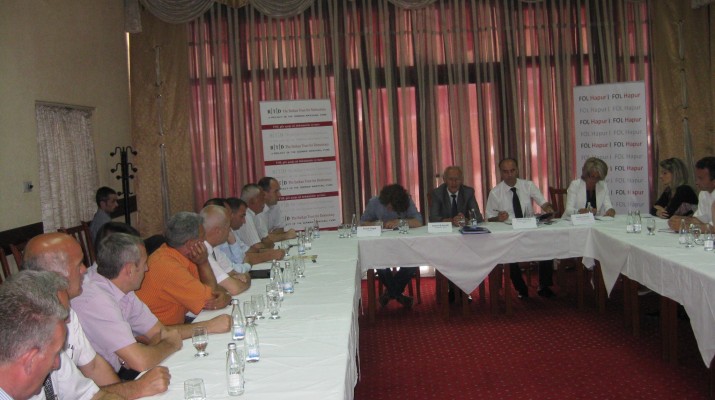
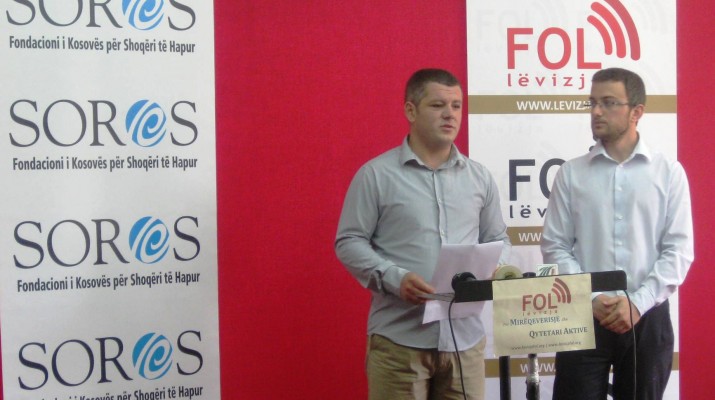
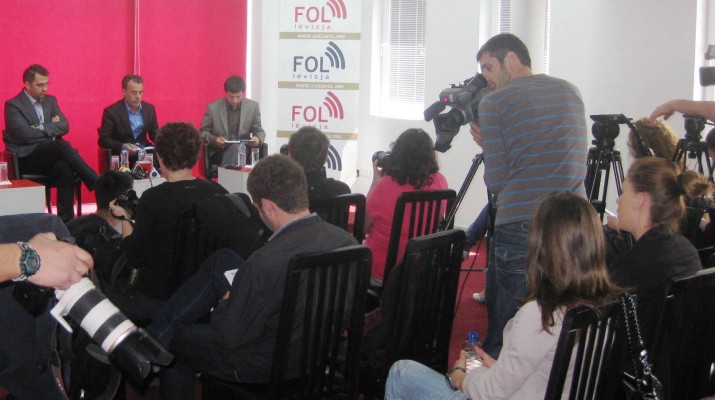
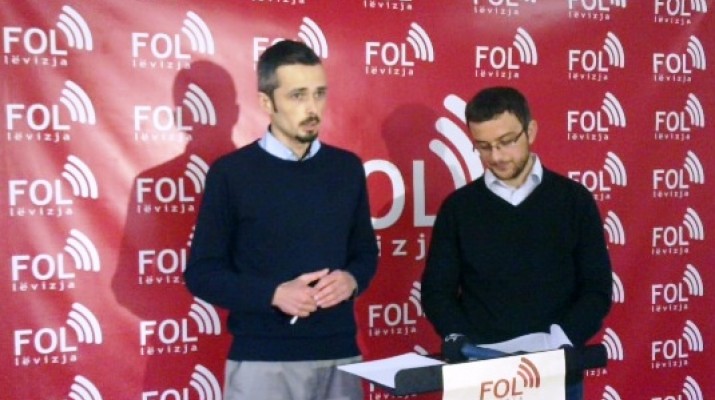
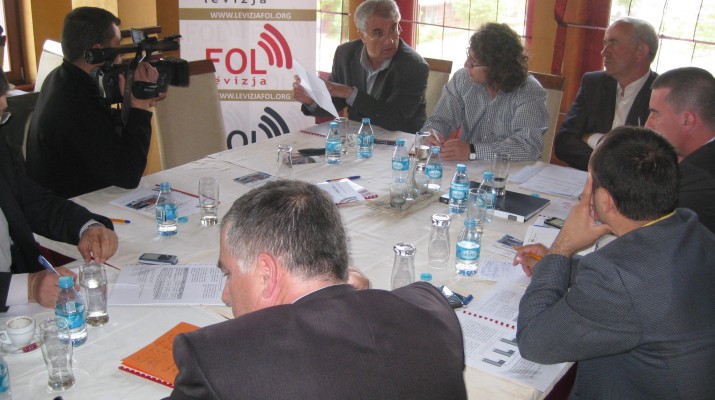
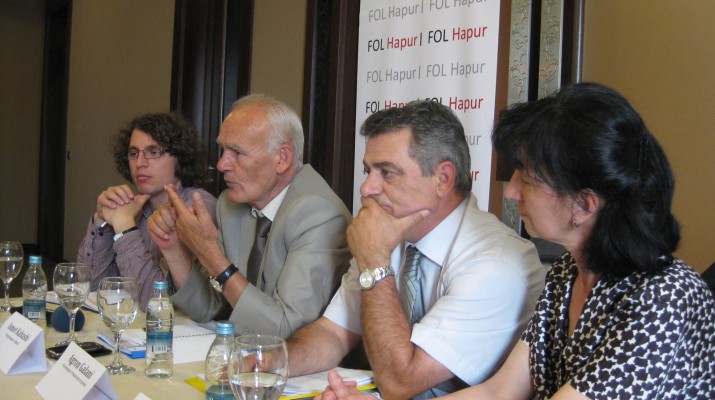
Peja – Gjakova, June 20, 2011– Movement FOL in cooperation with the State Chief Prosecutor, have conducted the debate in Peja and Gjakova, within the campaign “Prosecutions closer to the citizen”. Participants in these debates have been representatives of civil society, media, and representatives of political parties and citizens of these municipalities. While the panel members present were State Chief Prosecutor of Kosovo, Mr. Ismet Kabashi, Mr. Agron Galani, Chief Prosecutor of District Prosecution in Peja, Mrs. Lirije Morina, Chief Prosecutor of the Municipal Prosecution in Peja and Mrs. Shpresa Bakija., Chief Prosecutor of municipal prosecution in Gjakova.

Petrit Zogaj of FOL Movement, thanking the participants said that “FOL Movement in collaboration with the State Chief Prosecutor had initiated the campaign” Prosecutions closer to the citizen “, through which both parties aim to increase information about the role and work of the prosecution, encourage citizens to cooperate with prosecutions, and discuss the work of prosecutions in the regions “.

State Chief Prosecutor, Mr. Kabashi said that the prosecution is very interested to be fully a transparent institution towards citizens, civil society and media, and for this we thank Movement FOL for its commitment to the realization of this campaign. According to him the year 2010 has been a successful year for the justice system in Kosovo, “Kosovo Assembly approved two of the most basic laws for the good functioning of the justice system and has completed the process of appointment and re-appointment of judges and prosecutors “. He added that “the prosecution in 2010 has managed to proceed 8.2% more cases than the previous year and this year there have been many more cases of reporting of citizens in the prosecution.” Prosecution will pay particular attention to cases dealing with corruption and organized crime. According to prosecutor Kabashi “within the Special Prosecution was created a task force to fight against corruption and in all district prosecutions is assigned a prosecutor who deals with the investigation of these cases. “Mr. Kabashi in Gjakova said that with the law on courts which has been approved last year, the municipality of Gjakova will have the Basic Court.

The debate continued with the Chief District Prosecutor in Peja, Mr. Agron Galani, who emphasized the fact that this prosecution lacks prosecutors and that in July this year will begin with completion of vacancies with new prosecutors. According to him “only in 2010 are pursued 600 criminal charges, of which 529 charges has been raised, 10 charges relating to corruption and economic crimes and municipal officials had been arrested, who were previously” untouchable “by the justice “. “Prosecution in Peja district is transparent and asked NGOs, media and citizens not to be reluctant to seek information and documents in this prosecution,” concluded his speech Mr. Galani.

Mrs. Lirije Morina, the chief prosecutor of the Municipal Prosecution in Peja said that “During 2010 we had approximately 1100 criminal charges for grown people and 60 for juveniles.” Municipal prosecution is faced with ongoing problems and difficulties, but according to her “it is a positive fact that only last year the prosecution has begun a normal cooperation with the state prosecution.” According to her the “nature of the cases processed by this prosecution mostly are dealing with aggravated thefts, theft of woods, injuries, fights, traffic accidents, taking bribes, etc..”.

In the debate held in Gjakova, the chief municipal prosecutor in this municipality Mrs. Shpresa Bakia welcomed the initiative of Movement FOL and prosecution that the prosecution should be more open and closer to citizens. She said that “the prosecution of Gjakova municipality faces a very special phenomenon where the percentage of juvenile cases is higher than in Peja municipal prosecution.”

After this, the discussion was opened to the participants and had questions and answers, between participants and panellists invited to this debate.
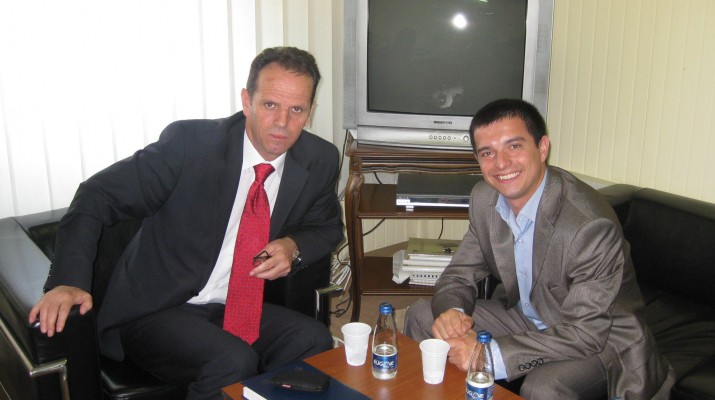
FOL has met the Chairman of KJC Mr. Peci

Prishtina, June 17, 2011 ” Today, representatives of the Movement FOL met with the Chairman of the Judicial Council of Kosovo, Mr. Enver Peci, to discuss the establishment of an anti-corruption forum as a platform for communication between the key institutions supposed to fight against corruption. Establishing such a forum is supported by the British Government. At this meeting also was discussed the procurement monitoring of KJC and allowing the Movement FOL to monitor trials of corruption cases.

FOL begins monitoring procurement at the Ministry of Health

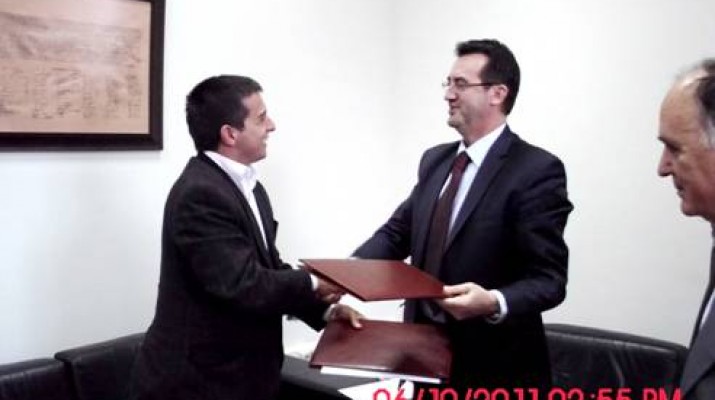
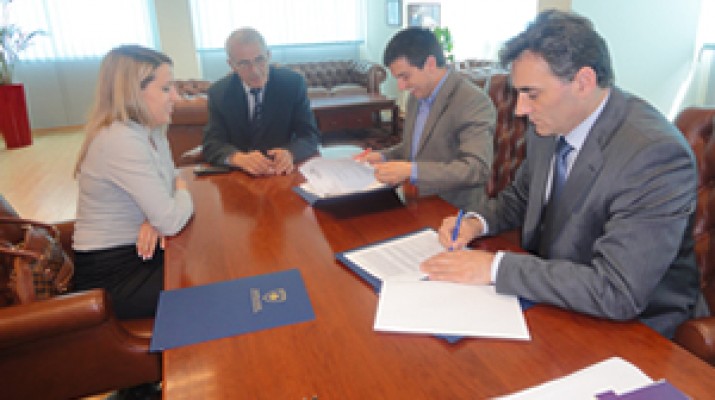
Prishtina, June 10 ” Minister of the Ministry of Health, Ferid Agani and executive director of the Movement FOL Ramadan Ilazi, on Friday signed a Memorandum of Cooperation between the Ministry and FOL, which enables the organization to observe directly the procurement procedures in this ministry. Such a memorandum aims to enhance transparency and accountability in public procurement process.

Movement FOL signed similar memorandums for monitoring procurement also with the Ministry of Justice and Public Administration while the Ministry of Infrastructure has refused to allow the monitoring of procurement by FOL Movement.

Signing of the memorandum with MH, the minister Agani and the leader of the Movement “FOL”, Ramadan Ilazi assessed as important to establishing accountability in managing public money.

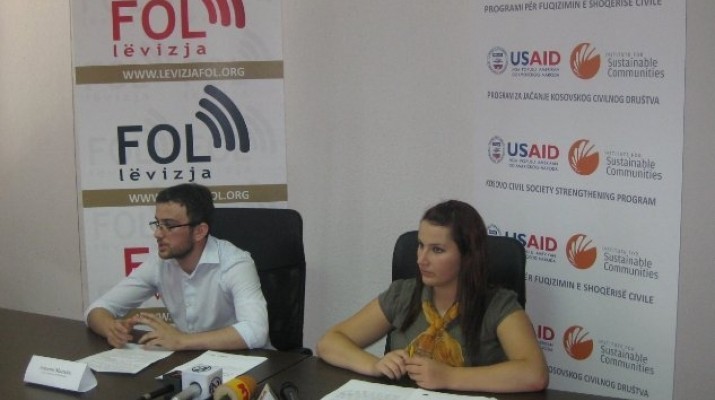
Fidan Kalaja, project coordinator of procurement monitoring at FOL Movement said that the procurement sector as the most affected by corruption should have special attention from civil society. “These memorandums favour the transparency growth and accountability and protect the public interests to prevent misuse of public money “, emphasized Castle.

Thus, in the period April to June, the Ministry of Justice have cancelled and re-tendered about 7 tenders. Movement FOL inspected during this phase also the implementation of a contract. Also during this time the request of FOL Movement for amendment of that law on Procurement has been supported, giving about 20 recommendations that should be met by new legislation.

Another practical achievement during this phase is the increase of accountability of economic operators during the draft of offers.

These memorandums are the first of the kind in Kosovo, an international practice recognized in the sphere of action of NGOs and it favours the function of advancing democracy and supervision of expenditure of public money.

“SPEAK Openly” with the British Ambassador and members of Civil Society

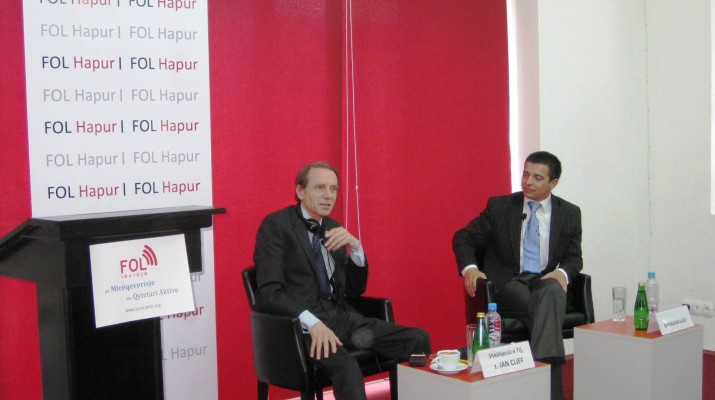
Prishtina, June 10, 2011 – Movement FOL within the forum “SPEAK Openly”, organized a panel discussion with the UK Ambassador in Kosovo, Mr. Ian Cliff, and members of civil society. The discussion focused on current developments in Kosovo, anti-corruption fight, the dialogue between Kosovo and Serbia, and the strategy of the United Kingdom to support the international recognition of Kosovo, especially those within the EU states that have not recognized Kosovo.

In his speech at the forum, Ambassador Cliff pointed out:
“Fighting corruption is one of the areas of special importance to the British Embassy. Supporting two projects regarding the fight against corruption, including the project of Movement FOL, shows our commitment towards corruption in Kosovo. This is an area where Kosovar leaders should be focus continuously to ensure that Kosovo can move forward in the EU integration “.

He added that “anti-corruption fight is part of British programs and such programs support the Kosovo institutions in the fight.
“Britain is providing political support for a greater number of recognition and to promote Kosovo’s membership in international and regional organizations.”

“Also, the UK believes that practical progress in the dialogue between Prishtina and Belgrade is crucial for EU integration aspirations – both for Kosovo and Serbia”.

Executive Director of the Movement FOL Ramadan Ilazi, noted that: “Movement FOL highly appreciates the support of the British Government for our country and civil society in Kosovo. FOL Movement believes that in order to increase the effectiveness in fighting corruption, public institutions need to enhance and strengthen communication and coordination among them”
Movement FOL has initiated the forum “SPEAK Openly” in order to bring the civil society closer to important decision making processes in country.

Over 7 million is the difference between the statements of property of senior officials in ACA and CEC

Prishtina, June 9, 2011 ” Today Movement FOL published the first Comparative Report on Evaluation of Declaration of the members of the Assembly of Kosovo at the Anti-Corruption Agency and the Central Election Commission. Based on the findings of this report, FOL has identified significant differences that exist between what the members of the Assembly of Kosovo have stated in ACA and CEC.

This report focuses precisely on the quality of the property declaration. This is done by focusing on a group of senior officials directly elected, respectively by comparing their property statements to the Anti Corruption Agency and the Central Election Commission (both made in 2010). The aim is that by identifying potentially incorrect data and possible inconsistencies, to give an insight into what challenges and problems the process of declaration of property of senior officials is going to face in the technical aspect, so that they can improve and promote the implementation of constitutional and legal obligation of senior officials to declare their property.

This report contains detailed data on the number of senior officials who are required to declare their property, the number of those who have done this duty during the reporting period and those who have not done so, and the number of officers against whom Anti-Corruption Agency has requested the imposition of administrative sanctions. According to the report, out of 800 senior public officials required to declare their property, 619 of them have declared the property, while 173 of them have not done this, which represents a 78.1% rate of implementation. Regarding the year 2010, within the first term of declaration (March 31, 2010) implementation rates increased 9.97% (from 78.1% to 88.07%). Expressed in absolute figures, from 1560 senior officials obliged to declare their property, 1374 of them have done so and 186 of them not, but by June there are only 69 of whom have not declared the property. Within the deadline for regular annual declaration of property, the rate of implementation is reported to be increased for 7.63% (from 88.07% to 95.7%). Regarding inter-institutional declaration of property of senior public officials, the report of 2009 shows refusal by two executive institutions to cooperate with the Anti Corruption Agency in providing requested information, while in 2010 there was no any barriers of this nature reported.

The findings presented in this policy analysis show that the declaration of the property of senior officials still faces challenges and problems. Among the most important identified are: there is considerable difference between the form of ACA and the CEC of declaration of the property of senior officials, the lack of a guideline on declaration of property, lack of mechanisms and procedures for verification of the property declared, the variance of data for different categories of property, and often even contradictory information.

Truth 0-Meter of Kosovo leader”s statements

Prishtina, June 5, 2011

Statement: “It is not good for anyone that we have not developed mechanisms of agreement, we have not created circumstances that not the road, but institutions are the place where the solution must be required.”

Author: Atifete Jahjaga, President of Kosovo
Date: May 13, 2011
Source: president-ksgov.net[1]
Evaluation: True

Justification: The institutions of Kosovo have not yet managed to create real mechanisms for participation in decision making and considering that we take this statement as true. The country’s president has a mandate to unify the political class and should use its authority to create these institutional mechanisms to increase citizen participation in decision making. Unlike the forms of reaction, including street protests are democratic tools that citizens express toward developments in the country and as such they cannot be stopped.

Statement: “From today I assure and guarantee all citizens of Kosovo and all Kosovo employees, that thanks to our consistent policies, very concrete and our determination, we have agreed with the IMF and the salary issue is solved once and for all.”

Author: Hashim Thaçi, Prime Minister of Kosovo,
Date: June 1, 2011
Source: Koha ditore[2]
Evaluation: False

Justification: International Monetary Fund has excluded Kosovo from the opportunity to benefit from its programs, precisely because the Government of Kosovo has not reached agreement with this institution for its decision to increase salaries in the public sector.

Statement: “There is no profit from them, God save us from EULEX”
Author: Bajram Rexhepi, Minister of Internal Affairs,
Date: April 27, 2011,
Source: koha.net[3]
Evaluation: Contradictory

Justification: While in an interview with Koha Ditore newspaper Mr. Rexhepi accused EULEX of failing to do its job, on the other hand in the report presented to the Assembly, he denies himself by saying that “The overall security situation and the rule of law in the Republic of Kosovo is calm and stable, but it can be classified as fragile, especially in the northern part of the country, but all this is under control, as a result of the commitment of all institutions responsible for security, ranging from Kosovo police, EULEX and KFOR who are engaged in maintaining order and security situation in this region, and throughout the Republic of Kosovo.

Programme promise: “During this term of government, public administration reform remains a key priority. Contributing the realization of this priority the government has made the an analysis of situation in all segments of public administration, through the program of Functional Review of Government”

Author: Programme of the Government of the Republic of Kosovo 2011-2014[5]
Date: February 2011
Source: Prime Minister”s website
Evaluation: False

Justification: The last action of the coalition government for the establishment of the Ministry of Diaspora is inconsistent with the government program and above all with the Programme of Functional Review of Government (Fridom). Since this program emphasizes that: “The number of ministerial portfolios is a concern that should be addressed. Kosovo currently has more ministries than other small states of the EU, affecting the cost and internal coordination. The objective should be rationalization of the composition of the government by re-arranging the functions in some ministries “[6], on the other hand the Government Kosovo regarding the needs of coalition establishes another additional ministry by increase the number of ministries to 19, even though the report Fridom emphasizes that the number of ministries shouldn”t be higher than 18. Fridom states that Kosovo has the highest number of ministries compared to other European countries, even though with the GDP significantly smaller than those countries.

Statement: “First of all I don”t have a party, I’m impartial, no party, AKR has its own problems, let them deal with their own problems, I am not responsible for them … but as far as my work and as a professional I have no connection with them.”

Author: Behxhet Pacolli, President,
Data: March 17, 2011,
Source: The show “Jeta në Kosovë”, RTK
Evaluation: False

Justification: There are two reasons why this statement of Mr. Pacolli is false. The first has to do with the fact that Mr. Pacolli was an active participant in three-party-meetings between the PDK, LDK and AKR, which resulted in an agreement and Mr. Pacolli also signed. At these meetings there is no doubt that Mr. Pacolli represented AKR otherwise there would be no reason he had to be in these meetings. And the second reason has to do with the recent agreement to restructure the government, which made Mr. Pacolli Deputy Prime Minister. In the statements of Mr. Pacolli the talks between him and Mr. Minister are confirmed regarding the amendment of the coalition agreement. Who negotiated on behalf Mr. Pacolli if he is no longer President of AKR”

SPEAK Openly” – Challenges of talks with Serbia

Prishtina, June 3, 2011 ” Today, Movement FOL began with a forum called “SPEAK Openly”, which aims to bring civil society closer to decision-making processes which are important for our country. The first activity within the forum was the discussion on Kosovo-Serbia dialogue. The panellists were: Mr. Bekim Baliqi, Head of the Department of Political Science in UP and Mr. Halil Matoshi, analyst.

Ramadan Ilazi, executive director of the Movement FOL at the opening of this discussion, said that the purpose of this debate is to bring a different perspective of the political talks between Kosovo and Serbia. He further stated that “It is important to understand that if this process will be summarized in an agreement and if such a document will be submitted for approval to the Assemblies of the two respective states. Kosovo experience has shown that negotiation processes that do not have public ownership can fail so it is essential the transparency of the process and the people of Kosovo are ensure that the country will benefit from this process.

On the other hand, Mr. Halil Matoshi, said that it is good that at least civil society can speak openly about this process, considering that in the Assembly of Kosovo we did not see something serious about this process.
“I think that it was not the right time for Kosovo to begin these negotiations. Assembly of Kosovo shall approve a resolution by which would require the suspension of these talks until the fulfilment of certain conditions by Serbia, including the cessation of the campaign against Kosovo’s and termination of the support of parallel structures in Kosovo.

The Head of the Department of Political Science at UP z. Bekim Baliqi, said that he disagrees with the fear what Kosovo is losing and what Serbia is wining from these talks. “What we know is that these are not talks, but classic negotiations. The most important issue in this process and which is not transparent so far is the duration of these talks, because they could not negotiate endlessly about something, “said Baliq. According to him, the parties which usually negotiate have opposing views therefore “the golden mediation” is required. “It is not yet very clear for Kosovo what to expect from these negotiations, on the other hand for Serbia it is very clear what it expects from these talks. If for Serbia has been a kind of seduction EU membership, and visa liberalization for Kosovo, it should have been known what would be the price that Kosovo will pay off in this case. “Baliq, who added that non-involvement of the United States of America as a mediator in these negotiations is a mistake.

Conclusions of this discussion were:
The Status quo in Kosovo is helping the crime in the north
Kosovo has began negotiations without previous preparation of public expectations and without a strategy for public ownership in the process.
The transparency of these negotiations is essential to increase public support for any eventual agreement

FOL expected the Norwegian Ambassador, his Excellency Mr. Sverre Johan Kvale

Prishtina, 30 May 2011 ” Today, Movement FOL expected the Ambassador of the Kingdom of Norway in Kosovo, his Excellency, Mr. Sverre Johan Kvale in a friendly meeting where they discussed the general situation in the country and FOL activities in the fight against corruption.

Government approves 50 decisions in two months, none is against corruption

Prishtina, May 27, 2011 ” Today, Movement FOL, published the two- month report (March – April) on institutional activities in the fight against corruption.
According to this report we find out that the Government of Kosovo during these two months has approved 50 (fifty) decisions. None of these decisions has been in the fight against corruption, organized crime or informal economy. In these decisions, within these decisions are the establishment of the Unit for International Cooperation in Law Enforcement and Legislative Strategy 2011.

Kosovo Assembly during two months (March and April) held seven plenary sessions. 4 (four) were held in March and 3 (three) of them in April. In none of these sessions has been discussed the high level of corruption in public institutions of the country.

Kosovo Judicial Council during the first quarter was not very productive in solving anti-corruption cases. Within the category “abuse of official duty or authority” 81 cases are unsolved at the beginning of the reporting period, 17 cases has been filed, 98 cases ongoing, 14 cases solved and 84 cases remain unsolved . In the category of “taking bribe” 21 cases are unsolved at the beginning of the reporting period, 2 cases have been filed, 23 cases ongoing, 0 cases solved and 23 remains unsolved. In the category of “giving bribe” 9 cases are unsolved at the beginning of the reporting period, 0 cases filed, 9 cases ongoing, 0 cases solved and 9 unsolved cases.

According to statistics from the Department for Investigation of Economic Crimes and Corruption (DIECC) Kosovo Police in March-April has conducted 106 investigations: 96 for abuse of official duty and 10 for taking bribe. 2 (two) suspects have been, 16 cases are sent to the Prosecution with identified suspects, 26 cases are sent to the Prosecution with special report. Meanwhile the value of damages alleged is likely to be calculated 139355.00 Euro: 131,950.00 for abuse of official position or authority and 7,405.00 for taking of bribes.

While Kosovo Customs over the past two months (March and April) have announced five disciplinary measures. These measures have been only in April. Within them are three written warnings and two training recommendation. The Professional Standards Department dealt with eight cases: four in March and four others in April. In March, the allegations were negligence in performing official duties, and in April damage of Customs property (1), failure to show up at work (1) and two other cases of negligence in the performance of official duty.

Publication of this report was supported by USAID through the Program for Strengthening Civil Society and implemented by the Institute for Sustainable Communities.

MOVEMENT FOL MONITORS THE PROCUREMENT IN THE MINISTRY OF PUBLIC ADMINISTRATION

Prishtina, 23 May 2011 – Minister of Public Administration, Mr. Mahir Yagcilar, and executive director of the Movement “FOL,” Mr.. Ramadan Ilazi, signed a Memorandum of Understanding between the MPA and the Movement “FOL” that has to do with observation and monitoring of procurement procedures.

This action is in order to promote transparency in the process of awarding public contracts, procurement procedures and tendering, in accordance with the Law on Access to Public Documents nr.03/L-215 and Article 7 of the Public Procurement Law No.03/L-241, which aims to prevent fraud, corruption and conflict of interest.

With this memorandum, MPA and Movement “FOL” will be part of monitoring the tendering procedures in all phases of the procedure, especially in the opening and evaluation of bids, providing full and direct access to all tender documents, as allowed by legal provisions. It is a step of the Government / Ministry towards transparency of institutional work, but also in fighting negative phenomena.

Publication of the report “Non-Public Procurement”

Project Coordinator, Fidan Kalaja, stated that this activity is a summary and analysis of Procurement Review Body (PRB) data, Public Procurement Regulatory Commission (PPRC), media and direct monitoring of the procedures by the Movement FOL.

He stressed that during this period Movement FOL has managed to sign a memorandum for monitoring of procurement procedures in the Ministry of Justice and also today we have been informed by the Ministry of Health and Public Administration for signing such a memo. He criticized the Ministry of Infrastructure and Education by rejecting our request for monitoring of procurement procedures in these ministries.

Meanwhile, policy analyst, Armend Mazreku, presented the findings of this report; he said that the institutions, public enterprises and other public agencies have continued just like before the old legal irregularities in the procurement process. During the period from January to March, 21 violations have been committed, three of them resulted in fines in amount to ” 70.000.00: 20.000.00 ” for PTK, ” 20.000.00 for the Ministry of Transport and Communications and 30,000. ” 00 for Telecommunications Regulatory Authority;

According to him, the Government of Kosovo has committed 4 violations, municipalities have also committed 4 violations, Public Enterprises (KEC and PTK) have committed 4 violations, the Constitutional Court has committed a legal violations during the procurement activity “translation services and transcript-Part 1 “.

Due to such irregularities this procurement activity has been re-tendered by PRB, the Assembly of Kosovo has committed a violation of Article 32.4 of PPL upon cancellation of the procurement activity “Renovation of room 301 in the building of Assembly of the Republic of Kosovo, Office of the Auditor General during the month of February, in February it has violated the procurement procedures in the tender “mobile telephony services to staff of OAG”, ART has not respected the decision of the PRB to re-evaluate the tender “Tender / Proposal for the National Centre for Radio Spectrum Monitoring” and then imposed a fine of 30.000.00 euro; Kosovo Customs has violated Article 59 and 60 of the PPL in the tender “Supply with hygienic expendable material “;
In addition to these violations, there are three other institutions that have committed violations: the Kosovo Property Agency (re-evaluation), Prishtina International Airport (re-tendering) and the Food and Veterinary Agency (re-tender).

Irregularities in the Ministry of Infrastructure, alarming

Prishtina, May 12, 2011 – The media reported on Thursday about irregularities and misuses in procurement in the Ministry of Infrastructure, as a result Kosovo budget is supposed to be harmed millions of euro. Such a situation was created as a result of a tender for summer and winter maintenance of national and regional roads of Republic of Kosovo for the year 2011/2012.

Thus, the Ministry of Infrastructure continues to lead in regarding suspicion of mismanagement and irregularities in the conduct of procurement procedures and award of public contracts. One of the main reasons that contribute to abuse in procurement in the ministry is the lack of transparency in the tendering process. FOL movement long ago asked the Ministry of Infrastructure to open procurement office for monitoring by civil society and media, but our request was not accepted.

Movement FOL takes this opportunity to once again request the Ministry of Infrastructure to allow FOL Movement, other civil society organizations, media and other institutions to have access to the monitoring of procurement procedures in order to increase the level of transparency in this ministry, which it could prevent abuse and corruption.

Regarding suspicions published in media about the tender for the maintenance of national roads, the movement FOL requires from the Ministry of Infrastructure respectively Minister Mr. Fehmi Mujota to investigate procedures for identifying individuals who, by their actions harmed the state budget, to be transparent and accountable regarding this case to the citizens of Kosovo.

We ask the Prosecution and Kosovo Police to immediately initiate investigation proceedings regarding these suspicions, and the Agency for Competitiveness must initiate investigations on suspicion that there was a prior agreement of the winning bid.

5 false statements of politicians

Prishtina, 7 May 2011 – Today, FOL movement published the next five statements evaluated by the truth o-Meter. The claim of Mr. Hashim Thaci that the media in Kosovo are the freest media in the region is considered as false referring to the Freedom House reports for 2009 and 2010 which portrait Kosovo as the worst in the region. Also, in the same TV show Thaci promised the removal of the fee for the media since January 2011, but FOL considers even this promise as broken since media continue to pay fees.

Another leader evaluated by the truth o-meter is Isa Mustafa regarding his statement “I”ll never shake hands with Mr Thaçi.” Even this statement is evaluated as false based on the agreement he reached with Prime Minister (as noted) to overcome the institutional crisis, for country”s president, constitutional changes and the changes in the electoral system.

Among the statements evaluated by truth “o- meter, are two statements of Behgjet Pacolli, one as President of AKR and the other as President of Kosovo. Mr.Pacolli promised during the election campaign that he would reduce the number of ministries, initially 11 and later 6, it is considered as broken promise or contradictory to his recent actions. Because of a coalition, the government became with 18 ministers, and then to increase participation of AKR in government he demanded the addition of a new ministry becoming 19.

Confiscation of the property, true justice in the fight against corruption

State would be the most beneficiary of confiscation of the property illegally acquired since the State treasure will grow. However, it is clear that in the case of Kosovo, the seizure of property can affect personal economic interests of many politicians and senior officials and this is probably why so far in Kosovo have been seized only 15 cows and 32 calves.

Public discourse has reduced the fight against corruption and organized crime by setting behind the bars the persons involved in such affairs. However, in the case of Kosovo even the first mentioned has run into difficulties, putting criminals and corrupt people behind the bars cannot be the main target, because true justice in the fight against corruption and organized crime, is when the state seizes property of those who have acquired illegally. State would be the largest beneficiary of such an action as the State treasure would grow. But, it is clear that in the case of Kosovo, the seizure of property can affect personal economic interests of many politicians and senior officials.

Confiscation of property means permanent seizure of the items according to a final decision by the competent court, and as assets that can be seized are considered movable and immovable property, cash and valuable pappers, which are in legal circulation , while the sequestration means provisional seizure of them in accordance with the law.

The primary problem for the confiscation of property gained illegally is the lack of a fundamental law that would oblige the authorities to confiscate the property acquired illegally, making it an integral part of the investigation, prosecution and punishment of the organized crime and corruption.

Kosovo, although has legal background for confiscation of property, the current legislation is insufficient. Using this stagnancy of legal framework and a non-functional judiciary, organized crime has created a comprehensive terrain from which certain individuals or groups have created enormous wealth.

So without a clear legal background and without an independent system with all controlling mechanisms, it is difficult to achieve concrete results in fighting organized crime, or confiscation of property illegally acquired.

Organized crime, or other illegal acts through which the illegally embezzlement of the property is achieved is not present only in Kosovo. Nowadays such criminal acts around the world are almost daily dids. Not by chance in theory of forensic crime these actions are known as the crime of “white collars” and their excellence can achieve perfection.

Regional countries such as Croatia, Serbia and Albania by now have their own laws or the so-called ?anti-mafia law package’. Currently, Bosnia and Herzegovina and Kosovo are the only states in the region that have not approved this law which regulates the institutional framework for managing the confiscated property that are acquired illegally. Unlike Kosovo, Bosnia and Herzegovina has fixed it partly through its criminal law. Meanwhile, Croatia, Albania and Serbia in their legislature have approved this package of laws, where not only involving the seizure of property law, but a series of other laws of this nature.
For example, Croatia and Serbia in the package of anti-mafia have 4 laws that are compatible among themselves, respectively the Law on fighting corruption, the conflict of interests, organized crime and trafficking, and the law for confiscation of the property. Albania also has a conflict of interest law, which clearly shows that no official, who works in public bodies, and at the same time is a private entrepreneur may not be assigned in any public position while standing in that position. Also the low on confiscation of the property clearly defines the activity area and its powers.

Without such a legislative package and without ensuring that all laws in question are in harmony with each other it is impossible to create a strong legal background. Therefore, in this context, there cannot be a good law for confiscation of the property gained illegally and other laws of this nature.

Potential law in this area in Kosovo must clearly define that the property acquired illegally is done in different illegal and legal ways. The law should specify that the origin of a property must be proved and justified by the owner and the holder of that property, and not his property be proved or justified be the state.

By asking a suspected individual or legal body to prove the origin of the property that one claim to own one is tried big deal. This is because that the state is limited to do it because of the laws and procedures that limit it. For example, many economic activities and legal entities that exist today in Kosovo operate legally, and if justice institutions investigate their activities, usually there are no required results. However, such a thing, by law obliges individuals to prove the origin of their property, even when there are many possibilities to investigate, this is pretty difficult if done only by the information offered by them.
The property often is acquired outside a specific territory, while its fruit is legally invested elsewhere. Therefore, the package of anti-Mafia laws in Kosovo should include a wide range of laws that will regulate exactly how the acquired property and its interconnections between them, because for such illegal acts it is needed a very organized, sophisticated and criminal network.

Kosovo has not yet approved the framework legislation for confiscation of the property, even though Prime Minister Hashim Thaci has claimed to have initiated such a thing since the middle of 2010.

(This article is based on the analysis published by FOL entitled “Analysis on the legal framework against property illegally acquired”)

Transparency of public investments in road infrastructure in Prizren

April 29, 2011 – Movement FOL has organized the next debate in Prizren on “Public Investments in Road Infrastructure: Transparency and Accountability”. Participants in this debate were municipal officials, civil society, media and citizens of this municipality.
Petrit Zogaj declared that Movement FOL has begun to implement this project based on the high level of investments in road infrastructure and the low level of transparency that has associated the realization of the projects in this sector. He added that the purpose of the discussions with the municipalities is to consider the trend of public investments in road infrastructure by central level and local in municipalities, the current situation, future plans and the level of transparency and accountability of these investments. According to him the debate in this municipality is of a particular importance considering that the largest infrastructure project Merdare-Morine highway is taking place in this municipality.

The debate continued with the Head of the Municipal Assembly of Prizren, Mr. Njiazi Kryeziu, who declared that the transparency and accountability in the municipality of Prizren is satisfactory regarding public investments realized in this municipality. According to him “, the design of the projects in this municipality is done in accordance with an eleven years tradition of local governance.” He added that “as the construction of Merdare-Morine highway is concerned, Prizren Municipality has formed a committee whose main task was informing citizens about the process of expropriation in the municipality”. He, on behalf of the Municipal Assembly and the Mayor expressed his disappointment regarding the non-involvement of the Municipality of Prizren directly in construction of Merdare-Morine highway. The process of accountability in the Municipality of Prizren, according to him, is conditioned by the nature of the governing coalition “because a party cannot take a decision itself without a consensus within the coalition, said Mr. Kryeziu.

The director of Public Services Department in the Municipality of Prizren, Mr. Hasan Hasani presented the municipal investments in road infrastructure in the Municipality of Prizren, among others he said “in 2010 were invested 6 million euros and in 2011 were planned to be invested around 7 million euro in road infrastructure projects in this municipality”. He added that all the decisions to invest in this sector were taken according to the importance and necessity of the investment in a certain area. The MTC allocated funds for two projects, to be implemented in 2010, one of them is not finished yet. He expressed disappointment regarding the central investment in this municipality, he said that “although the Municipality of Prizren is the second largest municipality by the number of inhabitants, the level of investments in road construction by the MTC has been little.”

The debate continued with Mr. Haziz Hodaj, chairman of the LDK parliamentary group in the municipality, who expressed his disappointment with the low level of transparency and accountability of the municipality regarding the investments in this sector. He said “we are not against construction of the highway, but we ask that this process be fair and transparent to the citizens of Kosovo”. He added that “in our community projects are facing delays and lots of irregularities, during the election campaign the municipality has invested in various projects disregarding tender procedures and there were no budgetary positions for these projects.”
After the presentation by officials, the discussion was opened to the participants and there were questions and answers about some projects, a special focus was paid to the expropriation process in the municipality. During this discussion there was a little change in the mood and minimalism of their concerns about the process of expropriation of their properties compared with the period when Movement FOL visited the residents of this municipality in July 2010.
This activity was supported from USAID through the Program for Strengthening Civil Society implemented by ISC – Institute for Sustainable Communities

Movement FOL Assembly extended with seventeen more members

Prishtina, 28 April 2011 ” On the regular Assembly meeting of Movement FOL it has been discussed and approved the narrative and financial report for 2010, which was presented by executive director Ramadan Ilazi and financial manager Fidan Cerkini. The Assembly was informed also about the external assessments regarding the work of the Movement FOL by foreign experts.

The new statute of the organization, Work Regulation and the Code of Conduct, were approved after few changes done in accordance with the Law Labour and new Law on Freedom of Association in Kosovo.

-Seventeen citizens joined Movement FOL as member of the assembly of the movement, they are from various professions and municipalities of Kosovo and will be part of the activities and decision-making process.

Two new members of the Advisory Board of the organization, Mr. Taulant Hoxha and Mr. Dardan Velija have been approved during this meeting , while we appreciated the so far contribution of Mrs. Engjëllushe Morina, Mr. Enver Robelli and Mr. Hajrullah Ceku who have contributed to the Advisory Board since the founding of the Movement FOL.

Next meeting of the Assembly of Members will be held on August 27, 2011 when there will be elections for the Executive Director of the organization.

The property of the corrupt must be confiscated

Prishtina, April 22, 2011- Movement FOL today published “The Analysis on the legal framework against property acquired illegally,” which addresses the lack of appropriate legislation for the confiscation of property gained illegally in Kosovo and which is very important in the fight against organized crime and corruption. The justice against those who misuse money of Kosovo citizens is done only when they are imprisoned and the property acquired illegally is confiscated.

Venera Ramaj, research in Movement FOL stressed that the institutions neglect to enforce the existing legislation in the field of confiscation of the property. It”s been more than a year since the law has become applicable and we haven”t noticed a serious commitment to implementing the Law on Administration of Confiscated and Seized Property, said Mrs. Ramaj. In addition, the primary problem for implementation of the law is the lack of a fundamental law that would oblige the authorities to confiscate the property acquired illegally, making it an integral part of the investigation, prosecution and punishment of corruption and organized crime “.

Its goal and scope is reduced by establishment of an Executive Agency within the framework of a government ministry, which will be responsible for the enforcement of court sentences and subsequent measures which are supposed to enforce the retributive justice (‘retaliatory punishment “) to almost all citizens of the state (taxpayers). It would also punish the abuse of public funds by returning them indirectly for the benefit of taxpayers.

This law, except that it fails to establish rules on the prevention and sanctioning of illegal enrichment, basically it is more of the secondary character. Its major part is focused on mostly technical aspects of the functioning of this executive agency and which must be solved through the terms of reference.

According to experts and lawyers, said Mrs. Ramaj, it is clear that the courts cannot deliver judgment and impose final judgments on confiscation of the property in cases other than those dealing with serious crimes, provided by the Criminal Code (Article 82 and 83). According to CCK, the illegal property can be confiscated only those persons who have committed a serious offenses.

Property nowadays can be appropriated by organized crime in a sophisticated manner. This method is often applied by people with ‘white collars’, who are not ordinary people, but can be part of high political, economic, diplomatic structures, etc, making it difficult for Criminal Code to be taken as legal basis for prosecution and effective punishment.

The Chairmen Zharku and Xhemali must resign or be dismissed

Prishtina, April 22, 2011 – We, the civil society organizations through this statement express our full support to the work of the judiciary in handling sensitive cases involving senior state officials. Such a case we consider is the case of Mr. Xhabir Zharku, Mayor of Kacanik and Bajrush Xhemaili, Mayor of Ferizaj, both convicted for criminal offenses by the Courts of the Republic of Kosovo.

According to Article 56 paragraph (h) of the Law on Local Government, the Mayor’s mandate ends if convicted of a criminal offense with a warrant for imprisonment for six (6) months or more. According to this article, there is no need to wait until a final decision of the Judiciary as claimed, but there is sufficient legal basis for dismissal of the mayorsf Xhemaili and Zharku if they do not resign.

While the judiciary has done its own work in these two cases, Mr. Zharku and Mr. Xhemaili did not let us know that they will respect the decision of the Court. Our organizations consider unacceptable the attempts to ignore or disregard the Court’s decision by senior officials of the Republic of Kosovo.

We consider such behaviour as blackmail against the justice authorities and mining of the efforts to establish the rule of law in Kosovo. Placement of individual interest above laws and decisions of the Judiciary should be unacceptable for a democratic society.

We appeal to the Government of the Republic of Kosovo, that in accordance to Article 64.1 and 64.3 of the Law on Local Government, to immediately suspend and then dismiss the Mayor of Kacanik Mr. Xhabir Zharku and the mayor of Ferizaj Mr. Bajrush Xhemaili if the latter refuse to resign.

Center for Policy and Advocacy (QPA), Foreign Policy Club, Initiative for Progress (INPO), Syri i Vizionit (SIV), Prishtina Institute for Political Studies (PIPS), Youth Initiative for Human Rights (YIHR ), Movement FOL, Kosovo Centre for International Cooperation (KCIC)

Debate: Public Investment in Road Infrastructure: Transparency and Accountability

Peja, April 19, 2011 – FOL Movement has organized the next debate with municipalities of Peja and Gjakova, on the topic “Public Investment in Road Infrastructure: Transparency and Accountability”. Participants in this debate were municipal officials, civil society, media and citizens of these municipalities.

Initially Mr. Petrit Zogaj from Movement FOL, expressed regret for not participating in this debate the municipal officials from the municipality of Decan, Klina and Istog, considering this as a lack of willingness to publicly discuss the topic of this debate. According to him, Movement FOL has begun to implement this project based on the high level of investment in road infrastructure and the low level of transparency that has associated the projects in this sector. He added that the purpose of discussions with the municipalities is to address the trend of public investment in road infrastructure from central and local level, the current status, future plans and the level of transparency and accountability of these investments.

The debate continued with the Director of Public Services Department in the Municipality of Gjakova, Mr. Bernard Frrokaj, who stated that the transparency and accountability in the municipality of Gjakova is satisfactory in terms of public investments realized in this municipality. According to him, ‘Information Office in the municipality is available to citizens for any claim that they have, every meeting is open to the media, citizens, civil society and international organizations and, most importantly is that in this municipality, according to the laws, each citizen can have access to contracts for each project that the municipality carries out “. As a negative phenomenon, according to him was “the tendency that municipal investments be planned and directed from the central level, which is the exclusive competence of the mayor.” Regarding investment in road infrastructure by the Government of Kosovo in the municipality, he said that “this municipality is ignored and the 7 projects that the municipality has submitted for funding from the central level has not yet received any response regarding them “.

The director for Public Services and Infrastructure in the Municipality of Peja, Mr. Naim Sahiti said that “our municipality is dissatisfied with the level of central investment in our community, and in 2008 in road infrastructure are invested 5.3 million euro, in 2009 around 2 million euro, no investments in 2010 and in 2011 about 500 thousand euro “. According to him Kosovo government does not allocate the budget based on the criteria and priorities. He proves this by the fact that “this municipality did not get any response regarding 11 projects submitted for funding ti the Government of Kosovo”. He further added that “in 2011, Municipality of Peja f has allocated about 1.7 million euro or investment in road infrastructure and this allocation is made according to certain criteria needs and debates conducted with citizens of this municipality.”

After a presentation by officials, the discussion was opened to the participants and there were questions about some projects which for some years are not realized yet and expressed dissatisfaction regarding the lack of transparency for such projects.
This activity was made possible with support from USAID through the Program for Strengthening Civil Society implemented by ISC – Institute for Sustainable Communities